
I received the following today through the AALS teaching listserv.  It may be of interest to some of you or to folks you may know in the region.

++++++++++++++

Dear Friends:

I am happy to report that the UC Davis School of Law is offering a mandatory skills course for 1Ls starting in Spring 2019. It will include segments on negotiation and client interviewing. If you are in northern California, or plan to be January through March 2019, I hope you will consider applying for one of the six adjunct positions relating to this exciting new course. Information here: https://recruit.ucdavis.edu/apply/JPF02281

Donna Shestowsky, J.D., Ph.D.
Director of Lawyering Skills Education
Professor of Law, UC Davis School of Law
Martin Luther King Jr. Research Scholar
Affiliated Faculty, Department of Psychology, UC Davis
dshest@ucdavis.edu
Phone: (530) 754-5693
My latest research, published in the Harvard Negotiation Law Review, can be found here:
https://ssrn.com/abstract=2945706
One of the odd things about teaching business and securities in the Trump era is that it’s been one of the few areas of law that’s been left largely unchanged by this singularly, umm, disruptive presidency.

That may be about to change.

As most readers are likely aware, the Supreme Court recently ruled in Lucia v. SEC that SEC ALJs are inferior officers, and therefore must be appointed by the Commission directly (instead of, as has been traditional, by the SEC staff).  The SEC, anticipating this holding, altered its procedures to have the Commission ratify the staff’s selection.  But – even assuming the ratification is sufficient – the next obvious question is whether, as inferior officers, ALJs must have fewer restrictions on their removal – an issue that, it should be noted, the Solicitor General’s office urged the Court to resolve against the SEC.  This is a much bigger deal, because leaving aside questions about how such a deficiency would be remedied as a technical matter, without such protections, the impartiality of the ALJs – and thus the fairness and, I suspect, the constitutionality of the entire administrative adjudicative process – would be open to question.  Cf. Kent Barnett, Resolving the ALJ Quandary, 66 Vand. L. Rev. 797 (2013) (anticipating these issues).

But that’s only the beginning.

In Janus v. AFSCME and NIFLA v. Becerra, the Supreme Court held that speech that was previously viewed as regulable – namely, required disclosures in the provision of health related services, and dues for union representation – instead would be subject to heightened scrutiny.  In both cases, the dissents pointed out that the Court’s reasoning would jeopardize a wealth of ordinary consumer – and securities – regulation.  As Justice Breyer put it, “In the name of the First Amendment, the majority today treads into territory where the pre-New Deal, as well as the post-New Deal, Court refused to go.”  Justice Kagan was even more blunt in her Janus dissent: “Speech is everywhere—a part of every human activity (employment, health care, securities trading, you name it).  For that reason, almost all economic and regulatory policy affects or touches speech. So the majority’s road runs long. And at every stop are black-robed rulers overriding citizens’ choices.”

And then there’s Masterpiece Cakeshop v Colorado Civil Rights Commission.  There, the Court largely avoided the free speech claim, but the majority opinion stated, “The free speech aspect of this case is difficult, for few persons who have seen a beautiful wedding cake might have thought of its creation as an exercise of protected speech. This is an instructive example, however, of the proposition that the application of constitutional freedoms in new contexts can deepen our understanding of their meaning.” – suggesting, again, the Court is inviting creative new First Amendment challenges to business regulation.  Indeed, a couple of years ago, John Coates empirically demonstrated the increasing use of the First Amendment to challenge business regulation.

As readers are likely aware, the SEC regulates in large part via required (and prohibited) speech.  After Citizens United, Larry Ribstein argued that some proposals for corporate governance and securities regulation might violate the First Amendment.  And, as it turns out, it was only three years ago that the SEC found itself in First Amendment crosshairs with respect to conflict minerals disclosures (umm, that link is to my post on the subject, and it anticipated that the DC Circuit would reconsider the matter en banc, which it … did not, so that only shows how seriously you should take my prognostications).  Rebecca Tushnet has more in-depth discussion of the conflict minerals case.  It seems to me that the SEC is long overdue for a First Amendment reckoning, and the climate has never been more ripe. 

Meanwhile, the Supreme Court has already granted cert to consider whether to reinvigorate the non-delegation doctrine, Justice Gorsuch has ostentatiously cast doubt on the viability of Chevron,* and Trump is expected to appoint a new conservative justice in the coming months – which will only encourage more aggressive litigation.  All of which suggests we’re about to see a rather dramatic dismantling of the regulatory state – including the SEC’s authority.

*although, to be fair, no one ever deferred much to the SEC anyway – which is like the Rodney Dangerfield of agencies – so Chevron’s fate may not end up making much difference to it.

If you’re teaching securities regulation and touch on GAAP v. Non-GAAP metrics, you may catch millennial attention by talking about National Beverage Corp., notable to millennial audiences as the maker of LaCroix.  National Beverage’s CEO put out a press release saying that:

National Beverage employs methods that no other company does in this area – VPO (velocity per outlet) and VPC (velocity per capita)… Unique to National Beverage is creating velocity per capita through proven velocity predictors. Retailers are amazed by these methods.

If you’re looking to evaluate the company’s financial situation, more clarity on these metrics might help.  The SEC reached out to ask for that information and got an odd response from a company executive, claiming that the “information is as secretive as the formulas of our beverages and should not be disclosed to our competition.”

It’s odd to tell the market that it should get excited about particular metrics and then refuse to provide information about what the metrics mean.  This little tempest may also be a good way to touch on puffery again.

The University of California Hastings College of the Law in San Francisco seeks to hire a tenured or tenure-track faculty member. We seek someone who is, or who promises to be, an innovative and productive scholar, an exemplary teacher, and a role model for our students, and who will contribute as a dynamic and engaged institutional citizen. We will accord priority in consideration to candidates who teach and produce scholarship in the areas of state and local government law or contracts/private law. We are particularly interested in recruiting someone who will contribute to our vibrant and diverse community of interdisciplinary scholars. Entry-level and lateral candidates should send a cv, statement of interest, and representative publications in .pdf format to Professor Chimène Keitner, Appointments Committee Chair, keitnerc@uchastings.edu, with the subject heading “Faculty Position.” We will conduct interviews on campus and at the 2018 AALS Faculty Recruitment Conference.

UC Hastings prohibits discrimination against any person employed; seeking employment; or applying for or engaged in a paid or unpaid internship or training program leading to employment with UC Hastings College of the Law on the basis of race, color, national origin, religion, age, sex, gender, sexual orientation, gender expression, gender identity, gender transition status, sex- or gender-stereotyping, pregnancy, physical or mental disability, medical condition (cancer-related or genetic characteristics), genetic information (including family medical history), ancestry, marital status, citizenship, or service in the uniformed services, including protected veterans. This policy applies to all employment practices, including recruitment, selection, promotion, transfer, merit increase, salary, training and development, demotion, and separation.

Call for Papers for

Section on Agency, Partnership, LLCs and Unincorporated Associations on

Respecting the Entity: The LLC Grows Up

at the 2019 AALS Annual Meeting

The AALS Section on Agency, Partnership, LLCs and Unincorporated Associations is pleased to announce a Call for Papers from which up to two additional presenters will be selected for the section’s program to be held during the AALS 2019 Annual Meeting in New Orleans on Respecting the Entity: The LLC Grows Up.  The program will explore the evolution of the limited liability company (LLC), including subjects such as the LLCs rise to prominence as a leading entity choice (including public LLCs and PLLCs), the role and impact of series LLCs, and differences in various LLC state law rights and obligations. The program will also consider ethics and professional responsibility and governance raised by the LLC. The Section is particularly seeking papers that discuss the role of the LLC as a unique entity (or why it is not).

The program is tentatively scheduled to feature:

  • Beth Miller, M. Stephen and Alyce A. Beard Professor of Business and Transactional Law, Baylor Law
  • Tom Rutledge, Member, Stoll Keenon Ogden PLLC, Louisville, KY

Our Section is proud to partner with the following co-sponsoring sections:

  • AALS Section on Business Associations
  • AALS Section on Transactional Law and Skills

Submission Information:

Please submit an abstract or draft of an unpublished paper to Joshua Fershee,Joshua.Fershee@mail.wvu.edu on or before August 1, 2018. Please remove the author’s name and identifying information from the paper that is submitted. Please include the author’s name and contact information in the submission email.

Papers will be selected after review by members of the Executive Committee of the Section. Authors of selected papers will be notified by August 25, 2018. The Call for Paper presenters will be responsible for paying their registration fee, hotel, and travel expenses.

Any inquiries about the Call for Papers should be submitted to: Joshua Fershee, West Virginia University College of Law, Joshua.Fershee@mail.wvu.edu or (304) 293-2868.

LOUISIANA STATE UNIVERSITY, PAUL M. HEBERT LAW CENTER seeks to hire a tenure-track or tenured faculty member in business and commercial law, with particular attention in corporate, partnership, and other areas of tax law. We may consider applications from persons who specialize in other areas as additional needs arise. Applicants should have superior academic credentials and publications or promise of productivity in legal scholarship, as well as a commitment to outstanding teaching. The Paul M. Hebert Law Center of LSU is an Equal Opportunity/Equal Access Employer and is committed to building a culturally diverse faculty. We particularly welcome and encourage applications from female and minority candidates.

Applications should include a letter of application, resume, references, and teaching evaluations (if available) to:

Melissa T. Lonegrass
Chair, Faculty Appointments Committee
c/o Pam Hancock (or by email to phancock@lsu.edu)
Paul M. Hebert Law Center
Louisiana State University
1 East Campus Drive
Baton Rouge, Louisiana 70803-0106

The close of business on Friday, June 22 marked the end of the 9th National Business Law Scholars Conference.  With Paul Mahoney and Cindy Schipani as our keynote speakers, two featured plenary panels (revisiting, respectively, the 2008 financial crisis and salient business crime issues), and 30 academic paper and author-meets-readers panels, this year’s conference was packed with activity.  Maggie Sachs, who retired from an illustrious business law teaching career effective May 31, and the University of Georgia hosted the event.  I am proud to have had a role in planning the conference and am relieved that our all-volunteer planning committee was able to (again) carry off a successful event.  A mostly final (!) event program is available here.  Thanks to Eric Chaffee for his usual Herculean efforts in organizing and reshuffling (up through the last day of the conference) the program.

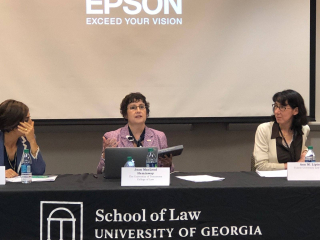
I moderated the financial crisis plenary panel, offered comments on David Webber‘s The Rise of the Working-Class Shareholder: Labor’s Last Best Weapon, (as shown in the picture below), presented a two-paper project on business deregulation that I am working on this summer, and introduced Cindy’s Friday keynote luncheon presentation on corporate board independence and diversity. [Note that BLPB co-blogger Ann Lipton also was on the book commentary panel with me (on the right in the photo below), as was fellow NYU Law alum Mehrsa Baradaran (on the left in the photo below).]

NBLS2018(BookPanelPicture)

Each of these programs, as well as the plenary sessions and concurrent panels that I attended as an audience member, was an educational experience for me.  Among other things, I got four super-helpful comments on my deregulation presentation.  That alone was worth the four-hour-plus drive from Knoxville to Athens.

The conference included (as speakers and audience members) business law faculty from both law schools and business schools as well as others (including corporate counsel and government officials) who work in business law from a governance, policy-making, or rule-making perspective.  The breadth of business law scholarship featured at the conference was inspiring.  I heard about ongoing academic research on board composition, financial regulation, technology/business law interactions, and more.

Next year, we will meet at the U.C. Berkeley School of Law, with Steven Davidoff Solomon hosting.  More on that soon.  For now, I will enjoy the warm glow of a stimulating conference in which we served over 100 business law scholars from around the world.