I swear I wasn’t going to blog about Elon Musk this week; I had several other ideas planned, but then someone went ahead and filed a new complaint in Delaware and I just can’t help myself.

In Ball v. Tesla, the plaintiff challenges both the upcoming pay ratification vote, and the Texas redomestication.  The arguments against pay ratification are pretty much the ones you’ve already heard in this space (as well as ones advanced by Prof. Elson in his proposed amicus brief), and we’ve pretty much exhausted those so I’ll skip it.

As for the Texas redomestication vote, the plaintiff claims that the required threshold to leave Delaware is 2/3 rather than a simple majority of outstanding shares due to certain provisions in Tesla’s charter.

I’ve previously blogged about this issue at Tesla; it has a staggered board and keeps trying reduce the stagger, but it can’t get the required 2/3 outstanding vote, because so many shareholders do not cast ballots at all. 

When Tesla drafted its charter way back when, it set about minimizing shareholder rights as much as it could under Delaware law.  It instituted a staggered board, it prohibited shareholders from acting by written consent – they can only act at a duly called meeting – and prohibited them from calling a meeting themselves.  And then, to ensure shareholders couldn’t amend the charter and remove the protections, it insulated those provisions with a two-thirds voting requirement to amend them (and a two-thirds vote requirement to amend the voting standard to amend them):

Notwithstanding any other provision of this Certificate of Incorporation … the affirmative vote of the holders of at least 66 2/3% of the voting power of all then outstanding shares of capital stock of the corporation entitled to vote generally in the election of directors, voting together as a single class, shall be required to amend, alter or repeal, or adopt any provision as part of this Certificate of Incorporation inconsistent with the purpose and intent of, Article V, Article VI, Article VII or this Article IX …

Now Tesla wants to move to Texas.  But Texas guarantees more shareholder rights than Delaware.  Specifically, in Texas, corporations cannot eliminate either the right of shareholders to act by written consent, nor the right of shareholders to call special meetings.  So when Tesla drafted a new Texas charter, it tried to minimize those rights as much as possible.  Specifically, the Texas charter permits action only by unanimous written consent, and permits shareholders to call a special meeting only if 50% of shareholders demand it (the highest threshold Texas permits).  Additionally, as Tesla notes in its proxy, under Texas law, even if shareholders call a special meeting, the Board may still postpone or reschedule it.

So, in Ball v. Tesla, the shareholder claims that these new charter provisions expand the rights granted in the original charter, and therefore, can only be amended – and the redomestication can only be approved – with the approval of two-thirds of the outstanding shares.

What happens next?

Well, I’m assuming Ball will be in some way consolidated with Tornetta.  I also assume the good attorneys at BLBG will be not at all happy about the challenge to the pay package, because they want to maintain control over the litigation.  If nothing else, their fee depends on the “benefit” they provided to Tesla shareholders, and Tesla has already telegraphed that if shareholders vote to ratify, the company plans to argue that the attorneys did not provide any benefit to Tesla shareholders, and therefore the fee should be reduced or eliminated.  So the Tornetta team already has a very strong incentive to argue that the ratification has no effect, and they will not be pleased that an interloper is trying to seize control of the issue.

With respect to the Texas redomestication, the vote’s in a week.  Chancellor McCormick cannot risk the company redomesticates and then she somehow has to reel it all back, which means she either has to decide this issue very quickly, or she has to make sure Tesla won’t move while there are (plausible) arguments outstanding.  That said, the Texas move is not self-executing once the vote occurs; even if shareholders vote in favor, Tesla will still have to file the appropriate forms with the Texas Secretary of State.  So, if Chancellor McCormick believes the complaint has merit, she does not have to block the vote (which is not something Ball has asked for anyway); she can enjoin Tesla (or seek a promise, which she seems to prefer), from filing the forms until the matter is sorted out.

Which brings us to – does the complaint have merit?

Imma stop you right there on the written consent thing.  The two-thirds requirement only applies to actions that are “inconsistent with the purpose and intent of” the original charter provisions, and there is no possibility of getting unanimous written consent in a public company (plus, Elon Musk owns shares; if he’s consenting, the point is moot anyway since he can call a special meeting).  Ball’s not going to succeed on that one.

What about the 50% threshold for calling a special meeting?

I’m going to start by saying I have not actually researched any caselaw on this, which might very well exist, and that obviously supersedes anything I’m about to say, but – I’d still rather be Tesla than Ball.  Fifty percent is still almost impossible to achieve in a public company outside the context of a shareholder meeting; moreso now that Tesla’s shareholder base is in the ballpark of 45% retail, and especially taking into account that Musk himself owns 13% (20% if you count the unexercised options, which number includes the ones in dispute).

So I think the real action here is over the pay ratification.

But I promised a lesson about corporate law, and here it is.

What if this challenge presented more of a threat to redomestication?  What if, for example, Texas set the maximum threshold for shareholders to call a special meeting at 25% – which is the MBCA standard – rather than 50%?

In that event, we can imagine a scenario.  Suppose Elon Musk called up his good buddy Governor Greg Abbott, and told him, “Greg, Tesla would love to reincorporate to Texas, but your law is blocking us!  Can you do something about that?”

How much do you think Texas cares about that maximum vote threshold for shareholders to demand a meeting – especially if, in my hypothetical, Texas just adopted the MBCA as written?

Probably not much.

So we can imagine that, at the next legislative session, a bill sails through the legislature to amend Texas’s corporate code to eliminate the right of shareholders to call special meetings, and voila!  Tesla freely reincorporates.

All of this is a thought experiment for Tesla but it’s a real-world thing that happens with companies all the time.  For example, this paper tells the story of the time that Massachusetts actually changed its corporate law in the middle of an active proxy fight in order to protect the management of a local firm.  And that’s not even unusual.

But, corporations and shareholders assume, it doesn’t happen in Delaware.  Why?  Partly because Delaware cares a lot more about its corporate code, but also because Delaware doesn’t have local firms.  I mean, you know, not really.  So it’s pretty much neutral ground.

At least, that’s what everyone’s always thought.

But right now, there’s a proposal to amend Delaware’s corporate code rather dramatically (prior posts here, here, herehere, and here), and as far as I can tell, that’s largely to protect a group of specific companies that got a bit over their skis with aggressive shareholder agreements when they went public, and now some faction of the Delaware bar is seeking to change the law in order to retroactively validate those arrangements.

So, you know.  We’ll see what happens.

Edit: In the comments, it’s proposed that the complaint fails for a simpler reason regarding the terms of Delaware’s redomestication statute, which overrides specific supermajority charter provisions.  That may be right.  Interestingly, Tesla recommends against shareholder proposals seeking declassification on the ground that they are impossible to implement without a two-thirds majority, but it cagily does not say that it could not implement them in conjunction with redomestication.  ISS reports that when it raised the possibility of declassification in conjunction with the Texas move, Tesla simply stated it preferred to keep the new Texas charter as close in form to the old one as possible and committed to revisiting the issue of declassification when it achieved sufficient shareholder participation at a meeting.
We’ve covered the TripAdvisor litigation here for some time.  With the case before the Delaware Supreme Court, Nevada has weighed in with an amicus brief.  Nevada, on behalf of Francisco Aguilar, Nevada’s Secretary of State, was represented by its Office of the Attorney General,  friend of the BLPB, Anthony Rickey, and DLA Piper’s John Reed.  Ann’s Tweet even makes an appearance.

Nevada argues that Delaware’s Chancery Court should not accept allegations in a complaint about Nevada law instead of analyzing Nevada law itself.  It also argues that the decision risks creating an exit tax on any corporation that seeks to leave Delaware for Nevada–or some other state.  To the extent that any other state arguably offers benefits that wouldn’t be available to a controlling shareholder in Delaware, the same standards would apply.  Thus, a reincorporation to Texas, Florida, or California might even be covered.  Depending on how far you take it, any corporation seeking to redomesticate to any of the many states with constituency statutes might face the same kind of challenge.

The amicus also points out that claims that Nevada has “raced to the bottom” should sound familiar to Delaware because Delaware itself has faced this accusation for many years. And while the TripAdvisor complaint included some comments made in Nevada’s internal legislative debate, the same could happen with Delaware with Delaware Representative Madinah Wilson-Anton‘s statement that any “lover of democracy, transparency, and the rule of law should be grossed out” over process leading to recent proposed amendments in Delaware.

It’s in Nevada’s interest to push back on the notion that Nevada law creates a “liability free” jurisdiction.  One common criticism of Nevada law is that its business judgment statute appears to exculpate for violations of the duty of loyalty.  What often gets missed though is the nuance.  Nevada does not separate loyalty and care for exculpation.  It does not exculpate for fiduciary breaches that include “intentional misconduct, fraud or a knowing violation of law.”  Any knowing betrayal or intentional violation of a duty of loyalty would not be exculpated.  While Delaware may allow liability for unintentional and unknowing violations of law, Nevada does not impose liability for those mistakes.

One thing that often gets glossed over, is that Nevada, like Delaware, has a strong economic incentive to balance investor and management rights in ways that maximize shareholder value.  If investors did not think that Nevada law’s benefits were worth the bargain, they could sell or discount what they pay for Nevada shares.  Indeed, the TripAdvisor decision considered looking at market reactions for potential damages.  If the market ever gave a negative judgment about a state’s corporate law, you could expect firms to flee the jurisdiction or the state to quickly move to correct the problem.

Dear BLPB Readers:

I’m excited to share a Call for Papers from the Journal of Financial Markets Infrastructures, where I am an Associate Editor.  Here is a brief description of the Journal from its website:

“The economic and technological landscape of financial market infrastructures (FMIs) is rapidly evolving and changing how we conduct transactions globally. Efforts to renew and strengthen payment, clearing and settlement systems have been undertaken internationally and the role of new technologies, including digital money, CBDCs, blockchains and smart contracts, is being continuously reassessed.

The Journal of Financial Market Infrastructures was the first journal to specialize in publishing peer-reviewed research in FMIs. Today, over a decade after its first publication, the journal continues to offer its readers a selection of the best ideas, developments and analysis in this dynamic and exciting sector of the economy.”

The call for papers is here: Download JFMI Call for Papers

At Emory Law’s Eighth Biennial Conference on the Teaching of Transactional Skills back in the fall of 2023, I had the privilege of presenting with my UT Law clinical teaching colleague, Brian Krumm.  (Congratulations are due to Brian, who was recently appointed the Interim Director of our Clayton Center for Entrepreneurial Law!)  The title of this post is also the title of our presentation.  An edited transcript of the presentation was recently published by Transactions: The Tennessee Journal of Business Law and can be found here. The abstract is as follows:

In this edited transcript, we explain how each of us–a doctrinal law professor and a clinician–use members of our campus and local communities to help instruct transactional business law students. We each have independently realized that there is a value to sharing these outside business and legal experts with our students. Among other things, we have found that we can bring unique areas of legal and business expertise into our teaching and, at the same time, introduce our students to real-life practice experiences and related simulations. All of this is foundational to law practice. In addition, experiences of this kind are, in our view, increasingly useful and important as we look toward preparing students for the concepts, principles, and skills that will be tested on the NextGen Bar.

Please contact me or Brian if you have questions about the teaching we describe in this transcript.  We are happy to provide more information and relevant teaching materials.  Jyst ask.

A collection of the presentations from the Emory Law conference is available here.

Which is why you get an extra blog post this week.

So I’m reading this entire fairness conflicted controller opinion and right there at the end, VC Laster preemptively wanders into a Caremark discussion – and the reason this is important is it hits on some of the issues I’ve blogged about previously with respect to the (over) extension of Caremark.

The case is Firefighters’ Pension System v. Foundation Building Materials, and I’ve got threads up at other social media spaces of the horror show of fiduciary breaches (help yourself), but here I’ll talk about the Caremark piece, which is tangential to the actual claims but important for theory. 

The traditional rule is that “Delaware law does not charter law breakers,” articulated in In re Massey Energy Co., 2011 WL 2176479 (Del. Ch. May 31, 2011), and part of a general family of cases that fall under the Caremark rubric that requires Delaware managers to take reasonable steps to ensure legal compliance.

Here’s what VC Laster writes in Foundation Building Materials:

timing principles govern Massey and Caremark claims. Before a plaintiff can invoke those theories, the plaintiff must point to some sufficiently concrete corporate injury. Typically, that will require a prior adjudication that the statute or regulation was violated, the payment of a fine or penalty, or a settlement.

The existence of a predicate injury serves an important policy function by limiting the ability of plaintiffs to use Massey and Caremark claims as vehicles to litigate alleged violations of far-flung statutory and regulatory regimes. Without that type of gating requirement, a stockholder plaintiff could assert that directors had knowingly violated a statutory or regulatory scheme in another state or country, plead facts supporting a statutory violation, and then litigate that claim in the Court of Chancery

In prior blog posts, I’ve expressed concern about how Caremark claims have been used as political weapons to attack corporate conduct even before a prior adjudication of wrongdoing or obvious injury to the corporation.

VC Laster’s new opinion therefore takes some first steps toward cabining that kind of use. 

The problem that remains theoretically, of course, is that to the extent the claim involves intentional lawbreaking, it isn’t intended to protect shareholders at all.  A claim for intentional lawbreaking can proceed even if, ex ante, the corporation calculates – correctly! – that the net present value of the wrongdoing, taking into account the risks involved, financially benefits shareholders.  In that sense, Massey claims are for society, not shareholders; they represent the outer limits of shareholder primacy.

For that reason, one could argue that the requirement of a prior corporate trauma raises questions about “fit.”  If the claim isn’t really about shareholders at all, why must there be a corporate trauma first before the claim can be brought? 

The argument would be, I suppose, something like, for the purposes of practicality of enforcement, it’s a risk shifting framework.  Directors can take that risk of lawbreaking to benefit shareholders, but they’re the ones who will financially suffer (or their insurance) if the risk doesn’t pan out and ultimately the corporation is injured as a result, because they’ll functionally indemnify the corporation for any damages suffered as a result of the lawbreaking.

The problem is, that kind of calculus fits poorly with Massey-like rhetoric about Delaware not chartering lawbreakers; it ends up right back with a permission structure for lawbreaking.  

Maybe this is a time when other news has overtaken corporate governance disputes, but governance disputes are we do here, so.

Also, what obviously has my attention right now are two issues: the upcoming Tesla vote on Musk’s pay and redomestication to Texas, and the proposed amendments to the DGCL.  This blog post is a couple of quick notes about both.

On the Tesla vote.

I previously blogged that a good argument could be made that restoring Musk’s pay package now offers no economic benefit to Tesla, and therefore would fall into the legal category of waste – which, under current doctrine (even if subject to challenge in the modern era) would require unanimous shareholder approval.  At the time, I offered the reservation that, from a practical perspective, waste would be difficult to litigate (and yes, if shareholders vote in favor, the effect of the vote will absolutely be litigated, by Tornetta, the current plaintiff, if no one else).  That’s because a court might be hesitant to hold that major institutional shareholders – with a fiduciary duty to maximize value for their beneficiaries – would cast an economically irrational vote.  From there, the court might reason backward and conclude that it couldn’t possibly be economic waste.

I also offered a rejoinder – namely, institutions might vote to approve the package because they were “coerced,” perhaps due to Musk’s threats to develop AI in his private businesses rather than Tesla (which he is using Tesla data to do).  But in my post, I treated that as a difficult argument to make, given that there was no suggestion of a threat in the proxy; the plaintiff would have to reach back to those earlier comments by Musk and ask a court to draw the inference that they were still influencing shareholders in June.

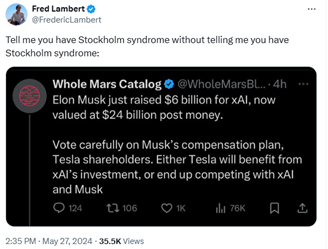
And then, of course, Musk couldn’t quite stay off ex-Twitter and he reaffirmed the threat, which Tesla was then forced to file as proxy solicitation material.  He also hinted at it during an earnings call before stopping himself, which was also filed as solicitation material, and Musk boosters are making the point pretty explicitly on social media:

Picture1

And all the reporting mentions the threat to develop AI outside of Tesla, so, now, it’s much easier for the plaintiff to argue that any shareholder vote in favor of Musk’s pay is coerced, and therefore without ratifying effect.  It works in tandem with the waste argument, even though they’re also alternatives – why did shareholders vote for waste? Coercion.  How do we know it was coercive?  Because of the lack of (legitimate) economic value for Tesla.  Etc.

And then there’s Texas. I think it would be difficult, legally, for shareholders to challenge reincorporation to Texas as somehow damaging to their rights; leaving aside the uncertain status of TripAdvisor, Texas’s law is similar to Delaware’s, and so formally, reincorporation doesn’t present the same specter of self-dealing.  (I’m not saying no one’s gonna try, who knows what those wacky shareholders might do).  And Tornetta’s legal team probably is going to stay focused on the pay package rather than the Texas issue (except to the extent they’re worried a reincorporation in Texas means a new lawsuit will be filed there that’s res judicata in Delaware).

Nonetheless, the attempt at reincorporation now adds color to the pay dispute.  Because yes, of course, Tesla’s proxy statement makes clear, the states have a lot of formal similarities in their laws.  And academics debate whether there’s any real benefit to incorporating in Delaware, and it might be reasonable for a startup entrepreneur setting up a new company headquartered in Texas to choose Texas as its chartering state.  But Tesla is not a new company – it’s an established public company that has already been operating according to (well, not according to) Delaware law for a while, now contemplating an expensive switch – involving special committee payments, advisors, hours, and expert analysis, not to mention vote whipping – for benefits that even the company itself claims largely are about branding. 

Even then, if Tesla were doing this on a clear day, then, you know, shrug. 

But it’s not a clear day, it’s in the wake of two high profile losses for Tesla – the Tornetta decision, and the earlier settlement over director pay – and one personal one for Musk, namely the Twitter case (which he dropped, because he knew he would lose), and comes only after Musk tweeted his declaration that Tesla would reincorporate in Texas, reincorporated his other companies out of Delaware, and tweeted that he would not acquire Delaware companies.  In the midst of several tweets about Delaware’s perfidy, he even urged other companies to leave.  Given that context – not to mention Chancellor McCormick’s previous findings regarding the Board’s deference to Musk – there is certainly cause to doubt that the Board, or the special committee, was entirely forthcoming about its reasons, and acting entirely in good faith, when insisting that Tesla should move to Texas right now because Tesla is “all-in on Texas,” and not at all acting on Musk’s personal ire.  Which is apparently what ISS said in its proxy recommendation – I don’t have access to the report itself, but it noted that, while the move itself was unobjectionable, “the process undertaken by the board to reach a decision . . . does leave something to be desired.”  And certainly outside observers read the move as an attempt to free the board to give Musk as much compensation as he wants.

And if that’s right – that no matter how thorough the proxy statement is about describing the Board’s reasoning and the special committee’s diligence, it’s impossible to escape the doubts raised by the context in which this is occurring – then even if the Texas proposal is not directly challenged by Tornetta, the fact of its existence supports the argument that all of the Board – including the special committee – is beholden to Musk.  Therefore, none of the Board’s actions – including the recommendation that the pay package be restored – can be trusted.

Point being, it adds heft to any legal challenges to the pay vote.

BUT!!  Given that it is, frankly, politically awkward for one state – Delaware – to claim there’s anything wrong with incorporating in another state, I wouldn’t be surprised if Chancellor McCormick didn’t want to engage with the Texas issue directly.  But it could still affect her thinking (and the thinking of the Delaware Supreme Court on appeal).

On Proposed Amendments to Delaware Law

Picture2

Prior posts in reverse chronological order here, herehere, and here.

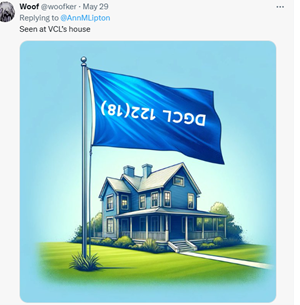
VC Laster has been active on LinkedIn, highlighting various ambiguities in the proposed DGCL 122(18).  But he’s doing more than poasting; in Columbia Pipeline Merger Group Litigation and in Wagner v. BRP Group, Inc., his legal reasoning reads as a direct challenge to the synopsis to those amendments, by demonstrating the fiduciary “outs” they propose are ephemeral.

For example, the DGCL 122(18) synopsis says:

even the enforceability of a claim for money damages for breach of the covenant may be subject to equitable review, and related equitable limitations, if the making or performance of the contract constitutes a breach of fiduciary duty…

New § 122(18) does not relieve any directors, officers or stockholders of any fiduciary duties they owe to the corporation or its stockholders, including … with respect to deciding whether to perform, or cause the corporation to perform, or to breach, the contract, whether in connection with their management of the corporation’s business and affairs in the ordinary course or their approval of extraordinary transactions, such as a sale of the corporation

However, in both Columbia Pipeline and BRP, Laster extensively discusses how fiduciary obligations cannot require corporations to break contracts, or free them of consequences (including damages or equitable remedies) when they do so.  The synopsis suggests contracts might be set aside when directors’ actions are reviewed under “enhanced scrutiny”; Laster takes that one on as well in both cases, concluding that it’s a misreading of Paramount Commc’ns Inc. v. QVC Network Inc., 637 A.2d 34 (Del. 1994).

Additionally, the synopsis says:

New § 122(18) does not relieve any directors, officers or stockholders of any fiduciary duties they owe to the corporation or its stockholders, including with respect to deciding to cause the corporation to enter into a contract with a stockholder or beneficial owner of stock….

In BRP, Laster highlights that fiduciary duties are only owed to current – not future – shareholders.  Which means, if fiduciary obligations are the only thing that protects shareholders when boards adopt these contracts, anyone who was not a shareholder at the time of contracting will have no claim.  In practical effect, a contract adopted pre-IPO could not be challenged by public stockholders.

Additionally, in Moelis, Laster held that the improper provisions of a stockholder agreement might be replicated via a preferred share issuance, though reserving the question just how far preferred shares might go.  In BRP, he elaborated on that point, arguing that some restrictions on board authority must be contained in the charter “proper,” and cannot even be included in preferred shares.  As he put it:

A counterparty also would not be able to secure covenants that bind the board through a preferred stock issuance. A certificate of designations can set forth “the designations and the powers, preferences and rights, and the qualifications, limitations or restrictions” of the class or series of stock that the board authorizes using blank check authority. 8 Del. C. § 102(a)(4). That list of features does not include imposing covenants on the board. To constrain or mandate action by the board under Section 141(a) requires a charter provision directed to the board, not a charter provision limited to the “the designations and the powers, preferences and rights, and the qualifications, limitations or restrictions” of a class or series of shares.  That type of provision could appear in the original charter. It also could be implemented through charter amendment duly approved under Section 242, or through a merger or comparable transaction where the DGCL authorizes amendments to the charter of the surviving corporation. A covenant binding the board could not be imposed through a certificate of designations. Under current law, it also cannot be imposed through a governance agreement.

Proposed DGCL 122(18) would authorize contracts that:

covenant that the corporation or one or more persons or bodies will take, or refrain from taking, actions specified in the contract

The implication being, DGCL 122(18) would authorize contracts that go further than what could be accomplished in a preferred share issuance.  Assuming that’s right, it just further demonstrates how DGCL 122(18) would more than authorize governance contracts, but actually encourage a shift of governance from the corporate form and into personal contracts. 


Over the years, I have written a number of blog posts here on Memorial Day that honor those who sacrificed their lives for us through national military service.  You can find the last few here, here, and here.  When practicable, I work in something about business law in those posts.

This year, as I contemplated what to write, I also was mired in grading and other teaching-related work.  On my mind throughout was generative artificial intelligence, a hot topic in law school circles and throughout education (and, of course, elsewhere, too).  The full range of benefits and burdens of generative artificial intelligence still remain to be discovered.

I wondered what a generative artificial intelligence tool would draft up as a blog post for Memorial Day.  Then, I thought, why wonder?  Why not give it a whirl?  So, I asked Google Gemini to “[w]rite a short blog post that combines business law with Memorial Day.”  Set forth below is what I got back.

Honoring Heroes, Respecting Rights: Business Law and Memorial Day

Memorial Day is a time to remember the brave men and women who died serving our country. But for businesses, it also presents some legal considerations. Here’s a quick look at how business law intersects with this solemn holiday.

    • Employee Rights: Federal law doesn’t mandate paid time off for Memorial Day. However, some states have their own laws, and many companies offer paid holidays as part of employee contracts. Businesses must ensure they’re following all applicable laws and agreements regarding employee pay and scheduling for the holiday.

    • Business Closings: If your business plans to close for Memorial Day, it’s crucial to communicate this clearly to employees and customers well in advance. This helps avoid confusion and ensures smooth operations upon reopening.

    • Sales and Promotions: While Memorial Day weekend often unofficially kicks off the summer shopping season, it’s important to be mindful of the true meaning of the holiday. Avoid promotions or marketing that appears disrespectful to the somber occasion.

    • Community Engagement: Businesses can choose to honor veterans and fallen soldiers by participating in local Memorial Day events or supporting veterans’ charities. This demonstrates respect for the holiday’s purpose while fostering positive community relations.

By understanding these legal aspects, businesses can ensure a respectful and compliant approach to Memorial Day, allowing them to honor our heroes while adhering to the law.

Honestly, it’s not too far off from some of what I have posted in the past.  I am not sure whether to be sad or happy about that.  But now I no longer have to wonder . . . .

Regardless, I do want to continue to pay respect to those who have died in military service to our country.  May they rest in eternal peace knowing that their lives and work are remembered and appreciated on this Memorial Day and every Memorial Day.

I previously posted about the proposed changes to Delaware law, the latest version of which would allow shareholder agreements insofar as they don’t go further than what a charter – including a preferred share issuance – could allow (except for the exemption from DGCL 115)

One thing I should have mentioned, though, highlighted by Marcel Kahan and Edward Rock here, is that the difference between a share issuance/charter provision, and a contract, is highly salient for purposes of an exchange listing.  Exchanges define control in terms of voting power, not contractual power; moreover, they prohibit corporate actions that would limit shareholder voting power after listing; dual class shares are fine, they just need to be established prior to listing rather than taking away shareholder voting power mid-stream.  What they don’t address, though, is power through shareholder agreements.  Which means, if the DGCL is amended as proposed, a public company could hand over additional governance powers to particular shareholders through contract, without affecting the formal voting power of existing shareholders, and very possibly remain compliant with Exchange rules.

To put it concretely: Elon Musk has vocally demanded 25% voting power of Tesla so that he can control the development of AI. He’s also admitted he can’t get that through a switch to dual-class shares, because of the listing rules.  If the DGCL changes go through, though, there is no reason the board couldn’t “contract” with him to give him outsized influence over Tesla’s governance, regardless of how existing shareholders vote. 

And that leads to the elephant in the room.  Delaware law is all about shareholder wealth – full stop.  My paper on Twitter v. Musk (which is now published and the final version is on SSRN, by the way /plug) is all about the fallacy of relying on Delaware law to advance any value other than shareholder wealth maximization.  But corporate governance does, in fact, matter to the rest of us; it matters whether single individuals wield nearly unchecked power over how corporations behave. 

Back in the 1930s, Congress actually legislated to discourage the use of holding companies, precisely in order to limit the power that individuals could wield over large corporate structures with only a small slice of equity interest.

More recently, as I talk about in my paper Beyond Internal and External, the FTC settled with Mark Zuckerberg to prevent him from exercising his rights as a shareholder to interfere with Facebook’s compliance with a privacy settlement.  Zuckerberg’s unchecked power in his shareholder capacity threatened Facebook’s ability to comply with the law.

So these proposed DGCL changes have very far reaching social consequences that simply have not been explored by Delaware lawmakers, let alone The Rest of Society.

Anyhoo, links to a recent news article here and a collection of Chancery Daily links here.


Earlier this month, VC Glasscock issued an opinion in Kormos v. Playtika Holding UK II, where he dismissed breach of fiduciary duty claims against the Chair/CEO and CFO of a controlled company.  The opinion made reference to an earlier bench ruling where he sustained claims against the company’s controlling shareholder, Giant/Alpha, which is what alerted me to the bench ruling – which issued in January – in the first place.  And that bench ruling is actually what has my attention.

Playtika Holding Corp is a publicly traded company with a controlling shareholder, Playtika Holding UK II Limited (“Holding”).  Holding is a wholly-owned subsidiary of Giant/Alpha.  In 2021, Giant/Alpha faced a liquidity crisis and desperately needed to raise cash, which it sought to do by selling Holding’s Playtika stock, potentially in connection with a sale of the entire company.  But the process was rushed and messy, with Playtika itself and Giant/Alpha running separate inquiries; eventually, Giant/Alpha instructed Playtika’s board to stop talking to potential buyers, but to instead cause Playtika to institute a self-tender for its own stock.  SEC rules require that tender offers treat all shares of a class equally, which meant that the public shareholders – as well as Giant/Alpha – were able to tender in to the offer.  But, with Giant/Alpha tendering, it could receive cash back from Playtika which would then solve its liquidity problems.

Plaintiffs, the public holders of Playtika, alleged that this was a conflicted transaction that was not in Playtika’s best interests, and was therefore subject to entire fairness review (though they did not claim the price paid for the shares was unfair).

There’s just one problem with that argument, doctrinally: ever since Sinclair Oil Corp. v. Levien, 280 A.2d 717 (Del. 1971), we know that in order to be a conflicted transaction, implicating the duty of loyalty, the controller must receive a nonratable benefit, i.e., some benefit not available to the other stockholders – and arguably, it has to be a benefit that specifically comes at the minority’s expense.  In Sinclair itself, for example, the controlling shareholder caused the company to pay out massive dividends that allegedly robbed the company of the ability to take advantage of alternative opportunities, and it did so for its own private reasons.  Still, the dividend payments weren’t a conflict transaction – and were therefore subject only to business judgment review – because all shareholders got the same dividends, controller and noncontrollers alike.  The controlling shareholder did not receive a special benefit at the expense of the minority (As the Delaware Supreme Court put it, “a proportionate share of this money was received by the minority shareholders of Sinven. Sinclair received nothing from Sinven to the exclusion of its minority stockholders. As such, these dividends were not self-dealing”).

Similarly, in Playtika, the self-tender may have been motivated by Giant/Alpha’s need for cash, but all shareholders could participate in the tender on equal terms, meaning, it wasn’t a conflict transaction, and was therefore subject only to business judgment review.

Except! 

There was a twist.

Giant/Alpha did not want to risk tendering so many shares that it actually lost control of Playtika.  So, it negotiated a provision whereby Playtika would have to announce the number of shares tendered publicly, which would allow Giant/Alpha to keep close tabs on the status of the offer.  Giant/Alpha could also withdraw shares that it previously tendered – which I gather was a negotiated term of the agreement, but also, by the way, required under SEC rules for all tendering shareholders.  So, because Giant/Alpha was able to monitor the shares tendered, and withdraw its own shares, it could adjust its tender and maintain control of the company.

Those provisions, according to VC Glasscock – as he explained in his bench ruling in January, and again in his recent opinion earlier this month, were a nonratable benefit to Giant/Alpha, because they uniquely allowed Giant/Alpha to maintain control, which was not something the minority could share.  And that was enough to transform the Playtika self-tender into a conflict transaction, subject to entire fairness review.

So here’s the thing.

Treating the right to monitor the number of public shares tendered as a nonratable benefit to Giant/Alpha – let alone one that comes at the expense of minority shareholders – strikes me as a bit of a reach.  SEC rules require that tendering shareholders be able to withdraw before the tender offer closes; that wasn’t a benefit unique to Giant/Alpha.  And if Playtika publicly announced how many shares had been tendered, that meant everyone could see what the status was.   

That said, the whole scenario was obviously hinky from the get-go.  There was an awful initial search for alternative transactions; the self-tender itself was designed to benefit Giant/Alpha, and you can see why a judge might be looking for a reason to at least scrutinize the arrangement more closely.  Hence, a nonratable benefit was identified – Giant/Alpha’s ability to modulate the number of shares it tendered. 

And it matters because, as I’ve written two papers about, and also blogged repeatedly (here, here, here, here, here, here, here, here, here, here, here, here, here, and here), the more that Delaware makes it very easy to insulate deals from review unless they involve a controlling shareholder conflict, the more that courts are motivated to identify a controlling shareholder conflict in order to give themselves the opportunity to review problematic transactions.  As my papers discuss, that’s often exhibited in the definition of what it means to be a controlling shareholder in the first place – but, as we can also see here, it exhibits itself in the definition of conflict, as well.

Anyway, that kind of morass is exactly why the Delaware Supreme Court granted interlocutory review of TripAdvisor, i.e., to address the definition of a conflict transaction.  But TripAdvisor involves a reincorporation from Delaware to Nevada; I have no idea whether the court will address just that scenario – which obviously involves questions of comity not present for other kinds of potential conflicts – or whether it will take a broader view of the problem.

IPL(Symposium2024-SaveDate)

I have written in the past about the intersections of leadership and law, including business law.  See, for example,  here, here, here, here, and here.  And I was privileged to be the Interim Director, for over three years, of the institute for Professional Leadership at The University of Tennessee College of Law.  I find there is such a strong connection between leadership and business law teaching and practice . . . .

We are celebrating the tenth anniversary of the Institute for Professional Leadership this fall.  The celebration, which will take place on Thursday, October 24 and Friday, October 25, will include a gala dinner and a symposium featuring workshops, a call-for-papers panel, and a series of expert panels.  The “save the date” notice is included above.  I hope you will consider responding to the forthcoming call for proposals and papers.  But regardless, I hope you will consider attending. Feel free to reach out to me with any questions.