Last week, Chancellor McCormick decided Sjunde AP-Fonden v. Activision Blizzard, which held that former shareholders of Activision had stated a claim that Activision’s board failed to comply with DGCL 251(b) when it approved the merger agreement with Microsoft.  The draft agreement that the board reviewed was missing key details, such as consideration, the disclosure letter, and a plan to handle dividend payments between signing and closing.  Those details were obviously filled in later, but the full board never formally approved the revised merger agreement – dividends, for example, were handled by committee.  McCormick held that while a board need not review a formal, final version of the agreement, Section 251(b) requires that they at least review a version that includes essential terms, and plaintiffs had for pleading purposes alleged that the Activision board failed to do so.  Due to the statutory violations, McCormick ultimately concluded, the plaintiffs had stated a claim for unlawful conversion of their shares.

So, here’s the thing.  Of course boards should formally review the essential terms of a merger agreement before declaring the deal’s advisability for statutory purposes.  How could it be otherwise?  But at the same time, it seems, you know, likely, that the individual Activision board members eventually came to learn the full essential terms and approved them, at least in practice if not through formal action.  Or, to put it another way, I think it’s unlikely there will be evidence that if the board had called a formal meeting to formally approve the final final merger, signed with a quill pen on a vellum scroll, the deal terms would have been any different. 

So the shareholders would have gotten the same deal regardless.  Meanwhile, the deal’s done; no way McCormick is going to unwind it.  (One case even held there can be no conversion claims post-merger because of the impossibility of unwinding, see Arnold v. Soc’y for Sav. Bancorp, Inc., 1995 WL 376919 (Del. Ch. June 19, 1995), though I am not sure that makes sense; conversion claims can be maintained when property is destroyed or transformed.). 

But, absent unwinding, the only remedy available to shareholders will be the fair value of their pre-merger shares.  And there are some precedents about determining fair value of a tradeable asset – giving the victim the benefit of the higher price when there are fluctuations in value after conversion – but here, the asset itself disappeared from the market after conversion.  Even if you looked to the pre-conversion price, Activision traded consistently below the deal price.  And if nothing else, I imagine that McCormick might conclude the fair value in this context should be calculated the same way it would be in an appraisal action, which probably means deal price.  Any way you slice it, I’m not sure what damages the shareholders can obtain, beyond nominal plus attorneys’ fees.  So it seems like an awful lot of running around for something that doesn’t really provide much benefit. 

And that, I think, was kind of the spirit of the grumblings about Delaware law I heard at the Delaware Developments panel at the Tulane Corporate Law Institute on Thursday.  (I missed the Activision discussion that I gather occurred in the prior panel; anyone know if they talked about remedies?)  Anyway, at Delaware Developments, mostly, corporate attorneys were complaining about new cases like Activision or Moelis that upset settled expectations and subjected corporations to unpredictable liabilities, but I think the spirit of the objection, and there’s some truth to this, is that it feels like formalities being enforced without a corresponding shareholder benefit.  There may be a systemic benefit from adhering to the technicalities – governance restrictions in the charter, not a shareholder agreement, and of course boards should have the details of a merger agreement when approving it – but it’s hard to see the benefit to shareholders by enforcing them ex post in individual cases.

But that’s the weakness of relying entirely on a system of private litigation.  Activision, for example, very much smacks of the kind of thing that should be handled with a regulatory fine and a stern warning to others.  But that’s not on the table.
Vice Chancellor Laster recently requested information from litigants in Seavitt v. N-able, Inc. with this letter.  According to the complaint:

Plaintiff brings this action because N-able is presently flouting this foundational principle of Delaware law through a contractual arrangement designed to entrench and perpetuate certain favored stockholders’ control over N-able’s business and affairs. Specifically, in violation of DGCL Section 141(a), N-able has provided certain favored stockholders—affiliates of the private equity firms Silver Lake Group, LLC (“Silver Lake”) and Thoma Bravo, LLC (“Thoma Bravo,” and together with Silver Lake, the “PE Investors”)—with a contractual power to control the most important decisions and functions properly entrusted to the Company’s Board under our corporate system.  

. . . 

Third, in violation of DGCL Section 141(k) and in further derogation of the stockholder franchise, N-able has adopted an invalid provision in its operative Amended and Restated Certificate of Incorporation (the “Certificate”), purporting to provide that as long as the PE Investors own in the aggregate 30% of the voting power of the Company’s outstanding shares, “directors may be removed with or without cause upon the affirmative vote of the [PE Investors]. . .” This provision violates DGCL Section 141(k), which governs the removal of directors and provides that directors may be removed only by a majority stockholder vote (or, in some cases, a higher vote pursuant to DGCL Section 102(b)(4)). N-able’s Certificate, by contrast, allows a favored minority of stockholders to remove duly-elected directors who continue to maintain the support of a stockholder majority

This may seem familiar to readers because Prof. Lipton recently blogged about a similar issue in Moelis.  This case has some different wrinkles because the court has to consider both shareholder agreement and corporate charter provisions.  The Moelis decision found that many of the shareholder agreement provisions would have been permissible if they had been included in a corporate charter.

This brings me to the letter.  It asks about a few issues:  (i) whether Delaware corporations can incorporate stockholder agreements by reference into their charters in order to give them the same effect as charter provisions; (ii) whether bylaws can incorporate stockholder agreements by reference and give them the same effect as bylaw provisions; and (iii) whether the charter and bylaws at issue adequately did the job here. The letter asked the parties to brief the issues and gave some specific questions.

Of particular interest to me is number 7 an “extremes case.” It asks whether a Delaware charter could include a provision saying that the corporation would be governed by Nevada law with the proviso that if there were “any conflict with a mandatory provision of the Delaware General Corporation Law, Delaware shall control.”  In non-mandatory cases, the charter would swap Delaware defaults for Nevada defaults.

I don’t expect corporations to actually do this.  It probably makes more sense to just reincorporate into Nevada if you want to be bound by Nevada law.  You’d probably save a lot of money that way.  Our local newspaper, the Review Journal, recently covered this issue.  It highlighted one recent mover’s cost calculation:

Laird Superfood, a plant-based food producer physically headquartered in Boulder, Colorado, reincorporated in Nevada on Dec. 31. In a filing with the U.S. Securities and Exchange Commission before the shareholder vote, it told investors that it expected to pay about $200,000 in Delaware taxes for that fiscal year. By contrast, Laird’s Nevada annual fees are expected to be about $700, according to the filing. Nevada doesn’t have corporate taxes.

It’ll be interesting to watch the briefs on this one as they come in.


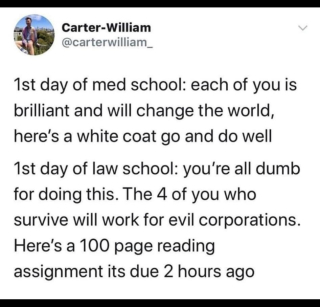
The meme below has been going around about the different framing for medical school and law school. I get why it is kind of amusing, but it is mostly rather upsetting because it resonates too readily with too many people.

IMG_4694

Although that has never been the institutional approach anywhere I have been, I will concede that there are at least some faculty members (and plenty members of the bench and bar) who think this way about law school and the legal profession. 

When I became a dean, I decided to do it, in part, because of how much I believe in the legal profession and what we are charged to do.  I believed, and I continue to believe, that lawyers are there to help people in what is often their worst of times.  Even when it is not bad, it is still usually a very significant time.  At the risk of being cliché, that means our jobs come with great power and responsibility. 

Despite what you may hear, our law students today are capable, smart, and caring.  They may not view the world the way we did, but we didn’t view the world the same as our predecessors, either.  There are challenges and different expectations, but there is no lack of ability or commitment.  Our students and our profession will be in good hands.  But we will need to work to do the good things expected of us. That has always been true.  

During orientation, when we welcome our students, the first thing we tell that is that they belong here.  I also tell them that they are here because we believe in them and that we expect each one of them to succeed.  That is the truth. We don’t admit anyone we don’t expect to succeed, and while not every single student is successful (for a variety of reasons), we are correct far more often than not.

Encouragement doesn’t stop during orientation.  I also try to provide reminders throughout the year so that students don’t forget why they are here. This is my message from January:

As we prepare for grades to come in, I want to encourage you to keep some perspective. If things went well, that’s awesome, and keep at it.  If things did not go as you’d hoped, please talk to your professors, your friends, and your student support team. The new year is a time for us to reset and restart, and everyone starts fresh. 


As you already know, law school is a lot of work. It needs to be because the jobs we have as lawyers are important ones.  Try not to get discouraged when school or work is hard.  We help people through some of their most challenging and complex problems.  And the reality is, you wouldn’t be here if it were easy.  You have sought out a rewarding, but difficult, profession, and it’s because you are committed to helping people. Embrace the challenge, and know we believe in you.  We really do.


When I started here more than four years ago, I asked out community to commit to three things consistent with our Jesuit values: (1) Faith, (2) Trust, and (3) Hope.  I ask you to commit to faith, spiritually, if that’s important to you, as well as faith in your abilities, in our profession, and in one another.  I also ask you to choose trust.  Trust the process, trust that we want the best for you, and trust that you can do this.  Finally, I ask that you work to create hope: hope for a better tomorrow; hope for your clients and community, and hope for those who are suffering. 


Faith and trust are choices. No one can give them to you.  You must decide whether to have faith and whether to trust. I promise that we will work to give you reasons to have faith and to trust us, but in the end, the choice, the power, is yours.  Hope, on the other hand, is something we can try to give people.  We’ll try to do that for you, and I hope you will try to do it for others.  


I wish you have a great semester, whether it’s your first spring semester, your second, or your last, and I look forward to all you will accomplish in 2024.  Work hard, work together, and take care of yourselves and each other, and good things will follow.  

As lawyers, we should always remember the great power and privilege that comes with our role. It is our job to do well and do good.  I very much believe in our profession. And to all the lawyers and law students out there, for what it’s worth, I believe in you. 


A U.S. District Court judge sitting in the Northeastern Division of the Northern District of Alabama found the Corporate Transparency Act (affectionately referred to in short form as the CTA) unconstitutional as detailed in a memorandum opinion issued on Friday.  The opinion granted the plaintiffs, the National Small Business United (NSBU) and Isaac Winkles, an NSBA member, their summary judgment motion on this basis.  The accompanying final judgment permanently enjoined the Secretary of the Treasury and other government defendants, as well as “any other agency or employee acting on behalf of the United States,” from enforcing the Corporate Transparency Act against the plaintiffs in the litigation.

Many of us business law profs–and all of our business law practice brethren–have been following the CTA, endeavoring to gain a more comprehensive understanding of its provisions and fashioning advice on compliance.  The CTA, enacted in 2021 and effective as of January 1, 2024, requires nonexempt companies (domestic or foreign corporations, limited liability companies, and other entities formed or, in the case of foreign entities, registered to do business in any U.S. state or tribal jurisdiction) to disclose certain information, including about their beneficial owners, to the Financial Crimes Enforcement Network (FinCEN), part of the U.S. Treasury Department.  Exempt firms include (among others) “large operating companies” with a presence in the U.S., entities with a class of securities registered under the Securities Exchange Act of 1934, as amended (or registered under the Investment Company Act of 1940, as amended, or the Investment Advisers Act of 1940, as amended), and controlled or wholly owned subsidiaries of certain exempt firms.

The March 1 memorandum opinion specifically holds that the U.S. Congress acted outside the scope of its constitutional power in enacting the CTA.  In holding the CTA unconstitutional, the court found that the congressional enactment of the CTA was not authorized under the Commerce Clause, Congress’s taxing power, or the Necessary and Proper Clause and could not be justified as incidental to the exercise by Congress of its express legislative authority.  As to the Commerce Clause–which has been interpreted broadly in many contexts–the court noted that “the CTA does not regulate economic or commercial activity on its face.”  The court also found that the CTA does not have a substantial effect on interstate commerce.  In essence, the court finds the CTA analogous to incorporation–a state entity structure and governance matter and not a matter of interstate commerce.

It will be interesting to see if there is any reaction at the federal level or any fallout in other federal trial courts.  The memorandum opinion is well written and easy to follow.  Having said that, although I am no constitutional law scholar, it seems that the court’s reasoning is subject to attack on a number of points.  I will continue to keep my ear to the ground on this.

I had so many choices for what to blog about this week.  The dispute about Donald Trump’s Truth Social SPAC?   Chancellor McCormick’s conclusion that the Activision/Microsoft merger might have violated Delaware law?  VC Laster’s Moelis decision?  Musk’s lawsuit against OpenAI

I ultimately decided to go with Moelis and OpenAI because they actually are fundamentally kind of the same thing, and this way I kill two birds with one stone.

So, earlier this week, it seemed like the big business law news was VC Laster’s holding in West Palm Beach Firefighters’ Pension Fund v. Moelis, issued last Friday, invalidating the shareholder agreement that Ken Moelis reached with Moelis & Co. when he took it public, and that allowed him to functionally remain in control of the business even when his voting stake dropped below a majority.  VC Laster held that the contract violated DGCL 141(a), which requires that corporations be managed by their boards of directors.

VC Laster recognized that every time a corporation enters into any kind of contract at all, the board’s choice set becomes more limited, but – using a word that I personally had never heard before and don’t know how to pronounce – concluded that there is a spectrum, starting with ordinary commercial contracts and ending with arrangements that ultimately intrude so far into corporate governance that they leave the realm of the commercial and raise a Section 141(a) issue.  Relying on Abercrombie v. Davies, 123 A.2d 893 (Del. Ch. 1956), he explained that the validity of a contract therefore depends on two inquiries: first, is it a governance arrangement at all?  If not, we’re done.  A number of factors go into determining whether the contract implicates corporate governance, including whether the contract involves some kind of commercial exchange, and whether it restricts the actions of internal corporate actors, namely, boards and shareholders.  

If the contract does implicate corporate governance, it will be invalid if it substantially restricts the board’s ability to manage the company.   In this case, the Moelis contract fit both bills: there was no commercial exchange, and the contract limited the board’s choices at every turn.  (My personal fave: The board was not permitted to discard the “Moelis” name without Moelis’s approval, even though name changes aren’t usually subject to a shareholder vote at all).

Among other interesting questions raised by the opinion are – what are the nondelegable functions of a corporate board?  DGCL 141(a) requires that corporations be “managed by or under the direction of a board of directors,” but in practice boards take advantage of the “under the direction of” piece and delegate most of those responsibilities to others.  What are the definitional board responsibilities that must remain with the board itself?  Certainly, merger negotiations fall into this category.  And in the Caremark context, Marchand v. Barnhill’s concept of “mission critical” risks is, functionally, a delineation of compliance responsibilities that are definitionally part of the board’s job and cannot be delegated to others.  The Moelis case also circles around the idea of core board functions that cannot be outsourced without violating Section 141(a).

Laster explains, however, that – though there are still outer limits imposed by the DGCL – many restrictions that would be prohibited in a stockholder agreement may still be permissible if they are contained in the corporate charter, or even in a new preferred stock issuance whose terms become part of the charter by operation of law.  And that’s the thing that grabs me.

Why does it matter whether something is in a shareholder agreement, versus a preferred share issuance?

Well, we can talk about transparency, and procedures for amendment – topics covered by Jill Fisch in her paper, Stealth Governance: Shareholder Agreements and Private Ordering.  I can also point out that now, after Moelis is already listed on the New York Stock Exchange, issuing new preferred stock that undermines the governance rights of existing shareholders may not be possible (does it count as a disparate reduction or restriction on shareholder rights if a shareholder agreement that existed at the IPO stage was invalidated and reconstituted in the form of a preferred share issuance?  I dunno).  But also, as I explain in my paper, Inside Out, preferred share terms are treated as internal affairs matters, subject to the law of the state of incorporation.  But shareholder agreements are ordinary contracts, and subject to ordinary choice of law.  Indeed, it’s not uncommon for shareholder agreements to contain a choice of law provision that is different from the state of incorporation.  (Yeah, that’s right, I answer to “Cassandra” now).

So the difference between putting it in a shareholder agreement and a preferred share issuance may be choice of law.

EXCEPT.

VC Laster, when explaining how to test for whether a shareholder agreement addresses governance matters (again, remember the mere fact that it addresses such matters does not invalidate it; you need to go to the second step of degree of constraint), he repeatedly referred to “internal affairs” and “internal governance.”  He didn’t mention choice of law, but the implication? was kind of? that a contract containing such restrictions might not, in fact, be subject to ordinary choice of law after all?  And might be deemed to be subject to the law of the state of organization? 

Which brings us, hilariously, to Elon Musk’s suit against OpenAI.  The gravamen of which, as I understand it, is that Sam Altman had an idea for developing AI for the benefit of “humanity,” pitched this to Musk, and Musk donated a bunch of resources while Altman organized multiple (Delaware) entities to effectuate the vision.  Generally speaking, those entities consist of a Delaware nonprofit corporation, OpenAI, Inc., which has a number of Delaware for-profit LLC subsidiaries.  Musk now advances various California breach of contract and analogous claims because, in his view, OpenAI, Inc. and its subsidiaries have failed to operate in accordance with the original humanity-focused set of promises. “This case is filed to compel OpenAI to adhere to the Founding Agreement and return to its mission to develop AGI for the benefit of humanity,” is an actual allegation at ¶33.

I will leave it to the nonprofit folks to talk about the standing of a donor to sue when a nonprofit fails to operate in accordance with expectations, though the fact that the complaint cites the relevant statute as “E.g. Cal. Bus. & Prof. Code § 17510.8” does not inspire confidence (the “eg” means “for example,” which I interpret as, there is no direct statute on point).  I will leave it to the contract folks to talk about whether promises of benefitting humanity are enforceable, or whether you can even cobble together a contract from the multiple conversations, emails, and organizational documents Musk cites.

Instead, I’ll talk about the fact that, in addition to disgorgement and damages, Musk seeks specific performance in the form of:

  1. An order requiring that Defendants continue to follow OpenAI’s longstanding practice of making AI research and technology developed at OpenAI available to the public, and
  2. An order prohibiting Defendants from utilizing OpenAI, Inc. or its assets for the financial benefit of the individual Defendants, Microsoft, or any other particular person or entity;

In other words, Musk claims that he has a contract, formed under California law, that allows Musk to dictate the governance choices of a Delaware organized (nonstock) corporation, and further, that a California court should order that this Delaware corporation conduct itself in accordance with his contract. 

Now, as a nonprofit, OpenAI is subject to jurisdiction not only of the Attorney General of its state of organization, but also the Attorney General of the states where it operates.  And I have no idea whether it has violated the legal rules governing nonprofits in those states – that’s up to the AGs.

But Musk is not invoking AG authority; he’s claiming a contractual right to dictate the governance of a Delaware-organized (nonstock) corporation.  So, especially in light of Moelis, if OpenAI wanted to take this as a serious threat, it could file a declaratory judgment action in Delaware to the effect that these “contracts” – if they even exist – are in fact contracts concerning internal affairs matters governed by Delaware law.  And, under Delaware law, at least at the corporate (OpenAI, Inc.) level, they are illegal intrusions into the board’s authority. (Though, I suppose, it might have difficulty getting personal jurisdiction over Musk in Delaware these days)

Senator Sanders recently released the Majority Report for the Senate’s Health, Labor, Education, and Pensions Committee.  That report has some grim findings about American retirements.  About half of people 55 and older have no retirement savings.  As we all know, defined-benefit pensions have become increasingly rare.  Unfortunately, defined-contribution pensions are often unavailable for a huge chunk of the workforce.  About 50 million workers don’t have a way to save for retirement through their payroll.

The report and its figures has to be part of any conversation now about how to think about efforts to improve the quality of financial advice and retirement savings.

There is much more in the report than this quick summary, and if you write or think about retirement issues, you should check it out.

Check out High-Status Versus Low-Status Stakeholders, an intriguing paper authored by one of our business school brethren, Justin Pace.  In this work, Justin approaches an important, yet difficult, topic at the intersection of corporate governance and the class divide.  The SSRN abstract follows.

The literature on stakeholder theory has largely ignored the difficult and central issue of how judges and firms should resolve disputes among stakeholders. When the issue is addressed, focus has largely been on the potential for management to use stakeholder theory as cover for rent seeking or on disputes between classes of stakeholders. Sharply underappreciated is the potential for disparate interests within a stakeholder class.

That potential is particularly acute due to a (largely education-driven) stark and growing class divide in the United States. There is a substantial difference between the interests of a highly educated professional and managerial elite and a pink-collar and blue-collar working class who mostly do not hold four-year degrees. Despite their smaller numbers, the professional and managerial elite will frequently win out in intra-stakeholder disputes with working class stakeholders due to their greater status, power, and influence.

Because this class divide is cultural, social, and political as well as economic, these disputes will go beyond financial pie splitting to culture war issues. This threatens to be destabilizing for both the republic and individual firms and undermines both the practical and ethical arguments for the stakeholder theory.

I also have been engaged by the idea that no class of stakeholders is homogeneous.  Business law scholars certainly could do a lot more work fleshing our salient differences of interest among stakeholders of a single type (including shareholders).  I (along with many others) have been known to note that not all shareholders have the same interests, for example. 

I look forward to digging into Justin’s article in more depth.  Based on my review so far, there are insights in it for many different business law scholars.  (Co-blogger John Anderson might enjoy his references to virtue theory, for example . . . .)  Anyway, give it a look.

If you happen to be in Miami or think it’s worth it to fly there next week, this is for you. I’ll be moderating the panel on regulatory considerations for promoters and influencers and we have student teams competing from all over the country. 

February 29 – March 1
University of Miami

Content is king. We live in the golden age where content creators, artists, and influencers wield power and can shift culture. Brands want to collaborate. Creators need to be sophisticated, understand deal points and protect their brand and intellectual property. Miami Law will be the first law school in the country to pull together law students with leading lawyers, influencers, artists, creatives and trendsetters for a negotiation competition and conference.  

Negotiation Competition – Thursday, February 29 

Where

Shalala Student Center, 1330 Miller Drive, Coral Gables, FL 33146

Who Should Participate

This competition is ideal for law and business students. THE. TEAMS ARE FINALIZED ALREADY.

What to Expect

Participants will have the chance to represent influencers, brands, artists, fashion companies and other creators in the first ever Counseling Creators: Influencers, Artists and Trendsetters Negotiation Competition

  • Register a team of law students (can include business school students)
    1. Team of up to 4
    2. Individual registrants will be placed on a team
  • In advance of the competition, you will be assigned two negotiations where you may be representing your favorite influencer, brand, artist, or fashion company negotiating the compensation, deliverables, and key deal points
  • Industry judges will grade your negotiation and provide feedback
  • Top teams will advance to the final negotiation to be held live during the conference 

Conference – Friday, March 1 

Where

Lakeside Village Auditorium, 1280 Stanford Dr, Coral Gables, FL 33146

Who Should Attend

This conference appeals to all lawyers, law students, brands, influencers, artists and creators for the first ever law school conference on Counseling Creators: Influencers, Artists and Trendsetters.  

What to Expect

  • Panel conversations + Keynotes
  • Topics such as: The Business of Content Creation, Fair Use for Content Creators, Clearances for Creators, The Brand Deal, Compliance and Regulatory Considerations for Creators, Promoter Liability
  • Opportunity to network and learn from industry leading creators, brands, and lawyers and more

PROGRAM (Subject to change)

9:00am – 9:15am         Opening Remarks

9:15am – 10:15am       The Brand Deal

Moderator: TBA

Speakers:

Jennifer Karlik, Director of Business Development, CAA Brand Management
Michael Calvin Jones, SVP, Creators, Wasserman
Mark Middlebrook, VP, Legal Affairs, Fanatics Collectibles
Michael Isselin, Partner, Entertainment & Media Group, Reed Smith
Jonathan Seiden, Senior Vice President, Associate General Counsel, Endeavor


10:20am – 11:20am    Fair Use and Clearances for Creators

Moderator: Vivek Jayaram, Founder, Jayaram Law and Co-Director, Arts Track, Entertainment, Arts and Sports Law Program at Miami Law

Speakers:
John Belcaster, General Counsel, MSCHF and Miami Law Entertainment, Arts and Sports Law Program Advisory Board Member
Katie Fittinghoff, Creative, MSCHF
Matt Rayfield, Creative, MSCHF


11:30am – 12:30pm    Athletes as Content Creators
 

Moderator: Greg Levy, JD ’10, Associate Dean & Director Entertainment, Arts & Sports Law Graduate Program, Miami Law

Speakers:
Kirby Porter, Founder, New Game Labs
Michael Raymond, Founder, Raymond Representation
Bob Philp, Sr. Executive, Sports Partnerships & Talent Management, Roc Nation Sports
Darren Heitner, Founder, Heitner Legal


12:30pm -1:30pm      LUNCH
 

1:30pm – 2:20pm      Creator Fireside Chat

2:25pm – 3:25pm       Regulatory Considerations and Promoter Liability for Creators

Moderator: Marcia Narine Weldon, Director of Transactional Skills Program, Miami Law

Speakers:
Toam Rubinstein, JD ’13, Senior Associate, Entertainment & Media Group, Reed Smith
Mr Eats 305, (@MrEats305), Food, Travel, & Lifestyle Creator & Law School Graduate
Tyler Chou, Founder and CEO, Tyler Chou Law for Creators


3:30pm – 4:30pm       The Fashion Collaboration

Moderator – Carolina Jayaram, CEO, The Elevate Prize and Co-Director, Arts Track, Entertainment, Arts and Sports Law Program at Miami Law

Speakers:
Demeka Fields, Counsel for Global Sports Marketing, New Balance
Danielle Garno, Partner and Co-Chair of Entertainment Practice, Holland & Knight and Miami Law Entertainment, Arts and Sports Law Program Advisory Board Member
Matthew Growney, Founder, Thermal Brands; Sr. Advisor (Fashion/Creative), PUMA & Stella Artois

 
4:40pm – 5:30pm       Competition Final


For More Information

Contact events@law.miami.edu or 305-284-1689.


A while back, I posted about an eyebrow-raising opinion out of the Second Circuit holding that clean audit opinions may not be material to investors because they use generic language.  Happily, the Second Circuit has agreed to take a second look at the issue, and invited the SEC to file an amicus brief, which it did.  (Alison Frankel has a column on the case here; the brief is linked here)

The brief is simple and makes the obvious point that the language of a clean audit opinion may be standardized, but its use reflects an industry understanding regarding the procedures used in the audit and the auditor’s conclusions.

One thing worth highlighting: As I explained in my original post, the way we seem to have gotten here is that the defendant auditor conducted a shoddy audit, but then argued that there was no link between its own audit deficiencies and the actual flaws in the underlying financial statements – i.e., even a proper audit would not have caught the problems.

The SEC argues that, even if true, that would not make the audit opinion immaterial; it might, however, affect the analysis of loss causation.  The distinction matters a lot to the SEC, because loss causation is only an element for private litigants; materiality, however, is an element that the SEC must prove in its own enforcement actions.

I agree with the SEC: a claim that the auditor would have issued a clean opinion – and missed the problems in the underlying financials – even if it had used proper procedures, is more properly characterized as a claim about loss causation, i.e, whether the false statement resulted in losses to the shareholders.

I like to use a little rule of thumb on the distinction between transaction causation (materiality) and loss causation.  Transaction causation asks, what would have happened if investors knew the truth?  Loss causation asks, what would have happened if the lie had been true? 

If investors would have done nothing differently, even had the truth been disclosed, the lie is immaterial. (This is, by the way, precisely what the Second Circuit has previously said about materiality). 

If the same losses would have occurred even if the allegedly false statements had been truthful – i.e., if there was some intervening cause that tanked the stock price – there is no loss causation.

In this case, it is impossible to believe that investors would have had no reaction had they been told the company was incapable of presenting a clean audit opinion.  Therefore, the Second Circuit should hold that the opinion was material.

And okay fine since I can’t resist…

As Ben Edwards blogged on Thursday, VC Laster came down with his long-awaited opinion in TripAdvisor.  The case was fascinating enough as it was – could it be a violation of fiduciary duty for a Delaware corporation to leave Delaware? – but in light of Elon Musk’s latest threats, it took on a heightened significance.

Most interestingly, VC Laster found, first, yes, a controller’s choice to relocate to a state that scrutinizes conflict transactions less closely than Delaware may itself be a conflict transaction.  And, second, damages rather than an injunction would almost certainly be the correct remedy.  Damages, he claimed, could be assessed by watching stock price movements; and not even necessarily at the moment of a shareholder vote, but even upon announcement of an intention to hold one.  (Which works for a public company, I guess; I assume we won’t see these disputes in private companies but that context would make a damages remedy much harder to fashion).

But here’s the thing.  To get there, he had to distinguish some prior cases that concluded that the elimination of litigation rights did not state a claim for breach of fiduciary duty.  This issue had come up, for example, in the context of charter amendments adding an exculpation clause under Section 102(b)(7), and in a reincorporation to California.  VC Laster was pretty clear that he simply thought some of them were wrongly decided, but his main point was that in those cases, the amendments were immaterial – i.e., it was not clear that the change conferred a non-ratable benefit on existing directors.  By contrast, he held, in this case, the differences between Nevada law and Delaware law are sufficiently plain – and the controller’s reasons for wanting the move sufficiently blatant – that the stockholder plaintiffs had at least, for pleading purposes, established they were losing a valuable right.

So … Texas?  As I previously wondered, Texas’s law might be different than Delaware’s but it is not obvious that it is so different – especially with respect to conflict transactions – that plaintiffs would be able to plead the same case.  And Musk may believe the Texas judges will less receptive to stockholder claims than Delaware judges, but, in TripAdvisor, VC Laster held that stockholders’ loss of access to any particular forum does not confer a material benefit on fiduciaries.

But!  If plaintiffs were able to plead that the move to Texas conferred a material benefit on Elon Musk, and then they had to prove damages via stock price movements – well, Musk gave them quite a boon by tweeting on January 30, in the middle of a dramatic slide in Tesla’s stock price due to the Tornetta verdict, that he hoped to reincorporate out of state.  That will sufficiently muddy the waters about price impact so as to give plaintiffs plenty of runway. 

Once again, foiled by bad tweets.

But finally, I think it will take quite a while to get that far, because if Tesla ever files a proxy statement for a shareholder vote, we will see some truly popcorn-worthy litigation over the completeness of the disclosures.  Will the proxy admit – or deny – the move was based on a Twitter poll?  How will the purposes of the move be characterized?  What was the board’s process for recommending the move, and how independent were the directors?  According to the WSJ, the directors intentionally keep concerns about Musk’s drug use out of the board minutes – can shareholder plaintiffs use §220 to get emails, then?  Etc, etc.