
This is a really interesting classroom case study.

As I originally blogged about here, it all begins with Spirit and Frontier agreeing to a stock deal – non-Revlon – and JetBlue swooping in with a topping cash bid.

Spirit’s management resisted, arguing that there was far more regulatory/antitrust risk with the JetBlue deal than with the Frontier deal.  But JetBlue kept insisting that regulatory risks could be managed, and offered an extremely generous set of reverse termination provisions if the deal was blocked (more on those in a minute).

Ultimately, Spirit’s management caved to the demands of its shareholders; it was clear they would reject Frontier in favor of JetBlue.  And the deal was, in fact, blocked on antitrust grounds.

The parties had agreed to use best efforts to complete the deal, including to appeal any court orders enjoining the merger.  As the agreement states:

both Parent and Company (and their respective Subsidiaries and Affiliates) shall contest, defend and appeal any Proceedings brought by a Governmental Entity, whether judicial or administrative, challenging or seeking to restrain or prohibit the consummation of the Merger or seeking to compel any divestiture by Parent or the Company or any of their respective Subsidiaries of shares of capital stock or of any business, assets or property, or to impose any limitation on the ability of any of them to conduct their businesses or to own or exercise control of such assets, properties or stock to avoid or eliminate any impediment under the HSR Act or similar applicable Law,

Termination cannot formally occur until all appeals have been exhausted.

JetBlue agreed to the following reverse termination fees to mitigate the risk of deal failure due to antitrust enforcement.  First, it agreed to pay $70 million to Spirit.  Second – and more unusually – it agreed to pay $400 million to Spirit shareholders.  And third, it agreed to a “prepayment” scheme, of sorts.  An initial payment of $2.50 per share was made to Spirit shareholders right after they voted in favor of the merger; after that, Spirit shareholders have been receiving a $0.10 per share “ticking fee” for every month of delay.  If the deal goes through, these payments are deducted from the merger consideration.  If the deal does not go through, shareholders get to keep them, plus whatever else is necessary to reach the $400 million mark.  If the deal is delayed to the point where the prepayments exceed $400 million, as I understand it – and someone please correct me if I’m getting this wrong – JetBlue keeps paying them, as long as the deal has not been formally terminated.  In other words, the longer the appeal process takes, the more likely it is JetBlue will have to pay reverse termination fees to Spirit shareholders in excess of $400 million.

I have no idea where the numbers are right now, but obviously, that makes fruitless appeals a lot less attractive.

Edit:  A reader pointed out that there is an outside date of July 2024, which is likely far too soon for any appeals to conclude, and JetBlue can terminate then.  But the ticking fees, I believe, still tick until then, and JetBlue cannot end this earlier, which means, Spirit does still have that leverage.

Which is why it’s understandable that, according to reports, JetBlue is not sure it wants to appeal.  And why it’s understandable that Spirit is insisting on adherence to the contract.  But there is a twist: Spirit’s financial condition is so poor that there are reports denying an imminent bankruptcy.  According to Reuters:

JetBlue… is also mindful that Spirit’s business has deteriorated significantly since the two agreed the tie-up in July 2022, …

Spirit, which like other airlines took a financial hit during the COVID-19 pandemic, has struggled more than its peers to recover, because its low-budget price model has left it little room to raise air fares after fuel prices rose. Its net debt rose from $3.3 billion to $5.5 billion over the past two years as its losses widened.

Which makes me think that JetBlue is considering pulling the MAE card.  Spirit experiencing an MAE is a separate and independent grounds for JetBlue to terminate, and the merger agreement definition of an MAE has a carve-back for disproportionate impact:

“Company Material Adverse Effect” means any change, event, circumstance, development, condition, occurrence or effect that (a) has had, or would reasonably be expected to have, individually or in the aggregate, a material adverse effect on the business, financial condition, assets, liabilities or results of operations of the Company Group, taken as a whole, or (b) prevents, or materially delays, the ability of the Company to consummate the transactions contemplated by this Agreement; provided, however, that none of the following will be deemed in themselves, either alone or in combination, to constitute, and that none of the following will be taken into account in determining whether there has been or will be, a Company Material Adverse Effect: …  (iv) acts of war, outbreak or escalation of hostilities, terrorism or sabotage, or other changes in geopolitical conditions, earthquakes, hurricanes, tsunamis, tornados, floods, mudslides, wild fires or other natural disasters, any epidemic, pandemic, outbreak of illness or other public health event (including, for the avoidance of doubt, COVID-19 and impact of COVID-19 on the Company) and other similar events in the United States or any other country or region in the world in which the Company conducts business; (v) any failure by the Company to meet any internal or published (including analyst) projections, expectations, forecasts or predictions in respect of the Company’s revenue, earnings or other financial performance or results of operations (it being understood that the underlying facts and circumstances giving rise to such event may be deemed to constitute, and may be taken into consideration in determining whether there has been, a Company Material Adverse Effect); … or (vii) any change in the market price or trading volume, or the downgrade in rating, of the Company’s securities (it being understood that the underlying facts and circumstances giving rise to such event may be deemed to constitute, and may be taken into consideration into determining whether there has been, a Company Material Adverse Effect); provided, further, that the effects or changes set forth in the foregoing clauses … (iv) shall be taken into account in determining whether there has occurred a Company Material Adverse Effect only to the extent such developments have, individually or in the aggregate, a disproportionate impact on the Company relative to other companies in the airline industry, in which case only the incremental disproportionate impact may be taken into account.

From my 30,000 foot view analysis, I’d say JetBlue has a stronger MAE argument than, you know, Musk did when trying to avoid the Twitter deal, and it makes me think that the whole situation could resolve – as is typical – in a settlement, say, where JetBlue pays an additional fee to avoid the appeals.

If that happens, I suppose there may remain messy questions like, will Spirit shareholders sue claiming they missed out on those additional ticking fees they were supposed to receive while appeals were pending?  Will they have a chance, given the merger agreement’s (typical) disclaimer of any third-party beneficiaries? 

Anyhoo, Matt Levine said it first (naturally) but it’s worth reiterating: This was a classic case where Spirit shareholders wanted something, its management wanted something else, and management was right.  I mean, the company not only lost the JetBlue and Frontier deals, but it’s obviously in pretty dire circumstances without either.  This is why management ultimately has such power under Delaware law.

On the other hand, I’ll need someone else to do the math, but maybe this was in fact the best outcome for diversified shareholders (who presumably are perfectly happy to simply own a JetBlue and a Frontier with one less competitor), and in some ways, that’s also what the law is designed to do.

Update: Looks like they went with the appeal after all.
Whatever your life’s work is, do it well. 
-Martin Luther King Jr., “Facing the Challenge of a New Age,” Dec. 3 1956, Montgomery, Alabama


These words from Dr. King have meaning for me today and every day.  Many lawyers and law professors are strivers, and I count myself among them.  We understand the burdens and joys of our roles and pursue them with vigor.  Having recently stepped back from an interim administrative role at UT Law, I feel more free to refocus on my instructional mission.

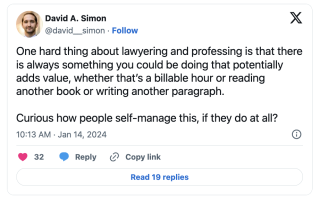
A tweet from a law prof colleague over the weekend asks a question that resonates.

Screen Shot 2024-01-15 at 12.11.00 PMI just love this observation and the related question! I am not on social media as much as I used to be, but when I am, I often am rewarded by tidbits like this.  Thank you, David, for commenting and asking.

I did reply.  FWIW, my reply was “For me, it’s about setting limits and persevering. There’s always more one can do. But we need sleep and time away to be most effective. And so we must sleep and save things for another day!”  Other replies offered similar and other personal wisdom.

Our roles as law professors–if we want to do the job well–involve focused attention and extensive effort.  Teaching (with all that entails from course design to assessment), researching,  writing, editing, and performing service to benefit the school, the university, the community, the academy, and the profession can be a heavy load to bear.  Managing it with self care can be a struggle.  That struggle is real, and we should, as David does, acknowledge and address it.  After all, Dr. King also is quoted as having said the words set forth below in a sermon, “The Three Dimensions of a Complete Life,” in April 1967 at the New Covenant Baptist Church in Chicago, Illinois.

You know, a lot of people don’t love themselves. And they go through life with deep and haunting emotional conflicts. So the length of life means that you must love yourself. And you know what loving yourself also means? It means that you’ve got to accept yourself.

Words of wisdom.  And so we plod on, endeavoring to do our life’s work well while also accepting and loving ourselves.  The latter should not be a burden, but rather a commitment to self leadership through self love that enables us to do our best work. 

Thank you, Dr. King, for helping lead us through, even years after your untimely death.  And again thank you, David, for your resonant post.

Tomorrow morning, the U.S. Supreme Court will be hearing oral arguments on a securities fraud case for which I am an amicus brief coauthor.  The case is: Macquarie Infrastructure Corporation, et al. v. Moab Partners, L.P., et al. (No. 22–1165, Certiorari to the C. A. 2nd Circuit).  The Court convenes at 10 am and has allotted one hour for oral argument: 30 minutes for the petitioners, 20 minutes for the respondent, Moab Partners, and 10 minutes for the U.S. Securities and Exchange Commission (“SEC”), as amicus supporting the respondents.  An audio feed of the argument is live-streamed on the Court’s website, and the Court posts the audio later in the day.

The question presented to the Court is: “May a failure to make a disclosure required under Item 303 of SEC Regulation S-K support a private claim under Section 10(b) of the Securities Exchange Act of 1934, even in the absence of an otherwise misleading statement?”  The issue in the case, in essence, is whether a mandatory disclosure rule properly adopted by the SEC gives rise to a duty to disclose that can be the basis of a securities fraud claim under Section 10(b) of and Rule 10b-5 under the Securities Exchange Act of 1934, as amended.  There is a circuit split on this issue.  As most of you know, in 1988, in Basic v. Levinson, the Supreme Court offered that “[s]ilence, absent a duty to disclose, is not misleading under Rule 10b-5.”  A duty to disclose is therefore a foundational element in a Section 10(b)/Rule 10b-5 claim.  Of course, the elements of proof extend beyond this essential disclosure duty element—including by incorporating the requirement that there be a misstatement or misleading omission of a material fact).

The Macquarie case involves a corporation’s alleged failure to comply with an SEC mandatory disclosure rule.  The corporation and other original defendants are the petitioners.  Our brief argues in favor of the respondents.  In sum, we argue that the SEC disclosure requirement creates a judicially cognizable duty to disclose for purposes of a claim under Section 10(b)/Rule 10b-5.  Accordingly, we contend that the omission of the required disclosure provides a basis for a Section 10(b)/Rule 10b-5 claim.  An omission to state material fact required to be disclosed under an SEC mandatory disclosure rule may mislead investors who expect that any required disclosure is made or inapplicable.

Many of us teach in this space.  If you have time to listen in, the argument may illuminate some new things.  And it is bound to be interesting, regardless.

In two of his columns this week, Matt Levine highlighted this new company that purports to facilitate vote buying.  It invites passive retail holders to sell their votes to interested buyers.  Though the site itself mentions that buyers might be interested in influencing board selection, advancing ESG initiatives, or affecting takeover/merger decisions, in communications with Matt Levine, the company apparently emphasized the potential to use bought votes to obtain a quorum.  (As we all know, retail-heavy companies – especially SPACs – have had trouble with that recently). 

What no one seems to be talking about is whether any of this is actually legal, and the answer is – maybe?  Maybe not?

Delaware does not prohibit vote buying outright.  First, it draws a distinction between (1) where the company uses company resources to buy a vote; (2) where a third party uses its own resources to buy a vote.

The first is more troubling, because it raises the possibility of conflicted transactions.  For example, in Hewlett v. Hewlett-Packard, 2002 WL 549137 (Del. Ch. 2002), the plaintiffs alleged that HP allocated business to Deutsche Bank in order to persuade Deutsche Bank to vote shares held in its asset management arm in favor of a merger.   The court held that “Management… may not use corporate assets to buy votes in a hotly contested proxy contest about an extraordinary transaction that would significantly transform the corporation, unless it can be demonstrated… that management’s vote-buying activity does not have a deleterious effect on the corporate franchise.”  Historically, there have been scenarios where management sought to buy votes to entrench their positions.  See Macht v. Merchants Mortgage & Credit Co., 194 A. 19 (Del.Ch. 1937).

But not every scenario is like that.  In Schreiber v. Carney, 447 A.2d 19 (Del. Ch.1982), the company wanted to reorganize, and pretty much everyone agreed the reorganization would be beneficial, but the proposal would have debilitating adverse tax consequences for one large blockholder.  The blockholder agreed to vote in favor, but only if the company loaned it sufficient funds to exercise certain warrants that would eliminate the tax problem.  When the transaction was challenged by a company shareholder, the Delaware Court of Chancery agreed this was vote buying, but not impermissible vote buying – the facts were fully disclosed, the deal was conditioned on approval by the remaining stockholders, and the purpose of the arrangement was not to defraud or disenfranchise the other stockholders but to further their collective interest.

What about third party vote buying?  That doesn’t use corporate resources at all.

Nonetheless, Delaware has expressed concern about it because it decouples the vote from economic interests in the shares.  See Crown EMAK Partners v. Kurz, 992 A.2d 377 (Del. 2010).  What if, for example, someone were to short the shares and then use bought votes to vote for a value-decreasing transaction?  Now, I’m not exactly sure how this would be economical – especially for retail votes – because you’d have to pay the shareholders enough to compensate them for the lost value of their shares, but maybe retail shareholders aren’t savvy enough to make those calculations and will sell their votes cheap.  As a result, the Delaware Supreme Court, affirming the findings of VC Laster, suggested that arrangements which decouple the vote from the economic interest are illegitimate.  Id. at 390 (“We hold that the Court of Chancery correctly concluded that there was no improper vote buying, because the economic interests and the voting interests of the shares remained aligned….”) .

That said, the whole set of rules is kind of muddled because of the obvious fact that there are plenty of ways, short of outright vote buying, to obtain votes without being exposed to the economic risks of the shares.  Whole articles have been written on the subject, with various proposed reforms. 

What this tells me is that if companies buy votes in order to obtain a quorum, that might be permissible under Schreiber, but you’d kind of have to assume the lack of a quorum wasn’t somehow a deliberate choice by shareholders, and that the final vote in fact advanced their collective welfare.

As for third party vote buying, I mean … I’m honestly not sure, but it doesn’t look good, because the economic interest in the shares remains with the seller.  Even if the buyer also has an economic interest through their own share ownership, they’re by definition obtaining votes that exceed their economic interest.  And if the buyer has no economic interest – if it’s just buying votes because it has other reasons for wanting the corporation to behave a certain way – well, big flashing warning signs.

Anyway, I’ll conclude by pointing out that there’s a case for permitting vote buying, if the sellers are uninformed/retail, and the buyers are long term wealth-maximizing institutional holders.


Dear BLPB Readers:

I wanted to help spread the word about various ways in which law students can begin connecting with the American Bar Association (ABA) and encourage interested readers – especially the professors! – to also assist in getting the word out! 

First, law students can join the ABA for FREE!  They can find out more here.  

Second, the annual Banking Law Committee meeting will be in Washington D.C. on January 18-20, 2024.  This year, it’s an in-person only event (other meetings this year will offer virtual options).  Law students can attend this and other meetings for FREE (to do so, a student must become a member of the ABA and the Business Law Section)! 

Of course, the ABA has many committees in addition to the one on banking, including consumer financial services, bankruptcy, corporate governance, antitrust etc. and resources and opportunities for students interested in a variety of professional legal paths (transactional, litigation, regulatory etc.).

Third, the Banking Law Committee will also have full day meetings at two ABA conferences later in 2024 (Orlando, April 4-6 and San Diego, September 12-14).  Both meetings will have in-person and online options.  Additionally, the April meeting (and perhaps the September one too!) will have a one-hour “New Members Subcommittee Session,” which could be a helpful way for law students to begin connecting with the ABA!    

Tulane Law School invites applications for its Forrester Fellowship, which is designed for promising scholars who plan to apply for tenure-track law school positions. This is a full-time faculty position in the law school, and faculty are encouraged to participate in all aspects of the intellectual life of the school. The law school provides significant support and mentorship, a professional travel budget, and opportunities to present works-in-progress in faculty workshops. 

Tulane’s Forrester Fellows teach legal writing in the first-year curriculum to first-year law students in a program coordinated by the Director of Legal Writing. Fellows are appointed to a one-year term with the possibility of a single one-year renewal. Applicants must have a JD from an ABA-accredited law school, outstanding academic credentials, and significant law-related practice and/or clerkship experience. If you have any questions about this position, please contact Erin Donelon at edonelon@tulane.edu. Interested candidates may apply here: Apply – Interfolio

Qualifications

J.D. from ABA-accredited law school; practice and/or clerkship experience

Dear BLPB Readers:

“The Midwest Academy of Legal Studies in Business (MALSB) Annual Conference is held in
conjunction with the MBAA International Conference. MBAA International draws hundreds of
academics from business-related fields such as accounting, business/society/government, economics,
entrepreneurship, finance, health administration, information systems, international business,
management, and marketing. The MALSB has its own program track on Legal Studies and attendees
may take advantage of the multidisciplinary nature of this international conference and attend sessions
held by the other program tracks.

Presentations in 2024 will have the option of in person or live online delivery. Tentatively MALSB paper
and panel in person/live online presentations are scheduled to begin Thursday morning (April 11, 2024)
and conclude Friday afternoon (April 12, 2024). If registration numbers require additional sessions, they
will be held Wednesday afternoon (April 10, 2024).”

Note that the registration/submission deadline is January 15, 2024.  The complete call for conference participation is here. Download Malsb_call_for_participation_2024

Looking back, it’s funny how the issue of litigation limits in corporate constitutive documents has really been a throughline throughout my academic career; my first paper on the subject, Manufactured Consent: The Problem of Arbitration Clauses in Corporate Charters and Bylaws, was written when I was still a VAP.  So now it’s like a theme.

Anyhoo, as you all know, the latest set of developments occurred when the Delaware Supreme Court decided Salzberg v. Sciabacucchi, 227 A.3d 102 (Del. 2020), and approved the use of litigation limiting bylaws and charter provisions even for non Delaware claims, specifically, federal securities and antitrust claims.

That was part of what inspired my latest paper on the subject, Inside Out (or, One State to Rule them All): New Challenges to the Internal Affairs Doctrine, arguing, among other things, that other states pay too much deference to Delaware by automatically treating these provisions as contracts governed by Delaware law, rather than asking which law to apply, and whether the elements of contract are met.

Well, a new case has come up, EpicentRx, Inc. v. Superior Court, 95 Cal.App.5th 890.

EpicentRx is private, organized in Delaware but headquartered in California.  Its charter and bylaws require that shareholder claims be filed in Delaware Chancery.  Well, one shareholder is suing, not only for breach of fiduciary duty under Delaware law, but also for fraud under California law.  In EpicentRx, Inc. v. Superior Court, the California appellate court held that the corporate constitutive documents are, in fact, a contract – governed by the internal affairs doctrine, which, by the way, is not what Salzberg held, there was a diagram and everything – but that in this case, a trial in Delaware Chancery would require the shareholder to forfeit its jury rights under California law, and therefore the contract is unenforceable.  (Yes, that’s an issue I mention briefly in my paper, by the way)

The California Supreme Court recently agreed to hear the case, Epicentrx, Inc. v. Superior Court, 2023 Cal. LEXIS 6991 (Cal., Dec. 13, 2023).

Now, I gather that a lot of the action will be about whether the particular claims advanced by the plaintiff are, in fact, jury claims under California law.  But I desperately hope the California Supreme Court will spend some time asking whether there’s even a contract here in the first place, including which state’s law applies (since, I say again, Delaware did not hold this question was governed by the internal affairs doctrine).  Now, since EpicentRx is private, these may be more difficult questions than in the context of publicly traded corporations.  The plaintiff presumably bought stock directly from the company, for all I know the investment contract incorporated the bylaw and charter provisions by reference, although – and I think this is key – one factor that makes constitutive documents noncontractual is that, as Boilermakers Local 154 Retirement Fund v. Chevron Corp., 73 A.3d 934 (Del. Ch. 2013) recognized, Delaware managers are subject to fiduciary duties when they enforce them, and I don’t even know how you ask whether it’s a violation of fiduciary duty to enforce a bylaw that causes a shareholder to forfeit a jury right.  In any event, all I really want is for the California Supreme Court to take these questions seriously.

Delaware’s Caremark cases continue to be catnip for me.

The latest is the Delaware Supreme Court’s Lebanon County Employees’ Retirement Fund v. Collis, reversing VC Laster’s decision from last year.

Plaintiffs alleged that AmerisourceBergen’s board of directors violated opioid drug laws by failing to monitor suspicious prescriptions, to the point where they altered their internal reporting systems so that fewer prescriptions would be flagged.  Ultimately, this conduct caused severe damage to the company, through a $6 billion global settlement, as well as other settlements and litigation costs.

VC Laster explored the allegations in detail, ultimately determining that, standing alone, the complaint stated a claim against the AmerisourceBergen board for a violation of Caremark duties. 

But!  Plot twist.  Because in mid 2022, after the plaintiffs’ complaint was filed, a federal West Virginia court cleared AmerisourceBergen of misconduct.  The case was filed by a city and county in West Virginia – areas that were ground zero for the opioid crisis – and among thousands of similar cases consolidated for pretrial proceedings in a larger multidistrict litigation.  After a bench trial, the judge found that the plaintiffs had failed to prove that AmerisourceBergen did not maintain an effective control system.  According to Laster, that decision was enough to undermine the plaintiffs’ claims that AmerisourceBergen’s directors had caused the company to break the law.  As he held:

In light of the West Virginia Court’s thorough analysis, it is not possible to infer that the Company failed to comply with its anti-diversion obligations, nor is it possible to infer that a majority of the directors who were in office when the complaint was filed face a substantial likelihood of liability on the plaintiffs’ claims.

Case dismissed.

On appeal, the Delaware Supreme Court held that Laster had improperly deferred to the factfinding of another court as to contested matters, namely, whether the AmerisourceBergen Board had complied with the Controlled Substances Act.  As the Court put it:

the question whether the defendants in the West Virginia litigation engaged in wrongful conduct and failed to comply with the CSA was, it seems clear to us, a question of fact… This Court has not addressed whether a court can take adjudicative notice of the factual findings of another court. The weight of authority in the federal courts applying Federal Rule of Evidence 201, which is nearly identical to D.R.E. 201, indicates that a court may not do so when the underlying fact is reasonably disputed.

So, Laster was reversed, and the complaint sustained.

I’ve posted a lot about how common Caremark claims are becoming, and how they’re becoming more successful.  I think this trend is likely to create a lot of headaches for the Delaware courts and among those headaches – as this case demonstrates – is how Delaware’s decisions are going to interact with the findings of other courts.  After all, Caremark is predicated on the existence of illegal conduct.  Other regulators are the ones who are primarily responsible for determining whether any illegal conduct occurred in the first place; Delaware’s role is secondary to those primary findings of legality/illegality.

In other words, it would be kind of odd if a Delaware court held that a board violated its fiduciary duties by causing the company to break the law, if the company’s primary regulator determined that the company had not broken the law.

Laster’s original decision, then, has the air of trying to work out how Delaware courts will operate in tandem with these other legal systems in the context of Caremark.  Laster treated the West Virginia decision as a legal declaration under Delaware Rule of Evidence 202, which thereby absolved AmerisourceBergen – and thus its board – of any wrongdoing. 

The Delaware Supreme Court, however, rejected that attempt.  In its view, the West Virginia decision was not, for evidentiary purposes, a legal declaration of the propriety of the board’s conduct, but a factual determination of what had historically occurred – contested facts that Delaware is free to revisit (“To be sure, the findings of the West Virginia Court are recorded in the ‘case law . . . of the United States[,]’ but they do not establish or recognize a rule or principle of law of the kind that is subject to judicial notice under D.R.E. 202”).  And though the Delaware Supreme Court’s decision, taken in isolation, certainly makes sense, I wonder if it will create more problems for Delaware going forward, if Caremark claims appear to be proceeding even where underlying regulatory actions fail.  Or, as I put it previously, “Delaware really can’t be in the business of functioning as a backup regulator for the entire United States.”

As I’ve mentioned before, the Department of Labor is now taking another go at improving advice standards for retirement accounts.  I put a quick letter together to give some reasons why I think it’s important to have high standards for advice in this context.

Although written to the Department of Labor, I tried to put the letter together in a way that would help journalists and others understand some of the critical issues facing Labor and the need to put some real protections in place.

One of the talking points often deployed by the industry here is that people should understand that they are in a sales environment and not rely overmuch on the insurance producer deploying every known psychological trick to generate trust.  In reality, many people–particularly older Americans do not understand that the advice is not free.  

My sense is that the rulemaking will probable go through and then we’ll find out how much room the courts will give to protect people here.