June 2015

The Turtles continue to have salience in the music world.  Now, they also are a “happening thing” in legal circles.  Two recently published law review articles take on an interesting issue in copyright law relating to pre-1972 sound recordings that has been the subject of legal actions brought by members of The Turtles.  The articles (both of which use the song Happy Together, a Turtles favorite, in their titles) are authored by my University of Tennessee College of Law colleague, Gary Pulsinelli, and Georgetown University Law Center Professor Julie L. Ross.  

In his abstract, Gary summarizes the problem as follows:

Federal copyright law provides a digital performance right that allows owners of sound recordings to receive royalties when their works are transmitted over the Internet or via satellite radio. However, this federal protection does not extend to pre-1972 sound recordings, which are excluded from the federal copyright system and instead left to the protections of state law. No state law explicitly provides protection for any type of transmission, a situation the owners of pre-1972 sound recordings find lamentable. These owners are therefore attempting to achieve such protection by various means. . . . 

He concludes:

[S]tate

So, I’m on vacation, which is not something I do very often, at least unrelated to work.  It’s been great, and we’re lucky to be able to do this (and to vacation as all). It’s ungodly hot, but hey, that’s the beach. I guess. Like I said, we don’t do it like this very often.

Anyway, I recently read a piece that talked about freedom in way that really resonated for me.  It is applicable personally, and it is applicable professionally.  Law schools, collectively, could stand to pay attention, as well. We have choices, we just have to recognize it. I’m no philosopher, but here’s the gist of the post that resonated with me, from Rapitude.com:

Sartre believed that we have much more freedom than we tend to acknowledge. We habitually deny it to protect ourselves from the horror of accepting full responsibility for our lives. In every instant, we are free to behave however we like, but we often act as though circumstances have reduced our options down to one or two ways to move forward. 

This is bad faith: when we convince ourselves that we’re less free than we really are, so that we don’t have

Recent news brings us two reminders that crowdfunding is an amoral fundraising tool. It can be used for evil as well as for good.

Crowdfunding War

First, the New York Times reports that Russian nationalists are using crowdfunding to fund the rebellion/invasion in eastern Ukraine. One website even allows donors to direct contributions to specific militia units. The Russian separatists claim to have raised millions of dollars. (Of course, they have also claimed there’s no Russian government involvement in the rebellion, so take these claims with a grain of salt.)

Not much can be done about the groups themselves, which are located in Russia. But, as the Times points out, the payment intermediaries who help facilitate these payments are at legal risk.

Crowdfunding Fraud

Second, Inc. magazine reports that the Federal Trade Commission has taken action against a man who raised $122,000 on Kickstarter to produce a board game, then used the money to pay his rent and move. The man, Erick Chevalier, agreed to a settlement that orders him to repay the money, but the judgment has been suspended because he no longer has any money.

A copy of the FTC’s complaint is here. The agreed order is 

I’ve just moved down to New Orleans to join the faculty at Tulane Law School (my bio will be updated  … um, eventually), where I’ll be teaching Business Enterprises and Securities Regulation to start.  As you can imagine, Louisiana is quite a change from both North Carolina and, before that, NYC.  One thing I noticed right off the bat is that most of the banks in Louisiana are local/regional institutions – not many national banks have branches here.  Which means that, as a former plaintiffs’ attorney, for the first time in my adult memory I have a bank account with a financial institution I haven’t sued.

(Sidenote: That was actually kind of an issue when I worked for the law firm then-known as Milberg Weiss.  I was told we had trouble getting firmwide health insurance because we’d sued all the carriers and they didn’t want to do business with us.)

Anyway, as I procrastinate from unpacking….

*actual representation of my apartment

….the big news that has my attention is the AIG verdict.  There have already been conflicting views on what it portends for future bailouts, but what fascinates me is how much of the opinion is devoted to the judge’s moral condemnation of the Fed’s actions, and his moral absolution of AIG, even though the relative good or evil of either player was really not relevant to his ultimate holding.

[More under the jump]

Conscious

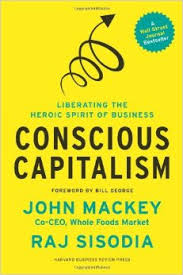
Recently, I finished reading Conscious Capitalism, written by Whole Foods Market co-CEO John Mackey and Babson College professor Raj Sisodia.

The book is much more “popular press” than academic, as should be clear from the splashy subtitle “liberating the heroic spirit of business.” There is a bit of academic influence in the appendix and notes, but it is mostly social business advocacy and story telling. In fact, the authors state that the primary purpose of the book “is to inspire the creation of more conscious businesses: businesses galvanized by higher purposes that serve and align the interests of all their major stakeholders.” (pg. 8). The book is interesting, passionate, and may accomplish its primary purpose.

The authors paint a compelling picture of Whole Foods Market and similar companies like Trader Joe’s, The Container Store, Costco, and Southwest Airlines. These companies appear to take a long-term view and consider what is best for all their stakeholders. I would have appreciated, however, more attention to the struggles the companies must have faced in attempting to satisfy all of their stakeholders. After finishing the book, I was left wishing the authors would have spent more time discussing how to make decisions in

Last week I posted the first of three posts regarding doing business in Cuba. In my initial post I discussed some concerns that observers have regarding Cuba’s readiness for investors, the lack of infrastructure, and the rule of law issues, particularly as it relates to Cuba’s respect for contracts and debts. Indeed today, Congress heard testimony on the future of property rights in Cuba and the claims for US parties who have had billions in property confiscated by the Castro government- a sticking point for lifting the embargo. (In 1959, Americans and US businesses owned or controlled an estimated 75-80% of Cuban land and resources). Clearly there is quite a bit to be done before US businesses can rush back in, even if the embargo were lifted tomorrow. This evening, PBS speculated about what life would be like post-embargo for both countries. Today I will briefly discuss the Cuban legal system and then focus the potential compliance and ethical challenges for companies considering doing business on the island.

Cuba, like many countries, does not have a jury system. Cuba’s court system has a number of levels but they have both professional judges with legal training, and non-professional judges who are

In response to one of my posts last week, co-blogger Josh Fershee raised concern about making minor changes to securities regulation–in that case, in the context of the tender offer rules.  Specifically, after raising some good questions about the teaser questions in a marketing flyer regarding a program I am moderating, he adds:

This reflects my ever-growing sense that maybe we should just take a break from tweaking securities laws and focus on enforcing rules and sniffing out fraud. A constantly changing securities regime is increasingly costly, complex, and potentially counterproductive. 

Admittedly, I am not that close to this, so perhaps I am missing something big, but I’m thinking maybe we should just get out of the way (or, probably better stated, keep the obstacles we have in place, because at least everyone knows the course).

Although I pushed back a bit, I generally agree with his premise (and I told him so).  I will leave the niceties regarding the tender offer rule at issue for another day–perhaps blogging on this after the moderated program takes place.  But in the mean time, I want to think a bit more out loud here about Josh’s idea that, e.g., mandatory disclosure and substantive regulation should be minimal and fraud regulation should be paramount.  Not, of course, a new idea, but a consideration that all of us who are honest securities policy-makers and scholars must address.

SEC Commissioner Kara M. Stein provided remarks at the Brookings Institute’s 75th Anniversary of the Investment Company Act on Monday, June 15th.  Now if that isn’t an exciting introduction to a post, I just don’t know what is.  She addressed a topic that is of great interest to me and a focus of my research:  retail/retirement investors.  I tend to call them Citizen Shareholders in my writing, and it is sentiment shared by Commissioner Stein:

“By retail investor, I mean the everyday citizen or household that is investing – not institutional investors or pension funds.  Eighty-nine percent of mutual fund assets are attributable to retail investors.” (emphasis added).

In her remarks she detailed several troubling aspects of the mutual fund industry–a primary investment source for retail investors– liquidity, leverage and disclosure.  She also highlighted future SEC rule making initiatives related to these issues.   For example, the Commission recently proposed new rules to enhance data reported to the Commission by registered funds. The proposed rule is available  here (Download SEC proposed disclosure rules) and received comments can be tracked on the SEC’s website here.

Noting that a major function of the 1940 Investment Act was transparency and

Public opinion polls often make news, but they don’t necessarily improve discourse or policy decisions.  This is true in business and politics, at least where the polls are created primarily for news purposes. Not all polls are bad, of course, and groups like Pew and some others can offer useful starting points for policy discussions. Still we should be skeptical of public opinion polls. 

A new poll released today provides a good example of how unhelpful polls can be. Robert Morris University (RMU) today issued a press release (about a new poll) that says Pennsylvanians “expressed both overwhelming support and strong environmental misgivings, about” hydraulic fracturing (fracking). This framing of the poll does not seem to reveal any inherent inconsistencies. It would be entirely reasonable for people to recognize the potential value fracking for oil and gas can have, while at the same time being worried about the environmental risks that come with fracking (or any other industrial process).  

In fact, I have argued that this is the proper way to consider risks and benefits to help ensure oil and gas operations are as environmentally sound as possible to ensure sustainable development. Unfortunately, the poll indicates some internal inconsistencies among