January 2016

There has long been a debate about whether corporations should be forced to disclose non-financial information about their operations, particularly information pertaining to social responsibility. For example, as Marcia Narine has repeatedly discussed, Dodd-Frank’s “conflict minerals” disclosure requirement may be not only ineffective to pressure companies into making ethical purchasing decisions, but may even be counterproductive, by causing companies to pull out of the Congo entirely (thus devastating the regional economy) rather than endure the expense of ensuring that their purchases do not indirectly finance armed groups.

Further to this issue, Hans B. Christensen, Eric Floyd, Lisa Yao Liu, and Mark Maffett have recently released a paper studying the effects of Dodd-Frank’s requirement that mining companies disclose information about their compliance with the Federal Mine Safety & Health Act of 1977. They find that after mine-owning companies became subject to Dodd-Frank’s disclosure requirements, they demonstrated a marked decrease in safety violations and injuries, counterbalanced by a decrease in productivity (apparently because they are spending more time on safety compliance). They also find that mines that disclose an “imminent danger order” from regulators post-Dodd Frank not only experience an immediate stock price reaction (especially the first time such an order

Mnookin

Perhaps the most common question I receive from the MBA students in my Decision Making & Negotiation Skill class is – what do I do when the other side is completely unreasonable or evil?

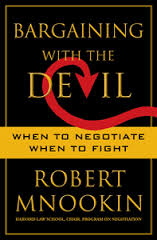
Robert Mnookin (Harvard) explores this question in his book Bargaining with the Devil: When to Negotiate and when to Fight

I won’t attempt to summarize the entire book, but I share a few representative quotes below. (Page numbers correspond to the 2010 hardback edition).

“By ‘Devil’ I mean an enemy who has intentionally harmed you in the past or appears willing to harm you in the future. Someone you don’t trust. An adversary whose behavior you may even see as evil.” (pg. 1)

“An act is evil when it involves the intentional infliction of grievous harm on another human being in the circumstances where there is no adequate justification.” (pg. 15)

Consider “Interests [of both sides]…Alternatives [of both sides]…Potential negotiated outcomes…Costs…Implementation…What issues of recognition and legitimacy are implicated in my decision” (pgs. 27-34).

“I believe there is reason to be deeply concerned whenever an agent or representative allows personal morality to override a rational analysis favoring negotiation – even with a devil.” (pg. 49)

“If you bargain

Last week, I threatened that I might have outtakes from the the Association of American Law Schools (“AALS”) panel discussion for the Section on Agency, Partnerships, LLCs and Unincorporated Associations, “Contract is King, But Can It Govern Its Realm?”.  The “conversation” between panelists and among panelists and audience members was rich and far-ranging, although much of it was not “new news” to those of us focused on the many legal questions relating to contracts in the unincorporated business associations space.  Here is my brief additional comment on the panel discussion, ex post.  A recording of the session should later be available, for those interested in listening in.

Although most of the discussion was intentionally not scripted (but, rather, organized by a set of questions shared with the panelists in advance), a few of us did have assignments.  I was charged with two key areas of earmarked participation.  First, I accepted an invitation to identify and categorize non-Delaware state law issues at the intersection of unincorporated business association law, contract law, and legislative drafting.  Second, I was invited to comment on my work on the LLC [operating] agreement as contract (or non-contract).  Although each topic is worthy of

On Sunday, the world lost a musical giant in David Bowie, who died of cancer at 69.  He was the first artist who that made me a true music fan. Like buy all the records, read the biographies, hang-posters-on-the-wall type fan.  I grew up with a love for Motown music, especially Smokey Robinson, the Supremes, and the Four Tops, that I still have, but my appreciation for that music came from listening to my parent’s records.

When it came time to choose my own artists, other kids were into Led Zeppelin and Pink Floyd, but Bowie emerged as my guy.  He was later followed by bands like R.E.M., the English Beat, and The Cure, among others, as I moved into more of the college radio scene, and I really liked Joan Jett, but Bowie was always The Guy.  My fandom started with an album I poached from my aunt, Heroes.  I also got ahold of David Live (1974), and then worked my way back before going forward.  The Rise and Fall of Ziggy Stardust and the Spiders from Mars, Space Oddity, The Man Who Sold the World, Aladdin Sane, Diamond Dogs, and

This post highlights SIGA Technologies, Inc. v. PharmAthene, Inc., Del. Supr., No. 20, 2015 (Dec. 23, 2015).

At the end of 2015, the Delaware Supreme Court issued an opinion affirming its earlier holding that where parties have agreed to negotiate in good faith, a failure to reach an agreement based upon the bad faith of one party entitles the other party to expectation damages so long as damages can be proven with “reasonable certainty.”

Francis Pileggi, on his excellent Delaware Commercial and Business Litigation blog, provides a succinct summary of the case, available here.  The parties to the suit entered into merger negotiations to develop a smallpox antiviral drug.  Due to the uncertainty of the merger negotiations, the parties also entered into a non-binding license agreement, the terms of which would be finalized if the merger fell through for whatever reason.   While nonbinding, the preliminary license agreement contained detailed financial terms and benchmarks.  When the merger was terminated, SIGA proposed terms for a collaboration that departed from the preliminary license agreement.  The Delaware Supreme Court affirmed the Court of Chancery finding that SIGA’s acted in bad faith.  The question of the case became what damages were due from

I, like many law professors, recently returned from the annual meeting of the Association of American Law Schools. I attended a number of interesting presentations, but the highlight of the conference for me was the opportunity to hear Frank Easterbrook speak on “The Corporate Law and Economics Revolution.”

I assume that most of our readers are familiar with Judge Easterbrook. He was a prominent corporate law scholar prior to (and after) being appointed to the Seventh Circuit Court of Appeals by President Reagan.

I have never met Judge Easterbrook. He left the academy two years before I began teaching. But I am certainly familiar with his writing. I have read several of his articles, and a well-used copy of his book (with Daniel Fischel) The Economic Structure of Corporate Law sits on my office bookshelf. And we do have a connection of sorts: my first citation ever came from him. He was kind enough to cite my very first article in one of his opinions, Amanda Acquisition Corp. v. Universal Foods Corp., 877 F.2d 496 (7th Cir. 1989).

At the conference session I attended, Judge Easterbrook’s views on law and economics were forcefully challenged by one of the other

Spring semester classes begin on Monday, and as a newbie professor, I’ve been spending a lot of my break preparing to teach Securities Regulation for the first time. While all my pals hang out at AALS in New York (hi, guys! Hope you’re having a good time!), I’ve chosen to remain at home, with multiple casebooks spread out over my living room floor.

Though the casebooks naturally focus on federal regulation, most have at least some discussion of regulation at the state level, including a brief explanation of the term “blue sky law.”  This is a phrase whose etymology has long been shrouded in mystery; Professors Macey and Miller traced it as far back as 1910, but could not find its origins.  See Jonathan R. Macey & Geoffrey P. Miller, Origin of the Blue Sky Laws, 70 Tex. L. Rev. 347 (1991).  As a result, the casebooks I’ve seen simply quote the Supreme Court’s opinion in Hall v. Geiger-Jones Co., 242 U.S. 539 (1917), describing such laws as designed to prevent “speculative schemes which have no more basis than so many feet of ‘blue sky.’”

I mention this because a few years ago, Rick Fleming, who was then

I will miss many of you at AALS this weekend because on Sunday morning I am speaking on a panel on corporate social responsibility in small businesses and startups at a conference for the United States Association for Small Business and Entrepreneurship (USASBE) in San Diego. My co-panelists include: Julian Lange, Governor Craig R. Benson Professor of Entrepreneurship and Public Policy, Associate Professor, Babson College; Megan M. Carpenter, Professor of Law, Co-Director, Center for Law and Intellectual Property, Faculty Director, IP and Technology Law Clinic, Faculty Director, Entrepreneurship Law Clinic, Texas A&M University School of Law; Sandra Malach, Senior Instructor, Entrepreneurship & Innovation, Haskayne School of Business, University of Calgary, Canada, former counsel at the Venture Development Legal Clinic, and previous positions at Stantec Engineering, Bennett Jones Barristers & Solicitors, Enron, and SAIT; and John Tyler, General Counsel and Corporate Secretary, the Ewing Marion Kauffman Foundation. The abstract that we presented to conference organizers stated:

Entrepreneurial and small businesses are increasingly incorporating “people, planet, and profits” into their business models and operations to a degree that goes beyond simply fulfilling the requirements of government regulations. Moreover, it can be argued that expanding a company’s mission to include