July 2017

The corporate form has been compared and contrasted favorably and unfavorably with government.  The literature is broad and deep.  Having said that, there is, perhaps, no one who writes more passionately on this topic than Daniel Greenwood.  Set forth below are two examples of text from his work that illustrate my point.

We live in a democratic age, in which the sole legitimate source of political power is the consent of the governed. Yet our business corporations defy every norm of democracy.
 
Most fundamentally, corporate law and our major business corporations treat the people most analogous to the governed, those most concerned with corporate decisions, as mere helots. Employees in the American corporate law system have no political rights at all—not only no vote, but not even virtual representation in the boardroom legislature. Board members owe a fiduciary duty to the corporation, according to most of the statutes, and to the shareholders, according to the popular shareholder primacy narratives, but they owe no consideration at all to employees.
 
Daniel J.H. Greenwood, Essay: Telling Stories of Shareholder Supremacy, 2009 Mich. St. L. Rev. 1049, 1060 (2009).
 
The corporation as a state-within-the-state . . . cannot be justified under any democratic theory, because this state-like entity defies all democratic norms internally. No corporation operates by the principle of one person, one vote. All economically significant corporations disenfranchise a substantial portion of the affected populace, while even shareholders vote according to the number of shares they hold. Moreover, standard corporate law sharply limits the control that even the “voters” have over “their” entity. The law bars them, in the absence of unanimous consent, from making fundamental value choices, for example, from balancing the pursuit of profit against other potential corporate goals, such as quality products, interests of non-shareholder participants or even the actual financial interests of the real human beings who own the shares. Moreover, it even bars them from electing directors pledged to particular interests: directors, unlike ordinary politicians, are bound by law to pursue the interests of all (and only) shares, and courts will enforce this duty-subject to the often significant limitations of the business judgment rule-at the behest of any shareholder, regardless of election results. Theorists, therefore, usually resort to market-based explanations of why the corporation is unable to exert any power over its shareholders, employees and other participants.
 
Daniel J.H. Greenwood, Markets and Democracy: The Illegitimacy of Corporate Law, 74 UMKC L. Rev. 41, 54–55 (2005) (footnotes omitted).  Whether you agree with Daniel or not on the substance, his views are transparent and his belief and energy are palpable.
 
With politics in the news every day and corporations on my mind, I have been pondering certain elements of democracy as they play themselves out in corporate governance.  In particular, of late, I have focused in on accountability as a core democratic norm.  

I’ve previously posted about the problem of multiforum litigation, and how it’s very much in Delaware’s interest to figure out a way to keep cases flowing to its courts.  In particular, Delaware’s recommendation that derivative plaintiffs seek books and records before proceeding with their claims simply invites faster filers to sue in other jurisdictions – and invites defendants to seek dismissals against the weakest plaintiffs, which will then act as res judicata against the stronger/more careful ones.   As VC Laster put it during a hearing in Avi Wagner v. Third Avenue Management, LLC, “The defendants want to get out of litigation, and the best way to do it is to fight the weak plaintiff . . . [T]hey have the plaintiff they want and the allegations they want….  This whole system of multi-forum litigation … creates a lot of systemic dysfunction. It’s certainly true that things should be resolved in one forum and at one time, but it doesn’t follow from that … that they should necessarily be followed under a system that incentivizes the filing of a fast complaint by a weak plaintiff so that defendants have the high ground.” (May 20, 2016).

Delaware’s latest proposal to

These days it is easy to get discouraged on how divided our nation seems to be on a number of issues. John Inazu, Distinguished Professor of Law, Religion, and Political Science at Washington University, maps a way forward in his book Confident Pluralism (2016).

The book is divided into two parts: (1) Constitutional Commitments, and (2) Civic Practices.

The first part “contend[s] that recent constitutional doctrine has departed from our longstanding embrace of pluralism and the political arrangements that make pluralism possible.” (8) Further, the first part offers guideposts for future decisions and political solutions. The first part argues for both inclusion and dissent, for the free formation of voluntary groups, for meaningful access to public forums, and for access to publicly available funding for diverse organizations. Provocatively, Inazu claims that Bob Jones case – which stripped tax-exempt status from Bob Jones University due to its prohibition of interracial dating/marriage – is “normatively attractive to almost everyone, [but] is conceptually wrong.” (75) Inazu claims that “[t]he IRS should not limit tax-exempt status based on viewpoint of ideology.” (79) He extends the argument to “generally available resources.” While the Trinity Lutheran case was decided by the Supreme Court after publication

As some of you know (and as I noted in a prior post), I have taught from time to time in the past (and will be teaching again this fall) a course focusing on nonhuman animals and the law.  The course reveals, among many other things, that business law doctrine and practice have a number of significant intersections with nonhuman animals.  Although I am likely to say more on that later, the earlier post linked in above notes a few things.

Yesterday, I received the “Call for Papers and Features” reproduced below.  Many of the suggested topics–and the overall theme of “animal welfare in the context of human development”–engage business law.  In particular, agricultural business seems to be on the ends of the editors . . . .  Accordingly, I am posting the call thinking that some of our readers would be interested in knowing about this.

[Aside: I do not subscribe to the citation policy of the journal for the “features” being sought through this call–e.g., “Almost every sentence must be cited” and “If a sentence does not have a citation, you should have a good reason (i.e., it is your concluding argument or a recommendation).”  Unless those who established these requirements are confident that “features” otherwise meeting their requirements do not contain novel legal or policy arguments or recommendations, that pair of citation “requirements” is absurd, imv.]

*          *          *

Logo_sm

CALL FOR PAPERS AND FEATURES

The Sustainable Development Law & Policy Brief (SDLP) is currently accepting submissions for its Fall 2017 edition on topics related to animal welfare in the context of human development. Development will not be sustainable if animal welfare and human-animal relationships are not included in development programs, policies, and laws. Therefore, it is important to highlight the commonality between animal welfare issues and human justice issues.

If you would like to submit an article or feature for consideration, please contact us at sdlp@wcl.american.edu immediately. We will accept submissions on a rolling basis. The deadline for submissions is Monday, September 25, 2017. We will select up to four articles and four features for publication, and we will notify the Authors by Monday, October 2, 2017. Article Requirements differ from Feature Requirements – see below.

Topics may include but are not limited to:

§ Consumption of Species Versus Ecotourism in Developing Nations
§ Exploitation of Natural Fisheries and the Associated Issue of Bycatch
§ Challenges in Regulating Offshore Aquaculture
§ The Effects of Anthropogenic Noise on Marine Life
§ Going Meatless and Securing Food Sources: Moving Away from Concentrated Animal Feeding Operations and Meat Consumption
§ Socio-Economic Challenges in Shifting from Animal-Based Agriculture to Plant- Based/Non-Animal Based Agriculture
§ Intersection Between Concentrated Animal Feeding Operations and Environmental Justice
§ Habitat Loss and Deforestation from Agriculture
§ The Role of Financial Institutions in Animal Agriculture Projects
§ How to Move Toward a Global Animal Welfare Policy
§ Human Health Implications Associated with the Production and Consumption of Animal Products
§ Balancing Wildlife and Continued Land Exploitation in National Parks and Preserves
§ The Effects of Deep Sea Bed Mining on Marine Life

SDLP is available online at LexisNexis, Westlaw, VLex, Hein Online, and on our website at www.wcl.american.edu/org/sdlp.

It is also widely distributed at law and graduate schools, and to representatives of international organizations worldwide.

We reserve the right to reject submissions at any time or for any reason. We also reserve the right to hold all submissions on file for later publication and reserve the right to revise submissions and/or cut text. Authors will have the opportunity to accept or reject any revisions. SDLP accepts submission of timely articles that have already been published elsewhere, so long as permission of the previous publisher is received.

[Click on the “Continue reading” button below for the requirements for articles and features.]

I am speaking at a plenary session tomorrow during the the Energy Impacts Symposium at the Nationwide & Ohio Farm Bureau 4-H Conference Center in Columbus, Ohio. The program is exciting, and I look forward to being a part of it.  The program is described as follows: 

Energy Impacts 2017 is a energy research conference and workshop, organized by a 9-member interdisciplinary steering committee, focused on synthesis, comparison, and innovation among established and emerging energy impacts scholars from North America and abroad. We invite participation from sociologists, geographers, political scientists, economists, anthropologists, practitioners, and other interested parties whose work addresses impacts of new energy development for host communities and landscapes.

The pace, scale, and intensity of new energy development around the world demands credible and informed research about potential impacts to human communities that host energy developments. From new electrical transmission lines needed for a growing renewable energy sector to hydraulically fracturing shale for oil and gas, energy development can have broad and diverse impacts on the communities where it occurs. While a fast-growing cadre of researchers has emerged to produce important new research on the social, economic, and behavioral impacts from large-scale energy development for host communities and landscapes, their discoveries

ABABookCover

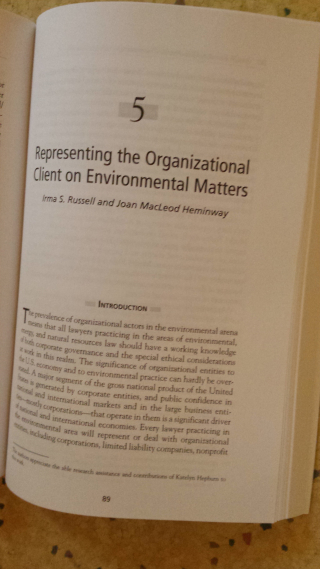
My good friend and long-time mentor Irma Russell and I wrote a chapter for the recently released ABA book, Ethics and the Environment: A Lawyer’s Guide.  Irma also is a co-editor of the book (with Vicki Wright).  In our joint contribution, the chapter entitled “Representing the Organizational Client on Environmental Matters,” Irma and I cover issues involving professional responsibility, corporate governance, and environmental compliance.  Guess which part was my primary responsibility . . . ?!)  Covering some 37 pages of the 242-page book, the rules we cover and the observations we make are fairly wide-ranging.  We hope, as we noted in our conclusion to the chapter, that we supply legal counsel representing corporations and other organizations with “foundational tools to assist them in providing advisory and advocacy-oriented services to organizational clients in the environmental law context.”  Irma and I received our copies last week.  The book soon will be available through the ABA and other outlets.


ABABookChapterPage

SaveSaveSaveSave

SaveSave

So Michael Piwowar inspired a bit of heartburn in the plaintiffs’ bar this week when, during a speech to the Heritage Foundation, he encouraged corporations to add mandatory arbitration provisions in their charters prior to an IPO. This is a subject on which I’ve frequently posted, but since it’s in the news again I can’t let it go by without comment.

Mandatory arbitration is an idea that terrifies plaintiffs’ attorneys because arbitration clauses typically come with a class action waiver, and that could sound the death-knell for federal securities litigation.  Moreover, because the Supreme Court has interpreted the Federal Arbitration Act to bar most attempts at regulating contracts to arbitrate, see, e.g., AT&T Mobility LLC v. Concepcion, 563 U.S. 333 (2011), the fear is that once an arbitration clause makes it into the corporate governance documents, it’s pretty much game over.  The plaintiffs’ bar has long taken comfort in the fact that (at least until now) the SEC has taken the position that such provisions are impermissible, which is exactly why Piwowar’s remarks raised concern.  Delaware, of course, recently amended its corporation law to prohibit the use of mandatory arbitration clauses in corporate charters and bylaws, see Del.