
December 2018

Law and Entrepreneurship Association – Call for Papers


The 13th annual meeting of the Law and Entrepreneurship Association (LEA) will be held on April 5, 2019 at Boston College Law School.


The LEA is a group of legal scholars interested in the topic of entrepreneurship—broadly construed. Scholars include those who write about corporate law and finance, securities, intellectual property, labor and employment law, tax, and other fields related to entrepreneurship and innovation policy. Our annual meeting is an intimate gathering where each participant is expected to read and actively engage with all papers under discussion.

The theme for the meeting will be Unicorns and the Law. We seek papers addressing issues raised by the growing number of highly-valued private companies that are delaying IPOs.  One or more panels will be organized around this theme. Possible topics include disclosure requirements, unicorn valuation, regulation of private trading markets, the role of sovereign wealth funds and mutual funds as unicorn investors and governance issues including dual class capitalization, fraud, employee protection, employment discrimination, and compliance with law. We also welcome papers on other topics relevant to entrepreneurship. 

Proposals should be comprehensive enough to allow the LEA board to evaluate the
The SEC Investor Advisory Committee met last week and considered how to respond to the unpaid arbitration awards problem.  This is an issue I’ve written about before.   As more outside attention has focused on the issue, FINRA has begun releasing statistics on how many arbitration awards go unpaid.  In 2017, about $25 million in awards went unpaid–amounting to roughly a third of the awards and a quarter of the total damages won.

The Investor Advisory Committee heard from an informed panel, taking statements from Christine Lazaro, President of the Public Investors Arbitration Bar Association (PIABA) and professor at St. John’s School of Law, Jill Gross, a professor at Pace Law School, Richard Berry, the head of FINRA’s dispute resolution group, and Robin Traxler, from the Financial Services Institute (also known as FSI).  There is also pending legislation on this issue from Senator Warren with Senator Kennedy on board as a bipartisan co-sponsor.

The issue matters for retirement savers swindled by bad brokers.  Professor Lazaro provided the committee with the stories of wronged investors, including the problem facing one retired couple:

Take for example the Sheas. The couple has been together for over 40 years. Mr.

If you read this blog regularly, you know that one of my pet issues has been litigation limits in corporate charters and bylaws (examples here, here, and here).

The holy grail, for those who are in favor of these things, has been to insert clauses in corporate governance documents that would require all securities claims to be arbitrated on an individualized basis.  The expectation has been that, given the Supreme Court’s recent jurisprudence, such provisions would pass muster under federal law.

In 2015, Delaware amended the DGCL to prohibit the insertion of arbitration clauses in corporate governance documents.  But that statute explicitly applies only to “internal corporate claims,” Del. Code tit. 8, § 115, leaving open the possibility that it would not prohibit arbitration clauses that only govern federal securities claims.

One of the main stumbling blocks to that maneuver has been the SEC’s resistance – a resistance that recently has been crumbling.

The other stumbling block has been the possibility – which I’ve discussed repeatedly in blog posts, a law review article, and a book chapter (abstract only on SSRN; you have to buy the book for the rest!) – is that

    As part of the duty of loyalty, a fiduciary of a company should not use confidential information belonging to the company for the fiduciary’s personal benefit.  See, e.g., Hollinger Intern., Inc. v. Black, 844 A.2d 1022, 1061 (Del. Ch. 2004).  In a recent Texas case, Super Starr Int’l, LLC v. Fresh Tex Produce, LLC, 531 S.W.3d 829 (Tex. App. 2017), a wrinkle on bringing such a breach of fiduciary duty claim was introduced — at least to me. 

    In December 2010, Kenneth Alford, Lance Peterson, and David Peterson created Tex Starr Distributing, LLC (the “LLC”).  Under the Tex Starr operating agreement, Fresh Tex Produce, LLC (the “Distributor”) and Super Starr International, LLC (the “Importer”) were the LLC’s only members.  Lance Peterson was associated with the Importer.

    In October 2016, the Distributor filed an original petition and application for injunctive relief individually and derivatively on behalf of the LLC. The defendants were the Importer, Lance Peterson, and others.  Among other claims, the Distributor brought an action for breach of fiduciary duty and for violation of the Texas Uniform Trade Secrets Act (“TUTSA”).  The Distributor’s breach of fiduciary duty claim alleged:  “By diverting [the LLC’s] accounts and business for [the

Sometimes I think courts are just trolling me (and the rest of us who care about basic entity concepts). The following quotes (and my commentary) are related to the newly issued case, Estes v. Hayden, No. 2017-CA-001882-MR, 2018 WL 6600225, at *1 (Ky. Ct. App. Dec. 14, 2018): 

“Estes and Hayden were business partners in several limited liability corporations, one of which was Success Management Team, LLC (hereinafter “Success”).” Maybe they had some corporations and LLCs, but the case only references were to LLCs (limited liability companies).

But wait, it gets worse:  “Hayden was a minority shareholder in, and the parties had no operating agreement regarding, Success.”  Recall that Success is an LLC. There should not be shareholders in an LLC. Members owning membership interests, yes. Shareholders, no. 

Apparently, Success was anything but, with Hayden and Estes being sued multiple times related to residential home construction where fraudulent conduct was alleged. Hayden sued Estes to dissolve and wind down all the parties’ business entities claiming a pattern of fraudulent conduct by Estes. Ultimately, the two entered a settlement agreement related to (among other things) back taxes, including an escrow account, which was (naturally) insufficient to cover the tax liability.  This

Women and underrepresented founders face a tremendous funding gap when compared to their male, and particularly white male, peers.   Consider just the 2016 statistics.   All-male firms raised $58.2 billion in venture capital funding while all-female firms raised only 1.46 billion.  The funding gap grows starker when we look at black-female-founded firms.  Startups founded by black women raised an average of $36,000.  In contrasts, white men pulled in an average of $1.3 million for business ventures that failed.  

Many people see how identity affects capital allocation.  Academic research has shown that otherwise identical pitches are more favorably received when voiced by a man.  Founders can see it and try to present themselves in ways that cater to investor preferences. Ann McGinley and I have written about the gap and the extraordinary measures founders take to contort themselves and their businesses to increase their access to capital. We even categorized relatively common techniques that founders use to raise capital.  We identified substitution as when a woman sends a man in her stead as a founder or co-founder because she believes that it’s the right business decision to bypass investor bias.  We also identified something we called “manclusion” where a woman has

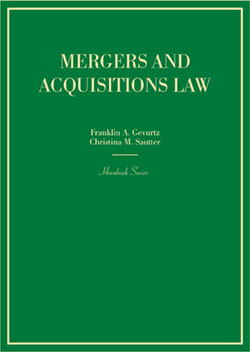
image from images.westacademic.com

West Academic Publishing has just released a new mergers and acquisitions hornbook co-authored by dear friends and business law prof colleagues Frank Gevurtz and Christina Sautter.  I had known that the book was in the offing, but I just got a note from Frank on Saturday confirming its publication and availability.  Here is the synopsis from West:

Gevurtz & Sautter’s Hornbook on Mergers and Acquisitions provides a comprehensive exploration of this important topic. Written in a casual style designed to engage the reader, the book clarifies and critiques critical doctrine. In addition to covering corporate laws governing mergers and acquisitions, the book explores securities, tax, and antitrust laws, as well as addressing the business, financial, and practical lawyering aspects of mergers and acquisitions.

I know these two to be folks with solid backgrounds and interesting insights in this area.  I have requested my online review copy.  Perhaps some of you will want to do that, too.  And for those without that privilege who want this in their libraries, you can get it by clicking on the West Academic Publishing link at the beginning of this post or purchase it on Amazon here.

Having just finished another semester of teaching a course required of all University of Oklahoma undergraduate business majors, the Legal Environment of Business (an introduction to business law), I wanted to share a few thoughts about why I have really enjoyed teaching business law in a business school.

When I taught Banking and Financial Institutions Law and Regulation in a law school, I loved when a student commented that my excitement for the topic had sparked their interest in the subject matter too.  Of course, such students were already generally attracted to the study of law!  I now occasionally have the joy of hearing that my enthusiasm for business law has sparked an undergraduate student’s interest in going to law school (they’d better take Banking!), and the excitement of knowing that I’ve potentially helped the student decide upon a professional direction. 

Like my students, I’ve found the Legal Environment of Business course to be challenging.  Teaching this course has definitely furthered my growth as a teacher.  In thinking of how best to engage students in the subject matter, I’m always searching for creative pedagogical approaches.  I’ve constructed in-class games such as “Procedural Trivia,” in which student teams compete