
September 2019

BLPB2019(MergerPanel)

I want to follow on Colleen’s post from yesterday with my own Business Law Prof Blog Symposium commentary.  But first, I want to thank Colleen, Ben, Josh, Doug, Haskell, and Stefan for participating with me in the symposium this year.  Our continuing legal education attendees, as well as our faculty and students, love this symposium each year.  It always turns out to be a wonderful pot pourri of business law topics that literally connect the threads of what we do as business lawyers and business law educators.

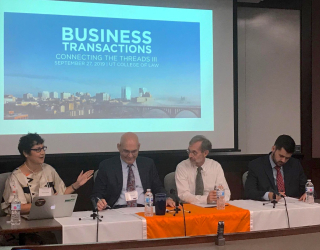
Rather than being a featured presenter this year, I chose to present panel-style with two of my UT Law colleagues.  (That’s us, plus our student commentator, Dixon Babb, in the photo above.  Thanks for capturing that, Haskell!)  The panel was designed to describe different conceptions of mergers based on distinct areas of legal expertise, together with related professional responsibility commentary.  I chose my colleagues Don Leatherman and Tom Plank to join me for this session–Don a tax law practitioner and teacher and Tom a property law practitioner and teacher.  The reason for these choices was simple: the three of us had covered this issue before in an informal conversation, and I had found

Call for Proposals – Feminist Judgments: Rewritten Corporate Law

DEADLINE: Friday November 1, 2019

The U.S. Feminist Judgments Project seeks contributors of rewritten judicial opinions and private contracts, and commentaries on rewritten opinions and contracts, for an edited collection tentatively titled Feminist Judgments: Rewritten Corporate Law.  This edited volume is part of a collaboration among law professors and others to rewrite, from a feminist perspective, key judicial decisions in the United States.  The initial volume, Feminist Judgments: Rewritten Opinions of the United States Supreme Court, edited by Kathryn M. Stanchi, Linda L. Berger, and Bridget J. Crawford, was published in 2016 by Cambridge University Press.  Cambridge University Press has approved a series of Feminist Judgments books. In 2017, Cambridge University Press published the tax volume titled Feminist Judgments: Rewritten Tax Opinions. Other volumes in the pipeline include rewritten opinions in the areas of reproductive justice, family law, torts, employment discrimination, trusts and estates, and health law. More information about the project can be found at https://law.unlv.edu/us-feminist-judgments.

Corporate law volume editors are Anne Choike, Usha R. Rodrigues and Kelli Alces Williams. The corporate law volume’s advisory panel is comprised of Alina Ball; Lisa Fairfax; Theresa Gabaldon; Joan

The Kelley School of Business at Indiana University is hiring legal studies professors. Details about the positions below. 

———–

Tenure-Track Position(s)

The Kelley School of Business at Indiana University seeks applications for a tenured/tenure-track position or positions in the Department of Business Law and Ethics, effective fall 2020. The candidate(s) selected will join a well-established department of 25 full-time faculty members who teach a variety of courses on legal topics, business ethics, and critical thinking at the undergraduate and graduate levels. It is anticipated that the position(s) will be at the assistant professor rank, though appointment at a higher rank could occur if a selected candidate’s record so warrants. 

To be qualified, a candidate must have a J.D. degree (or equivalent terminal law degree) with an excellent academic record and must demonstrate the potential for outstanding teaching and research in law and/or ethics. We seek applicants with research and teaching interests across a broad range of law and ethics issues in business, and we would be pleased to receive applications from scholars whose research or teaching interests intersect with issues of racial, ethnic, and gender diversity and equity in corporate and work environments (including but not limited to corporate board

On Friday, I attended and spoke at my first BLPB Symposium: Connecting the Threads III.  I learned a ton from listening to the presentations of my co-bloggers, the faculty and student responses to each presentation that followed, and questions from the engaged audience.  It was a great event made possible by the hard work of the U. of Tennessee College of Law student editors and staff of Transactions: The Tennessee Journal of Business Law.  In particular, Colleen Conboy and Tanner Hamilton did an excellent job of organizing the event, and co-blogger Joan Heminway and her faculty colleague George Kuney, the Director of the Clayton Center for Entrepreneurial Law and Lindsay Young Distinguished Professor of Law, also deserve thanks and kudos for their involvement!  I can’t wait for next year!

My presentation, Banking on the Cloud, shared its title with my Symposium paper (w/David Fratto and Lee Reiners).  Professor Gary Pulsinelli and law student Savannah Darnall commented – big thank you to both!  My remarks began by noting that this title referred to two important realities: 1) the amount of financial industry outsourcing to cloud service providers (the big three: Amazon Web Services, Microsoft Azure

Friend-of-the-BLPB Seth Oranburg informs me that the call for papers is now open for the #Futurelaw 4.0 Junior Faculty Workshop, offering newer scholars the opportunity to present and respond to research and writing in law-and-technology areas of endeavor.  Details (including how to apply for inclusion) are available at www.duq.edu/future-law-4.  The workshop is to be held on November 22, 2019.  Submissions are due on October 14, and complete drafts are due on November 8.  

Please spread the word quickly!  This sounds like an exciting opportunity, but there is a short fuse on applications.

There is a lot going on in VC Slights’s new opinion in Tornetta v. Musk,  refusing to dismiss a shareholder suit challenging Elon Musk’s eye-popping compensation package.

In Kahn v. M&F Worldwide Corp., 88 A.3d 635 (Del. 2014) (“MFW”), the Delaware Supreme Court held that, in the context of a squeeze-out merger, controlling shareholders can obtain business judgment review – rather than entire fairness – if they employ the dual protections of requiring the affirmative vote of a majority of the disinterested shares, and requiring that the deal be negotiated at the outset by a fully-empowered independent board committee.

Since then, there have been a lot of questions about MFW’s application, including whether MFW can/should be employed beyond the context of squeeze outs, which brings us to Tornetta.

Last year, Tesla granted Elon Musk a new compensation package that would award him as much as $55 billion in Tesla stock options, conditioned on achieving certain milestones.  The package was approved by a vote of the unaffiliated Tesla stockholders, but did not satisfy the full set of MFW preconditions (i.e., it was not negotiated by an independent committee, etc).  Thus, Tornetta filed a lawsuit challenging the award on the ground that (1) Musk is a Tesla controlling shareholder (2) the award is therefore an interested transaction subject to review for fairness and (3) the award was unfair.  The claims were brought both directly and derivatively.

Now, the first interesting thing about this case is the number of issues that could have been raised on the motion to dismiss, but were not (though defendants may still raise them later).

Defendants could have, but did not, dispute that Musk was a controlling shareholder (likely because VC Slights previously concluded he was in a case challenging the Tesla/SolarCity merger – I’ll come back to that).

Defendants could have, but did not, dispute that the directors who approved the package were dependent on Musk.

Directors could have, but did not, move to dismiss for failure to make a demand on the board (more on that below).

Directors could have, but did not, move to dismiss on the ground that the claim could not be maintained as a direct action (again, more below).

As a result, the narrow question before Slights was simply whether stockholder approval alone can cleanse a compensation award to a controller, or whether instead MFW procedures are required.  And he held that MFW procedures are always required when a controller’s interests conflict with those of the minority.

[More under the jump]

Chapter 5 in Elizabeth Chamblee Burch’s Mass Tort Deals brings together so many things.  It’s got arbitration, securities filings, banks, conflicts of interest, and so much more. (You can see some of the prior posts on this here.)

Let’s start with arbitration.  Burch gets the reality that arbitration contracts today are essentially imposed on the public by more powerful businesses.  She’s also correct that these agreements essentially cause the law to slowly, wither and lose its influence.  I’ve written about this and compared it to a dark shadow.  As arbitration supplants judicial resolution, industries insulate themselves from the threat of negative court rulings.  This procedural structure may allow bad practices to go on for far longer than they would have if courts actually decided cases.  It may also perpetuate injustices within arbitration forums.  Defendants may even argue that a claim should be denied because no precedent supports it.  Yet the precedent cannot come into existence if an industry has entrenched itself with arbitration provisions.  The lack of any precedent for relief should not doom claims in instances where courts can only rarely rule.

Mass tort settlement deals essentially shunt victims into a private dispute resolution world full of

[NOTE: You should see embedded Tweets. If you don’t, please try a different browser.]

The University of Idaho College of Law seeks to fill a tenure-track or tenured faculty position beginning in the Fall of 2020 in the area of Commercial Law for its Moscow location. Both entry-level and lateral candidates are encouraged to apply. In addition to courses in Sales and Property Security, the faculty member will be expected to teach two additional courses – which may include Bankruptcy, Payment Systems, Real Estate Transactions, and/or State Debtor-Creditor Law – according to the interest of the faculty member and the needs of the College of Law. Candidates must have (1) a J.D. from an ABA-accredited school or the equivalent; (2) a distinguished academic record; (3) a record or the promise of teaching excellence; (4) a record or the promise of scholarly productivity; and (5) a record or the promise of expertise in the area of Commercial Law. Preference will be given to candidates with (1) post-J.D. practice, clerking, or teaching experience; and (2) post-J.D. experience related to Commercial Law and other courses listed above. Situated in the beautiful Pacific Northwest, the University of Idaho is a comprehensive research institution. Information about the College of Law is available on its website at https://www.uidaho.edu/law. Interested

This past week, Dr. Robert Engle, the 2003 Nobel Laureate in Economics and Michael Armellino Professor of Management and Financial Services at the NYU Stern School of Business, spoke at the University of Oklahoma in the Deane and Ginger Kanaly Lecture Series at the Michael F. Price College of Business and in our Energy and Commodities Finance Research Conference

Engle’s Kanaly Lecture focused on the work of Stern’s Volatility Institute (V-Lab), which he directs.  Specifically, he spoke at length about a measurement of systemic risk termed “SRISK.”  Systemic risk is generally understood to be the risk that the collapse of a financial institution or market will trigger domino-like collapses throughout financial markets and the broader economy.  SRISK measures the capital shortfall of a firm conditional on a severe market decline, and is a function of its size, leverage and riskSRISK can be used not only to measure capital shortfalls in firms, but also undercapitalization of a country or global financial system.  It forecasts how much capital a firm (country or global system) would need to raise were a crisis to occur and, naturally, leads to questioning savings sufficiency.  It asks: how prepared is a