
March 2021

“Peer assessment score” – the opinion of deans and certain faculty about the overall quality of a law school – accounts for 25% of a school’s score in the U.S. News ranking. It is the most heavily weighted item. Bar passage, for comparison, is just a bit over 2%. When told this my pre-law students almost inevitably say — “why would I care what deans and faculty at other schools think?”  

Below are the 25 schools that have the lowest peer assessment relative to overall rank and the 25 schools with the highest peer assessment relative to overall rank. Tier 2 schools are not included because they do not have a specific overall rank. TaxProfBlog provided the data

I am not unbiased here. I teach in the business school at Belmont University, and our law school has the biggest negative gap between peer assessment and overall rank. There are some reasonable reasons for this gap — e.g., the school is young (the law school founded in 2011, though the university was founded in 1890) and a lot of deans/faculty may not know that the law school is doing well on incoming student credentials, bar passage
As a teaser to a forthcoming article I coauthored with two of my students (who co-presented with me) for the Business Law Prof Blog symposium back in the fall, I offer a short excerpt on business interruption insurance litigation resulting from governmental actions forcing business closures as a result of the pandemic, focusing on a recently decided Tennessee case.

In general, business lawyers got inventive in bringing legal claims of many kinds. A federal district court case recently decided in Tennessee, Nashville Underground, LLC v. AMCO Insurance Company, No. 3:20-cv-00426 (M.D. Tennessee, March 4, 2021), offers a notable example involving the interpretations of a business interruption insurance policy. The plaintiff in the action, a Nashville bar, restaurant, and entertainment venue, claimed coverage under the food contamination endorsement in its business interruption insurance policy for the damages suffered when it was forced to close its doors by governmental orders issued in March 2020 in response to the COVID-19 pandemic. The insurer denied coverage. The court held for the defendant insurer on its motion to dismiss for failure to state a claim, finding the contract language unambiguous. The court’s conclusion in its opinion noted sympathy, in spite of the outcome.

Like

This past Friday and Saturday, The Tobias Leadership Center at Indiana University, the Center for Legal Studies and Business Ethics at the Spears School of Business at Oklahoma State University, and the American Business Law Journal hosted the online symposium “Ethical Leadership and Legal Strategies for Post-2020 Organizations.”  I wanted to share with readers the program slides Download 2021-Symposium-Slides for “details of the interesting topics and diverse approaches that were taken to the symposium’s theme.” 

The American Business Law Journal anticipates publishing a special issue on the symposium’s theme.  I’ll be sure to keep readers posted!

This week, I offer brief comments on a couple of different things:

1.  I’ve previously blogged about courts that stretch the definition of “forward-looking statement” in order to preclude defendants from claiming the protections of the PSLRA safe harbor.  But probably the more common scenario runs in the other direction.  Behold Police and Fire Retirement System of Detroit v. Axogen, 2021 WL 1060182 (M.D. Fla. Mar. 19, 2021), where the plaintiffs alleged that Axogen claimed that the potential demand for its medical products was very large because of the sheer number of nerve repair surgeries performed every year in the U.S.  As it turned out, far fewer surgeries were performed annually; in effect, the plaintiffs argued that Axogen overstated the size of its market.  Here’s what the court said in its dismissal order:

Plaintiff … [focuses] in particular on statements made in Axogen’s offering materials and elsewhere that a certain number of people in the United States “each year…suffer”  traumatic PNI [peripheral nerve injuries], which “result in over 700,000 extremity nerve repair procedures,” and that “[t]here are more than 900,000 nerve repair surgeries annually in the U.S.”  Plaintiff argues these statements refer to “present existing

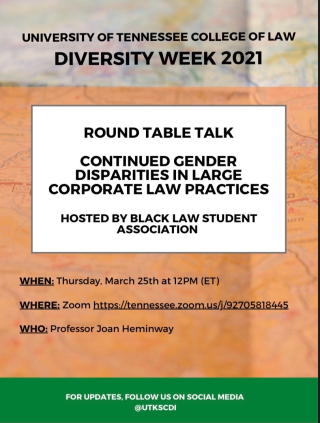
Yesterday, I had the honor of leading a roundtable discussion on women and the practice of business law.  The roundtable was part of a series convened by UT Law’s Student Council on Diversity and Inclusion, and this specific roundtable was hosted by our Black Law Student Association.  Here’s the promotional flyer from the event.

SCDIRoundtableAnnouncement

In preparing for the session, I had occasion to review two ABA reports from the past few years: Roberta D. Liebenberg & Stephanie A. Scharf, Walking Out The Door : The Facts, Figures, and Future of Experienced Women Lawyers in Private Practice (ABA 2019), and Destiny Peery, Paulette Brown & Eileen Letts, Left Out or Left Behind: The Hurdles, Hassles, and Heartaches of Achieving Long-term Legal Careers for Women of Color (ABA 2020). I was reminded of the fall-off in female lawyers in BigLaw over the course of their careers.  Quoting from the first report:

BigLaw is no stranger to the loss of experienced women attorneys. While entering associate classes have been comprised of approximately 45% women for several decades, in the typical large firm, women constitute only 30% of non-equity partners and 20% of equity partners. Women lawyers face many other challenging hurdles

Earlier today, a number of law school securities clinics met online with the SEC thanks to its Office of the Investor Advocate to talk about what they have been seeing in their cases.  By the most recent count, we’re down to only about 12 securities clinics nationwide.  Jill Gross has written about these disappearing clinics.  In my role, I teach business organizations, securities regulation, professional responsibility, and also offer a clinic from time to time.  At UNLV, clinics are not always offered every semester because our faculty also teach other courses.  With the need to turn a clinic on and off, I can’t run the kind of investor protection clinic I ran when I was at Michigan State because the cases just don’t wrap up in a semester.  Although we’ve done it in the past at UNLV with good results for clients and students, it’s not something that works well without attorney support to carry the cases and provide broader assistance when we’re not in session.  With that in mind, we’ve offered a “Public Policy”clinic here this semester with a focus on helping non-profits in preparing comment letters and advocating for their own goals.  This new offering focuses mostly on

I always learn a ton in reading Professor Julie Andersen Hill’s banking articles.  A TON!  Hence, I’m excited to see that she recently posted her new piece, Cannabis Banking: What Marijuana Can Learn from Hemp (forthcoming 2021, Boston University Law Review).  This is her second article on cannabis banking, the first being an excellent symposium piece, Banks, Marijuana, and Federalism.  As both houses of Congress have recently reintroduced the SAFE Banking Act, these articles couldn’t be more timely.  Here’s the abstract for Cannabis Banking:

Marijuana-related businesses have banking problems. Many banks explain that because marijuana is illegal under federal law, they will not serve the industry. Even when marijuana-related businesses can open bank accounts, they still have trouble accepting credit cards and getting loans. Some hope to fix marijuana’s banking problems with changes to federal law. Proposals range from broad reforms removing marijuana from the list of controlled substances to narrower legislation prohibiting banking regulators from punishing banks that serve the marijuana industry. But would these proposals solve marijuana’s banking problems?

In 2018, Congress legalized another variant of the Cannabis plant species—hemp. Prior to legalization, hemp-related businesses, like marijuana-related businesses, struggled with banking. Some hoped legalization would solve

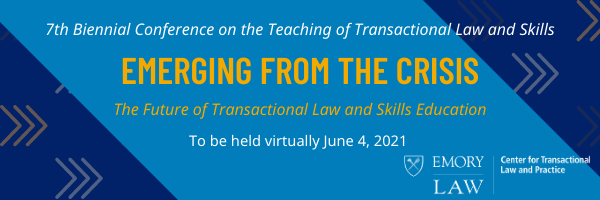
EmoryConference2021

Registration is Open!

It is our great pleasure to announce that registration is now open for the seventh biennial transactional law and skills education conference to be held virtually on June 4, 2021. Please join us to celebrate and explore our theme – Emerging from the Crisis: The Future of Transactional Law and Skills Education with you. This year, we have reduced the registration fee to $50 per person. Secure your space today!

Call for Proposals

Please take a moment to review the Call for Proposals and submit your proposal here. Also, please share the CFP with your colleagues who may not have attended the Conference before. Consider forwarding it to adjuncts and professors teaching relevant subjects. Can you also think of any teachers who might be interested in attending or presenting?

The Call for Proposals deadline is 5 p.m. April 15, 2021. We look forward to receiving your proposals.

Last, but certainly not least, at this year’s Conference, we will announce the winner of the second Tina L. Stark Award for Teaching Excellence. Would you like to nominate yourself or a colleague for this award? More information will be forthcoming regarding award eligibility and the nomination

A speculative frenzy appears to have taken hold of markets, extending to everything from GameStop shares to sports cards and anything blockchain (again).  Caught up in the mania are SPACs – specifically the blank-check firms trading before an acquisition target has been identified.

The difficulty, as the Financial Times recently reported, is that retail shareholders caught up in the SPAC craze aren’t necessarily interested in voting their shares when it comes time to consummate a merger.  Worse, a large number of them may have sold their shares after the record date, leaving no one to actually cast the ballot.

Which is why Switchback Energy Acquisition Corporation recently issued the most extraordinary press release:

  • Stockholders as of the Close of Business on December 16, 2020 Should Vote Their Shares Even if They No Longer Own Them

Switchback Energy Acquisition Corporation (NYSE: SBE) (“Switchback”) today announced that it convened and then adjourned, without conducting any other business, its virtual Special Meeting of Stockholders to February 25, 2021 at 10:00 a.m., Eastern time (the “Special Meeting”), to allow for more time for stockholders to vote their shares to reach the required quorum and approve the required proposals….

Switchback has

The University of Connecticut School of Business hosts The Business and Human Rights Initiative, which “seeks to develop and support multidisciplinary and engaged research, education, and public outreach at the intersection of business and human rights.” Professor Stephen Park, Director of the Business and Human Rights Initiative, invited me to be a discussant at the most recent meeting of the Initiative’s workshop series. The workshop focused on Rachel Chambers’ and Jena Martin’s excellent paper, A Foreign Corrupt Practices Act for Human Rights. Here’s an abstract:

The global movement towards the adoption of human rights due diligence laws is gaining momentum. Starting in France, moving to the Netherlands, and now at the European Union level, lawmakers across Europe are accepting the need to legislate to require that companies conduct human rights due diligence throughout their global operations. The situation in the United States is very different: on the federal level there is currently no law that mandates corporate human rights due diligence. Civil society organization International Corporate Accountability Roundtable is stepping into the breach with a legislative proposal building on the model of the Foreign Corrupt Practices Act to prohibit corporations from engaging in grave human rights