
August 2024

Last month I had the privilege of presenting some of my current work at Bocconi University in Milan, Italy.  The promotional poster for the event is included below. All of the workshop presentations (present company excepted) were engaging.

I presented on part of an ongoing research project–a series of papers on environmental, social, and governance (ESG) information.  The first two papers on the series, The Materiality of ESG Information: Why It May MatterT, 84 LSU L. Rev. 1365 (2024), and ESG and Insider Trading: Legal and Practical Considerations, 26 U. Penn. J. Bus. L. __ (forthcoming 2024), address the significance of ESG information under the U.S. federal securities laws and the potential and actual involvement of ESG information in insider trading.  In Milan, I shared my ideas and preliminary research for a third paper currently titled Corporate Information Compliance in an ESG World.  I expect to turn to work on this paper in earnest in the coming months.  I will briefly lay out my current thoughts here in the hope that you may have some feedback.

ESG information plays a role in many business operational settings that are invoked in legal compliance and addressed in compliance policies
AALS Section on Agency, Partnerships, LLCs, and Unincorporated Associations

Calls for Papers

The AALS Section on Agency, Partnerships, LLCs, and Unincorporated Associations is pleased to announce two calls for papers, one for a panel presentation and one for a works-in progress session geared to workshopping the research and writing of junior faculty.

Panel Presentation:

Up to three paper presenters will be selected for the section’s principal panel to be held during the AALS 2025 Annual Meeting in San Francisco, CA. The program is entitled Technology’s Intersection with Agency, Partnerships, and Unincorporated Associations. Co-Sponsored by the Sections on Technology, Law and Legal Education and Transactional Law and Skills, the session is designed to explore research and teaching involving the interactions of principal/agent relationships, partnerships, and unincorporated business associations with artificial intelligence, blockchains, cybersecurity, and other technological developments.

Works-in-Progress Session:

The section seeks paper proposals from junior scholars for a works-in-progress program.  Submissions for this session may relate to any topic within the scope of the law governing agency, partnerships, LLCs, or unincorporated associations.

Submission Information: 

To respond to either or both calls for papers, please submit a substantial abstract (five or more pages) or draft of an unpublished paper to

Two job announcements, early career and later stage:

Tulane University Law School invites applications from entry-level and early career lateral candidates (less than three years of tenure-track teaching experience) for one or more tenure-track faculty positions.  We welcome applications from candidates with teaching and research interests in all topics, but we are particularly interested in candidates who focus on maritime law and the first year curriculum: civil procedure, contracts, property, and torts. Please direct any questions about this position to Freddy Sourgens at fsourgen@tulane.edu. To learn more about the law school, visit our website at https://law.tulane.edu/. Interested applicants may apply at the following link: http://apply.interfolio.com/150799.

Tulane University is committed to creating a community and culture that foster a sense of belonging for all. We are a recognized employer and educator valuing AA/EEO, Protected Veterans, and Individuals with Disabilities. We encourage all qualified candidates to apply. We are intentionally seeking candidates who contribute to fostering equity, diversity, and inclusion in support of Tulane’s strategic initiatives.  

Also:

Tulane University Law School seeks to fill these faculty positions:

Houck Chair in Environmental Law (and Director of the Center for Environmental Law)
Niels F. Johnsen Chair in Maritime Law
David Boise

The Southern Illinois University Simmons Law School is searching for three tenure-track professors to join us next fall. The successful candidates will teach doctrinal law courses. Current needs include Criminal Law, Criminal Procedure, Evidence, Business Courses, Contracts, Labor & Employment, Family Law, and Trust & Estates. Other courses are dependent on the needs of the institution and the candidate’s experience. 

See the position description for additional information.

THE OHIO STATE UNIVERSITY MORITZ COLLEGE OF LAW

Location: Columbus, OH

Subjects: Contracts, Intellectual Property, Business Law, Constitutional Law Start Date: August 15, 2025

The Ohio State University Moritz College of Law seeks to hire up to two entry-level or lateral candidates for positions in Private Law (especially contracts, intellectual property, and business law and complementary areas, including securities regulation, corporate finance, and tax) and Public Law (especially constitutional law and complementary areas).

The Ohio State University’s Shared Values include Excellence and Impact, Diversity and Innovation, Inclusion and Equity, Care and Compassion, and Integrity and Respect. Ouruniversity community welcomes differences, encourages open-minded exploration and courageous thinking, and upholds freedom of expression. We define diversity broadly andvalue multiple dimensions of diversity, including, but not limited to, demographic, religion, country of origin, perspective, ability status, and background.

Ohio State prides itself on welcoming a wide range of viewpoints and providing opportunities for all to deepen and develop their intellectual curiosities. As a land-grant university, werecognize and understand that a diverse faculty, staff, and student body in which all may engage in open dialogue, be exposed to new ideas and perspectives, belong, and feel valuedand included is essential to our efforts in meeting

Previously, I blogged about Mivtachem Insurance v. Furtarom, 54 F.4th 82 (2d Cir. 2022), where the Second Circuit held that false statements about a target company – most of which were included in the acquiring company’s S-4 – were not made “in connection with” sales of the acquirer’s securities, and therefore, purchasers of the acquirer’s stock did not have standing to bring Section 10(b) claims against target company officers.

Inevitably, the same thing came up in a pair of cases about SPACs, where purchasers in the publicly-traded SPAC entity wanted to bring claims based on pre-merger false statements about the target company.  A New York district court, following Frutarom, denied the claims; a California district court rejected the Second Circuit’s reasoning (and dismissed the claims on other grounds, namely, that at the time of the false statements it wasn’t clear that the target company really was going to be a target company).

Anyway, the California case, which involved the Lucid de-SPAC, was just appealed to the Ninth Circuit and the Ninth Circuit … followed the Second Circuit’s rule.  In Max Royal LLC v. Atieva, it held:

As noted above, Blue Chip limits standing to “purchasers or

Wendy Gerwick Couture has posted a thoughtful article entitled, Nevadaware Divergence in Corporate Law.  It’s available here.  She presents some new perspectives on Nevada corporate law and emphasizes that Nevada has adopted a different policy balance than Delaware. She does this through three thorough sections analyzing exculpation, appraisal, and freeze-out mergers under both Nevada and Delaware law.  

This detailed focus gives some real insights.  She recognizes that many of the claims about Nevada exculpating for breaches of the duty of loyalty are overstated.  Nevada exculpates for breach of fiduciary duty under a single standard.  To the extent that any breach of the duty of loyalty involves any intentional misconduct, it would not be exculpated under Nevada law. It’s a much narrower category–unintentional breaches of the duty of loyalty–that may be exculpated under Nevada law.

She also recognizes that burden of proof differences in exculpation may shift outcomes.  Delaware places the burden of proof on a party seeking exculpation.  Nevada places the burden of proof on the party aiming to impose monetary liability.  This difference undoubtedly shifts litigation costs for many disputes.

If you’re interested in TripAdvisor case or other comparative corporate law issues, her work helps bring real

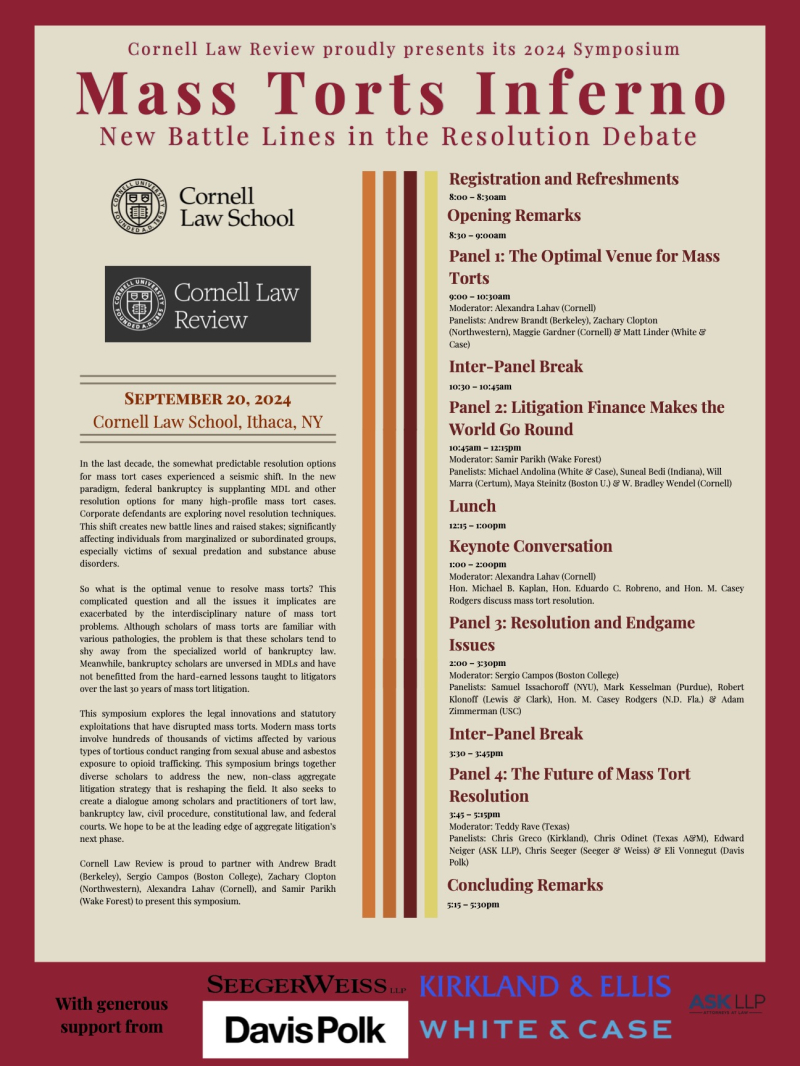
Cornell Law Review will be hosting its 2024 symposium, Mass Torts Inferno: New Battle Lines in the Resolution Debate, on September 20, 2024 in Ithaca, New York. Modern mass torts involve hundreds of thousands of victims affected by various types of tortious conduct ranging from sexual abuse and asbestos exposure to opioid trafficking. This symposium brings together diverse scholars to address the new, non-class aggregate litigation strategy that is reshaping the field. It also seeks to create a dialogue among scholars and practitioners of tort law, bankruptcy law, civil procedure, and constitutional law. The law review is proud to partner with Andrew Bradt, Sergio Campos, Zachary Clopton, Alexandra Lahav, and Samir Parikh to present this event.  

For those interested in attending, please contact Griffin Perrault at gp344@cornell.edu.

CornellPoster2024

Mississippi College School of Law invites applications from entry-level candidates for multiple tenure-track faculty positions expected to begin in July 2025. Our search will focus primarily on candidates with an interest in teaching one or more of the following subject areas: Real Property, Intellectual Property, Sports/Entertainment Law, and Cyber Law/Law & Technology.

We seek candidates with a distinguished academic background (having earned a J.D. and/or Ph.D.), a commitment to excellence in teaching, and a demonstrated commitment to scholarly research and publication. We particularly encourage applications from candidates who will enrich the diversity of our faculty. We will consider candidates listed in the AALS-distributed FAR, as well as those who apply directly.

Applications should include a cover letter, curriculum vitae, a scholarly research agenda, the names and contact information of three references, and teaching evaluations (if available). Applications should submitted using the following link: https://www.mc.edu/offices/human-resources/employment?rID[32]=389.

I am please to be able to publish this post authored by our former BLPB editor/co-blogger Stefan Padfield.  We miss his voice here, but he is doing good work in his current role, as this post shows!  Thanks for contributing this, Stefan.

+++++

On November 14, 2023, the National Center for Public Policy Research (NCPPR) – where I work – submitted a shareholder proposal to Johnson & Johnson that sought disclosures related to overboarding. (For the uninitiated, overboarding refers to the issue of corporate directors sitting on too many boards but can also be extended, as it is here, to other commitments.) On March 1, 2024, the SEC staff informed J&J that no action would be recommended against the company by the staff if J&J excluded NCPPR’s proposal. This no-action relief arguably represents a change in the long-standing SEC practice of supporting proposals related to overboarding and is thus worthy of further examination. (The underlying documents can be accessed here; the SEC staff also granted no-action relief to Verizon and Lowe’s on the same proposal.)

By way of background, the SEC staff is on record as saying that an overboarding proposal “relates to director qualifications.” Accordingly, the SEC