
Photo of Anne Tucker

Anne Tucker teaches and researches contracts, corporations, securities regulations, and investment funds.

Tucker’s research focuses on three areas of business law. The first is on the regulation and administration of funds (both public and private funds) and how pooled investments can achieve significant personal and social ends, such as retirement security and private funding for social entrepreneurship. Second, she focuses on impact investing and contract terms that reinforce impact objectives alongside financial returns. Third, she studies corporate governance, including the role of institutional investors as shareholders. Read More

Today marks the 4 year anniversary of the Citizens United decision and tomorrow marks the 41st anniversary of Roe v. Wade.  Corporations, the First Amendment, and Reproductive choice/freedom may have seemed like odd bed-fellows, but all three issues come together in the upcoming Hobby Lobby case challenging the application of access to birth control required under the health care law to a corporation whose owners oppose the extension on the grounds of religious freedom. 

Consider this a teaser on the issues offered up in the Hobby Lobby case.    Law professors are filing amicus briefs on this case coming down on either side of the issue.  One group arguing that religious views of the owners should not protect the corporation from complying and another arguing that the religious views of the owners can be imputed to the corporation and thus exempt it from compliance.  This is set to be a fantastically interesting issue, and hopefully one that will generate some healthy debate on this blog.  There will be more to come from me on this issue, but for now…consider this a teaser (or a place holder).

And if you crave more substance and internet sleuthing this afternoon, let me
(1) Corporate Disclosures, (2) Indirect Advocacy, (3) Climate Change, and (4) Institutional Investors 

The Union of Concerned Scientists, an alliance of more than 400,000 citizens and scientists, released a report today: Tricks of the Trade: How Companies Influence Climate Policy Through Business and Trade Associations.  The report is based on data collected by CDP, an international not-for-profit that “works with investors, companies and governments to drive environmental disclosure”.  CDP administers an annual climate reporting questionnaire to more than 5,000 companies worldwide with the support of various institutional investors (722 institutional investors with over $87 trillion in capital). The 2013 questionnaire asked companies about climate policy influence, including board membership in trade associations, lobbying, and donations to research organizations.

Tricks of the Trade highlights outsourced political influence through the use of trade associations and interest groups that lobby on behalf of their members rather than the members engaging in these activities in their own name.  The report highlights 3 main issues:  (1) lack of transparency, (2) incongruence with the outsourced message among responding companies, and (3) the continued role that the Citizens United decision has on corporate spending and political discourse.

 Transparency:

  • Of the 5,557 companies that received the

Francis G.X. Pileggi and Kevin F. Brady at Delaware Corporate & Commercial Litigation Blog closely track Chancery and Supreme Court cases out of Delaware.  Their annual Delaware round up, is always a top-notch, quick  and dirty summary of the year. If you haven’t kept up with the major cases, or want a quick reference when thinking about what developments to include in your classes this spring or next fall–then this list is for you.

Here are 2 additional cases that I have found noteworthy for some combination of scholarship, teaching and practice reasons:

1.  Chevron forum selection clause enforceability

Chancellor Strine’s opinion in Boilermakers Local 154 Retirement Fund v. Chevron Corp.,et al, upheld the enforceability of a Delaware forum selection clause unilaterally adopted by corporate boards of directors of Defendants.  Plaintiffs dismissed their appeal, and moved to dismiss their remaining claims in Chancery Court leaving intact Chancellor Strine strong support of forum selection clauses.  Chevron was preceded Chevron was preceded by National Industries Group (Holding) v. Carlyle Investment Managements LLC and TC Group LLC, a 2013 Delaware Supreme Court opinion, which addressed the contractual enforceability of forum selection clauses. 

2.  Huatacu Upholding waiver of dissolution rights when

From the posting:

The Louis D. Brandeis School of Law at the University of Louisville seeks to hire a visitor for the 2014-15 academic year.  Primary areas of curricular need are tax, decedents’ estates and related courses.  Other curricular needs may include commercial law and/or family law.  The visitor will teach four courses during the 2014-15 academic year.  Both entry-level and experienced applicants will be considered.  Salary will be commensurate with experience.

 The University of Louisville is located in Louisville, Kentucky.  Louisville is a city of 1.3 million with vibrant arts, educational, medical and business communities, and was named Lonely Planet’s Top US Travel Destination for 2013.  Information about the law school is available at the school’s website at http://www.law.louisville.edu/.  For further information about the school, or to apply, please contact Associate Dean for Academic Affairs Timothy S. Hall at hallt@louisville.edu or (502) 852-6830.

 The University of Louisville is an equal opportunity institution and does not discriminate against persons on the basis of race, age, religion, sex, disability, color, sexual orientation, national origin or veteran status.  Applications from individuals who will contribute to the diversity of our law school are encouraged.

The following information was shared with me by my friend, Professor Ciara Torres-Spelliscy at Stetson Law.  On February 28, 2014, Stetson Law in Gulfport, FLorida, will host: 

Taking Stock of Citizens United: How the Law Has (and Has Not) Changed Four Years Later.

Panel One: Quantifying the Problem of Money in Politics
Citizens United opened a new avenue for corporations and unions to spend in politics by purchasing political ads. This ability to spend was added to older avenues of political activity such as corporate and union segregated funds (SSFs or PACs), lobbying and direct contributions in certain states. The question of what political spenders get in return for this largess remains an open one.
 
Panel Two: The Risk of Corruption Collides with Free Speech
From a Constitutional law perspective, the courts have long wrestled with the placing political spending into a single paradigm. On one hand, courts have recognized that running for political office is costly and fundraising implicates First Amendment concerns such as the freedom of speech and association. On the other hand, campaign spending can be a corrupting force in the democratic process. Layered on top of this is an impulse by the courts to treat

Lyman Johnson, Robert O. Bently Professor of Law at Washington & Lee, has a new article out in the Delaware Journal of Corporate Law titled, Unsettledness in Delaware Corporate Law: Business Judgment Rule, Corporate Purpose.

Abstract:  This Article revisits two fundamental issues in corporate law. One — the central role of the business judgment rule in fiduciary litigation — involves a great deal of seemingly settled law, while the other — is there a mandated corporate purpose — has very little law. Using the emergent question of whether the business judgment rule should be used in analyzing officer and controlling shareholder fiduciary duties, the latter issue having recently been addressed by Chancellor Strine in the widely-heralded MFW decision, this Article proposes a fundamental rethinking of the rule’s analytical preeminence. For a variety of reasons, it is suggested that fiduciary duties should be made more prominent and the business judgment rule should be dramatically deemphasized. The policy rationales for the rule are sound, but they have no relevance for shareholders and introduce needless complexity. For directors, those rationales do not apply in the loyalty setting, and in the care setting, can be achieved by recalling simply that there is no substance to

In 13 Things We Learned about Money in Politics in 2013, written by Stetson Professor Ciara Torres-Spelliscy, numbers 9 and 10 highlight the intersection of corporate and campaign finance laws.

10. Disappointing nearly 700,000 members of the public who had asked for more transparency from public companies, the Securities and Exchange Commission (SEC) refused to require transparency for corporate political spending — for now.

9. Shareholder suits over corporate political spending bookended the year. In January, the Comptroller of New York sued Qualcomm, as a shareholder under Delaware law, to get their books and records of political spending. In December, the insurance giant Aetna was suedby a shareholder represented by Citizens for Responsibility and Ethics in Washington (CREW) for hiding its political spending.

To access the rest of the list and other campaign finance information provided by the Brennan Center for Justice, click here.

-Anne Tucker

The main question is whether or not the Fed will begin tappering its current bond buying policy which has been in place since 2008.  NPR did a quick and accessible print and radio story on the Fed and the issue of tappering.  Both versions of the story are available here.  I’ve also posted on this blog before on the issues facing the Fed as leadership is about to change hands.

Watch it live at 2:30 pm today here.  

[editted today at 3:15]– Summary of Fed Policy Announcements:

  • Fed will reduce (tapper) its bond buying program from $85 billion to $75 billion per month, with additional tapering expected as the economy continues to strengthen.
  • The policy at the Fed is dependent, in part, upon the rate of inflation, which has been running below the 2% benchmark.  “The [Fed] recognizes that inflation persistently below its 2 percent objective could pose risks to economic performance, and it is monitoring inflation developments carefully for evidence that inflation will move back toward it objective over the medium term.”
  • Short-term interest rates are expected to hold steady through 2014 with some anticipated increase in 2015, especially if the unemployment rate falls

The National Business Law Scholars Conference (NBLSC) will be held on Thursday, June 19th and Friday, June 20th at Loyola Law School, Los Angeles. This is the fifth annual meeting of the NBLSC, a conference which annually draws together dozens of legal scholars from across the United States and around the world. We welcome all scholarly submissions relating to business law. Presentations should focus on research appropriate for publication in academic journals, especially law reviews, and should make a contribution to the existing scholarly literature. We will attempt to provide the opportunity for everyone to actively participate. Junior scholars and those considering entering the legal academy are especially encouraged to participate.

To submit a presentation, email Professor Eric C. Chaffee at eric.chaffee@utoledo.edu with an abstract or paper by April 4, 2014. Please title the email “NBLSC Submission – {Name}”. If you would like to attend, but not present, email Professor Chaffee with an email entitled “NBLSC Attendance.” Please specify in your email whether you are willing to serve as a commentator or moderator. A conference schedule will be circulated in late May.  More information is available here:  http://lls.edu/resources/events/listofevents/eventtitle,81539,en/

Conference Organizers

Barbara Black (The University of Cincinnati College of Law)

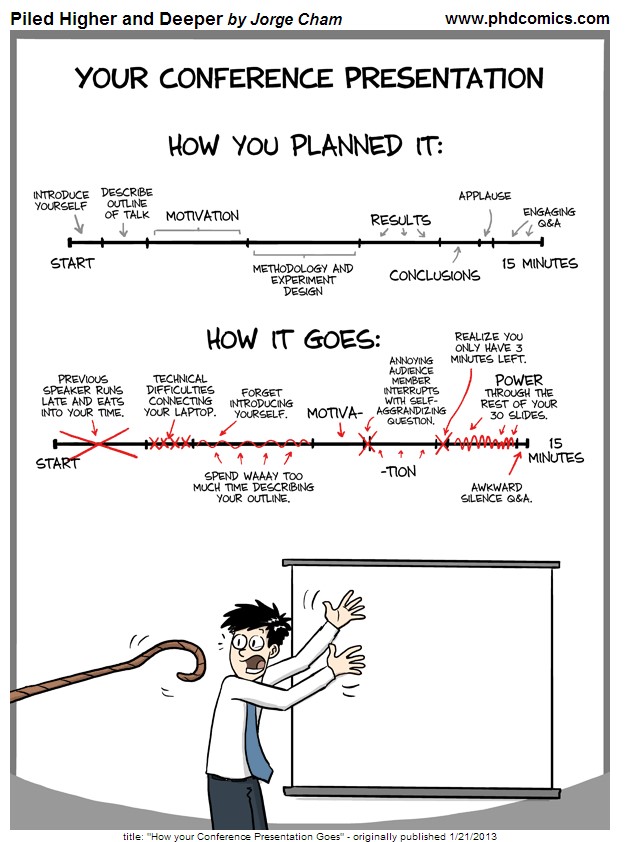
With winter break nearly upon us this means grading, writing projects, and possibly some conference travel with the upcoming AALS annual meeting.  I plan on putting together my AALS talk (on incorporating experiential exercises in teaching LLCs) next week, and have drawn inspiration from the following image:

Conference Image

The Business Law programs are on Saturday, January 4th and are listed below. If you would like to highlight other programs, please respond in the comments, and I will add to the list.

  • The program will explore:  The … topic of effectively teaching LLCs.  
  • 2:00 pm – 3:45 pm Business Associations
    The Value Proposition for Business Associations in Tomorrow’s Legal Education
  • The panel will be exploring: How does business associations teaching and scholarship contribute to the U.S. program of legal education?  How could or should it contribute?  What role does the basic law school course on business associations play in an optimized law school curriculum?  What course content, pedagogy, and teaching tools best support that role?  How does business associations scholarship inform and support that role?    
  • 4:00 pm –