Photo of Haskell Murray

Professor Murray teaches business law, business ethics, and alternative dispute resolution courses to undergraduate and graduate students. Currently, his research focuses on corporate governance, mergers & acquisitions, sports law, and social entrepreneurship law issues.

Professor Murray is the 2018-19 President of the Southeastern Academy of Legal Studies in Business (“SEALSB”) and is a co-editor of the Business Law Professor Blog. His articles have been published in a variety of journals, including the American Business Law Journal, the Delaware Journal of Corporate Law, the Harvard Business Law Review, and the Maryland Law Review. Read More

The corporate form has been compared and contrasted favorably and unfavorably with government.  The literature is broad and deep.  Having said that, there is, perhaps, no one who writes more passionately on this topic than Daniel Greenwood.  Set forth below are two examples of text from his work that illustrate my point.

We live in a democratic age, in which the sole legitimate source of political power is the consent of the governed. Yet our business corporations defy every norm of democracy.
 
Most fundamentally, corporate law and our major business corporations treat the people most analogous to the governed, those most concerned with corporate decisions, as mere helots. Employees in the American corporate law system have no political rights at all—not only no vote, but not even virtual representation in the boardroom legislature. Board members owe a fiduciary duty to the corporation, according to most of the statutes, and to the shareholders, according to the popular shareholder primacy narratives, but they owe no consideration at all to employees.
 
Daniel J.H. Greenwood, Essay: Telling Stories of Shareholder Supremacy, 2009 Mich. St. L. Rev. 1049, 1060 (2009).
 
The corporation as a state-within-the-state . . . cannot be justified under any democratic theory, because this state-like entity defies all democratic norms internally. No corporation operates by the principle of one person, one vote. All economically significant corporations disenfranchise a substantial portion of the affected populace, while even shareholders vote according to the number of shares they hold. Moreover, standard corporate law sharply limits the control that even the “voters” have over “their” entity. The law bars them, in the absence of unanimous consent, from making fundamental value choices, for example, from balancing the pursuit of profit against other potential corporate goals, such as quality products, interests of non-shareholder participants or even the actual financial interests of the real human beings who own the shares. Moreover, it even bars them from electing directors pledged to particular interests: directors, unlike ordinary politicians, are bound by law to pursue the interests of all (and only) shares, and courts will enforce this duty-subject to the often significant limitations of the business judgment rule-at the behest of any shareholder, regardless of election results. Theorists, therefore, usually resort to market-based explanations of why the corporation is unable to exert any power over its shareholders, employees and other participants.
 
Daniel J.H. Greenwood, Markets and Democracy: The Illegitimacy of Corporate Law, 74 UMKC L. Rev. 41, 54–55 (2005) (footnotes omitted).  Whether you agree with Daniel or not on the substance, his views are transparent and his belief and energy are palpable.
 
With politics in the news every day and corporations on my mind, I have been pondering certain elements of democracy as they play themselves out in corporate governance.  In particular, of late, I have focused in on accountability as a core democratic norm.  

As some of you know (and as I noted in a prior post), I have taught from time to time in the past (and will be teaching again this fall) a course focusing on nonhuman animals and the law.  The course reveals, among many other things, that business law doctrine and practice have a number of significant intersections with nonhuman animals.  Although I am likely to say more on that later, the earlier post linked in above notes a few things.

Yesterday, I received the “Call for Papers and Features” reproduced below.  Many of the suggested topics–and the overall theme of “animal welfare in the context of human development”–engage business law.  In particular, agricultural business seems to be on the ends of the editors . . . .  Accordingly, I am posting the call thinking that some of our readers would be interested in knowing about this.

[Aside: I do not subscribe to the citation policy of the journal for the “features” being sought through this call–e.g., “Almost every sentence must be cited” and “If a sentence does not have a citation, you should have a good reason (i.e., it is your concluding argument or a recommendation).”  Unless those who established these requirements are confident that “features” otherwise meeting their requirements do not contain novel legal or policy arguments or recommendations, that pair of citation “requirements” is absurd, imv.]

*          *          *

Logo_sm

CALL FOR PAPERS AND FEATURES

The Sustainable Development Law & Policy Brief (SDLP) is currently accepting submissions for its Fall 2017 edition on topics related to animal welfare in the context of human development. Development will not be sustainable if animal welfare and human-animal relationships are not included in development programs, policies, and laws. Therefore, it is important to highlight the commonality between animal welfare issues and human justice issues.

If you would like to submit an article or feature for consideration, please contact us at sdlp@wcl.american.edu immediately. We will accept submissions on a rolling basis. The deadline for submissions is Monday, September 25, 2017. We will select up to four articles and four features for publication, and we will notify the Authors by Monday, October 2, 2017. Article Requirements differ from Feature Requirements – see below.

Topics may include but are not limited to:

§ Consumption of Species Versus Ecotourism in Developing Nations
§ Exploitation of Natural Fisheries and the Associated Issue of Bycatch
§ Challenges in Regulating Offshore Aquaculture
§ The Effects of Anthropogenic Noise on Marine Life
§ Going Meatless and Securing Food Sources: Moving Away from Concentrated Animal Feeding Operations and Meat Consumption
§ Socio-Economic Challenges in Shifting from Animal-Based Agriculture to Plant- Based/Non-Animal Based Agriculture
§ Intersection Between Concentrated Animal Feeding Operations and Environmental Justice
§ Habitat Loss and Deforestation from Agriculture
§ The Role of Financial Institutions in Animal Agriculture Projects
§ How to Move Toward a Global Animal Welfare Policy
§ Human Health Implications Associated with the Production and Consumption of Animal Products
§ Balancing Wildlife and Continued Land Exploitation in National Parks and Preserves
§ The Effects of Deep Sea Bed Mining on Marine Life

SDLP is available online at LexisNexis, Westlaw, VLex, Hein Online, and on our website at www.wcl.american.edu/org/sdlp.

It is also widely distributed at law and graduate schools, and to representatives of international organizations worldwide.

We reserve the right to reject submissions at any time or for any reason. We also reserve the right to hold all submissions on file for later publication and reserve the right to revise submissions and/or cut text. Authors will have the opportunity to accept or reject any revisions. SDLP accepts submission of timely articles that have already been published elsewhere, so long as permission of the previous publisher is received.

[Click on the “Continue reading” button below for the requirements for articles and features.]

ABABookCover

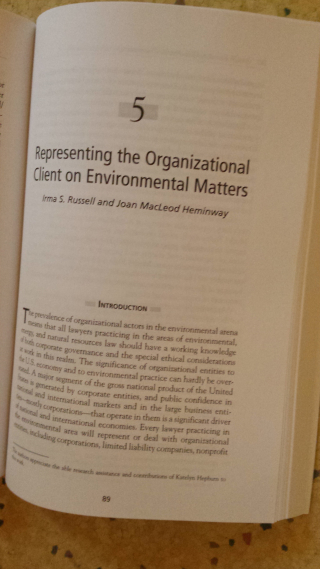
My good friend and long-time mentor Irma Russell and I wrote a chapter for the recently released ABA book, Ethics and the Environment: A Lawyer’s Guide.  Irma also is a co-editor of the book (with Vicki Wright).  In our joint contribution, the chapter entitled “Representing the Organizational Client on Environmental Matters,” Irma and I cover issues involving professional responsibility, corporate governance, and environmental compliance.  Guess which part was my primary responsibility . . . ?!)  Covering some 37 pages of the 242-page book, the rules we cover and the observations we make are fairly wide-ranging.  We hope, as we noted in our conclusion to the chapter, that we supply legal counsel representing corporations and other organizations with “foundational tools to assist them in providing advisory and advocacy-oriented services to organizational clients in the environmental law context.”  Irma and I received our copies last week.  The book soon will be available through the ABA and other outlets.

 
ABABookChapterPage

SaveSaveSaveSave

SaveSave

Last year, I was asked to contribute to a symposium on law and entrepreneurship hosted at the University of North Carolina.  Although I had to Skype in for my presentation from Little Rock, Arkansas (where I had just given a separate, unrelated CLE presentation), the panel to which I was assigned was fabulous.  Great scholars, with great ideas.

For my contribution to the symposium, I chose to reflect on the unfulfilled promise of the potentially mutually beneficial relationship between an entrepreneur and a business finance lawyer.  I recently posted the published work memorializing my thoughts on the topic, featured this spring with several other articles from the symposium in a dedicated edition of the North Carolina Law Review.  The brief abstract for my article follows:

Entrepreneurs have the capacity to add value to the economy and the community. Business lawyers—including business finance lawyers—want to help entrepreneurs achieve their objectives. Despite incentives to a symbiotic relationship, however, entrepreneurs and business finance lawyers are not always the best of friends. This Article offers several approaches to bridging this gap between entrepreneurs and business finance lawyers.

My hope in writing this article was to infuse some energy into conversations about the role

Save the Date!

The Yale Law School Center for Private Law will host a Private Equity Conference on November 17, 2017. The conference will bring leading theorists from law, economics, finance, and sociology into dialogue with people with experience at the highest levels of private equity, including from law practice, financial firms, and institutional investors.

Oliver Hart, winner of the 2016 Sveriges Riksbank Prize in Economic Sciences in Memory of Alfred Nobel, will give the keynote address.

Other speakers include:

Jon Ballis, Kirkland & Ellis
Rosemary Batt, Cornell University, ILR School
Neil Fligstein, UC Berkeley Sociology Department
Stephen Fraidin, Pershing Square Capital Management
Will Gaybrick, Stripe
Adam Goldstein, Princeton University Department of Sociology
Victoria Ivashina, Harvard Business School
Andrew Metrick, Yale School of Management
Meridee Moore, Watershed Asset Management
John Morley, Yale Law School
Alan Schwartz, Yale Law School
David Swensen, Chief Investment Officer, Yale University

Location: Yale Law School, 127 Wall St., New Haven, CT

Time: Approximately 9:45 a.m.-4:00 p.m.

Cost: There is no cost associated with this event, though pre-registration is required. Registration information will be available soon at this link

     Most LLC statutes provide an exclusive charging order remedy that creditors can use against a member’s interest.  A charging order is effectively a lien on the member’s transferable interest (i.e., the member’s financial rights) in the LLC.  If a court imposes a charging order, the judgment creditor is entitled to any distributions made by the LLC that would otherwise have gone to the debtor-member.  The entitlement to distributions continues until the judgment creditor has received enough proceeds to pay off the judgment.  The creditor is not permitted, however, to execute on a member’s interest in the same way that a creditor could normally execute on the debtor-member’s non-exempt personal property.  If the LLC does not make sufficient distributions, some statutes allow a court to order foreclosure of the charging lien, which effectively results in a sale of the debtor-member’s transferable interest.  Significantly, even with foreclosure, the purchaser at the foreclosure sale will only become a transferee and will not have the status of a member (nor the rights of a member).  This charging order scheme protects the rights of the non-debtor members to control the admission of new members to the LLC.

     In Olmstead v. Federal

Please forgive the self-promotion, but the Columbia Law School Blue Sky Blog recently published a blog post on my recent article with Professor Julie Hill, The Duty of Care of Bank Directors and Officers, 65 Ala. L. Rev. 965 (2017).

The blog post is reprinted below, and the link to the article is here:  https://ssrn.com/abstract=2965023

The 2008 financial crisis was catastrophic for the U.S. banking industry. Between 2007 and 2014, 510 banks failed. Another 700-plus banks received some type of federal monetary assistance. Unsurprisingly, this led to calls to hold bank directors and officers legally accountable for harm they may have caused.

One federal regulator with the power to hold directors and officers of failed banks financially responsible is the Federal Deposit Insurance Corporation (FDIC). The FDIC acts as a receiver for failed banks. It has authority to sue directors and officers for losses they caused to failed banks and has been aggressive in doing so.  Yet even as the FDIC brings director and officer suits, the standard of liability for breach of the duty of care in the banking setting is misunderstood.

Duty of care liability in non-bank corporations is typically governed by state statute and common law.

The University of Richmond School of Law invites submissions for the inaugural Mid-Atlantic Junior Faculty Forum. This workshop will be held on Wednesday, May 10 and Thursday, May 11, 2017 in Richmond, Virginia.

Overview

This new workshop will bring together junior law scholars to present their scholarship in an informal collegial atmosphere.  The workshop is timed to allow participants to incorporate feedback on early ideas or projects before the summer.  Papers and works-in-progress are welcome at any stage of completion.  To maximize discussion and feedback, the author will provide a brief introduction to the paper, but the majority of the individual sessions will be devoted to collective discussion of the papers. 

Richmond Law will provide all lunches and dinners for those attending the workshop, but attendees will cover their own travel and lodging costs.

Eligibility

All untenured law faculty at Mid-Atlantic law schools who have been teaching for ten years or less are eligible to participate.   Those who do not currently hold a permanent or visiting faculty appointment, but expect to do so beginning in fall 2017 are also welcome. 

Submission Procedure

If you would like to participate, please send an abstract of the paper you would like to present

Tulane Law School invites applications for a one-semester visiting position in the Fall of 2017. Our specific needs for the Fall 2017 semester include basic income tax and corporate tax, criminal law, and professional responsibility. Applicants must possess a J.D. from an ABA-accredited law school, strong academic credentials, and at least three years of relevant law-related experience; prior teaching experience is strongly preferred. Applicants should submit a letter of interest, CV, and the names and contact information of three references through Interfolio at https://apply.interfolio.com/40060. For additional information, please contact Onnig Dombalagian at odombala@tulane.edu.

Tulane University is an equal employment opportunity/affirmative action employer committed to excellence through diversity. All eligible candidates are invited to apply for position vacancies as appropriate.

Below are some resources related to the integration of faith and work stemming from businesses or business people.

Companies 

Organizations

Presentations 

Books and Articles