Photo of Haskell Murray

Professor Murray teaches business law, business ethics, and alternative dispute resolution courses to undergraduate and graduate students. Currently, his research focuses on corporate governance, mergers & acquisitions, sports law, and social entrepreneurship law issues.

Professor Murray is the 2018-19 President of the Southeastern Academy of Legal Studies in Business (“SEALSB”) and is a co-editor of the Business Law Professor Blog. His articles have been published in a variety of journals, including the American Business Law Journal, the Delaware Journal of Corporate Law, the Harvard Business Law Review, and the Maryland Law Review. Read More

My mind is still reeling from my trip to Lisbon last week to keynote at the Building The Future tech conference sponsored by Microsoft.

My premise was that those in the tech industry are arguably the most powerful people in the world and with great power comes great responsibility and a duty to protect human rights (which is not the global state of the law).

I challenged the audience to consider the financial price of implementing human rights by design and the societal cost of doing business as usual.

In 20 minutes, I covered  AI bias and new EU regulations; the benefits and dangers of ChatGPT; the surveillance economy; the UNGPs and UN Global Compact; a new suit by Seattle’s school board against social media companies alleging harmful mental health impacts on students; potential corporate complicity with rogue governments; the upcoming Supreme Court case on Section 230 and content moderator responsibility for “radicalizing” users; and made recommendations for the governmental, business, civil society, and consumer members in the audience.

Thank goodness I talk quickly.

Here are some non-substantive observations and lessons. In a future post, I’ll go in more depth about my substantive remarks. 

1. Your network
An ambitious question, yes, but it was the title of the presentation I gave at the Society for Socio-Economists Annual Meeting, which closed yesterday. Thanks to Stefan Padfield for inviting me.

In addition to teaching Business Associations to 1Ls this semester and running our Transactional Skills program, I’m also teaching Business and Human Rights. I had originally planned the class for 25 students, but now have 60 students enrolled, which is a testament to the interest in the topic. My pre-course surveys show that the students fall into two distinct camps. Most are interested in corporate law but didn’t know even know there was a connection to human rights. The minority are human rights die hards who haven’t even taken business associations (and may only learn about it for bar prep), but are curious about the combination of the two topics. I fell in love with this relatively new legal  field twelve years ago and it’s my mission to ensure that future transactional lawyers have some exposure to it.

It’s not just a feel-good way of looking at the world. Whether you love or hate ESG, business and human rights shows up in every factor and many firms have built

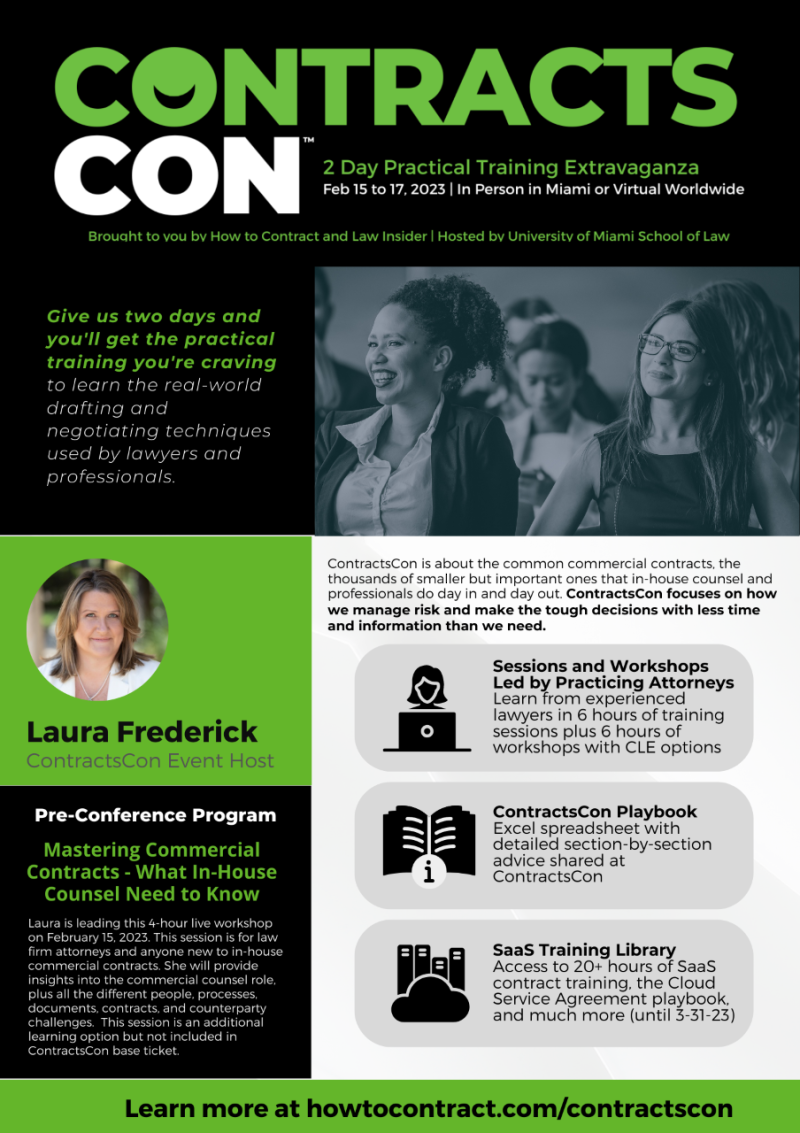
It’s the holidays and it’s time to treat yourself and members of your team to practical training and fantastic networking in sunny Miami in February. We don’t have bomb cyclones down here. The Transactional Skills Program at the University of Miami School of Law couldn’t be more excited to host the How to Contract Conference from February 15-17, 2023. 

Thumbnail_ContractsCon Flyer - 1 page (12-23-2022)

  • ContractsCon is a training and networking EXTRAVAGANZA focused on the practical contract drafting and negotiating skills that in-house counsel and contracts professionals need to know. 
  • This event is a zero-fluff, to-the-point training on the nitty-gritty details. ContractsCon includes:
    • speakers who get the in-house experience and can explain why we draft the way we do
    • training centered around provision-level playbooks for you and your company to use when you return to work
    • workshops that provide a deeper dive into more nuanced topics and include interactive group activities
    • ContractsCon Playbook, featuring the advice and drafting approaches discussed at ContractsCon
    • access to How to Contract’s SaaS Contracts Training Library, with 20+ hours of training videos, the Cloud Services Agreement Playbook, and lots more (through March 31, 2023)
    • CLE pending in 26 states for up to 7 hours for virtual ticket holders and up to 13 hours for in-person attendees
  • ContractsCon is an annual

I’m a huge football fan. I mean real football– what people in the US call soccer. I went to Brazil for the World Cup in 2014 twice and have watched as many matches on TV as I could during the last tournament and this one. In some countries, over half of the residents watch the matches when their team plays even though most matches happen during work hours or the middle of the night in some countries. NBC estimates that 5 billion people across the world will watch this World Cup with an average of 227 million people a day. For perspective, roughly 208 million people, 2/3 of the population, watched Superbowl LVI in the US, which occurs on a Sunday.

Football is big business for FIFA and for many of its sponsors. Working with companies such as Adidas, Coca-Cola, Hyundai / KIA, Visa, McDonald’s, and Budweiser has earned nonprofit FIFA a record 7.5 billion in revenue for this Cup. Fortunately for Budweiser, which paid 75 million to sponsor the World Cup, Qatar does not ban alcohol. But in a plot twist, the company had to deal with a last-minute stadium ban. FIFA was more effective in Brazil, which has

As much as I love being a professor, it can be hard. I’m not talking about the grading, keeping the attention of the TikTok generation, or helping students with the rising mental health challenges.

I mean that it’s hard to know what to say in a classroom. On the one hand, you want to make sure that students learn and understand the importance of critical thinking and disagreeing without being disagreeable.

On the other hand, you worry about whether a factual statement taken out of context or your interpretation of an issue could land you in the cross hairs of cancel culture without the benefit of any debate or discussion.

I’m not an obvious person who should be worried about this. Although I learned from some of the original proponents of critical race theory in law school, that’s not my area of expertise. I teach about ESG, corporate law, and compliance issues.

But I think about this dilemma when I talk about corporate responsibility and corporate speech on hot button issues. I especially think about it when I teach business and human rights, where there are topics that may be too controversial to teach because some issues are too close

Last month, I posted about an experiment I conducted with students and international lawyers. I’ve asked my law student, Kaitlyn Jauregui to draft this post summarizing the groups’ reasoning and provide her insights. Next week, I’ll provide mine in light of what I’m hearing at various conferences, including this week’s International Bar Association meeting. This post is in her words.

After watching The Social Dilemma, participants completed a group exercise by deciding which social issues were a priority in the eyes of different tech industry stakeholders. The Social Dilemma is a 2020 docudrama that exposes how social media controls that influences the behavior, mental health, and political views of users by subjecting them to various algorithms. Director Jeff Orlowski interviewed founding and past tech employees of some of the biggest companies in Silicon Valley to bring awareness to viewers.  

Groups of primarily American college students, primarily American law students, one group of Latin American lawyers, and one group of international lawyers completed the exercise. Each of the groups deliberated from the perspective of a CEO, investor, consumer, or NGO.  Acting as that stakeholder, the team then ranked the following issues in order of importance: Incitements to

I had originally planned to post Pt. 2 of the blog post I did a couple of weeks ago, but this announcement is time sensitive.

I’m thrilled to announce that the Transactional Skills Program at the University of Miami School of Law is partnering with Laura Frederick for the second How to Contract conference. It’s time sensitive because we are considering holding a side event with a contract drafting and negotiation competition for law students if there’s enough interest. If you think you would be interested, please email me at mweldon@law.miami.edu.

For lawyers, there are virtual and live options for the contract conference. I’ve cut and pasted from the website so you can see why you should come to sunny Miami (and it won’t be hurricane season):

It is not about the mega deals.

ContractsCon is about the contracts you work on EVERY DAY. We want to help you learn how to draft and negotiate the deals you see all the time.

Because for every 100-page specialized contract sent to outside counsel, there are thousands of smaller but important ones that in-house counsel and professionals do day in and day out.

ContractsCon focuses on how we manage risk and make the tough decisions with less

You can’t read the business press without seeing some handwringing about ESG. It’s probably why I’ve been teaching, advising, and sitting on a lot more panels about the topic lately. Like it or not, it’s here to stay (at least for now) so I decided to do a completely unscientific experiment on lawyer and law student perceptions of ESG using a class simulation. Over the past three months, I’ve used the topic of tech companies and human rights obligations to demonstrate how the “S” factor plays out in real life. I used the same simulation for foreign lawyers in UM’s US Law in Action program, college students who participated in UM’s Summer Legal Academy, Latin American lawyers studying US Business Entities, and my own law students in my Regulatory Compliance, Corporate Governance, and Sustainability class at the University of Miami.

Prior to the simulation, I required the students to watch The Social Dilemma,  the Netflix documentary about the potentially dangerous effects of social media on individuals and society at large. I also lectured on the shareholder v. stakeholder debate; the role of investors, consumers, NGOs, and governments in shaping the debate about ESG; and the basics

Millions of law school graduates around the US just took the bar exam. Others are preparing to enter colleges and graduates schools in a few weeks. How will these respective groups do? While a lot depends on how much and how well they study, a large part of their success or failure may depend on how they’ve been taught. I recently posted about how adults learn and what the research says we should do differently. In this post, I’ll show how I used some of the best practices in the last ten days when I taught forty foreign lawyers from around the world  and thirty college students in separate summer courses offered by the University of Miami as well as nine Latin American lawyers who were taking courses in business law from a Panamanian school. I taught these disparate groups about ESG, disclosures, and human rights. With each of the cohorts, I conducted a simulation where I divided them into groups to prioritize issues based on whether they were a CEO, an investor, a consumer, the head of an NGO, and for the US college students, I added the roles of a member of Congress or influencer. In a

IMG_4568

(Some neighborhood children playing duck-duck-goose in our common space on July 4th.)

Recently, I finished philosopher David McPherson’s book The Virtues of Limits published by Oxford University Press this year. While I disagree with McPherson in certain areas, I highly recommend his book. I was reacting to the book with friends and the author before I even completed it. Perhaps it would have been best to refrain from commenting until I had finished, but it was a sign that the book was quite thought-provoking. The book was well-written and accessible, even to a non-philosopher like me. 

Given that this post only has a loose connection to business law, I will place the remainder of my thoughts below the page break.