
I am proud to be presenting (alongside a stellar group of business law folks) at this symposium and honoring my friend and our wonderful colleague Jill Fisch. More information, including information on how to register to attend (if you are in the neighborhood) can be found here.

Materiality and the SEC’s Rulemaking Authority
Over the summer, friend-of-the-BLPB Bernie Sharfman posted a draft paper to SSRN that was the subject of a short colloquy between us. The paper, The Ascertainable Standards that Define the Boundaries of the SEC’s Rulemaking Authority, asserts, among other things, that materiality is one of three “ascertainable policy standards that Congress has placed in the Acts to guide the SEC’s rulemaking discretion.” The reasoning?
- “[T]here are multiple references to materiality in the Acts.”
- The SEC’s 1972 annual report avers that “[a] basic purpose of the Federal securities laws is to provide disclosure of material financial and other information on companies seeking to raise capital through the public offering of their securities, as well as companies whose securities are already publicly held.”
- “As observed by Professor Ruth Jebe, it is fair to say that materiality ‘constitutes the primary framing mechanism for financial reporting.'”
Bernie acknowledges that “there is no explicit statutory language in the Acts that forbids the SEC from promulgating rules requiring non-material disclosures.” I might add that nothing in either the Securities Act of 1933, as amended (“1933 Act”), or the Securities Exchange Act of 1934, as amended (“1934 Act”), explicitly limits the SEC’s rulemaking
Two Exciting Chair Opportunities at Brandeis (Louisville) Law!
Faculty Position (Harold Edward Harter Endowed Chair)
uofl.wd1.myworkdayjobs.com/en-US/UofLCareerSite/details/…
Position Description:
The University of Louisville’s Brandeis School of Law invites applications for the Harold Edward Harter Endowed Chair of Commercial Law, to commence July 1, 2024. The holder of the Harter Chair should have a well-established record of outstanding scholarship as well as teaching expertise in one or more areas of Commercial Law, consistent with the expectations of a tenured, full professor. The University of Louisville is a vibrant, intellectual community while Louisville is a thriving, major metropolitan city with a great legal market.
The Brandeis School of Law is committed to excellence in preparing lawyers for productive careers. The school boasts an excellent faculty with a deep commitment to teaching and academic support, and a low student-faculty ratio. Our smaller class sizes foster close interaction between students and faculty, nurture a culture of collegial learning, and provide opportunities for individualized attention. In addition to teaching excellence, our faculty is deeply committed to producing excellent scholarships and to community engagement. Our faculty boasts many engaged scholars.
The School of Law strives to promote collegiality and professionalism, and its culture is based on civility and respect for all students, faculty, and staff.
UConn Law Seeking Faculty
ASSOCIATE PROFESSOR OF LAW / PROFESSOR OF LAW
The University of Connecticut School of Law invites applications from entry-level and lateral candidates for two full-time, tenure-track, or tenured-at-hire faculty positions commencing in the fall of 2024. Although we will consider candidates with a range of curricular and scholarly expertise, subject areas of particular interest include criminal procedure, environmental and energy law, and taxation; we also have needs in civil procedure, constitutional law, cybersecurity, land use, professional responsibility, property, securities regulation, and trusts and estates. A successful candidate will have a record of professional accomplishments commensurate with an appointment at the rank of (1) Associate Professor (for entry-level candidates) or (2) Professor (for lateral candidates) with an opportunity for tenure-at-hire.
The UConn School of Law is especially interested in candidates who will add to the diversity of our faculty and community. We welcome applications from underrepresented groups and other candidates with experiences, backgrounds, and viewpoints that will enrich the diversity of our institution. UConn Law School is the top-ranked public law school in the Northeast, offering a professional education and scholarly environment of the highest quality. The School is committed to building and supporting a vibrant, multicultural, and diverse community of
How Do Law Partners Fare When Their Firms Fail?
Andrew Granato has posted his draft paper After the “Partner Run”: the Dewey & LeBoeuf Diaspora on SSRN. You can find it here. The abstract reads as follows:
“Partner runs” are a phenomenon distinctive to the American legal profession, a result of legal professional responsibility rules, partnership governance, and bankruptcy law that occasionally causes individual law firms to spiral into liquidation following unexceptional setbacks. It is unclear whether this idiosyncratic feature of law firm collapse can pose a threat to the industrial organization of the legal profession. Can lawyers easily recover and recreate the benefits of law firm scale by re-merging into other law firms with ease, or does a partner run mark a scarlet letter that poisons lawyers’ careers, and the legal profession as a whole, permanently?
I provide the first rigorous examination of this issue using the case study of the 2012 downfall of Dewey & LeBoeuf, the largest law firm bankruptcy ever. I hand-construct a dataset using public information in directories, news reports, and LinkedIn of the career outcomes of every lawyer who worked at Dewey’s U.S. offices in 2012 and a control group of similarly situated lawyers at law firms identified to me by
SEALS 2024 – More Business Programming
Last week, I posted about a discussion group I am organizing on teaching numeracy for the Southeastern Association of Law Schools (SEALS) 2024 annual meeting. (Thanks to those who responded!) I also am working with folks who are organizing another session. More on that in another post! And some of you or others you know also may be proposing panels or discussion groups. But the Business Law Workshop at the conference can always use another program, imv.
With that thought in mind, I am reaching out to suggest that you organize a business program for the SEALS 2024 annual meeting. The SEALS submission webpage includes instructions and information about the submission process and a hypertext link to the the submission site. The submission site is open for 2024 program proposals now and is easy to navigate. I am happy to help by answering any questions you may have (or by getting answers for you).
The only tricky parts are determining the type of session you want to organize and complying with the requirements for that type of session. The two most common types of programs are panels and discussion groups, as follows:
PANELS
Panels are the traditional presentations at most
SEALS 2024 – Teaching Numeracy Discussion Session
The Southeastern Association of Law Schools (SEALS) is soliciting proposals for its 2024 annual meeting (to be held at the Harbor Beach Resort & Spa in Fort Lauderdale, Florida from July 21-July 27, 2024). After last year’s meeting, folks suggested to me it could be time again to have a teaching panel at SEALS in 2024. Specifically, the suggestion was made that a group be put together to talk about teaching numeracy to business-inclined students. I am happy to organize it.
Please let me know if you want to join in on this discussion group. I am looking for at least nine folks to join me. Email me or leave a comment here if you would like to join in.
Financial Restructuring Roundtable: Call for Papers

The Third Annual Financial Restructuring Roundtable will be held in person on April 4, 2024 in New York City. Spearheaded by Samir Parikh, Robert Rasmussen, and Michael Simkovic, this invitation-only event brings together practitioners, jurists, scholars, and finance industry professionals to discuss important financial restructuring and business law issues.
The Roundtable invites the submission of papers. Selected participants will receive a $2,000 stipend and have the opportunity to workshop their papers in an intimate, collegial setting.
We seek papers exploring diverse topics and will be interested in interdisciplinary perspectives. Papers will be selected through a blind review process. Junior scholars (with one to ten years in academia) are invited to submit a 3 – 5 page overview of a proposed paper. Submissions may be an introduction, excerpt from a longer paper, or extended abstract. The submission should be anonymized, and – aside from general citations to the author’s previous articles – all references to the author should be removed.
Please submit proposals by October 30, 2023. Invitations will be issued via email by December 1, 2023. Working drafts of papers should be available for circulation to participants by March 1, 2024.
Proposals – as well as questions and concerns
Connecting the Threads VII: This Coming Friday!
I am pleased to report that Connecting the Threads is back for another year–our seventh! As readers will recall, this annual symposium features the work of your Business Law Prof Blog editors (sometimes with coauthors), with commentary from Tennessee Law faculty members and students. Every year, my colleagues and I offer up a variety of presentation topics covering developing theory, policy, doctrine, pedagogy, and practice trends in various areas of business law.
This year’s panels include:
“Algorithms to Advocacy: How Emerging Technologies Impact Legal Practice and Ethics”
Marcia Narine Weldon
“The Road and Corporate Purpose”
William P. Murray and J. Haskell Murray
“Is the SEC Proposing a ‘Loaded Questions’ Climate Disclosure Regime?”
John P. Anderson
“Business Lawyer Leadership: Valuing Relationships”
Joan Heminway
“Metals Derivatives Markets and the Energy Transition”
Colleen Baker and James Coleman
If you are in the Knoxville area, please come join us on Friday for the day. The program runs from 8:30 am (registration) to 3:00 pm. Registration for CLE credit can be accessed here.
DEIB and Business Law Program this Week
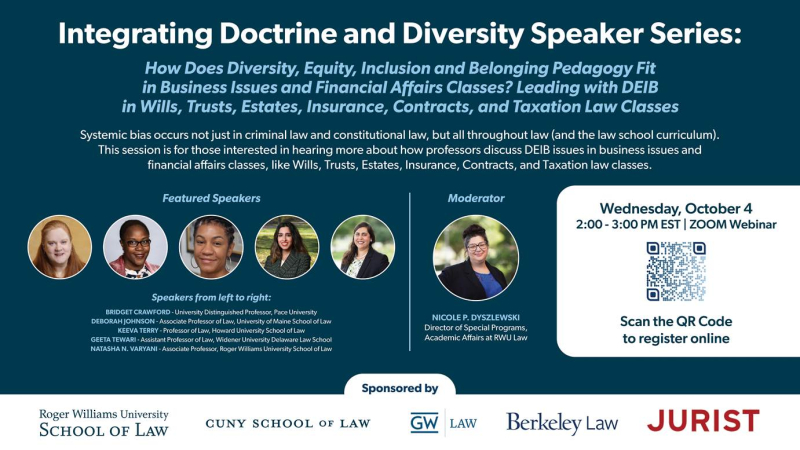
RWU Law looks forward to the next installment of the Integrating Doctrine & Diversity Speaker Series:
HOW DOES DIVERSITY, EQUITY, INCLUSION AND BELONGING PEDAGOGY FIT IN BUSINESS ISSUES AND FINANCIAL AFFAIRS CLASSES? LEADING WITH DEIB IN WILLS, TRUSTS, ESTATES, INSURANCE, CONTRACTS, AND TAXATION LAW CLASSES
Wednesday, October 4 | 2:00 – 3:00 PM EST
Zoom Webinar Registration here.
Details about the Featured Speakers & Program here.