
Photo of Joan Heminway

Professor Heminway brought nearly 15 years of corporate practice experience to the University of Tennessee College of Law when she joined the faculty in 2000. She practiced transactional business law (working in the areas of public offerings, private placements, mergers, acquisitions, dispositions, and restructurings) in the Boston office of Skadden, Arps, Slate, Meagher & Flom LLP from 1985 through 2000.

She has served as an expert witness and consultant on business entity and finance and federal and state securities law matters and is a frequent academic and continuing legal education presenter on business law issues. Professor Heminway also has represented pro bono clients on political asylum applications, landlord/tenant appeals, social security/disability cases, and not-for-profit incorporations and related business law issues. Read More

I had the opportunity to attend one of the sessions in the Interdisciplinary Workshop on Corporations, Private Ordering, and Corporate Law last week.  The program was co-hosted by Foundations of Law and Finance (Goethe University Frankfurt, Center for Advanced Studies) and Columbia Law School.  Luckily for me, the piece of the program I attended featured Nizan Geslevich Packin presenting a work-in-progress she is co-authoring with Anat Alon-Beck entitled Board Observers: Shadow Governance in the Era of Big Tech.

Although a draft of the paper is not yet posted, here is the SSRN abstract:

This Article examines the rise in corporate governance practice of appointing board observers, especially in the context of private equity, venture capital (VC), and corporate venture capital (CVC). Board observers are non-voting members attending board meetings to gain knowledge and insight. They arguably also provide valuable feedback, an outside perspective, and can even help ensure corporate operations. In recent years, board observer seats – a notion also existing in the nonprofit sector – have become increasingly popular in the for-profit business world, where investors have various market and business justifications for using board observers, including corporate governance considerations, minimizing litigation exposure, navigating antitrust issues, CFIUS regulation
The University of Chicago Business Law Review recently published an interesting and engaging article written by David Rosenfeld.  The article is entitled “Insider Abstention and Rule 10b5-1 Plans” and is available on SSRN.  The SSRN abstract for David’s article follows.

Company insiders will typically be in possession of material non-public information (MNPI) about their companies. In order to allow insiders the opportunity to trade, the SEC adopted Rule 10b5-1, which provides an affirmative defense to insider trading liability if the trades are made pursuant to a written plan or trading instruction entered into when the trader was not aware of MNPI. Over the years, there has been considerable concern that insiders were abusing Rule 10b5-1 plans by adopting plans just prior to trading, adopting multiple plans, or even terminating plans when they turned out to be unprofitable. The SEC recently adopted new rules designed to curb some of the more abusive practices, but one significant problem remains: while Rule 10b5-1 plans are supposed to be irrevocable, insiders who back out of plans have so far escaped liability under the central anti-fraud provision of the federal securities laws, principally because a violation of that provision requires an actual trade.

The

As you may know or recall, I am teaching an advanced business law course that leverages the characters and transactions featured in HBO Max’s Succession.  I reported on the course here back in November. The inspiration for the course came in part from the work some of us did to produce a series of educational sessions as the Waystar Royco School of Law last year.  I posted on that lecture series here on the BLPB, too, including here.

From that series of Zoomcasts, a publication opportunity, some press inquiries, and a few new friendships followed, as well as the idea for my Succession course.  We are only a few classes in so far, but we had the pleasure of hosting friend-of-the-BLPB Ben Means in class today.  As you may know, Ben directs South Carolina’s innovative Family and Small Business Program.  He also participated int he Waystar Royco School of Law (ad)venture and was a super guest.  We covered a lot of ground on family businesses, big and small, in our 75 minutes together this morning.  Thank you, Ben.

This class meeting and my Securities Regulation teaching today had me thinking about small businesses and innovation.  That reminded

Whatever your life’s work is, do it well. 
-Martin Luther King Jr., “Facing the Challenge of a New Age,” Dec. 3 1956, Montgomery, Alabama

These words from Dr. King have meaning for me today and every day.  Many lawyers and law professors are strivers, and I count myself among them.  We understand the burdens and joys of our roles and pursue them with vigor.  Having recently stepped back from an interim administrative role at UT Law, I feel more free to refocus on my instructional mission.

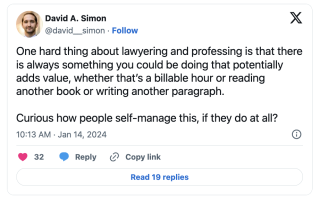
A tweet from a law prof colleague over the weekend asks a question that resonates.

Screen Shot 2024-01-15 at 12.11.00 PMI just love this observation and the related question! I am not on social media as much as I used to be, but when I am, I often am rewarded by tidbits like this.  Thank you, David, for commenting and asking.

I did reply.  FWIW, my reply was “For me, it’s about setting limits and persevering. There’s always more one can do. But we need sleep and time away to be most effective. And so we must sleep and save things for another day!”  Other replies offered similar and other personal wisdom.

Our roles as law

Tomorrow morning, the U.S. Supreme Court will be hearing oral arguments on a securities fraud case for which I am an amicus brief coauthor.  The case is: Macquarie Infrastructure Corporation, et al. v. Moab Partners, L.P., et al. (No. 22–1165, Certiorari to the C. A. 2nd Circuit).  The Court convenes at 10 am and has allotted one hour for oral argument: 30 minutes for the petitioners, 20 minutes for the respondent, Moab Partners, and 10 minutes for the U.S. Securities and Exchange Commission (“SEC”), as amicus supporting the respondents.  An audio feed of the argument is live-streamed on the Court’s website, and the Court posts the audio later in the day.

The question presented to the Court is: “May a failure to make a disclosure required under Item 303 of SEC Regulation S-K support a private claim under Section 10(b) of the Securities Exchange Act of 1934, even in the absence of an otherwise misleading statement?”  The issue in the case, in essence, is whether a mandatory disclosure rule properly adopted by the SEC gives rise to a duty to disclose that can be the basis of a securities fraud claim under Section 10(b) of and Rule 10b-5 under

I was honored to be invited recently to write a column for our local bar magazine, DICTA, entitled “Privileged to Be a Lawyer.”   My contribution, Joy in Lawyering, can be found here.  It took no time at all to write this short piece.  The words came straight from my heart through my fingers to the keyboard.  The punchline (for those who don’t care to read the entire column): “Truly, I know of few career choices that could have given me so much.”  I can only hope that many of you feel the same way.

Widener Law Commonwealth seeks an entry-level or pre-tenure lateral faculty member to fill one tenure track position starting in the 2024-2025 academic year. We have a specific need in our year-long Contracts course. The remainder of the teaching package is flexible. This position reports to the dean of the law school.

WLC is a dynamic community of teachers and scholars. We pride ourselves on our dedication to our students, our engagement with teaching, and our scholarly impact. Many of our scholars are actively engaged in law reform efforts at both the state and federal level.

The law school is committed to fostering an environment in which faculty, staff, and students from a variety of backgrounds, cultures, and personal experiences are welcomed and can thrive. Faculty and staff are active participants in our work to enhance diversity, equity, inclusion, and belonging. We welcome applications from members of historically underrepresented groups.

Established in 1989, Widener Law Commonwealth is an independently accredited law school within Widener University. Located in Harrisburg, PA, the law school’s location in the capital of Pennsylvania provides impactful experiences for both our faculty and students. . . .

+++++

The full position announcement is here.

Touro Law is hiring in its Clinical Program for a director of the new Small Business Legal Assistance Clinic. Please pass along this opportunity if you know someone who may be interested in the pursuit of social justice through transactional work and teaching. Please see job description and application at this link. The position, starting in the summer of 2024, is for a full time faculty member with voting privileges and annual renewal up to a 3-year term. Applications will be considered on a rolling basis, with priority for those submitted by December 31, 2023.

In June, at the National Business Law Scholars Conference in Knoxville, I sat in on a paper panel featuring Sarah Williams’s work in process, Regulating Congressional Insider Trading: The Rotten Egg Approach.  A draft of the resulting paper, forthcoming in the Cardozo Law Review, has been made available on SSRN.  The abstract is copied in below.  

A 2004 study revealed that the stock portfolios of members of Congress were consistently outperforming those of the investing public. The financial success of federal lawmakers was statistically correlated to the use of nonpublic information obtained in connection with the performance of legislative responsibilities – reasonably characterizable as insider trading. Cries of dismay over such profiteering by lawmakers have been echoing in the public domain since Samuel Chase, Maryland’s representative in the Continental Congress, cornered the flour market in 1788 after learning that copious quantities of the product would be purchased by the government to support the Continental Army. Notwithstanding efforts to apply insider trading law to curb this behavior and the enactment of the Stop Trading on Congressional Knowledge (“STOCK”) Act, fortuitous securities transactions by members of Congress continue to occur in connection with headlining national events; it was recently observed

It always is a great pleasure to pass along and promote the work of a colleague.  And today, I get to post about the work of a UT Law colleague!  Many of you know Tomer Stein, who came to join us at UT Law back in the summer.  He is such an ideal colleague and, like many of us, has broad interests across business finance and governance.

This post supports a recent draft governance piece, the title of which is the same as this post–Of Directorships: Reconfiguring the Theory of the Firm.  You can find the draft here.  The abstract is included below.

This Article develops a novel account of directorships and then uses it to reconfigure the theory of the firm. This widely accepted theory holds that firms emerge to satisfy the economic need for carrying out vertically integrated business activities under a fiduciary contract that substitutes for the owners’ multiple agreements with contractors and suppliers. As per this theory, the fiduciary contract is inherently incomplete, yet often preferable: while it cannot address all future contingencies in the firm, it will effectively direct all unaccounted-for firm events by placing them under the owners’ purview as a