
Photo of Joan Heminway

Professor Heminway brought nearly 15 years of corporate practice experience to the University of Tennessee College of Law when she joined the faculty in 2000. She practiced transactional business law (working in the areas of public offerings, private placements, mergers, acquisitions, dispositions, and restructurings) in the Boston office of Skadden, Arps, Slate, Meagher & Flom LLP from 1985 through 2000.

She has served as an expert witness and consultant on business entity and finance and federal and state securities law matters and is a frequent academic and continuing legal education presenter on business law issues. Professor Heminway also has represented pro bono clients on political asylum applications, landlord/tenant appeals, social security/disability cases, and not-for-profit incorporations and related business law issues. Read More

image from scontent-atl3-2.xx.fbcdn.net

Each year on and around Memorial Day, in addition to all the promotional sales that hit my email in box and text messaging apps, I read many grateful testimonials to those whose lives were lost in national military service.  The personal reflections are touching and inspire in me both sorrow for the loss and pride in the United States of America.  As many before me have said, there is no greater sacrifice for one’s country.

Although family members alive during my lifetime have served in the armed services, none of those family members died in the line of service.  I have been lucky to not suffer that kind of loss.  It would be heartbreaking.

Today, my brother (who researches our family history) asked his Facebook friends–me included–to honor “all of those who have lost their lives in the struggle for freedom.”  That request followed a brief recitation of the story of one of our family members who lost his life as a civilian working in what became enemy territory in World War II.  Here is what my brother wrote:

1st cousin 1 generation removed Donald MacLeod Williams (14 May 1921, San Francisco, California – 9 Mar 1943, Sasebo, Nagasaki, Japan)
Set forth below are key portions of the posting for The University of Tennessee College of Law’s new Clinical Teaching Fellowship.  Applications are solicited for either our advocacy or transactional law clinic. The full announcement, including instructions on how to apply, can be found here. Applications will be considered on a rolling basis.  However, preference will be given to applications received before May 1, 2023. For questions, please contact Director of Clinical Programs Joy Radice at jradice@utk.edu

*          *          *

The University of Tennessee College of Law is accepting applications for our new Clinical Teaching Fellowship to begin in the summer of 2023.  This two-year fellowship will prepare talented lawyers and aspiring clinicians with at least 2 years of practice experience to become full-time clinical faculty at U.S law schools.  The Clinical Teaching Fellow will work alongside and learn from current full-time clinical faculty who teach in the College of Law’s Legal Clinic.  The Clinical Teaching Fellow will be immersed in all aspects of clinical teaching from learning clinical pedagogy to supervising law students on their casework.  The UT Law Clinical Teaching Fellow will also develop a research agenda and

For those of you interested in watching or listening to the inaugural Peter J. Henning lecture (the subject of my blog post last Monday), you can find the recording here.  Friend-of-the-BLPB Chris Lund was kind enough to send the link along.  As you’ll note, Judge Rakoff’s remarks (which were introduced by Chris) begin with comments about Peter, his contributions to our field, and his service to the general public.  Judge Rakoff’s thoughts in that regard are so well taken.  The whole presentation was such a fitting tribute.

I hope you all enjoy the lecture as much as I did!

I am pleased to share with you that the inaugural Peter J. Henning Lecture at Wayne State University Law School will be held next Monday, April 3rd, at 6:00 pm.  The speaker is the Honorable Jed S. Rakoff (United States District Court for the Southern District of New York) who knew Peter and valued his work.  See the flyer below.  Come if you are able.

As readers may recall, Peter was a mentor and friend.  His work and my work in insider trading law and practice intersected.  I offered some comments on my relationship with him here on the BLPB shortly after his untimely passing last year.  I also shared some thoughts at the 2022 National Business Law Scholars Conference and wrote a short related tribute to Peter forthcoming in the Wayne Law Review.  I will be at the lecture on Monday. 

I know many of you also have been touched by Peter or his work.  He was a special man who made great contributions in many spheres.  Please note in the flyer below that financial support for the lecture series is being solicited.  I hope that some of you will take advantage of this opportunity to honor Peter

I teach business law courses that involve planning and drafting in connection with business transactions. I know many of you do, too.  My question is, how do you teach your students to find drafting precedents (if that is part of your teaching) for transactional business law projects/tasks?  Do you advise students to use forms or to walk back provisions in fully negotiated agreements?

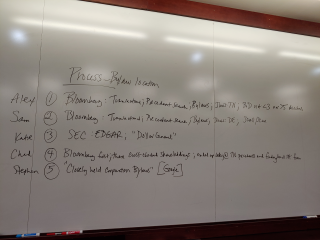
In our capstone 3L planning and drafting course at UT Law, Representing Enterprises, I let students take their own path in finding drafting precedents and ask them to report out their process to the class.   We talk through the pros and cons of their individual approaches, which I capture on the whiteboard.  My board notes from a recent class (during which we talked through how students located precedent bylaws for a closely held–preferably Tennessee–corporation) are included below.

RE(LocatingBylaws2023)

Although Bloomberg Law was a popular resource for students who shared their process in this particular class meeting, the Securities and Exchange Commission’s website and Google also got some love.  In the ensuing discussions, a student also mentioned Westlaw’s Practical Law as a resource, although that’s not reflected in this picture.

In other advanced business law planning/drafting courses, I

The following came to me from Patricia Wilson, Associate Dean and Professor of Law, Chair of the Faculty Appointments Committee at Baylor Law:

Baylor Law is accepting applications for two lecturer positions in our Legal Analysis, Research and Communication (LARC) program, as described below, to begin no later than August 1, 2023.  Please share with anyone you believe may be interested.

Lecturer (Transactional Drafting)

Candidates must possess a juris doctor. You will be asked to provide a letter of interest; curriculum vitae; transcripts, a list of three references in the application process, and two writing samples demonstrating the candidate’s writing style.  Salary is commensurate with experience and qualifications.

The selected individual will have responsibility for teaching in the Legal Analysis, Research & Communications (LARC) program. Responsibilities include working collaboratively with other faculty members of the Baylor Law Writing Program to create, teach and grade assignments for the LARC 4 course (Transactional Drafting) and coordinating all of the writing efforts across all three years of the curriculum to ensure consistency and best management of resources. The ideal candidate will have at least three years of transactional legal writing experience, including drafting and analyzing a variety of different contracts and business entity governing documents.

Screenshot 2023-02-24 at 5.47.18 PM

Catholic Law seeks to fill several faculty positions to begin in Fall 2023. We are seeking candidates for entry-level and lateral positions, tenure-track or contract, in a wide variety of subjects, including Clinical Education, Lawyering Skills, Civil Procedure, Family Law, Trusts and Estates, Criminal Law and Procedure, Evidence, Corporate and Securities Law, International Law, and Contracts and Commercial Law.

Candidates in Clinical Education may have opportunities to teach in our existing clinics but also may propose new clinical areas. We are particularly interested in clinical offerings compatible with participation by our evening students.

We are also seeking candidates whose teaching and research interests may be in any of the above subject matter areas (or others) who are also interested in participating in our University’s Institute for Latin American and Iberian Studies.

Catholic Law is a national leader in preparing students of all faiths for the practice of law and is an integral part of The Catholic University of America, the national university of the Catholic Church, located on a beautiful residential campus in the heart of the nation’s capital.

Candidates must possess a J.D. or equivalent, superior academic credentials, and relevant professional experience, such as teaching, legal practice, or

For those of you who may have been wondering about Emory Law’s biennial Conference on the Teaching of Transactional Law and Skills, I have posted current information below.  I am pleased to see that our business law journal, Transactions: The Tennessee Journal of Business Law, is again publishing the proceedings.  This has been a great partnership between Emory Law and Tennessee Law over the years.  The proceedings of the 2021 Emory Law conference can be found here.

Just as I was ready to post this, I heard from the 2023-24 Editor-in-Chief of the journal, Bethany Wilson, that we are currently accepting articles for the Fall 2023 edition of Transactions. The articles published by Transactions typically focus on transitional business law issues and topics, including agency, antitrust, arbitration, bankruptcy, business associations, contracts, insurance, intellectual property, labor and employment, property, real estate, secured transactions, securities regulation, shareholder litigation, and tax. If you have any articles that you would be interested in having published by Transactions, please send them our way. Articles can be submitted via Scholastica or by emailing an abstract and copy of the article to bwilso92@vols.utk.edu.

image from dim.mcusercontent.com

As I noted in a post a few weeks ago, I am presenting on corporate fiduciary duties tonight as the Roy/Demoulas Distinguished Professor of Law and Business at the Waystar/ROYCO School of Law.  The title of my presentation is: What the Roys Should Learn from the Demoulas Family (But Probably Won’t).  The presentation will run from 9:00 pm to 10:00 pm Eastern on Zoom at the following link:  https://us02web.zoom.us/j/86783560319?pwd=cTJza2N6elFyVGhBUFVjdk1Gb2oxQT09.

If you do not know about the Demoulas family and their fiduciary duty tangles up in Massachusetts, my presentation will inform you (and may even get you interested).  Members of the family were locked in litigation with each other for over 20 years.  Much of that litigation relates to alleged breaches of corporate and trust fiduciary duties.  And for those who have not watched the HBO Max series Succession, I will offer a window on some of the characters and plot lines, tying them in to observations about the Demoulas family.  

I welcome your attendance and participation!

I teach a unit on the legal aspects of valuation in my Corporate Finance planning and drafting seminar every year.   I have often been able to secure as a guest speaker on one day during that unit a friend of mine who is a seasoned valuation expert (and was the expert whose opinion carried the day in the most recent Tennessee Supreme Court case on valuation in an M&A context).  

There is a relatively large body of academic literature on appraisal (a/k/a dissenters’) rights and, more generally, the history of valuation law and practices in the M&A context.  In the Business Associations textbook of which I am a coauthor, I excerpt from Mary Siegel’s 1995 article, Back to the Future: Appraisal Rights in the Twenty-First Century (32 Harv. J. on Legis. 79).  Her 2011 follow-on article, An Appraisal of the Model Business Corporation Act’s Appraisal Rights Provisions (74 Law & Contemp. Probs 231 (2011)), also is a good read on appraisal rights history.  Other legal academics who have dipped their toes into these waters include George Geis, Bayless Manning, Brian JM Quinn, Randall Thomas, and Barry Wertheimer (who is no longer a law