Photo of Joan Heminway

Professor Heminway brought nearly 15 years of corporate practice experience to the University of Tennessee College of Law when she joined the faculty in 2000. She practiced transactional business law (working in the areas of public offerings, private placements, mergers, acquisitions, dispositions, and restructurings) in the Boston office of Skadden, Arps, Slate, Meagher & Flom LLP from 1985 through 2000.

She has served as an expert witness and consultant on business entity and finance and federal and state securities law matters and is a frequent academic and continuing legal education presenter on business law issues. Professor Heminway also has represented pro bono clients on political asylum applications, landlord/tenant appeals, social security/disability cases, and not-for-profit incorporations and related business law issues. Read More

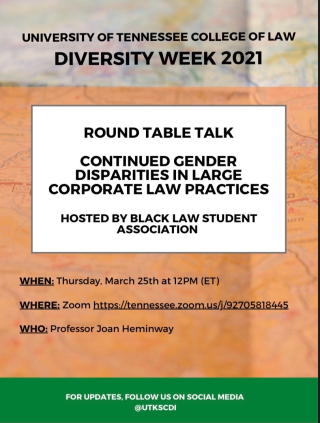
Yesterday, I had the honor of leading a roundtable discussion on women and the practice of business law.  The roundtable was part of a series convened by UT Law’s Student Council on Diversity and Inclusion, and this specific roundtable was hosted by our Black Law Student Association.  Here’s the promotional flyer from the event.

SCDIRoundtableAnnouncement

In preparing for the session, I had occasion to review two ABA reports from the past few years: Roberta D. Liebenberg & Stephanie A. Scharf, Walking Out The Door : The Facts, Figures, and Future of Experienced Women Lawyers in Private Practice (ABA 2019), and Destiny Peery, Paulette Brown & Eileen Letts, Left Out or Left Behind: The Hurdles, Hassles, and Heartaches of Achieving Long-term Legal Careers for Women of Color (ABA 2020). I was reminded of the fall-off in female lawyers in BigLaw over the course of their careers.  Quoting from the first report:

BigLaw is no stranger to the loss of experienced women attorneys. While entering associate classes have been comprised of approximately 45% women for several decades, in the typical large firm, women constitute only 30% of non-equity partners and 20% of equity partners. Women lawyers face many other challenging hurdles

EmoryConference2021

Registration is Open!

It is our great pleasure to announce that registration is now open for the seventh biennial transactional law and skills education conference to be held virtually on June 4, 2021. Please join us to celebrate and explore our theme – Emerging from the Crisis: The Future of Transactional Law and Skills Education with you. This year, we have reduced the registration fee to $50 per person. Secure your space today!

Call for Proposals

Please take a moment to review the Call for Proposals and submit your proposal here. Also, please share the CFP with your colleagues who may not have attended the Conference before. Consider forwarding it to adjuncts and professors teaching relevant subjects. Can you also think of any teachers who might be interested in attending or presenting?

The Call for Proposals deadline is 5 p.m. April 15, 2021. We look forward to receiving your proposals.

Last, but certainly not least, at this year’s Conference, we will announce the winner of the second Tina L. Stark Award for Teaching Excellence. Would you like to nominate yourself or a colleague for this award? More information will be forthcoming regarding award eligibility and the nomination

2021 National Business Law Scholars Conference
June 17-18, 2021

The University of Tennessee College of Law
Knoxville, Tennessee

Call for Papers

The National Business Law Scholars Conference (NBLSC) will be held on Thursday and Friday, June 17-18, 2021.  The 2021 conference is being hosted by The University of Tennessee College of Law.  The conference will be conducted in a hybrid or online format, as determined by the NBLSC planning committee in the early part of 2021.

This is the twelfth meeting of the NBLSC, an annual conference that draws legal scholars from across the United States and around the world. We welcome all scholarly submissions relating to business law. Junior scholars and those considering entering the academy are especially encouraged to participate. If you are thinking about entering the academy and would like to receive informal mentoring and learn more about job market dynamics, please let us know when you make your submission.  We expect to be in a position to offer separate programming for aspiring law professors and market entrants, as we have done in the past, likely on a separate date after the conference concludes.

Please use the conference website to submit an abstract or paper by April

Friend-of-the-BLPB Bernie Sharfman and his co-author Vincent Deluard recently posted their article, How Discretionary Decision-Making Has Created Performance and Legal Disclosure Issues for the S&P 500 Index, on SSRN.  The article plays to several audiences, as noted by the authors.  The SSRN abstract follows:

When investment funds track the S&P 500, the index becomes more than just a list of 500 companies. The focus then turns to the financial and regulatory issues that arise from the discretionary decision-making of its Index Committee. The discussion of these issues and their implications should be of extreme interest to both investors and regulators. This discussion involves: how Sharpe’s equality will hold in practice, what kind of companies may still be impacted by the index effect, how we are to understand the expected returns versus risk of a broad based market portfolio, whether funds that track the S&P 500 are to be considered actively managed or passive, the S&P 500’s suitability as an “appropriate” benchmark index, and what kind of legal disclosures are required in the use of the index. As a result of our discussion, including our empirical findings, we do not find the S&P 500 index to be desirable for either

Friend of the BLPB Greg Shill‘s recent article, The Independent Board as Shield, is an engaging, provocative piece on board independence and the business judgment rule.  The abstract provides a taste of his argument and principal related proposal.

The fiduciary duty of loyalty bars CEOs and other executives from managing companies for personal gain. In the modern public corporation, this restriction is reinforced by a pair of institutions: the independent board of directors and the business judgment rule. In isolation, each structure arguably promotes manager fidelity to shareholder interests—but together, they enable manager prioritization. This marks a particularly striking turn for the independent board. Its origin story and raison d’être lie in protecting shareholders from opportunism by managers, but it functions as a shield for managers instead.

Numerous defects in the design and practice of the independent board inhibit its ability to curb managerial excess. Nowhere is this more evident than in the context of transactions that enrich the CEO. When executive compensation and similar matters are approved by independent directors, they take on a new quality: they become insulated by the business judgment rule. This rule is commonly justified as giving legal effect to the comparative advantage

This comes to us from friend-of-the-BLPB, Agnieszka McPeak:

Gonzaga Law is seeking a visiting assistant professor (VAP) for its Center for Law, Ethics, and Commerce, a centerpiece of Gonzaga Law School’s identity and mission. Persons with strong academic records, a dedicated commitment to teaching, and the potential for outstanding scholarship are encouraged to apply. The position is a full-time, 9-month, visiting position beginning in August 2021, with the potential to renew for one (but no more than one) additional year (contingent upon funding). The fellow may be permitted to work entirely remotely.

The successful candidate will teach up to three courses in the academic year in areas related to the Center and its mission, including at least one upper-level Business Law elective. Experiential and clinical teaching are also optional. The candidate will work closely with the Director of the Center for Law, Ethics, and Commerce to plan and participate in activities related to the Center’s goals and mission. In addition, the VAP will be invited to participate in faculty workshops and will be offered a budget for scholarship and travel. More information here: https://gonzaga.peopleadmin.com/postings/15150

I know Agnieszka (who directs the Center for Law, Ethics, and Commerce) is excited to

The University of Iowa College of Law anticipates hiring one lateral faculty member in the Health Law and Policy area and one lateral faculty member in the Environmental Law area.

QUALIFICATIONS: Consistent with the mission and responsibilities of a top-tier public research university, we are interested in candidates who are (or have the potential to become) recognized scholars and teachers and who will participate actively in the life of the College of Law.

APPLICATION PROCEDURE: To apply, candidates should submit a letter of interest, CV, a list of three references, and a law school transcript through Jobs@UIOWA, https://jobs.uiowa.edu, refer to Requisition #74104.  The University of Iowa College of Law is deeply committed to a community of excellence, equity, and diversity and welcomes applications from women, underrepresented minorities, persons with disabilities, LGBTQI+ individuals, and other candidates who will contribute to the diversification and enrichment of ideas and perspectives. Candidates who can contribute to these goals are encouraged to apply and to identify their strengths in this area.

ABOUT UIOWA: Iowa Law provides the ideal setting for professional growth as a law teacher and legal scholar. As a small school within a Big Ten university, we offer an

The following news of a virtual conference (hosted by the University of Kentucky Rosenberg College of Law, with support from the John S. and James L. Knight Foundation) comes to us from Ramsi Woodcock at UK Law/Business & Econ:
 
Please join us as we think through antitrust, data, taxation, consumer welfare, property, bigness, and tech policy from the perspective of the distribution of wealth at Inframarginalism & Internet: A Conference on Markets as Wealth Distributors, and the Implications for Tech Policy, which will be held online on Thursday, February 18 and Friday, February 19.


Speakers include:
 
-Herbert Hovenkamp
-Fiona Scott Morton
-A. Douglas Melamed
-Thomas Philippon, author of The Great Reversal: How America Gave Up on Free Markets
 
-Katharina Pistor, author of The Code of Capital: How the Law Creates Wealth and Inequality
 
-Chris Sagers, author of United States v. Apple: Competition in America
-David J. Teece
-Susan Crawford, author of Fiber: The Coming Tech Revolution–and Why America Might Miss It
-Gerrit De Geest, author of Rents: How Marketing Causes Inequality
 
Panels include:
Antitrust Futures
The Meaning and Control of Bigness
Redistribution Through Antitrust and Consumer Law

Visiting Assistant Professor in Law

Faculty Posting Date: February 12, 2021

To Apply: apply.interfolio.com/84257


Duquesne University School of Law, located in Pittsburgh, Pennsylvania, invites applications to fill up to two full-time visiting assistant professors beginning 2021-2022 academic year. Each position will have a one-year appointment that may be renewable for a second year. VAP will teach courses in legal education. We seek colleagues who can contribute to the diversity of our campus community and wish to advance diversity, equity, and inclusion through teaching and service.

DUTIES AND RESPONSIBILITIES:

Teach Up to 12 credit hours for the year. Assigned courses will vary, but likely curricular needs include: torts, professional responsibility, technology, privacy, and health law.

REQUIRED QUALIFICATIONS:

Juris Doctorate from an ABA-accredited law school.

Preferred Qualifications

Experience teaching legal education.

Evidence of significant practical experience in an area of curricular need.

APPLICATION INSTRUCTIONS:

Catholic in its mission and ecumenical in spirit, Duquesne University values equality of opportunity as an educational institution and as an employer. We aspire to attract and sustain a diverse faculty that reflects contemporary society, serves our academic goals that enriches our campus community. We particularly encourage applications from members of underrepresented groups and support dual-career couples through

I tell my students that the participants in securities transactions are “the three Is” or  “I3“: issuers, intermediaries, and investors.  Tomorrow morning, having covered the definition of a security and the concept of materiality, I offer some foundational words on investors. 

What to tell?  Of course, I will talk a bit about investment theory, the investor protection policy and mechanisms of federal securities law, the composition/demographics of the typical equity ownership of a public company, etc.  But what do I say about GameStop Corp.?  Set forth below is a chart summarizing the trading in GameStop common stock for the past five days: (courtesy of Google Finance):

Screen Shot 2021-02-08 at 11.54.19 PM

Who are the investors in the market for GameStop common stock, options, and short positions now?  Who will they be in a month or six months or a year (assuming a trading market can be sustained)?  And what do the changes in GameStop’s investor profile say about the firm itself, about the New York Stock Exchange, and about various related aspects of securities regulation?  

There remain few answers to the fundamental question of who owns or is trading in GameStop’s publicly traded common stock.  Nevertheless, there are many worthy conversation