Photo of Joan Heminway

Professor Heminway brought nearly 15 years of corporate practice experience to the University of Tennessee College of Law when she joined the faculty in 2000. She practiced transactional business law (working in the areas of public offerings, private placements, mergers, acquisitions, dispositions, and restructurings) in the Boston office of Skadden, Arps, Slate, Meagher & Flom LLP from 1985 through 2000.

She has served as an expert witness and consultant on business entity and finance and federal and state securities law matters and is a frequent academic and continuing legal education presenter on business law issues. Professor Heminway also has represented pro bono clients on political asylum applications, landlord/tenant appeals, social security/disability cases, and not-for-profit incorporations and related business law issues. Read More

NIULogo

POSITION ANNOUNCEMENT

NORTHERN ILLINOIS UNIVERSITY COLLEGE OF LAW invites applications for an anticipated opening for an entry-level tenure-track faculty position beginning August 2021. Duties include engaging in high quality research and teaching, as well as being an active participant in law school and university service. Applicants must hold a J.D. degree from an ABA accredited law school, or a foreign law school equivalent, and must provide evidence of the potential for engaging in high quality research and teaching.

Preferred qualifications include record of scholarly publication, teaching experience (particularly in a law school), legal practice experience, strong law school record, law journal membership, and clerkship experience.

We will consider candidates with a broad range of teaching and research interests, but the successful candidate will be expected to teach at least one first-year course (which may include Constitutional Law I: The Federal System). Our upper-level needs include, but are not limited to, Business Law, Commercial Law, Criminal Law and Procedure, Tax, Trusts and Estates, and skills courses. Applications are encouraged from women, members of minority groups, and others whose background and experience would contribute to the diversity of the law school community.

If you wish to apply, please go to the position posting

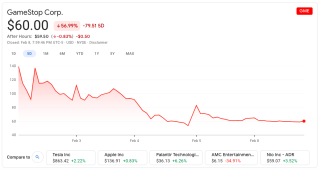
Wow.  All I can say is . . . wow.  Last Monday, GameStop Corp. was, for me, just a dinosaur in the computer gaming space–a firm with a bricks-and-mortar retail store in our local mall that I have visited maybe once or twice.  What a difference a week makes . . . .

Now, GameStop is: frequent email messages in my in box; populist investor uprisings against establishment institutional investors; concern about students investing through day-trading accounts; news and opinion commentary on all of the foregoing (and more); compulsion to inform an under-informed (and, in some cases, bewildered) community of friends and family.  This change of circumstances, which is centered on, but not confined to, the volatile market for GameStop’s common stock, raises many, many questions–legal questions and factual questions.  Some are definitively answerable, others are not.

The legal questions run the gamut from possibilities of securities fraud (including insider trading) and market manipulation, to the governance of trading platforms, the propriety of trading limitations and halts, and the authority and control of clearinghouses.  Co-blogger Ben Edwards published a post here last Thursday on the trading halts in GameStop stock, the role of clearinghouses, and the possibility of market manipulation. 

Over six years ago, I began writing about the job-seeking cover letter as an important piece of the career development and execution puzzle.  My first post focused on the essential elements and formatting of an appropriate cover letter for a job search.  My second cover letter post, written a bit more than a year later, honed in on best practices for creating the body of the letter–the part of the letter that does the key substantive work in making a case with the employer that you deserve an interview, principally by showing the employer that y0u have something the employer needs or finds valuable.  A key element of that post was the its emphasis on introduction of the “PAR” method, which I maintain is a key to both cover letters and job interviews.  About six months after that second post, I wrote a third post on networking letters.

That last post was published in July of 2016.  That just does not seem possible.  It cannot have been that long ago!  But it is.  Time flies when you are having fun, as they say.

It may go without saying, but I have continued to give resume, cover letter, and

As we launch into another online/hybrid semester of legal education, I want to share a new article by Jen Randolph Reise: Moving Ahead: Finding Opportunities for Transactional Training in Remote Legal Education. Here’s the abstract:

This article builds on the many calls for teaching business acumen and transactional skills in law school with a timely insight: the shift to remote legal education creates opportunities to do so, in particular by incorporating practice problems and mini-simulations in doctrinal courses. Weaving together the literature on emerging best practices in online legal education, cognitive psychology, and the science of teaching and learning, Professor Reise argues that adding formative assessments and experiential education is effective in teaching and is critical in remote learning.

Offering vivid examples from her experience teaching Business Organizations online, she urges legal instructors to use the opportunity presented by the shift to remote education to incorporate problems and simulations as an effective way to motivate students to prepare for class, to expose them to transactional practice skills, and to effectively teach them key doctrinal concepts.

For those of you who do not know Jen, she is currently a Visiting Professor at Mitchell Hamline School of Law (Twitter: @jenreise). 

It really boils down to this: that all life is interrelated. We are all caught in an inescapable network of mutuality, tied in a single garment of destiny. Whatever affects one directly, affects all indirectly. We are made to live together because of the interrelated structure of reality.

Did you ever stop to think that you can’t leave for your job in the morning without being dependent on most of the world? You get up in the morning and go to the bathroom and reach over for the sponge, and that’s handed to you by a Pacific islander. You reach for a bar of soap, and that’s given to you at the hands of a Frenchman. And then you go into the kitchen to drink your coffee for the morning, and that’s poured into your cup by a South American. And maybe you want tea: that’s poured into your cup by a Chinese. Or maybe you’re desirous of having cocoa for breakfast, and that’s poured into your cup by a West African. And then you reach over for your toast, and that’s given to you at the hands of an English-speaking farmer, not to mention the baker. And before you

In my ongoing work for the Tennessee Bar Association, I was alerted to a recent Delaware Chancery Court decision of note.  The decision is embodied in a December 22, 2020 letter to counsel written by Chancellor Andre G. Bouchard in the case captioned In re WeWork Litigation (Consol. Civil Action No. 2020-0258-AGB).  It offers an illustration of the attorney-client privilege challenges that may exist in business associations that operate within networks consisting of affiliated or associated business firms.

The In re WeWork Litigation letter opinion involves a document production dispute.  The controversy relates to communications engaged in by discovery custodians employed at Sprint, Inc. but working on behalf of SoftBank Group Corp.  Specifically, the Sprint employees assisted SoftBank with document discovery relating to its involvement with The We Company (“WeWork”), a plaintiff in the case.  (Sprint is not involved in any substantive way in the litigation.  However, at times relevant to the chancellor’s opinion, SoftBank owned 84% of Sprint.)  The controversy centers around the conduct of Sprint CEO Michael Combes and a Sprint employee, Christina Sternberg.  Each provided SoftBank’s chief operating officer with document discovery assistance.  As Chancellor Bouchard aptly noted, these Sprint employees “wore multiple hats.”  (This comment in

Indiana University Robert H. McKinney School of Law seeks one or more entry-level or experienced applicants interested in serving as a full-time, temporary faculty member for the 2021-2022 academic year. Subject matter needs include property, intellectual property, administrative law, and health law-related courses. 

As part of IUPUI, Indiana’s premier urban research institution, the law school is committed to being a welcoming community that reflects and enacts the values of diversity, equity, and inclusion that inform academic excellence. We seek candidates who will not only enhance our representational diversity but whose research, teaching, and community-engagement efforts contribute to diverse, equitable, and inclusive learning and working environments for our students, staff, and faculty. IU McKinney condemns racism in all its forms and has taken an anti-racist stance that moves beyond mere statements to interrogating its policies, procedures, and practices. We hope to identify individuals who will assist in our mission to dismantle racism so that everyone has the opportunity to succeed at IU McKinney. The law school is an Equal Opportunity/Affirmative Action Institution with a strong commitment to inclusion and offers domestic partner benefits: https://mckinneylaw.iu.edu/about/administration/policies/diversity-and-inclusion/. For more information about the school, please visit http://indylaw.indiana.edu/.

Interested candidates should submit a CV

As our legal academy readers know, this week features the annual conference of the Association of American Law Schools (“AALS”), the professional association for law schools and their faculty and staff.  I am sure many of us will publish posts now and later about the conference and its varied programs.  I focus today on the Section on Leadership, of which my Dean (Doug Blaze) is the current chair.  Doug has been among the national leaders in the movement to teach leadership in law schools.  Among other things, he was a founder of the section and of the Institute for Professional Leadership at UT Law (of which I am the current Interim Director).

I highlight two things in this post.

First, the Fall 2020 section newsletter deserves attention.  The entire issue focuses on racism.  It includes a number of short articles written by a variety of contributors, including (but not limited to) law professors.  Tony Thompson, Professor of Clinical Law at NYU Law, introduces the issue, referencing the events that catapulted racism and racial injustice into the legal news and public eye in meaningful ways earlier this year.  He writes: “T]he public protests have . . . sparked . . .

This post catches up on a few recent position listings that may be of interest to business law faculty and have not yet been posted here.

+++++

TEMPLE UNIVERSITY BEASLEY SCHOOL OF LAW

LOW INCOME TAXPAYER CLINIC DIRECTOR
AND VISITING PRACTICE PROFESSOR OF LAW

Position Summary: The Temple University Beasley School of Law was recently notified that it will receive funding from the IRS to open and operate a Low Income Taxpayer Clinic (LITC) on its Main Campus in North Philadelphia which will also serve taxpayers in northeastern Pennsylvania. It is therefore soliciting applications for the position of Visiting Practice Professor of Law and Director of the LITC, which is expected to operate on a part-time basis during 2021. The position will begin on January 15, 2021 or as soon thereafter as practicable, and will run through the end of the calendar year. The Clinic Director will be expected to establish and operate the LITC, including developing a panel of pro bono attorneys and performing community outreach, and to take a leadership role in applying to the IRS for a multi-year grant, which will likely need to be submitted in June, 2021. In addition, the Clinic Director will be expected

2021 National Business Law Scholars Conference
June 17-18, 2021

The University of Tennessee College of Law
Knoxville, Tennessee

The National Business Law Scholars Conference (NBLSC) will be held on Thursday and Friday, June 17-18, 2021.  The 2021 conference is being hosted by The University of Tennessee College of Law.  The conference will be conducted in a hybrid or online format, as determined by the NBLSC planning committee in the early part of 2021.

This is the twelfth meeting of the NBLSC, an annual conference that draws legal scholars from across the United States and around the world. We welcome all scholarly submissions relating to business law. Junior scholars and those considering entering the academy are especially encouraged to participate. If you are thinking about entering the academy and would like to receive informal mentoring and learn more about job market dynamics, please let us know when you make your submission.  We expect to be in a position to offer separate programming for aspiring law professors and market entrants, as we have done in the past, likely on a separate date after the conference concludes.

Please use the conference website, which will be available at https://law.utk.edu/ in January, to submit an abstract