Screenshot 2019-09-13 21.09.15

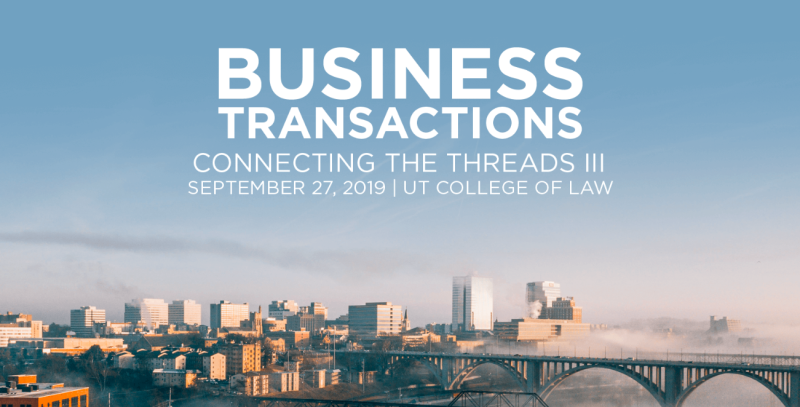
I am pleased to announce that The University of Tennessee College of Law is again hosting editors of this blog for a symposium focusing on current topics in business law.  The website for the symposium, which is sponsored by UT Law’s Clayton Center for Entrepreneurial Law, is here.  Faculty and students from UT Law will comment on presentations given by my fellow BLPB bloggers.  Participating editors of the BLPB in this year’s program include Colleen Baker, Ben Edwards, Josh Fershee, me, Doug Moll, Haskell Murray, and Stefan Padfield.  The lunchtime panel features me and two of my UT Law colleagues exploring the legal meaning and understanding of mergers and other business combinations from various perspectives, including business associations law, bankruptcy and UCC law, and federal income tax law.  That, alone, is surely worth the price of entry!

If you live in or near Knoxville, please come and join us.  Continuing legal education credit is available to members of the Tennessee bar.  If you cannot make it to the symposium, however, a video recording of the proceedings will later be available on UT Law’s website, with an expected option for online continuing legal education credits.  (Last year’s program is available
Call for Papers for Section on Law & the Social Sciences Program at the AALS Annual Meeting

The Section on Law & Social Sciences is pleased to announce a Call for Papers from which one or two additional presenters may be selected for the section’s program panel to be held during the AALS 2020 Annual Meeting in Washington, D.C. The panel is entitled “Empirical Research in Business Law: Works in Progress,” and the panelists will summarize the methods and/or results of their current qualitative or quantitative empirical research projects as works in progress.

Form and Length of Submission:

The Section welcomes relevant submissions in the form of research proposals, preliminary pilot studies, or even nearly completed projects with results. Junior scholars are particularly encouraged to submit. Submissions should incorporate at least a brief (3-5 page) summary or abstract of the project.

Submission Method and Due Date:

Papers should be submitted electronically to David Kwok (dkwok@uh.edu). The due date for submission is September, 20, 2019. Authors selected will be notified by September 27, 2019. The Call for Papers presenters will be responsible for paying their registration fee and hotel and travel expenses.

Inquiries or Questions:

Have you ever wanted to learn the basics about blockchain? Do you think it’s all hype and a passing fad? Whatever your view, take a look at my new article, Beyond Bitcoin: Leveraging Blockchain to Benefit Business and Society, co-authored with Rachel Epstein, counsel at Hedera Hashgraph.  I became interested in blockchain a year ago because I immediately saw potential use cases in supply chain, compliance, and corporate governance. I met Rachel at a Humanitarian Blockchain Summit and although I had already started the article, her practical experience in the field added balance, perspective, and nuance. 

The abstract is below:

Although many people equate blockchain with bitcoin, cryptocurrency, and smart contracts, the technology also has the potential to transform the way companies look at governance and enterprise risk management, and to assist governments and businesses in mitigating human rights impacts. This Article will discuss how state and non-state actors use the technology outside of the realm of cryptocurrency. Part I will provide an overview of blockchain technology. Part II will briefly describe how public and private actors use blockchain today to track food, address land grabs, protect refugee identity rights, combat bribery and corruption, eliminate voter fraud

I had planned to write about the Statement on the Purpose of a Corporation signed by 200 top CEOs. If you read this blog, you’ve likely read the coverage and the varying opinions. I’m still reading the various blog posts, statements by NGOs, and 10-Ks of some of the largest companies so that I can gather my thoughts. In the meantime, many of these same companies  will be at the UN Forum on Business and Human Rights touting their records. I’ve been to the Forum several times, and it’s worth the trip. If you’re interested in joining over 2,000 people, including representatives from many of the signatories of the Statement, see below. You can register here:

The UN annual Forum on Business and Human Rights is the global platform for stock-taking and lesson-sharing on efforts to move the UN Guiding Principles on Business and Human Rights from paper to practice. As the world’s foremost gathering in this area, it provides a unique space for dialogue between governments, business, civil society, affected groups and international organizations on trends, challenges and good practices in preventing and addressing business-related human rights impacts. The first Forum was held in 2012. It attracts more

Last week, I posted about the Annual Conference of the Academy of Legal Studies in Business.  Since then, I reflected on Robert Prentice’s fantastic presentation at this event on Ethical Decision Making and the Conformity Bias.  So, I decided to mention the conference again both to highlight Prentice’s extensive and important work in business ethics, and to remind – and perhaps in some cases, introduce – BLPB readers of a phenomenal teaching resource: Ethics Unwrapped, a program within the Center for Leadership and Ethics (CLE) at the McCombs School of Business at the University of Texas.

Prentice’s conference talk was entertaining, engaging, and thought-provoking.  Here’s the description: Even the best people are only boundedly ethical. A wide range of social and organizational pressures, cognitive heuristics and biases, and situational factors affect (often adversely) people’s ethical decision making. This paper explores one of these influences that is often underestimated—the conformity bias, which is the tendency that people have to take their cues as to what to think and how to act from those around them, particularly members of their in-group.  Click here to download the paper: Download Conformity Bias Paper Montreal 

One of the many videos offered by

I just returned from the Annual Conference of the Academy of Legal Studies in Business (ALSB) in Montreal, Canada.  It was a great conference, packed with a variety of panels, paper presentations, workshops, social opportunities, and events showcasing this beautiful city to the north.  Hence, there’s much that could be shared!  In today’s post, I’ve decided to highlight two conference panels whose format I found to be creative and intellectually exciting.  Both identified an overarching theme, and then scholars with divergent interests discussed the theme in the context of their own research.  Then, after panelists’ initial remarks, the moderator posed questions to panel participants before welcoming audience queries.   

Stephen Park assembled and moderated a group of scholars (including me!) to discuss interconnections among global financial markets and sovereign actors, as both regulators and market participants.  Tim Samples examined sovereign debt restructuring; Matthew Turk focused on the sovereign/banking nexus and interactions between governments and intergovernmental actors; Jeremy Kress discussed bank capital requirements for sovereign debt; and, I considered the use of sovereign debt to meet clearinghouse margin requirements.  The panel was a lot of fun and we were all really grateful to Stephen for taking the lead in organizing it! 

I am just back from the 2019 Southeastern Association of Law Schools (SEALS) conference.  I participated in several different kinds of activities this year.  This post reports out on each.

I first served as a participant in a series of discussion groups tailored to provide information to aspiring law professors.  The attendees included newly minted fellows and VAPs, mid-to-later-career lawyers/judges looking to switch to full-time law faculty (some already adjuncts or visitors), and (in general) law practitioners testing the waters for possible engagement with the Association of American Law Schools faculty recruitment process.  SEALS has served selected prospective law professors with a specialized track of preparative programming for a number of years.  This set of discussion groups represents an extension of that type of programming, on a more general informational level, to a wider audience of folks interested in careers in law teaching.

I also presented in a discussion group, sponsors by West Academic, on “Teaching to Engage.”  Steve Friesland of Elon Law moderated the session.  I shared some of my “first class” and assessment simulations for business law doctrinal and experiential courses.  I learned from many others who shared their own ways of engaging students.

For last year’s Business Law Prof Blog symposium at UT Law, I spoke on issues relating to the representation of business firms classified or classifiable as social enterprises.  Last September, I wrote a bit about my presentation here.  The resulting essay, Lawyering for Social Enterprise, was recently posted to SSRN.  The SSRN abstract follows.

Social enterprise and the related concepts of social entrepreneurship and impact investing are neither well defined nor well understood. As a result, entrepreneurs, investors, intermediaries, and agents, as well as their respective advisors, may be operating under different impressions or assumptions about what social enterprise is and have different ideas about how to best build and manage a sustainable social enterprise business. Moreover, the law governing social enterprises also is unclear and unpredictable in respects. This essay identifies two principal areas of uncertainty and demonstrates their capacity to generate lawyering challenges and related transaction costs around both entity formation and ongoing internal governance questions in social enterprises. Core to the professionalism issues are the professional responsibilities implicated in an attorney’s representation of social enterprise businesses.

To illuminate legal and professional responsibility issues relevant to representing social enterprises, this essay proceeds in four parts.

WomensLeadership2019(IMG_1193)

Last Thursday and Friday, I had the honor and pleasure of joining a large group of women interested in law school leadership at the second annual Women’s Leadership in Legal Academia conference.  The two days provided many opportunities for education and inspiration. Four of my UT Law colleagues started off the conference with a workshop focused on microaggressions.  My mini-workshop entitled “Leading from Where We Are” (picture above taken by fellow BLPB blogger Colleen Baker, who attended the session) followed.

The workshop extended my thoughts on leadership as a concept distinct from titles–thoughts I had touched on in an earlier blog post for the Leading as Lawyers blog. It also offered me the chance to describe an optimal organizational structure, with leaders at every key juncture.  In introducing my panelists, I noted leadership attributes that I had observed in each and told a related/relevant story about our relationship.  Then, we offered for discussion two hypothetical situations in which a faculty member is challenged to lead.  In each case, we started with small group work and followed through with a report-out to the “committee of the whole.”  One of the hypotheticals involved a (potential) misunderstanding between the dean and the

JillFisch(1)

Today, the 10th annual National Business Law Scholars Conference concluded.  Jill Fisch gave today’s keynote lecture at lunchtime.  She masterfully (really) tied together the scholarship of the far-and-away vast majority of the business law scholars attending the conference by weaving together corporate purpose, private ordering, and choice of entity.  In tying these themes together, she encouraged us all to use our scholarship to serve multiple audiences–including the judiciary, the law practice community, and industry.

This talk resonated with me from start to finish.  I was riveted.  I knew Jill was talking directly to me and so many others in the room who have plumbed the core of corporate governance and tried to address multiple audiences with our work.  She validated, and encouraged us to continue (and expand), our work in these somewhat unsettled (and sometimes unsettling!) areas of business law.

Take me for example (since I know myself best . . . ).  As Jill talked about corporate purpose, I heard her to be validating part of my article on Corporate Purpose and Litigation Risk in Publicly Held U.S. Benefit Corporations.  When she addressed private ordering, I understood her to be endorsing my observations on that subject (as