
I had the opportunity to attend one of the sessions in the Interdisciplinary Workshop on Corporations, Private Ordering, and Corporate Law last week.  The program was co-hosted by Foundations of Law and Finance (Goethe University Frankfurt, Center for Advanced Studies) and Columbia Law School.  Luckily for me, the piece of the program I attended featured Nizan Geslevich Packin presenting a work-in-progress she is co-authoring with Anat Alon-Beck entitled Board Observers: Shadow Governance in the Era of Big Tech.

Although a draft of the paper is not yet posted, here is the SSRN abstract:

This Article examines the rise in corporate governance practice of appointing board observers, especially in the context of private equity, venture capital (VC), and corporate venture capital (CVC). Board observers are non-voting members attending board meetings to gain knowledge and insight. They arguably also provide valuable feedback, an outside perspective, and can even help ensure corporate operations. In recent years, board observer seats – a notion also existing in the nonprofit sector – have become increasingly popular in the for-profit business world, where investors have various market and business justifications for using board observers, including corporate governance considerations, minimizing litigation exposure, navigating antitrust issues, CFIUS regulation

As you may know or recall, I am teaching an advanced business law course that leverages the characters and transactions featured in HBO Max’s Succession.  I reported on the course here back in November. The inspiration for the course came in part from the work some of us did to produce a series of educational sessions as the Waystar Royco School of Law last year.  I posted on that lecture series here on the BLPB, too, including here.

From that series of Zoomcasts, a publication opportunity, some press inquiries, and a few new friendships followed, as well as the idea for my Succession course.  We are only a few classes in so far, but we had the pleasure of hosting friend-of-the-BLPB Ben Means in class today.  As you may know, Ben directs South Carolina’s innovative Family and Small Business Program.  He also participated int he Waystar Royco School of Law (ad)venture and was a super guest.  We covered a lot of ground on family businesses, big and small, in our 75 minutes together this morning.  Thank you, Ben.

This class meeting and my Securities Regulation teaching today had me thinking about small businesses and innovation.  That reminded

The title of this post is the name of the advanced business associations law course I will teach in the spring.  I got the idea for this course after talking to students about decreasing enrollments in advanced business law courses.  Although they attributed much of the decrease to grade shopping, they also noted that they and their peers often base course registration decisions on course names (from which they make assumptions) without reading the course descriptions.  So, a course named “Advanced Business Associations,” no matter how creatively it is taught (and I teach it as a discussion seminar), is not likely to attract positive attention.  When I floated using the HBO Max series Succession as a jumping off point for a discussion seminar on business law, they responded favorably.  The rest is, as they say, history. The proof of the pudding will be in the registration numbers.

The idea for the Succession-oriented course came to me quite naturally. I already was writing an essay on fiduciary duties relating to the series–forthcoming in the DePaul Law Review in a special volume focusing on Succession.  So, it was only a small jump to think about teaching more broadly from the

BLPB(FinRestructRoundtable)

The Third Annual Financial Restructuring Roundtable will be held in person on April 4, 2024 in New York City. Spearheaded by Samir Parikh, Robert Rasmussen, and Michael Simkovic, this invitation-only event brings together practitioners, jurists, scholars, and finance industry professionals to discuss important financial restructuring and business law issues.

The Roundtable invites the submission of papers. Selected participants will receive a $2,000 stipend and have the opportunity to workshop their papers in an intimate, collegial setting.

We seek papers exploring diverse topics and will be interested in interdisciplinary perspectives. Papers will be selected through a blind review process. Junior scholars (with one to ten years in academia) are invited to submit a 3 – 5 page overview of a proposed paper. Submissions may be an introduction, excerpt from a longer paper, or extended abstract. The submission should be anonymized, and – aside from general citations to the author’s previous articles – all references to the author should be removed.

Please submit proposals by October 30, 2023. Invitations will be issued via email by December 1, 2023. Working drafts of papers should be available for circulation to participants by March 1, 2024.

Proposals – as well as questions and concerns

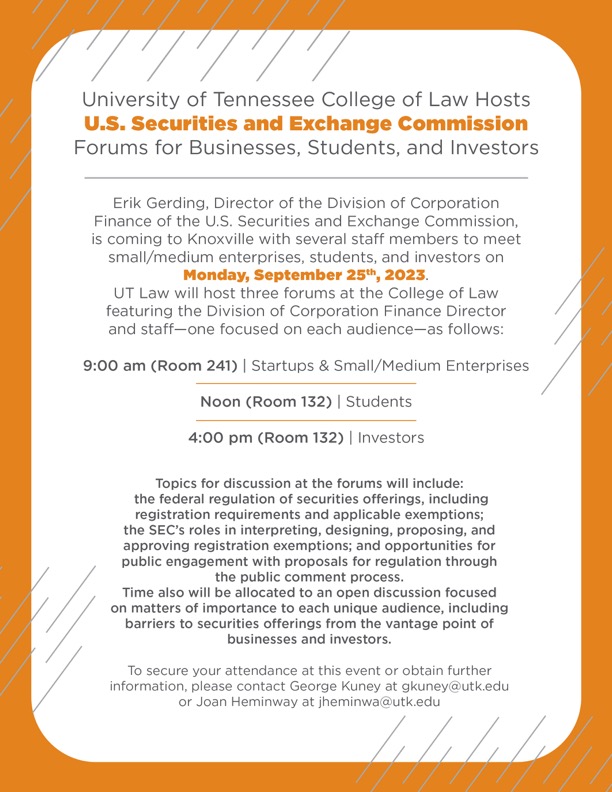
It was so much find to have our business law prof colleague Erik Gerding and two fabulous key members of his staff here in Knoxville yesterday.  I had posted on this visit last week.  Our visitors regaled us on the role of the U.S. Securities and Exchange Commission (“SEC”) Division of Corporation Finance, the registration requirements and exemptions under the Securities Act of 1933, as amended (“1933 Act”), and the rule-making part of the Division’s (and SEC’s) mission.

Erik explained how, when he is teaching Securities Regulation, he spends two classes at the beginning of the semester putting the “fear of God” into his students about the registration requirement in Section 5 of the 1933 Act.  (His point is to make the dangers clear up front, since students tend to drop the class who should take it, given that they plan to practice business law in one way or another.)  Erik’s colleague, Jennifer Zepralka, Chief of the SEC’s Office of Small Business Policy, similarly noted in her remarks that there are only three kinds of securities offerings: registered, exempt from registration, and illegal.  Erik’s Counsel, Jeb Byrne, echoed this.  And in the session at lunch time, one of my

We are excited to welcome our colleague Erik Gerding, the Director of the U.S. Securities and Exchange Commission Division of Corporation Finance, together with members of his staff, to The University of Tennessee College of Law a week from today. Information about the visit is included below.  If you are in the neighborhood, stop by!

SECFlyer

Thanks to my dear and patient friend and colleague Nizan Packin, I set out on a research and writing adventure a bit more than eighteen months ago.  The result is a book chapter on NFTs for her forthcoming edited volume, The Cambridge Handbook for the Law and Policy of NFTs.  The chapter is entitled “Non-investment Finance in an NFT World.”  At her suggestion, I recently posted the draft chapter to SSRN.  You can find it here, and the abstract is set forth below.

Recent years have witnessed the rise of NFTs as vehicles for non-investment finance, including in nonprofit and political fundraising. As with other financial sectors in which NFTs have a role, the use of NFTs in financing nonprofits and political campaigns and committees has revealed gaps and ambiguities in existing legal regulatory systems. Appetite exists to evolve legal frameworks to complete and clarify applicable bodies of law and regulation.

This chapter undertakes to illuminate and reflect on the use of NFTs in financing nonprofits, political campaigns, and political committees. It begins by reviewing general aspects of the non-investment Internet finance environment and then describes and illustrates the use of NFTs in nonprofit and political fundraising.

image from siliconflatirons.org

Friend-of-the-BLPB Andrew Schwartz has written his first book on a topic about which we both enjoy thinking and researching and writing: investment crowdfunding.  We have been cohabiting this corporate finance space for more than ten years now.  All credit is due to Andrew for laying down these words—his hard-fought wisdom—in a book.  He captures so much about the law and regulation of crowdfunding in the investment context in this volume.  I had the opportunity to offer some feedback to Andrew during the drafting process.   I recommend having the book on your bookshelves.

Colorado Law is hosting an event on its campus in Boulder on September 8, The Future of Startup Finance: A Symposium on “Investment Crowdfunding”, honoring the release of the book, which is entitled Investment Crowdfunding.  If you are in the neighborhood, you’ll want to stop by.  Among the invited speakers are many friends from the corporate finance law academy, as well as former SEC Commissioner Allison Herren Lee.

Congrats to Andrew!

Greetings from SEALS, where I’ve just left a packed room of law professors grappling with some thorny issues related to ChatGPT4, Claude 2, Copilot, and other forms of generative AI. I don’t have answers to the questions below and some are well above my pay grade, but I am taking them into account as I prepare to teach courses in transactional skills; compliance, corporate governance, and sustainability; and ethics and technology this Fall.

In no particular order, here are some of the questions/points raised during the three-hour session. I’ll have more thoughts on using AI in the classroom in a future post.

  1. AI detectors that schools rely on have high false positives for nonnative speakers and neurodivergent students and they are easy to evade. How can you reliably ensure that students aren’t using AI tools such as ChatGPT if you’ve prohibited it?
  2. If we allow the use of AI in classrooms, how do we change how we assess students?
  3. If our goal is to teach the mastery of legal skills, what are the legal skills we should teach related to the use of AI? How will our students learn critical thinking skills if they can

Ciao, from Italy.

Tomorrow, I have the privilege of sharing my work in an international symposium at the University of Genoa at the invitation of Vanessa Villanueva Collao.  This symposium offers a unique opportunity for transnational collaboration among corporate governance scholars.  We also are celebrating Vanessa’s completion of her J.S.D. degree (University of Illinois 2023).  

I am presenting my paper, forthcoming in the Michigan State Law Review, on civil insider trading in personal networks.  This is the companion paper to my article on criminal insider trading in personal networks, recently published in the Stetson Business Law Review and part of my larger, long-term project on U.S. insider trading in friendships and family situations.  As many readers may know, this project has fascinated me for a number of years now.  Each phase of the project offers new insights.  And each audience helps provide valuable food for thought. I am confident that the participants in and audience members at tomorrow’s symposium will be no exception.  I look forward to the interchanges on my work and the work of others being featured.

The program for the symposium is included below.  You will see more than a few fascinating members of the U.S.