The University of Tennessee College of Law’s business law journal, Transactions: The Tennessee Journal of Business Law, recently published my essay, “The Fiduciary-ness of Business Associations.”  You can find the essay here.  This essay–or parts of it, anyway–has been rattling around in my brain for a bit.   It is nice on a project like this to be able to get the words out on a page and release all that tension building up inside as you fashion your approach.

The abstract for the essay is included below. 

This essay offers a window and perspective on recent fiduciary-related legislative developments in business entity law and identifies and reflects in limited part on related professional responsibility questions impacting lawyers advising business entities and their equity owners. In addition—and perhaps more pointedly—the essay offers commentary on legal change and the legislative process for state law business associations amendments in and outside the realm of fiduciary duties. To accomplish these purposes, the essay first provides a short description of the position of fiduciary duties in U.S. statutory business entity law and offers a brief account of 21st century business entity legislation that weakens the historically central role of fiduciary duties in unincorporated

CGC(20thAnn&NeelCeleb-2023)
Earlier today, I had the honor of making a brief presentation at a luncheon honoring both the 20th anniversary of the Corporate Governance Center at The University of Tennessee, Knoxville, and a dear colleague and mentor, C. Warren Neel, who passed away at the end of March.  Set forth below are the reflections I shared at the luncheon–in relevant part.   These are my prepared remarks, but I often comment extemporaneously, rather than read.  So, please understand that I did not exactly say what is set forth below, although it accurately captures the content I delivered.

+     +     +

Lawyers must be lawyers, and so I start with law.

On July 30, 2002, President George W. Bush signed into law the Sarbanes-Oxley Act of 2002—the most broad-based federalization of corporate governance since the adoption of the federal securities law regime itself in the 1930s. It was in the shadow of that landmark legislation that The University of Tennessee’s Corporate Governance Center—now appropriately named the Neel Corporate Governance Center—was born. Like the legislation itself, the Corporate Governance Center cast a wide net. As an interdisciplinary research program that includes the College of Law and the College of Business

Friend-of-the-BLPB Tom Rutledge alerted me earlier today to a Thomson Reuters piece on the TripAdvisor reincorporation litigation that quotes not one but two of our blogger colleagues: Ann Lipton and Ben Edwards (in that order).  Ann is quoted (after a mention and quotation of one of her recent, more entertaining tweets) on the Delaware judicial aspects of the case.  Ben is quoted on the Nevada corporate law piece.  So great to see these two offering their legal wisdom on this interesting claim.

Ann’s tweet (perhaps predictably) offers a different “take” on Nevada law than Ben’s press statements.

Ann: “I tell my students, Nevada is where you incorporate if you want to do frauds . . . .” 

Ben: “The folks here are people acting in good faith, trying to do what’s right – not cynically racing to the bottom . . . .”

And then Ben gets the last word: “Nevada . . . has become a home for billionaires leaving Delaware in a huff.”

Beautiful.

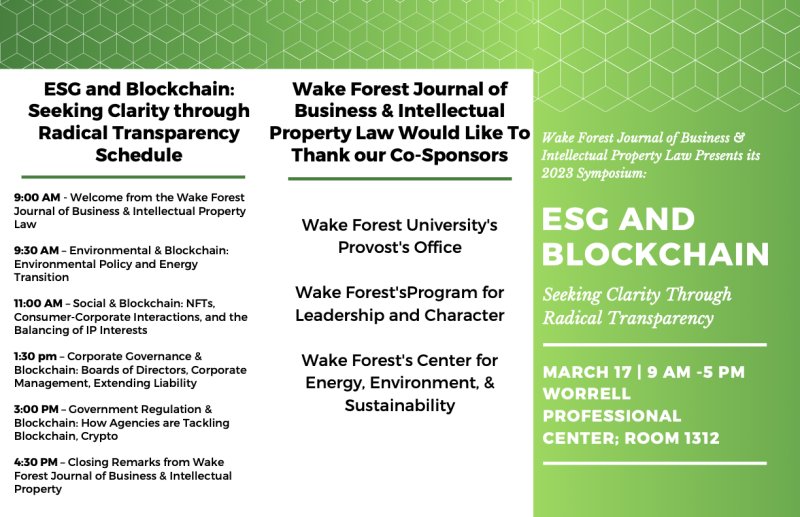
I am honored to be speaking later today on ESG, blockchains, and corporate governance at this symposium at Wake Forest University School of Law.  This practitioner-centered symposium promises to offer significant information useful to my teaching and scholarship.  My fellow speakers hail from law firms and other organizations across the United States.  I am excited to share and learn!

WakeForest2023(Flyer)

As I noted in a post a few weeks ago, I am presenting on corporate fiduciary duties tonight as the Roy/Demoulas Distinguished Professor of Law and Business at the Waystar/ROYCO School of Law.  The title of my presentation is: What the Roys Should Learn from the Demoulas Family (But Probably Won’t).  The presentation will run from 9:00 pm to 10:00 pm Eastern on Zoom at the following link:  https://us02web.zoom.us/j/86783560319?pwd=cTJza2N6elFyVGhBUFVjdk1Gb2oxQT09.

If you do not know about the Demoulas family and their fiduciary duty tangles up in Massachusetts, my presentation will inform you (and may even get you interested).  Members of the family were locked in litigation with each other for over 20 years.  Much of that litigation relates to alleged breaches of corporate and trust fiduciary duties.  And for those who have not watched the HBO Max series Succession, I will offer a window on some of the characters and plot lines, tying them in to observations about the Demoulas family.  

I welcome your attendance and participation!

I’m an avid reader of Matt Levine’s Money Stuff newsletter.  Yesterday, he discussed a recently posted article by Dhruv Aggarwal, Albert H. Choi, and Yoon-Ho Alex Lee, Meme Corporate Governance.  Although I’ve not yet had time to review the paper, it’s now on my reading list, and I thought other BLPB readers might want to add it to theirs too!  Here’s the abstract:

In 2021, several publicly traded companies, such as GameStop and AMC, experienced a dramatic influx of retail investors in their shareholder base. This Article analyzes the impact of the “meme stock surge” phenomenon on the companies, particularly with respect to their governance outcomes and structures. The paper presents three principal findings. First, as a preliminary matter, we show how the “meme stock” frenzy was affected by the introduction of the commission-free trading platform, such as Robinhood, in 2019. We show empirically that the meme stock companies experienced a larger trading volume when commission-free trading was widely introduced. Second, we examine how the influx of retail shareholders has directly affected the governance outcomes at the meme stock companies. The main finding is that, notwithstanding the promise of more active shareholder base, meme stock companies have experienced

My mind is still reeling from my trip to Lisbon last week to keynote at the Building The Future tech conference sponsored by Microsoft.

My premise was that those in the tech industry are arguably the most powerful people in the world and with great power comes great responsibility and a duty to protect human rights (which is not the global state of the law).

I challenged the audience to consider the financial price of implementing human rights by design and the societal cost of doing business as usual.

In 20 minutes, I covered  AI bias and new EU regulations; the benefits and dangers of ChatGPT; the surveillance economy; the UNGPs and UN Global Compact; a new suit by Seattle’s school board against social media companies alleging harmful mental health impacts on students; potential corporate complicity with rogue governments; the upcoming Supreme Court case on Section 230 and content moderator responsibility for “radicalizing” users; and made recommendations for the governmental, business, civil society, and consumer members in the audience.

Thank goodness I talk quickly.

Here are some non-substantive observations and lessons. In a future post, I’ll go in more depth about my substantive remarks. 

1. Your network

As some of you may have heard, following on the success of the Yada Yada Law School, administered by friend-of-the-BLPB Greg Shill, a group of law faculty are getting together to teach classes in the waystar/ROYCO School of Law this semester.  Classes start this week.  Class meetings will be held weekly, on prescribed days, at 6pm-7pm Pacific/8pm-9pm Central/9pm-10pm Eastern.  The first two sessions are as follows:

Tuesday, January 24:
Professor Diane Kemker
Introduction: Using “Succession” (And Scripted Entertainment) to Teach Law: How and Why
[Assignment: Required: any/all of “Succession,” Seasons 1-3; Optional/recommended: any/all of “Yellowstone,” Seasons 1-5]

Wednesday, February 1:
Professor Megan McDermott
Greg Needs a Lawyer. Is He Getting an Ethical One?
[Assignment: Season 3, Ep. 2]

I will be presenting on February 16 on What the Roys Should Learn from the Demoulas Family (But Probably Won’t), a lesson on corporate law fiduciary duties.

General information is provided in the syllabus included below.  A full schedule of class sessions will be available soon.  I will publish that, too.  I hope many of you will plan on attending.

++++++++++++

WaystarROYCOlogo

SYLLABUS
“Succession and the Law”
Spring 2023

About the course

This is a completely unofficial course for lawyers

I have given several talks on ESG (environmental, social, and governance) matters in the past few months.  And, of course, it is a subject discussed in the classroom.  As we celebrate the birthday of Dr. Martin Luther King Jr. today (and this week), I could not help but feel that his work provided a foundation for—somehow embraced—current ESG discussions and actions.  So, I went poking around on the Internet.

I guess I am not the only one who noticed this connection.

On the environmental part of ESG, Los Padres ForestWatch offers that:

Dr. King’s actions and teachings led to many important acts being passed in congress including the Civil Rights Act of 1964 and the Voting Rights Act of 1965. It’s through this work that Dr. King created a movement that was meant for us to understand how we are mutually tied together and that all life is interrelated. It’s this structure of thinking that has led many to believe that his work was the early structure for the Environmental Justice Movement. We see after Dr. King’s passing that environmentalists were able to pass the Clean Air Act of 1970, the Clean Water Act of 1972 and the Endangered Species

An ambitious question, yes, but it was the title of the presentation I gave at the Society for Socio-Economists Annual Meeting, which closed yesterday. Thanks to Stefan Padfield for inviting me.

In addition to teaching Business Associations to 1Ls this semester and running our Transactional Skills program, I’m also teaching Business and Human Rights. I had originally planned the class for 25 students, but now have 60 students enrolled, which is a testament to the interest in the topic. My pre-course surveys show that the students fall into two distinct camps. Most are interested in corporate law but didn’t know even know there was a connection to human rights. The minority are human rights die hards who haven’t even taken business associations (and may only learn about it for bar prep), but are curious about the combination of the two topics. I fell in love with this relatively new legal  field twelve years ago and it’s my mission to ensure that future transactional lawyers have some exposure to it.

It’s not just a feel-good way of looking at the world. Whether you love or hate ESG, business and human rights shows up in every factor and many firms have built