
Last week, S.E.C Commissioner Daniel M. Gallagher, gave a speech, Activism, Short-Termism, and the SEC: Remarks at the 21st Annual Stanford Directors’ College. I agree with many of Commissioner Gallagher’s views on short-termism, and (I will semi-shamelessly note) he cited one of my earlier posts about the role of activists on board decision making. In his remarks, he said, with regard to short-termsim (i.e., companies operating for short term rather than long-term gains):

The current picture is bleak . . . 

Clearly, there’s a way for all the parties . . . to co-exist peacefully. The SEC sets a level playing field; companies manage themselves for the long-term with the vigorous oversight of the board; and activists put pressure on those companies that fall short of that ideal.[47] Unfortunately, we are not in that happy place. Rather, there seems to be a predominance of short-term thinking at the expense of long-term investing. Some activists are swooping in, making a lot of noise, and demanding one of a number of ways to drive a short-term pop in value: spinning off a profitable division, beginning a share buy-back program, or slashing capital expenditures or research and development expenses. Having inflated
In my final post on the subject of “respectability” of lawyers (the first four can be found here, here, here and here), I’d like to tie my thoughts together, discussing what the various parties can do to make Bird and Orozco’s thesis of assimilation of lawyers into corporate business teams the “new normal”.  This should give lawyers more career opportunities in the future, slow the loss of influence of the legal profession in businesses, and make legal education a more attractive choice.  Much of the discussion in academia has ignored the in-house counsel approach as being a viable option for the woes of the legal industry.  Below the fold, this post will discuss the roles that academia, in-house counsel, and business firms each may play in increasing the potential for success of a new model for business lawyers.

It’s always nice to blog and research about a hot topic. Last week I wrote about compliance challenges for those who would like to rush down to do business in Cuba- the topic of this summer’s research. Yesterday, Corporate Counsel Magazine wrote about the FCPA issues; one of my concerns. Earlier this week, I attended a meeting with the Greater Miami Chamber of Commerce and the United States International Trade Commission. Apparently, on December 17th, the very same day that President Obama made his surprise announcement that he wanted to re-open relations with Cuba, Senator Ron Wyden coincidentally sent a request to the USITC asking for an investigation and report on trade with Cuba and an analysis of restrictions. Accordingly, the nonpartisan USITC has been traveling around the country speaking to lawyers and business professionals conducting fact-finding meetings, in order to prepare a report that will be issued to the public in September 2015. Tomorrow the Miami Finance Forum is holding an event titled the New Cuba Revolution.

This will be my third and final post on business and Cuba and in this post I will discuss the focus of my second potential law review article

The AALS Annual meeting will be held in NYC in January, 2016.  The Section on Business Associations will be co-hosting a program entitled The Corporate Law and Economics Revolution 40 Years Later: The Impact of Economics and Finance Scholarship on Modern Corporate Law.

Presenters will include Judge Frank Easterbrook, Professor Roberta Romano  (Yale) and Professor Kent Greenfield (Boston College).

 The full call for papers is available here:  Download AALS Call for Papers 2016-1The deadline for submitting an abstract (please send to Professor Usha Rodrigues at  rodrig@uga.eduis August 27, 2015

I had the privilege of sitting in on a stimulating paper session on “Private Fiduciary Law” at the Law and Society Association conference in Seattle last month.  The program featured some super work by some great scholars.  My favorite piece from the session, however, is a draft book chapter written by Gordon Smith that he recently posted to SSRN.  Aptly entitled The Modern Business Judgment Rule, the chapter grapples with the current state of the business judgment rule in Delaware by tracing its development and reading the disparate doctrinal tea leaves.  Here is a summary of his “take,” as excerpted from his abstract (spoiler alert!):  “The modern business judgment rule is not a one-size-fits-all doctrine, but rather a movable boundary, marking the shifting line between judicial scrutiny and judicial deference.

In the mere 18 pages of text he uses to engage his description, analysis, and conclusion, Gordon gives us all a great gift. His summary is useful, his language is clear, and his analysis and conclusions are incredibly useful, imho.  I am no soothsayer, but I predict that this will be a popular piece of work.

Gordon posted on his paper the other day on The

Conscious

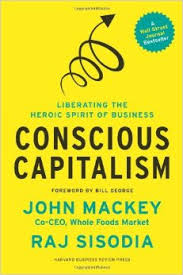
Recently, I finished reading Conscious Capitalism, written by Whole Foods Market co-CEO John Mackey and Babson College professor Raj Sisodia.

The book is much more “popular press” than academic, as should be clear from the splashy subtitle “liberating the heroic spirit of business.” There is a bit of academic influence in the appendix and notes, but it is mostly social business advocacy and story telling. In fact, the authors state that the primary purpose of the book “is to inspire the creation of more conscious businesses: businesses galvanized by higher purposes that serve and align the interests of all their major stakeholders.” (pg. 8). The book is interesting, passionate, and may accomplish its primary purpose.

The authors paint a compelling picture of Whole Foods Market and similar companies like Trader Joe’s, The Container Store, Costco, and Southwest Airlines. These companies appear to take a long-term view and consider what is best for all their stakeholders. I would have appreciated, however, more attention to the struggles the companies must have faced in attempting to satisfy all of their stakeholders. After finishing the book, I was left wishing the authors would have spent more time discussing how to make decisions in

Last week I posted the first of three posts regarding doing business in Cuba. In my initial post I discussed some concerns that observers have regarding Cuba’s readiness for investors, the lack of infrastructure, and the rule of law issues, particularly as it relates to Cuba’s respect for contracts and debts. Indeed today, Congress heard testimony on the future of property rights in Cuba and the claims for US parties who have had billions in property confiscated by the Castro government- a sticking point for lifting the embargo. (In 1959, Americans and US businesses owned or controlled an estimated 75-80% of Cuban land and resources). Clearly there is quite a bit to be done before US businesses can rush back in, even if the embargo were lifted tomorrow. This evening, PBS speculated about what life would be like post-embargo for both countries. Today I will briefly discuss the Cuban legal system and then focus the potential compliance and ethical challenges for companies considering doing business on the island.

Cuba, like many countries, does not have a jury system. Cuba’s court system has a number of levels but they have both professional judges with legal training, and non-professional judges who are

On June 11, 2015, the Delaware House of Representatives joined the Delaware Senate in passing a bill that would prohibit fee-shifting bylaws by Delaware stock corporations. The bill awaits signature by Delaware Governor Jack Markell. Nonetheless, the panel provides a nice debate, between practicing attorneys, and is available here. The information from the Chancery Daily is below. 

Fordham Law School hosted a panel on Fee Shifting in Shareholder Litigation, featuring three members of the corporate law council of the Delaware State Bar Association, which submitted proposed amendments to the Delaware General Corporation Law that would preclude the adoption of fee-shifting provisions in corporate instruments, on Thursday, March 26, 2015.  A webcast video of the panel is now available online here.
 
Moderated by:

Professor Sean J. Griffith – Fordham Law School

Panelists:

Frederick Alexander – Morris Nichols Arsht & Tunnell
Chris Cernich – Institutional Shareholder Services
Kurt Heyman – Proctor Heyman Enerio
Mark Lebovitch – Bernstein Litowitz Berger & Grossman
Norman Monhait – Rosenthal Monhait & Goddess
Andrew Pincus – Mayer Brown

Apparently, there is a split of opinion on what some people believe God wants the world to do about the climate. On one side, Senator Jim Inhofe does not believe the man is responsible for climate change. He has publicly stated that, “[T]he Genesis 8:22 that I use in there is that ‘as long as the earth remains there will be seed time and harvest, cold and heat, winter and summer, day and night.’ My point is, God’s still up there. The arrogance of people to think that we, human beings, would be able to change what He is doing in the climate is to me outrageous.” When I mentioned this quote to a European audience at a conference on climate change and business in 2013, there was an audible gasp. He also wrote a 2012 book, The Greatest Hoax: How the Global Warming Conspiracy Threatens Your Future. His position did not change after the 2013 Intergovernmental Commission on Climate Change Report definitively declared that climate change was largely man made. This would all be irrelevant if Senator Inhofe wasn’t the Chair of the Senate committee that oversees the environment. Inhofe was the keynote speaker last week at the

Cuba has been in the news a lot lately. I’ve just returned from ten days in Havana so I could see it first hand both as a person who writes on business and human rights and as an attorney who consults occasionally on corporate issues. The first part of the trip was with the International Law Section of the Florida Bar. The second was with a group of art lovers. I plan to write two or three blog posts about the prospects of doing business in Cuba if and when the embargo is lifted. Because I do some consulting work, I want to make clear that these views are my own as an academic and should not be attributed to anyone else.

In this post I will just briefly list some basic facts about Cuba and foreign investment. Next week I will talk a bit more about investment, introduce the Cuban legal system, and talk about some of the business and compliance challenges. That’s the subject of my research this summer. The following week I will address human rights in Cuba and how various governments and businesses are addressing those issues, the subject of another article I am