Decent amount of reading for a summer than seemed quite chaotic. Fairly eclectic . Always open to suggestions. 

The Plague – Albert Camus (1947) (Novel). French-Algerian town of Oran and its citizens deal with disease, death, and loneliness. Reflection here

God and Money – John Cortines and Gregory Baumer (2016) (Personal Finance). Two recent Harvard Business School graduates discuss thoughts on faith, finances, and giving. Less than 3% of American adults give away 10% or more of their income. Advocates for setting a floor of giving away at least 10% of gross income. In addition, the authors suggest setting an income and net worth cap and giving away the remainder. Reflection here (near the end of the post). 

How to get Filthy Rich in Rising Asia – Mohsin Hamid (2013) (Novel). Family, love, business, morality, and violence. Novel claims to be written in a self-help style (though it didn’t really capture the self-help voice, in my opinion). I greatly preferred Hamid’s The Reluctant Fundamentalist (2008) to this one, but still think Hamid is talented and worth reading. As a father and a son, I liked this quote near the end – “You feel a love [toward your son] you

Yesterday, I had the pleasure of moderating a panel of Black entrepreneurs sponsored by the Miami Finance Forum, a group of finance, investment management, banking, capital markets, private equity, venture capital, legal, accounting and related professionals. When every company and law firm was posting about Black Lives Matter and donating to various causes, my colleague Richard Montes de Oca, an MFF board member, decided that he wanted to do more than post a generic message. He and the MFF board decided to launch a series of webinars on Black entrepreneurship. The first panel featured Jamarlin Martin, who runs a digital media company and has a podcast; Brian Brackeen, GP of Lightship Capital and founder of Kairos, a facial recognition tech company;  and Raoul Thomas, CEO of CGI Merchant Group, a real estate private equity group.

These panelists aren’t the typical Black entrepreneurs. Here are some sobering statistics:

  • Black-owned business get their initial financing through 44% cash; 15% family and friends; 9% line of credit; 7% unsecured loans; and 3% SBA loans;
  • Between February and April 2020, 41% of Black-owned businesses, 33% of Latinx businesses, and 26% of Asian-owned businesses closed while 17% of White-owned business closed;
  • As of 2019,

Earlier today (July 14), Fordham University hosted a webinar entitled Reopening Justly or Just Reopening: Catholic Social Teaching, Universities & COVID-19.   

Speakers on the topic of the ethics of reopening schools include the following theology professors: 

Christine Firer Hinze discussed Catholic Social Thought, human dignity, and solidarity. She reminded us that reopening universities is literally a question of life and death, but is also a question of livelihood. Gerald Beyer stressed looking to the the latest science and considering the common good (the flourishing of all). Craig Ford commented on the reality that some universities may be facing financial collapse, that the pandemic is likely to be with us for a long while, and that there are no perfect solutions. Ford also suggested a focus on protecting those who are most vulnerable. Kate Ward talked about moral injury, lamentation, and redemption. A question and answer period — including on the topics of racial justice, transparency, shared sacrifices and mental health — followed opening remarks.

What remains when the intoxicating distractions of life are removed?

Albert Camus in The Plague (1947) engages this question, and nearly 70 years later, so does Doctor Paul Kalanithi in When Breath Becomes Air (2016).

I read both of these books on vacation at Ocean Isle, NC late last month; this was not exactly light, uplifting beach reading.

Before the plague engulfed the Algerian coastal town of Oran, Camus’ narrator notes that:

Our citizens work hard, but solely with the object of getting rich. Their chief interest is in commerce, and their chief aim in life is, as they call it, “doing business.” Naturally they don’t eschew such simpler pleasure as love-making, sea bathing, going to the pictures. But, very sensibly they reserve these past times for Saturday afternoons and Sundays and employ the rest of the week in making money, as much as possible . . . . Nevertheless there still exist towns and countries where people have now and then an inkling of something different. In general it doesn’t change their lives. Still they have had an intimation, and that’s so much to the good. Oran, however, seems to be a town without intimations; in other words,

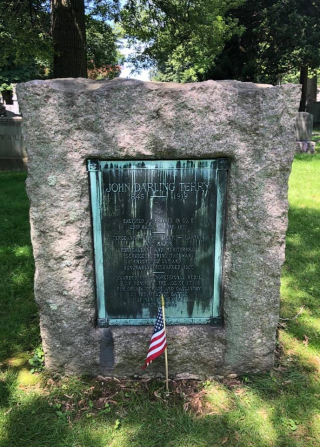
JohnDarlingTerryGravestone

As we close out the holiday weekend, I offer simple words of respect, admiration, and thanks for those who have sacrificed their lives for all of us.  Amidst the barbecues and beer and whatnot, it is sometimes difficult to remember that we take today to honor our fallen heroes.  Although I spent today working (grades for all courses due tomorrow!), I took time out to remind myself that life is not all about business law prof’ing and contemplate the importance of the day.

The photo above (taken by my brother last year) depicts a gravestone honoring one of our family’s military heroes.  He did not die in combat, but he was wounded and received the Congressional Medal of Honor.  Although we honor those kinds of commitments more directly on Veteran’s Day, I was thinking about him today–and about the thin line that divides life and death, especially in times of military conflict.

My heart goes out to all who have lost family and friends in the line of battle or otherwise in service to our country.  May those lost servants rest in peace.  And may those who remain take pride in their ultimate sacrifice.

Maybe I am just sensitized to these media reports because of my research and teaching, but it seems that the COVID-19 pandemic has sparked new media interest in and engagement with corporate governance issues.  I have received four media calls in the past few weeks–two on background and two for source quotations.  That is an unusual rate of contact for me. Is anyone else noticing this?

Of course, there has been a lot to talk about.  Annual meetings already called and noticed to shareholders needed to move online.  As managers and employees moved out of workplaces to shelter at home, well-worn systems of decision-making and information dissemination–as well as the expectations of others in connection with them–changed or were challenged.  Filing and other deadlines became guidelines . . . .

The two media calls in which I was asked to provide background information related to

  • increased or altered director and legal counsel attentiveness to drafting force majeure clauses and material adverse change/effect definitions in light of what we now know about COVID-19 and its effects and
  • prospects for various kinds of shareholder derivative, direct, and class action litigation in light of COVID-19 and related board decision making.  

I was

This has been quite a first year as a dean. Heck, it’s been quite a year for all of us.  

I woke up (very) early this morning, and it struck me that I hadn’t been in contact with our students since Friday, which was our last day of classes. I don’t want to be a distraction to their studies, but I also realized the midway through the first week, they might need a reminder of what they have accomplished in the face of unique and unprecedented challenges. Following is the note I sent our students, which I share for all of us who might need a reminder of what we’re accomplishing. It is addressed to our Creighton Law students, but it’s for all law students. Hang in there.  

Dear Students,

It’s the middle of the first week of what has to be the strangest finals we have ever experienced. This is always a time of hard work, long days, and high stress, but never before have we had to be so separate while going through it. We can’t experience study group or lunch breaks with friends, or play basketball or soccer in a group to blow off steam.

In his Wednesday post (here), co-blogger Stefan J. Padfield highlighted a recent development in the arbitration area that I also want to bring to readers’ attention.  I’m sure that all BLPB readers are a party to an arbitration agreement as these provisions have become so widespread in consumer adhesion contracts.  The New York Times recently ran a fascinating article by Michael Corkery and Jessica Silver-Greenberg, ‘Scared to Death’ by Arbitration: Companies Drowning in their Own System.  It details an innovative development in which entrepreneurial lawyers “are leaders in testing a new weapon in arbitration: sheer volume,” which is something the current arbitration system can’t handle. 

Arbitration provisions in consumer adhesion contracts generally bar class-action lawsuits and might also bar class-wide arbitration.  And it often makes little economic sense for an individual to take a large corporation to arbitration.  Not surprisingly, many don’t.  Corkery and Silver-Greenberg note that “Over the past few years, the nation’s largest telecom companies, like Comcast and AT&T, have had a combined 330 million customers.  Yet annually an average of just 30 people took the companies to arbitration…”  Now entrepreneurial lawyers such as Teel Lidow, who runs FairShake, and Travis Lenkner at

The National Center for Public Policy Research has posted an open letter to Blackrock CEO Larry Fink that should be of interest to readers of this blog.  I provide some excerpts below.  The full letter can be found here.

Dear Mr. Fink,

….

This economic crisis makes it more important than ever that companies like BlackRock focus on helping our nation’s economy recover. BlackRock and others must not add additional hurdles to recovery by supporting unnecessary and harmful environmental, social, and governance (ESG) shareholder proposals.

…. we are especially concerned that your support for some ESG shareholder proposals and investor initiatives brings political interests into decisions that should be guided by shareholder interests…. when a company’s values become politicized, the interests of the diverse group of shareholders and customers are overshadowed by the narrow interests of activist groups pushing a political agenda.

…. ESG proposals will add an extra-regulatory cost …. This may harm everyday Americans who are invested in these companies through pension funds and retirement plans. While this won’t affect folks in your income bracket, this may be the difference between affording medication, being able to retire, or supporting a family member’s education for many Americans.

There

In my post last week, I mentioned the President’s invocation of the Defense Production Act during the current COVID-19 crisis.  I was immediately curious about this law when news of the President’s March 27 memorandum focused on General Motors and ventilator production hit my radar screen (a/k/a, my laptop, which has effectively become my lap these days).  Surely, it must be unusual for the U.S. government, I thought, to direct the nature, means, and timing of production and supply.  That seems antithetical to the spirit, if not the letter, of U.S. capitalism.  However, the more I read, the less curious and concerned I am, at least for the moment.  Perhaps some of the reporting in this area is more geared to generating a splashy news item than, well, alerting us to something truly unusual or troubling.  Nevertheless, I will make a few foundational points on the Act here.  I may have more to say later.

The Defense Production Act of 1950 can be found in Chapter 55 of Title 50 of the U.S. Code.  The Act recognizes that “the security of the United States is dependent on the ability of the domestic industrial base to supply materials and services