Further to Ann’s post on Sunday sharing the text of her comment letter on Delaware’s S.B. 313 (and more particularly the proposal to add a new § 122(18) to the General Corporation Law) and my post on § 122(18) last week, I share below the text of my comment letter to the Delaware State House of Representatives Judiciary Committee.  Although Ann and I each got one minute to deliver oral remarks at the hearing held by the Judiciary Committee on Tuesday, 60 seconds was insufficient to convey my overarching concerns–which represent a synthesis and characterization of selected points from my post last week.  The comment letter shared below includes the prepared remarks I would have conveyed had I been afforded additional time.

Madame Chair and Committee Members:

I appreciated the opportunity to speak briefly at today’s hearing. As I explained earlier today, although I am a professor in the business law program at The University of Tennessee College of Law, my appearance before the committee relates more to my nearly 39 years as a corporate finance practitioner, which has included bar work (most recently and extensively in the State of Tennessee) proposing and evaluating corporate and other business

Like so many others, I have wanted to say a word about West Palm Beach Firefighters’ Pension Fund v. Moelis & Company, 311 A.3d 809 (Del. Ch. 2024).  My angle is a bit different from that of many others.  It derives from my 15-year practice background, my 24-year law teaching background, and my 39-year bar service background.  It focuses on a doctrinal analysis undertaken through a policy lens.  But I want to note here the value of Ann Lipton’s existing posts on Moelis and the related proposed addition of a new § 122(18) to the General Corporation Law of the State of Delaware (DGCL).  Her posts can be found here, here, here, and here.  (Sorry if I missed one, Ann!)  Ben Edwards also published a related post here.  They (and others offering commentary that I have read) raise and touch on some of the matters I address here, but not with the same legislative policy focus.

I apologize at the outset for the length of this post.  As habitual readers know, long posts are “not my style” as a blogger.  This matter is one of relatively urgent legislative importance, however, and I am eager

Over the years, I have written a number of blog posts here on Memorial Day that honor those who sacrificed their lives for us through national military service.  You can find the last few here, here, and here.  When practicable, I work in something about business law in those posts.

This year, as I contemplated what to write, I also was mired in grading and other teaching-related work.  On my mind throughout was generative artificial intelligence, a hot topic in law school circles and throughout education (and, of course, elsewhere, too).  The full range of benefits and burdens of generative artificial intelligence still remain to be discovered.

I wondered what a generative artificial intelligence tool would draft up as a blog post for Memorial Day.  Then, I thought, why wonder?  Why not give it a whirl?  So, I asked Google Gemini to “[w]rite a short blog post that combines business law with Memorial Day.”  Set forth below is what I got back.

Honoring Heroes, Respecting Rights: Business Law and Memorial Day

Memorial Day is a time to remember the brave men and women who died serving our country. But for businesses, it also presents some legal considerations.

ESG greenwashing has been getting attention among legal academics.  In Rainbow-Washing, 15 Ne. U. L. Rev. 285 (2023), LMU Law’s John Rice explores the

increasingly common, but destructive, practice in which corporations make public-facing statements espousing their support of the LGBTQIA+ community . . . to draw in and retain consumers, investors, employees, and public support, but then either fail to fulfill the promises implicit in those statements or act in contravention to them. 

My own forthcoming article in the University of Pennsylvania Journal of Business Law, presented at the November 2023 ILEP-Penn Carey Law symposium honoring Jill Fisch, mentions the increasing notoriety of ESG greenwashing and cites to John’s article.

Last week, UVA Law Professor Naomi Cahn called out ESG greenwashing in Forbes, citing to a study to be published in the Journal of Accounting Research that finds “firms’ ESG rhetoric may not match their reality.”  She suggests that “a meaningful analysis of a firm’s ESG commitment requires much further digging, and ultimately it requires meaningful oversight from outside the ESG community on what should be disclosed and the accuracy of the reports.”  The article references a forthcoming book coauthored by Cahn, June Carbone (Minnesota

Check out the third issue of volume 73 of the DePaul Law Review!  It includes a series of papers emanating from the HBO series Succession.  As you may recall, I posted a call for papers for this issue about a year ago.  Most of the papers in the issue came from a venture originated and organized by Susan Bandes and Diane Kemker called the Waystar Royco School of Law.  I wrote about that enterprise here.  

I participated in the Waystar Royco School of Law Zoom meetings as the “Roy/Demoulas Distinguished Professor of Law and Business.”  I presented on fiduciary duty issues comparing the principals of two family businesses–The Demoulas family from Northern Massachusetts and Succession‘s Roy family from New York.  You can find my Zoom session here (Passcode: #hN+7J5N).  That presentation resulted in an essay that I wrote for the DePaul Law Review issue as well as an advanced business associations course based on the Succession series. I finish teaching that course this week.  I also presented on the topic of my Succession essay at the Popular Culture Association conference back in March.  I include a screenshot of my cover slide below.

I just posted the

A federal jury found Matthew Panuwat liable for insider trading late last week.  As you may recall, the U.S. Securities and Exchange Commission (SEC) brought an enforcement action against Mr. Panuwat in the U.S. District Court for the Northern District of California back in August 2021.  In that legal action, the SEC alleged that Mr Panuwat violated Section 10(b) of the Securities Exchange Act of 1934, as amended, and Rule 10b-5, seeking a permanent injunction, a civil penalty, and an officer and director bar. The theory of the case, as described by the SEC in a litigation release, was founded on Mr. Panuwat’s deception of his employer, Medivation, Inc., by using information obtained through his employment to trade in the securities of another firm in the same industry.

Matthew Panuwat, the then-head of business development at Medivation, a mid-sized, oncology-focused biopharmaceutical company, purchased short-term, out-of-the-money stock options in Incyte Corporation, another mid-cap oncology-focused biopharmaceutical company, just days before the August 22, 2016 announcement that Pfizer would acquire Medivation at a significant premium. Panuwat allegedly purchased the options within minutes of learning highly confidential information concerning the merger. According to the complaint, Panuwat knew that investment bankers had cited Incyte

Sometimes, the scholarly enterprise offers one the opportunity to deeply learn while sharing embedded knowledge.  I never thought that my 2022 Southeastern Association of Law Schools discussion group on Elon Musk and the Law would turn into such a rich learning experience.  But it did.  

In organizing the group, I knew folks would focus on all things Twitter (especially as the year proceeded).  But because of the kind offer of the Stetson Law Review to host a symposium featuring the work of the group and publish the proceedings, I was able to dig in a bit deeper in my work, which focused on visioning what it would be like to represent Elon Musk.  The resulting article, “Representing Eline Musk,” can be found here.  The SSRN abstract follows.

What would it be like to represent Elon Musk on business law matters or work with him in representing a business he manages or controls? This article approaches that issue as a function of professional responsibility and practice norms applied in the context of publicly available information about Elon Musk and his business-related escapades. Specifically, the article provides a sketch of Elon Musk and considers that depiction through a professional conduct lens

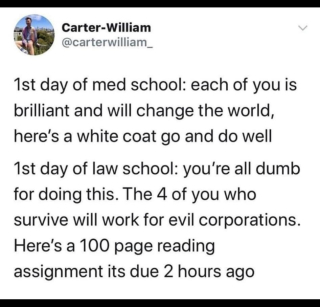
The meme below has been going around about the different framing for medical school and law school. I get why it is kind of amusing, but it is mostly rather upsetting because it resonates too readily with too many people.

IMG_4694

Although that has never been the institutional approach anywhere I have been, I will concede that there are at least some faculty members (and plenty members of the bench and bar) who think this way about law school and the legal profession. 

When I became a dean, I decided to do it, in part, because of how much I believe in the legal profession and what we are charged to do.  I believed, and I continue to believe, that lawyers are there to help people in what is often their worst of times.  Even when it is not bad, it is still usually a very significant time.  At the risk of being cliché, that means our jobs come with great power and responsibility. 

Despite what you may hear, our law students today are capable, smart, and caring.  They may not view the world the way we did, but we didn’t view the world the same as our predecessors, either.  There

A U.S. District Court judge sitting in the Northeastern Division of the Northern District of Alabama found the Corporate Transparency Act (affectionately referred to in short form as the CTA) unconstitutional as detailed in a memorandum opinion issued on Friday.  The opinion granted the plaintiffs, the National Small Business United (NSBU) and Isaac Winkles, an NSBA member, their summary judgment motion on this basis.  The accompanying final judgment permanently enjoined the Secretary of the Treasury and other government defendants, as well as “any other agency or employee acting on behalf of the United States,” from enforcing the Corporate Transparency Act against the plaintiffs in the litigation.

Many of us business law profs–and all of our business law practice brethren–have been following the CTA, endeavoring to gain a more comprehensive understanding of its provisions and fashioning advice on compliance.  The CTA, enacted in 2021 and effective as of January 1, 2024, requires nonexempt companies (domestic or foreign corporations, limited liability companies, and other entities formed or, in the case of foreign entities, registered to do business in any U.S. state or tribal jurisdiction) to disclose certain information, including about their beneficial owners, to the Financial Crimes Enforcement Network (FinCEN), part of

If you happen to be in Miami or think it’s worth it to fly there next week, this is for you. I’ll be moderating the panel on regulatory considerations for promoters and influencers and we have student teams competing from all over the country. 

February 29 – March 1
University of Miami

Content is king. We live in the golden age where content creators, artists, and influencers wield power and can shift culture. Brands want to collaborate. Creators need to be sophisticated, understand deal points and protect their brand and intellectual property. Miami Law will be the first law school in the country to pull together law students with leading lawyers, influencers, artists, creatives and trendsetters for a negotiation competition and conference.  

Negotiation Competition – Thursday, February 29 

Where

Shalala Student Center, 1330 Miller Drive, Coral Gables, FL 33146

Who Should Participate

This competition is ideal for law and business students. THE. TEAMS ARE FINALIZED ALREADY.

What to Expect

Participants will have the chance to represent influencers, brands, artists, fashion companies and other creators in the first ever Counseling Creators: Influencers, Artists and Trendsetters Negotiation Competition

  • Register a team of law students (can include business school students)
    1. Team of