
Screenshot 2019-07-05 15.51.43

The dark side of entrepreneurial finance

Editors: Arvind Ashta, Olivier Toutain

Theme of the special issue

Whether we are talking about start-ups, more recently “grow up” or more broadly about company creation-takeover, entrepreneurial finance attracts a lot of attention, from the entrepreneurs’ side and from the side of private and public financing organisations and the media. Entrepreneurial finance includes Founder’s equity, Love Money, Business Angel, Venture Capital, LBO Funds, banks, IPOs and various alternative financing treated as shadow banking: micro-credit, loan sharking, leasing, crowdfunding, Initial Coin Offerings, among others (Block, Colombo, Cumming, & Vismara, 2018; Wright, Lumpkin, Zott, & Agarwal, 2016).

Financing is considered as an inherent dimension of the entrepreneurial development process (Panda, 2016; Yunus, 2003). Without financing, there is no investment and, therefore, little chance of starting a business with adequate production tools and an organization capable of absorbing the trials and tribulations of starting and developing entrepreneurial activities. Without funding, the risk of lack of legitimacy is also high: what does it mean in the entrepreneurial ecosystem not to have the support of one or more funding agencies? More so in the start-up world! Is that conceivable? Finally, can the entrepreneur now free himself from financial support, even if he does not really need it to start his business? If the reasoning is pursued further, does the entrepreneur have a choice? In other words, is it possible to create and develop your company without mobilizing the financial resources of the territory? Without entering into a financial system and ecosystem that regulates the creation and takeover of companies in a territory? Or a system that pushes the entrepreneur to finance so much that the system itself collapses by bringing forth a financial crisis (Boddy, 2011; Diamond & Rajan, 2009; Donaldson, 2012; Guérin, Labie, & Servet, 2015; Mishkin, 2011).

Applying for funding today is often considered as a difficult adventure: is it really a fighter’s path given the particularly numerous mechanisms in France? But are they also numerous in Europe? In the world? Is the cost of financing transparent or hidden (Attuel-Mendes & Ashta, 2013)? In any case, to adventure is to walk and remove obstacles while following a guide… often at the funder’s request… which is often called coaching or mentoring. Or following the guide, sometimes – or often, depending on the reader’s appreciation – results in respecting rules, imposed steps, in short, to adopt a good conduct… to such an extent that the entrepreneur can lose track of his North Star, or at least part of his project, modified by “pitching” and integrating the comments, suggestions, strong suggestions of potential funders… In other words, if we push the reflection further, the accompanying logic proposed in the form of good intentions by the funders of an ecosystem, are they not likely, by force, to respond to external constraints, to generate effects opposite to expectations: inhibited entrepreneurs, whose project has lost its originality, vitality and excellence through the coaching or mentoring of initially imagined value creation (Collewaert, 2009)? Isn’t the finance injected into the support systems finally a Dr Jekyll and Mr Hyde of entrepreneurship? In other words, if it constitutes an unprecedented measure of support for entrepreneurial growth in the world, does it not at the same time generate “antipreneurial” effects? Normative and highly biased, do financial actors deserve such a place in the creative process? What is it that basically legitimizes their central place? (Bateman, 2010; Sinclair, 2012) What is the hidden face of entrepreneurial finance (Henderson & Pearson, 2011; Krohmer, Lauterbach, & Calanog, 2009; Toe, Hollandts, & Valiorgue, 2017)?

The purpose of this issue is to extract itself from the normative fields and discourses that highlight, in the vast majority of cases, the important role of finance in the development of entrepreneurship, whether purely economic, social or environmental. In other words, we are asking ourselves here about the secondary, even hidden, effects of finance on the emergence and development of new companies in France and around the world.

The proposals will address, among other things, the following topics:

  • What place does finance occupy today in the feeling of success and accomplishment of an entrepreneurial activity?
  • How do entrepreneurs interact with potential funders?
  • How do funders dialogue with each other?
  • How do funders make their investment decisions? Rationality, Short termism, information asymmetry….
  • How do entrepreneurs and funders negotiate? On which elements of the project or company? Are there any losers? What is lost in the process?
  • How does the relationship between entrepreneurs and funders change over time?
  • Can finance harm the value creation produced by entrepreneurial activity? Can it affect entrepreneurial freedom?
  • Is it possible to free oneself from financing circuits? How?

Finally, what is the dark side of entrepreneurial finance?

Timeline:

Submission of texts: By April 30, 2020 at the latest

Publication: March 2021

[I have omitted here the list of references supporting the text citations.  Please contact me by email if you would like a .pdf copy of the call for papers that includes the list.  There is more information after the jump.]

GruninBanner_2019_0

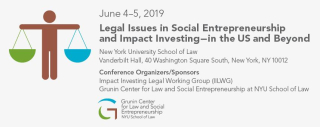
Earlier this month, I attended and presented at the 2019 Legal Issues in Social Entrepreneurship and Impact Investing–in the US and Beyond conference co-organized by the Impact Investing Legal Working Group and the Grunin Center for Law and Social Entrepreneurship at the NYU School of Law.  My friends Deb Burand and Helen Scott (also my Corporations and Securities Regulation professor when I was at NYU Law) co-direct the Grunin Center.  They organized a super conference this year.  Each year, the conference draws more folks–and with good reason.

I presented as part of a panel that compared and contrasted the use of different forms of entity for social enterprise businesses.  My role was (perhaps predictably, given that I wrote this piece) to defend the use of traditional for-profit corporations for this purpose.  I got some love from the panel and the audience, but so did others with different views . . . .

One of the nifty features of this conference is the use of lunchtime slots for “table talks” (roundtable discussions) and workshops.  I attended a table talk entitled “Gender Lens Investing: A Year in Review and A Look Ahead” and a workshop on “Re-Designing Legal Education for Lawyers, Social

My friend and colleague, Priya Baskaran, asked me to post the following, which I am happy to do: 

Over the past year, a critical mass of law school faculty and staff have expressed interest in establishing an AALS Section on Community Economic Development (CED). The proposed section will provide a dynamic, collaborative environment to enhance the scholarship, activism, and direct legal work of CED-focused faculty and professional staff. Notably, the section will help bridge existing gaps between various actors in the CED universe by increasing opportunities for networking and enabling greater synergy and collaboration between scholars and experts in various substantive subjects and disciplines related to CED. Interested faculty and professional staff are invited to read the full petition.

I think this is a great idea, and I will be signing the petition (here).  I have been working with an interdisciplinary group on my campus, WVU Center for Innovation in Gas Research and Utilization (CIGRU). We are a multidisciplinary group of researchers who are experts in science, engineering, environmental, policy, law, and finance. The CIGRU conducts research and services relevant to gas, oil, and chemicals. Our experimental research includes broad areas covering catalysis, reaction engineering, material science, power generation, and gas turbine. The CIGRU undertakes U.S. government- and industry-funded research projects developing clean and renewable energy technologies. Our services include air emission control, regulatory and policy, law and finance relevant to shale gas.

I have been leading CIGRU’s Economic and Community Development Group for the past few years.  About 18 months ago, CIGRU earned a five-year seed grant awarded by the West Virginia Higher Education Policy Commission, under its Research Challenge Grant program. The WVU gas utilization team includes eight CIGRU researchers, working in partnership with Marshall University, the WVU Energy Institute, the WVU Bureau for Business and Economic Research, the West Virginia Chemical Alliance Zone, Morgantown’s National Energy Technology Laboratory and the Mid-Atlantic Technology, Research and Innovation Center. So, this idea resonates with me. I think this is a great idea, and it has my support. If you agree, I hope you’ll sign on, too.  

For anyone interested, CIRGUs grant announcement and a description of the program are available after the jump. 

Boston University School of Law is seeking to hire a full-time attorney in its Startup Law Clinic (the “Clinic”). The Clinic is part of BU Law’s Entrepreneurship, Intellectual Property, and Cyberlaw Program, which is a unique collaboration between BU Law and the Massachusetts Institute of Technology.

The Clinic represents current students at MIT and BU on matters related to a wide range of legal issues faced by early-stage business ventures. The attorney would be expected to help law students counsel clients and represent students in transactional settings. Clients often present questions of law involving for-profit and nonprofit entity formation, allocations of equity, startup financing, employment and independent contractor issues, ownership of intellectual property, privacy policies, terms of service and other third-party contractual relationships, and trademark and copyright matters. Experience representing startup ventures is considered a plus.

The attorney’s primary responsibility will be to supervise and assist students with direct client representation matters. The attorney will also assist the Clinic Director and Assistant Director in preparing and teaching a year-long seminar for students enrolled in the Clinic, including developing materials, performing research, and coordinating classroom activities and guest presentations. The position is a year-round position and the attorney also would work

I’d like to thank the Business Law Prof Blog for the opportunity to be a guest blogger!  In this first post, I build on a subject of previous posts (here, here, and here): Theranos, a now defunct Silicon Valley health-care start-up.

I rely heavily on the Financial Times to follow developments in one of my main research areas: financial market clearing and settlement (I’ll plan to report next week on the upcoming December 4th meeting of the Market Risk Advisory Committee, sponsored by CFTC Commissioner Rostin Behnam).  The FT recently announced that Wall Street Journal investigative reporter John Carreyrou’s book, Bad Blood: Secrets and Lies in a Silicon Valley Startup, had been named the FT/McKinsey Business Book of the Year 2018.  Having immensely enjoyed reading past winners, I wasted no time in ensuring that Amazon Prime speedily delivered it to my doorstep. 

Bad Blood is a riveting tale of Theranos’ spectacular rise and fall, and well-worth the reader’s time.  A fun fact is that a pathologist blogger, Adam Clapper (founder of the former Pathology Blawg), tipped Carreyrou onto the Theranos story (Chapter 19).  Additionally, in the months after Bad Blood’s publication, its

Tom Rutledge, at Kentucky Business Entity Law Blog, writes about a curious recent decision in which the Kentucky Court of Appeals overrule a trial court, holding that the law of piercing the veil required the LLC veil to be pierced. Tavadia v. Mitchell, No. 2017-CA-001358-MR, 2018 WL 5091048 (Ky. App. Oct. 19, 2018).

Here are the basics (Tom provides an even more detailed description):

Sheri Mitchell formed One Sustainable Method Recycling, LLC (OSM) in 2013. Mitchell initially a 99% owner and the acting CEO with one other member holding 1%. Mitchell soon asked Behram Tavadia to invest in the company, which he did.

He loaned OSM $40K at 6% interest from his business Tavadia Enterprises, Inc. (to be repaid $1,000 per month, plus 5% of annual OSM profits).  There was no personal guarantee from Mitchell.  OSM then received a $150,000 a business development from METCO, which Tavadia personally guaranteed and pledged certain bonds as security.

Two years (and no loan payments) later under the original $40,000 loan, Tavadia agreed to delay repayment. OSM and Tavadia the created a second loan for $250,000, refinancing the original $40,000 and a subsequent Tavadia $12,000 loan.  This loan provided Tavadia a 25% ownership interest

Friend of the Business Law Prof Blog Anat Beck recently posted a draft of her article entitled Unicorn Stock Options – Golden Goose or Trojan Horse? on SSRN.  I heard presentations on earlier versions of this piece, which I personally find quite intricate and interesting.  An excerpt fro the SSRN abstract follows:

This article examines a contemporary puzzle in Silicon Valley – is there a shift in unicorn employees expectations that results in labor contracting renegotiations? It explores the challenges faced by unicorn firms as repeat players in competitive technology markets. It offers the following possible solutions. First, new equity-based compensation contracts, and critiques them. Second, alternatives to the traditional liquidity mechanisms, and critiques them.

It concludes with proposals to remove legal barriers to private ordering, and new mandatory disclosure requirements.

The article has been picked up by the Harvard Law School Forum on Corporate Governance and Financial Regulation and linked to in a Matt Levine column for Bloomberg.  This is a good read, especially for those of you interested in entrepreneurial business law (which is Anat’s speciality).

We’re a month away from our second annual Business Law Professor Blog CLE, hosted at the University of Tennessee on Friday, September 14, 2018. We’ll discuss our latest research and receive comments from UT faculty and students. I’ve entitled my talk Beyond Bitcoin: Leveraging Blockchain for Corporate Governance, Corporate Social Responsibility, and Enterprise Risk Management, and will blog more about that after I finish the article. This is a really long post, but it’s chock full of helpful links for novices and experts alike and highlights some really interesting work from our colleagues at other law schools.

Two weeks ago, I posted some resources to help familiarize you with blockchain. Here’s a relatively simple definition from John Giordani at Forbes:

Blockchain is a public register in which transactions between two users belonging to the same network are stored in a secure, verifiable and permanent way. The data relating to the exchanges are saved inside cryptographic blocks, connected in a hierarchical manner to each other. This creates an endless chain of data blocks — hence the name blockchain — that allows you to trace and verify all the transactions you have ever made. The primary function of a

I am both a business law professor and an energy law professor, which is sometimes surprising to people. That is, some folks are surprised that have a research focus in two areas that are seemingly very distinct.  In one sense, that’s true, at least in the academic realm.  Most energy law scholars tend to have a focus on more close related disciplines, such as environmental law, administrative law, and property law.  And business law scholars tend to trend toward things like commercial law, bankruptcy, tax, and contracts.  

There is substantial overlap, though, in the energy and business law spaces, as I have noted on this blog before. I am even working on some research that looks specifically at the role laws and regulations have on business and economic development.   My work with the WVU Center for Innovation in Gas Research and Utilization builds on this energy and business nexus. 

I am pleased to share a newly published article I wrote with Amy Stein from the University of Florida’s Levin College of Law. The piece is called Decarbonizing Light-Duty Vehicles, and it appears in the July issue of Environmental Law Reporter. It is available here. This article

Our colleagues and friends at the Burgundy School of Business have informed me about an opportunity to participate in the European Academy of Management (EURAM) conference to be held in Reykjavik, Iceland from June 20-23.  (Note: these dates overlap with the 2018 National Business Law Scholars Conference.)  The Strategic Interest Group on Entrepreneurship (GIS 03) for the EURAM conference has established a sub-track on the “Sharing Economy” at the EURAM 2018 meeting. Djamchid Assadi of the Burgundy School of Business is coordinating this part of the program.

Djamchid is looking for both paper submissions and reviewers for the Sharing Economy sub-track.  Paper submissions are due by January 10 (2:00 pm Belgium time) and applications to serve as a reviewer are due December 31.  (Paper presenters are required to review at least two papers at the conference.)  Information about the conference can be found here.  The reviewer application form is available here.

Please contact Djamchid at Djamchid.Assadi@bsb-education.com if you are interested in submitting a paper.  He can tell you how to designate the paper for GIS 03.  Apparently, in GIS 03, you can declare your interest in the “The Sharing Economy” subtract.  Please feel free to use my name in