
Today, I am spending my birthday attending and presenting at the Fifth Annual Midwest Symposium on Social Entrepreneurship in Kansas City, Missouri.  I owe my presence here to my entrepreneurship colleagues and friends Tony Luppino (UMKC Law) and John Tyler (Kauffman Foundation).  Thanks for the awesome birthday present, guys.

There’s so much I have to say about just the first day of this event.  (I also will be here and presenting tomorrow.)  The proceedings so far have been incredibly thought-provoking and instructive.  Most intriguing has been the focus around creating an ecosystem for social entrepreneurship.  Of course, law and lawyers have roles in that.  Hence, this blog post . . . .

Specifically, I want to devote today’s post to the four essential action-elements necessary to generate a successful, sustained future for social entrepreneurship as posited and described by Mark Beam, Maverick in Residence at the Kauffman Foundation, in his kick-off keynote presentation this morning.  (As an aside, I will note that Mark started his talk with a brief recounting of the origin of the word “maverick,” which was independently fascinating.)  Here are Mark’s four elements, as I captured them in my notes (likely imperfectly), together with a bit of summary definitional commentary.  He contended that, to build a sustainable ecosystem for social entrepreneurship, we must:

  1. Redefine work (recognizing entrepreneurship as work; taking into account the power and effects of technology, but knowing it needs to serve us and the human potential)
  2. Nurture entrepreneurial ecosystems that mimic and integrate natural systems (e.g., helping people to help themselves; moving resources from the “haves” to the “have-nots”)
  3. Evolve our capacity to serve more of the entrepreneurial community through ecosystem design (referring to three megatrends outlined by Kauffman Foundation CEO Wendy Guillies–demography, geography, and technology; opening up entrepreneurship to all to increase business, start-ups employment, productivity)
  4. Tell new stories (relating anecdotes that connect us; “we create the future through the stories we tell ourselves”—visioning the future through stories)

That may not sound like much, but trust me.  The talk (beautifully delivered with amazing graphics, photography, and media content) was much better than my quick summary of the outtakes.

What Mark said made a lot of sense to me based on my related experience and work.  But I found myself thinking about the role of the lawyer in these action items.  How can lawyers–especially business lawyers–who support social enterprise help social entrepreneurship to productively move forward?
COLLECTIVE BOOK ON LEGAL INNOVATION

Call for submissions

The program « Law & Management » developed by the European Center of Law and Economics (known as CEDE in French) of ESSEC Business School, is an innovative and pioneering research program which aims to study the use of law as a competitive factor.

In this regard, the members of the research program « Law & Management » have decided to publish a collective book focusing on legal innovation. This book, co-edited by A. Masson (ESSEC) and D. Orozco (Florida State University), will analyze, by crossing the points of view of lawyers and creative specialists, the concept and life cycle of legal innovations, techniques and services, whether they are related to legislation, legal engineering, legal services, legal strategies…, as well as the role of law as a source of creativity and interdisciplinary teamwork. All the techniques that could facilitate legal innovations from the perspective of design thinking to predictive design, through the customer experience will be analyzed.

The program Board is now opening the call for proposals. Papers proposals (consisting in a brief summary in English) of a maximum length of 1000 words, should be sent to

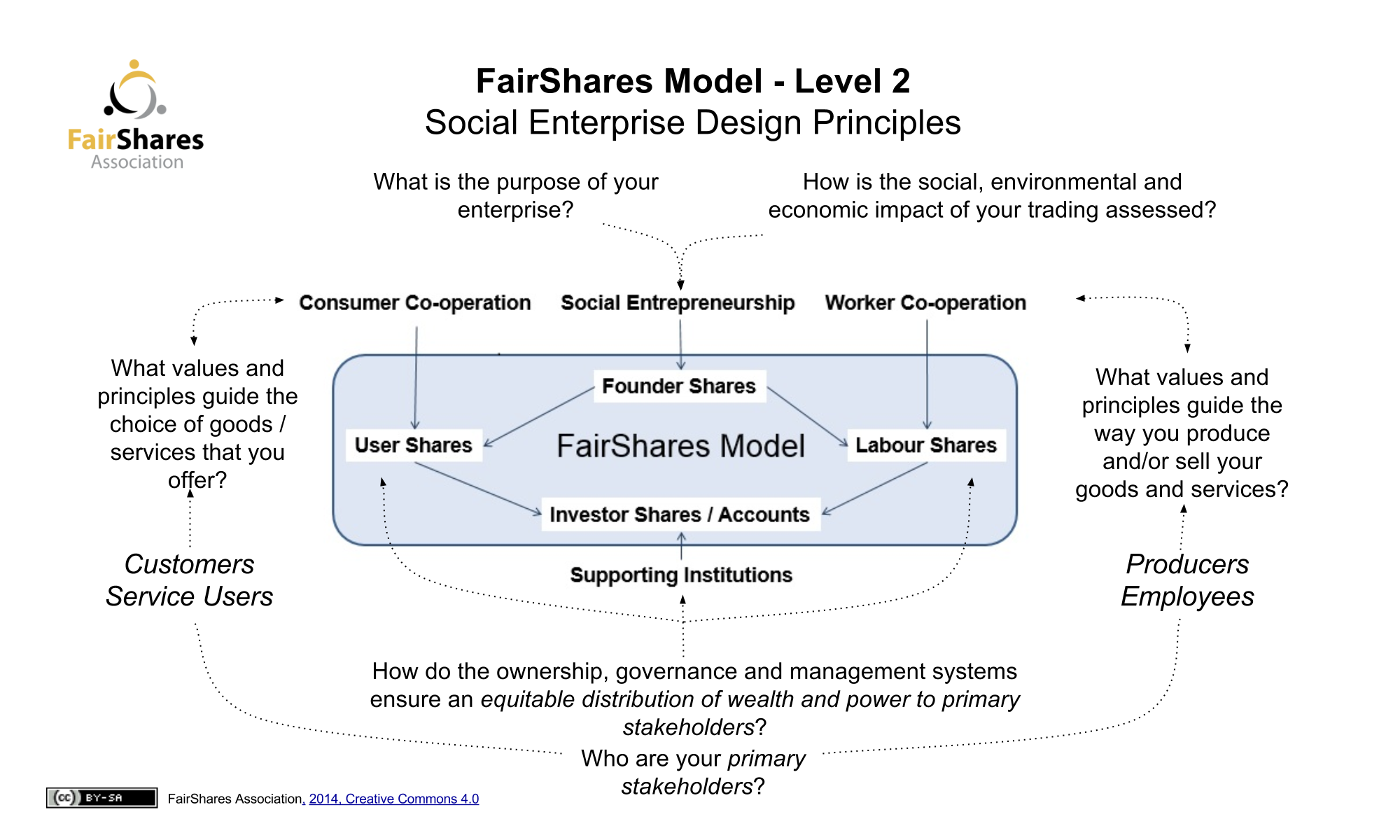
On of the many interesting things discussed during the social enterprise law workshop at Notre Dame Law School was the “FairShares Model.” Nina Boeger (University of Bristol-UK) brought the model to the group’s attention, and the model was new news to me.

The FairShares Model was “created during a research programme on democratising charities, co-operatives and social enterprises involving academics at Sheffield Hallam University and Manchester Metropolitan University in the UK.”

The FairShares Model cites the “Social Enterprise Europe Ltd” when noting that social enterprises “aim to generate sustainable sources of income, but measure their success through:

  • Specifying their purpose(s) and evaluating the impact(s) of their trading activities;

  • Conducting ethical reviews of their product/service choices and production/consumption practices;

  • Promoting socialized and democratic ownership, governance and management.”

To address theses aims, the FairShares Model offers social audits and suggests the issuing some combination of (1) founder shares, (2) labour shares, (3) investor shares, (4) user shares.

While I agree that significant corporate governance changes should be considered, at first glance this model seems a bit unwieldy if all four types of shares are issued. Still, I am interested in learning more. 

One of the many questions surrounding benefit corporations is whether their choice of legal entity form will scare away investors.

As previously reported, we now have our first publicly traded benefit corporation. And in this week’s news certified B corp and benefit corporation Data.world announced a 18.7 million dollar raise. This raise ranks in the top-ten largest raises by a benefit corporation, according to the information I have seen on benefit corporations. I compiled the publicly available information I was able to uncover on social enterprise raises (including by benefit corporations) in a forthcoming symposium article for the Seattle University Law Review. It is quite possible that there are raises that have been kept quiet and that I have not seen. This Data.world news was announced days after final edits and will not be in my article.

As is often the case in social enterprise news, this news could be seen as encouraging or discouraging for supporters of the benefit corporation form.

On one hand, this is a fairly sizeable raise and a bit of evidence that not all serious investors are scared away by a legal form that mandates a general public benefit purpose.

On the other hand, the mere fact

On Monday President Trump signed an Executive Order on Reducing Regulation and Controlling Regulatory Costs. The Order uses budgeting powers to constrict agencies and the regulatory process requiring that for each new regulation, two must be eliminated and that all future regulations must have a net zero budgeting effect (or less). The Order states:

“Unless prohibited by law, whenever an executive department or agency (agency) publicly proposes for notice and comment or otherwise promulgates a new regulation, it shall identify at least two existing regulations to be repealed.”

Two points to note here.  First, the Executive Order does not cover independent agencies like the Securities and Exchange Commission and the Commodity Futures Trading Commission, agencies that crafted many of the rules required by the 2010 Dodd-Frank Wall Street reform law–an act that President Trump describes as a “disaster” and promised to do “a big number on“.  The SEC, the CFTC and Dodd-Frank are not safe, they will just have to be dealt with through even more sweeping means.   Stay tuned.  The 2-for-1 regulatory special proposed on Monday is a part of President Trump’s promise to cut regulation by 75%.

Second, the Order is intended to remove regulatory obstacles to Americans

Energy and business are closely related, and the former often has a direct impact on latter.  At Whitehouse.gov, the President has posted his energy plan, making the following assertions: 

Sound energy policy begins with the recognition that we have vast untapped domestic energy reserves right here in America. The Trump Administration will embrace the shale oil and gas revolution to bring jobs and prosperity to millions of Americans. We must take advantage of the estimated $50 trillion in untapped shale, oil, and natural gas reserves, especially those on federal lands that the American people own. We will use the revenues from energy production to rebuild our roads, schools, bridges and public infrastructure. Less expensive energy will be a big boost to American agriculture, as well.

It is certainly true that we “have vast untapped domestic energy reserves right here in America.” It has brought some wealth and prosperity to the nation, and low oil prices because the country “embrace[d] the shale oil and gas revolution to bring jobs and prosperity to millions of Americans.” However, low oil and gas prices (which largely remain) have slowed that growth and expansion because shale oil and gas exploration and production was

I recently finished my first consistent year of running since high school. To celebrate, I bought and read Once a Runner. Yes, that is how nerds like me celebrate – buy and read a book. I was asleep by 10pm on New Year’s Eve.

Once a Runner is a cult classic published in 1978 and authored by a former University of Florida runner (and fellow lawyer), John Parker Jr. The novel was originally self-published, sold at running stores and out of the back of the author’s car. It eventually became a New York Times Bestseller. The story follows the fictional Quenton Cassidy as he moves from a successful (but still somewhat distracted) college runner to a laser-focused, woods-dwelling hermit who increases his training to beat the best runners in the world. He does, eventually, beat one of the very best milers (in a small track meet), and then goes on to win silver in the Olympic Games.

Among the passages that struck me was the following from Quenton’s time at a cocktail party, after spending months (in relative solitude) training and logging 100+ mile weeks:

What was the secret, they wanted to know; in a thousand different ways they wanted to know

At the end of every semester I resolve to give less work to my students so that I don’t have so much to grade. This upcoming semester I may actually keep that resolution, but I do plan to keep my blogging assignment. In each class, I provide an extra credit or required post or series of posts of between 200-500 words so that students can learn a fundamental legal skill—communicating clearly, correctly, and concisely.

If you are reading this post, then you are already a fan of legal blogs. Academics blog to get their ideas out quickly rather than waiting for the lengthy law review cycle to publicize their thoughts. Academics can also refine ideas they are incubating by blogging and receiving real time feedback from readers. Practicing lawyers blog (or should) for a slightly different reason. Blogging can enhance a lawyer’s reputation and visibility and ultimately lead to more business.

Yesterday, I met with an attorney who will speak to the students in my new course on Legal Issues for Startups, Entrepreneurs, and Small Businesses. I mentioned to him that I found his blog posts enlightening and that they filled a gap in my knowledge base. Although I practiced

My favorite new (to me) podcast is NPR’s How I Built This. They describe the podcast as “about innovators, entrepreneurs, and idealists, and the stories behind the movements they built. Each episode is a narrative journey marked by triumphs, failures, serendipity and insight — told by the founders of some of the world’s best known companies and brands.”

So far, I have listened to two of the episodes: one about the Sam Adams founder Jim Koch and one about the Clif Bar co-founder Gary Erickson.

On the Sam Adams episode, I liked Jim Koch’s distinction between scary and dangerous — repelling off a mountain with an expert guide is scary but not not necessarily dangerous; walking on a snow-covered, frozen lake on a sunny day is dangerous but not necessarily scary. Jim said that his comfortable job at Boston Consulting Group was not scary, but it was dangerous in luring him away from his true calling. However, founding his own company (Sam Adams) was scary, but not really as dangerous as working for BCG. Also, it was interesting to find out that Jim Koch is a Harvard JD/MBA.

On the Clif Bar episode, though I have eaten more than

My October included some signifiant tricks and a bunch of parallel treats.  I will highlight but a few of each here.  They illustrate, in my view, the busy mid-semester lives that law professors may have.

The Tricks

It was a real trick for me to give three distinct presentations in three cities (two in person and one virtually) in a two-day period early in the month.  On the morning of October 6, I participated in a panel discussion at The Crowdfunding Conference in New York City (New York).  That afternoon, I jumped on a plane for Little Rock (Arkansas), where I gave a continuing legal education presentation on crowdfunding for the Arkansas Bar Association as part of a program on “Capital Raising Today and Securities Law Issues.”  Finally, later that day, I was Skyped into a the North Carolina Law Review 2016 annual symposium in Chapel Hill (North Carolina) on “The Role of Law in Entrepreneurship,” at which I presented a draft paper, forthcoming in the North Carolina Law Review, on the important role of business finance lawyers in entrepreneurial enterprise.  

It then was a trick to refocus my energy on faculty hiring a few days later.