Last Friday, I had the privilege of speaking, with other colleagues, at the 2023 Stetson Law Review Symposium on “Elon Musk and the Law.”  (See the flyer on the program, below.)  This symposium grew out of a discussion group I organized at the 2022 Southeastern Association of Law Schools Conference.  I posted about it here back in May of last year.

I could not have been happier with the way the symposium worked out.  The Stetson Law students, faculty, and administration were well organized, kind, and fun–a total pleasure to work with.  And I got excellent questions and feedback on my early draft paper, Representing Elon Musk, which focuses attention on the lawyer-client relationship under the American Bar Association’s Model Rules of Professional Conduct.  I look forward to seeing the final published proceedings in two forthcoming books of the Stetson Law Review.

*               *               *
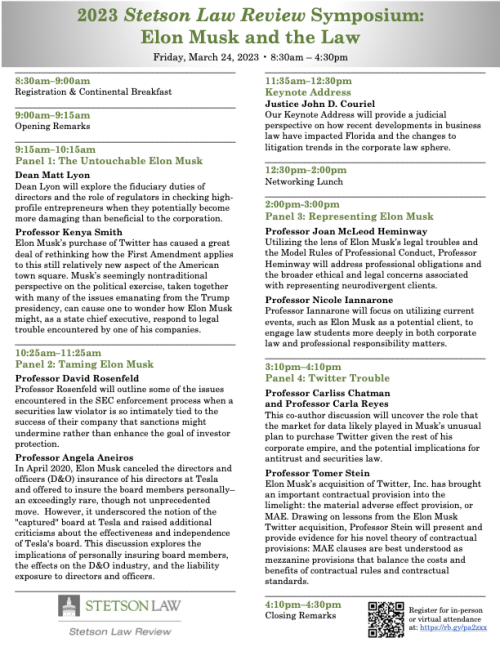
Stetson2023(flyer)

My mind is still reeling from my trip to Lisbon last week to keynote at the Building The Future tech conference sponsored by Microsoft.

My premise was that those in the tech industry are arguably the most powerful people in the world and with great power comes great responsibility and a duty to protect human rights (which is not the global state of the law).

I challenged the audience to consider the financial price of implementing human rights by design and the societal cost of doing business as usual.

In 20 minutes, I covered  AI bias and new EU regulations; the benefits and dangers of ChatGPT; the surveillance economy; the UNGPs and UN Global Compact; a new suit by Seattle’s school board against social media companies alleging harmful mental health impacts on students; potential corporate complicity with rogue governments; the upcoming Supreme Court case on Section 230 and content moderator responsibility for “radicalizing” users; and made recommendations for the governmental, business, civil society, and consumer members in the audience.

Thank goodness I talk quickly.

Here are some non-substantive observations and lessons. In a future post, I’ll go in more depth about my substantive remarks. 

1. Your network

An ambitious question, yes, but it was the title of the presentation I gave at the Society for Socio-Economists Annual Meeting, which closed yesterday. Thanks to Stefan Padfield for inviting me.

In addition to teaching Business Associations to 1Ls this semester and running our Transactional Skills program, I’m also teaching Business and Human Rights. I had originally planned the class for 25 students, but now have 60 students enrolled, which is a testament to the interest in the topic. My pre-course surveys show that the students fall into two distinct camps. Most are interested in corporate law but didn’t know even know there was a connection to human rights. The minority are human rights die hards who haven’t even taken business associations (and may only learn about it for bar prep), but are curious about the combination of the two topics. I fell in love with this relatively new legal  field twelve years ago and it’s my mission to ensure that future transactional lawyers have some exposure to it.

It’s not just a feel-good way of looking at the world. Whether you love or hate ESG, business and human rights shows up in every factor and many firms have built

I’m a huge football fan. I mean real football– what people in the US call soccer. I went to Brazil for the World Cup in 2014 twice and have watched as many matches on TV as I could during the last tournament and this one. In some countries, over half of the residents watch the matches when their team plays even though most matches happen during work hours or the middle of the night in some countries. NBC estimates that 5 billion people across the world will watch this World Cup with an average of 227 million people a day. For perspective, roughly 208 million people, 2/3 of the population, watched Superbowl LVI in the US, which occurs on a Sunday.

Football is big business for FIFA and for many of its sponsors. Working with companies such as Adidas, Coca-Cola, Hyundai / KIA, Visa, McDonald’s, and Budweiser has earned nonprofit FIFA a record 7.5 billion in revenue for this Cup. Fortunately for Budweiser, which paid 75 million to sponsor the World Cup, Qatar does not ban alcohol. But in a plot twist, the company had to deal with a last-minute stadium ban. FIFA was more effective in Brazil, which has

Back in March, I posted about a paper, “Censorship and Market Failure in the Marketplace of Ideas,” that Professor Jeremy Kidd and I presented at a research roundtable on Capitalism and the Rule of Law hosted by the Law & Economics Center at George Mason University Antonin Scalia Law School. A complete version of that paper is now available here. Here is the abstract:

Use of the familiar metaphor of the exchange of ideas as a “marketplace” has historically presumed that free and uninhibited competition among ideas will reliably arrive at truth. But even the most fervent economic free-market advocates recognize the possibility of market failure. Market failure is a market characteristic (e.g., monopoly power) that precludes the maximization of consumer welfare.

The last few years have witnessed increased calls for censorship of speech and research pertaining to a variety of subjects (e.g., climate change; COVID-19 sources and treatments; and viewpoints concerning race, gender, and sexual orientation) across a variety of fora. The consistent refrain in favor of this censorship is that the spread of false or misleading information is preventing access to or distorting the truth and thereby inhibiting social progress: undermining democracy, fomenting bigotry, costing lives, and

IMG_4568

(Some neighborhood children playing duck-duck-goose in our common space on July 4th.)

Recently, I finished philosopher David McPherson’s book The Virtues of Limits published by Oxford University Press this year. While I disagree with McPherson in certain areas, I highly recommend his book. I was reacting to the book with friends and the author before I even completed it. Perhaps it would have been best to refrain from commenting until I had finished, but it was a sign that the book was quite thought-provoking. The book was well-written and accessible, even to a non-philosopher like me. 

Given that this post only has a loose connection to business law, I will place the remainder of my thoughts below the page break. 

Prior to joining academia, I served as a compliance officer for a Fortune 500 company and I continue to consult on compliance matters today. It’s an ever changing field, which is why I’m glad so many students take my Compliance, Corporate Governance, and Sustainability course in the Fall. I tell them that if they do transactional or commercial litigation work, compliance issues will inevitably arise. Here are some examples: 

  • In M&A deals, someone must look at the target’s  bribery, money laundering, privacy, employment law, environmental, and other risks
  • Companies have to complete several disclosures. How do you navigate the rules that conflict or overlap?
  • What do institutional investors really care about? What’s material when it relates to ESG issues?
  • What training does the board need to ensure that they meet their fiduciary duties?
  • How do you deal with cyberattacks and what are the legal and ethical issues related to paying ransomware?
  • How do geopolitical factors affect the compliance program?
  • Who can be liable for a compliance failure?
  • What happens when people cut corners in a supply chain and how can that affect the company’s legal risk?
  • What does a Biden DOJ/SEC mean compared to the same offices under Trump?
  • Who

IMG_4022

Recently, I published a short piece for the Nashville Institute for Faith and Work (NIFW) about Business Ethics in a Pandemic.

As mentioned there, I have found teaching Business Ethics courses extremely challenging, but important. While law can be unclear, the boundaries of business ethics are even more vague. 

Perhaps it is simply because one of my younger brothers is an English professor, but I have been increasingly drawn to using literature in the teaching of business ethics as a way to grapple with the lack of clarity.

So far, I have used the fiction and poetry of Derrick Bell, Wendell Berry, Octavia Butler, Anton Chekov, Ross Gay, Ursula Le Guin, Cormac McCarthy, Mary Oliver, Ranier Maria Rilke, May Sarton, George Saunders, and Leo Tolstoy. Admittedly, this is a bit of an odd mix, but I think each of these writers have something important to say, even if I do not use each of them every semester. 

I remain open to other suggestions, and I plan to rotate in other authors as I continue to teach our business ethics course. (I also hope to write a few longer pedagogy articles in the law & literature and ethics & literature

It’s a lovely Friday night for grading papers for my Business and Human Rights course where we focused on ESG, the Sustainable Development Goals (SDGs), and the UN Guiding Principles on Business and Human Rights. My students met with in-house counsel, academics, and a consultant to institutional investors; held mock board meetings; heard directly from people who influenced the official drafts of EU’s mandatory human rights and environmental due diligence directive  and the ABA’s Model Contract Clauses for Human Rights; and conducted simulations (including acting as former Congolese rebels and staffers for Mitch McConnell during a conflict minerals exercise). Although I don’t expect them all to specialize in this area of the law, I’m thrilled that they took the course so seriously, especially now with the Biden Administration rewriting its National Action Plan on Responsible Business Conduct with public comments due at the end of this month.

The papers at the top of my stack right now:

  1. Apple: The Latest Iphone’s Camera Fails to Zoom Into the Company’s Labor Exploitation
  2. TikTok Knows More About Your Child Than You Do: TikTok’s Violations of Children’s Human Right to Privacy in their Data and Personal Information
  3. Redraft of the Nestle

Earlier this month, the U.S. Senate Committee on Banking, Housing, and Urban Affairs held a hearing on the Insider Trading Prohibition Act (ITPA), which passed the house with bipartisan support in May of last year. Some prominent scholars, like Professor Stephen Bainbridge, have criticized the ITPA as ambiguous in its text and overbroad in its application, while others, like Professor John Coffee, have expressed concern that it does not go far enough (mostly because the bill retains the “personal benefit” requirement for tipper-tippee liability).

My own view is that there are some good, bad, and ugly aspects of the bill. Starting with what’s good about the bill:

  • If made law, the ITPA would end what Professor Jeanne L. Schroeder calls the “jurisprudential scandal that insider trading is largely a common law federal offense” by codifying its elements.
  • The ITPA would bring trading on stolen information that is not acquired by deception (e.g., information acquired by breaking into a file cabinet or hacking a computer) within its scope. Such conduct would not incur Section 10b insider trading liability under the current enforcement regime.
  • The ITPA at least purports (more on this below) to only proscribe “wrongful” trading, or trading