
Happy holidays! Billions of people around the world are celebrating Christmas or Hanukah right now. Perhaps you’re even reading this post on a brand new Apple Ipad, a Microsoft Surface, or a Dell Computer. Maybe you found this post via a Google search. If you use a product manufactured by any of those companies or drive a Tesla, then this post is for you. Last week, a nonprofit organization filed the first lawsuit against the world’s biggest tech companies alleging that they are complicit in child trafficking and deaths in the cobalt mines of the Democratic Republic of Congo. Dodd-Frank §1502 and the upcoming EU Conflict Minerals Regulation, which goes into effect in 2021, both require companies to disclose the efforts they have made to track and trace “conflict minerals” — tin, tungsten, tantalum, and gold from the DRC and surrounding countries. DRC is one of the poorest nations in the world per capita but has an estimated $25 trillion in mineral reserves (including 65% of the world’s cobalt). Armed militia use rape and violence as a weapon of war in part so that they control the mineral wealth. The EU and US regulators believe that consumers
Parenting and Grading
After spending the entire day grading undergraduate business law exams, I drove to my son’s elementary school for our first parent-teacher conference. On my wife’s advice, I mostly just listened. My legal and academic training have given me “a very particular set of skills” that I can use to construct and deconstruct arguments in a way some people find combative, so my wife’s advice was probably wise.
The parent-teacher conference for our kindergarten-aged son went well. Most important to me, it was clear that our son’s teacher already appeared to love him and seemed committed to helping him develop. But I worry about what our education system may do to my son. Only two months into formal school, my sweet son, who has been in speech therapy since age two, is already receiving grades. Granted, the grades are pretty soft at this point – 3 for mastery, 2 for on track to complete this year, 1 for behind schedule. I hope he will not get overly discouraged. I also know he will not receive nearly as much affirmation in school for his impressive, budding artistic skills as he would for a photographic memory.
This parent-teacher conference, coupled with
Nobel Prize and The Challenges of Global Poverty

Congrats to MIT professors Abhijit Banerjee, Esther Duflo and Michael Kremer on their recent Nobel Prize in Economics.
A few years ago, I completed Professors Banerjee and Duflo’s free online EdX course on “The Challenges of Global Poverty.”
Evidently, they are doing a rerun of that course, starting February 4, 2020. You can sign up here.
Is Boycotting a Bust?
Last week, I led a “legal hack” for some of the first year students during orientation. Each participating professor spoke for ten minutes on a topic of our choice and then answered questions for ten minutes. I picked business and human rights, my passion. I titled my brief lecture, “Are you using a product made by slaves, and if you are, can you do anything about it”?
In my ten minutes, I introduced the problem of global slavery; touched on the false and deceptive trade practices litigation levied against companies; described the role of shareholder activists and socially responsible investors in pressuring companies to clean up supply chains; raised doubts about the effectiveness of some of the disclosure regimes in the US, EU, and Australia; questioned the efficacy of conscious consumerism; and mentioned blockchain as a potential tool for provenance of goods. Yes. In ten minutes.
During the actual hack later in the afternoon, I had a bit more time to flesh out the problem. I developed a case study around the Rana Plaza disaster in which a building collapse in Bangladesh killed over 1,000 garment workers six years ago. Students brainstormed solutions
Sex, Lies, and M&A
I’m at the tail end of teaching my summer transactional lawyering course. Throughout the semester, I’ve focused my students on the importance of representations, warranties, covenants, conditions, materiality, and knowledge qualifiers. Today I came across an article from Practical Law Company that discussed the use of #MeToo representations in mergers and acquisitions agreements, and I plan to use it as a teaching tool next semester. According to the article, which is behind a firewall so I can’t link to it, thirty-nine public merger agreements this year have had such clauses. This doesn’t surprise me. Last year I spoke on a webinar regarding #MeToo and touched on the the corporate governance implications and the rise of these so-called “Harvey Weinstein” clauses.
Generally, according to Practical Law Company, target companies in these agreements represent that: 1) no allegations of sexual harassment or sexual misconduct have been made against a group or class of employees at certain seniority levels; 2) no allegations have been made against independent contractors; and 3) the company has not entered into any settlement agreements related to these kinds of allegations. The target would list exceptions on a disclosure schedule, presumably redacting the name of the accuser to preserve
Law Student Health & Wellness
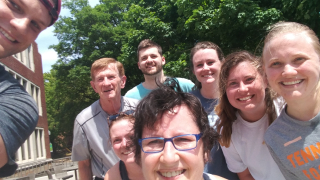
This picture brings me joy. It captures the mood among all of us (me, my UT Law emeritus colleague John Sobieski, and a group of UT Law students) after my last UT Law yoga session this past spring. I need to begin to wrestle with how I will be able to teach yoga at the College of Law this coming semester, since I will be full-time back in the classroom teaching two demanding business law courses (Business Associations and Corporate Finance). All ideas are welcomed . . . .
My law school yoga teaching came to mind this week not because I am already deep into planning the fall semester (although that comes soon) but because of two independent health/wellness items that hit my radar screen this week. First, I was reminded that the Knoxville Bar Association (of which I am a member) is offering a full-day continuing legal education program in September entitled “Balancing the Scales of Work and Wellness – Finding Joy through Self-Care Practical Advice & Wellness Strategies”. Second, I learned today that my UT Law colleague Paula Schaefer penned a nifty post yesterday on the Best Practices for Legal Education blog: Examples of How Law Schools
The College Admissions Scandal and Adversity

The college admissions scandal has been on my mind a good bit since the story broke. (Listen to the podcast “Gangster Capitalism” if you need to catch up on the details of the scandal.)
One student, more than any other in the scandal, has been in the media’s crosshairs: Olivia Jade Giannulli. Olivia Jade – a social media influencer (whatever that means) – seems to be getting so much attention because of her famous parents (actress Lori Loughlin and fashion designer Mossimo Giannulli), and because of some unfortunate comments she made about college on YouTube. Olivia Jade said: “I don’t know how much of school I’m going to attend but I’m going to go in and talk to my deans and everyone and hope I can try and balance it all. But I do want the experience of game day and partying, I don’t really care about school. As you guys all know. ” I don’t know much about Olivia Jade, but she comes across as spoiled, arrogant, selfish, entitled, obnoxious, and lacking self-awareness. In many ways, I hope my children and my students grow up to be her opposite.
In contrast, three runners who I
Managing Compliance Across Borders Conference at the University of Miami- June 26-28
Join me in Miami, June 26-28.
|


|
June 26-28, 2019 Managing Compliance Across Borders is a program for world-wide compliance, risk and audit professionals to discuss current developments and hot topics (e.g. cybersecurity, data protection, privacy, data analytics, regulation, FCPA and more) affecting compliance practice in the U.S., Canada, Europe, and Latin America. Learn more |
|||
|
See a Snapshot: Who Will Be There?
|
|||
|
|
|||
|
Location |
|||
|
|
|||
|
CLE Credit |
|||
|
|
|||
|
Program Fee: |
Why Businesses Should Not Ignore the Operation Varsity Blues Scandal
As a former compliance officer who is now an academic, I’ve been obsessed with the $25 million Varsity Blues college admissions scandal. Compliance officers are always looking for titillating stories for training and illustration purposes, and this one has it all– bribery, Hollywood stars, a BigLaw partner, Instagram influencers, and big name schools. Over fifty people face charges or have already pled guilty, and the fallout will continue for some time. We’ve seen bribery in the university setting before but those cases concerned recruitment of actual athletes.
Although Operation Varsity Blues concerns elite colleges, it provides a wake up call for all universities and an even better cautionary tale for businesses of all types that think of bribery as something that happens overseas. As former Justice Department compliance counsel, Hui Chen, wrote, “bribery. . . is not an act confined by geographies. Like most frauds, it is a product of motive, opportunity, and rationalization. Where there are power and benefits to be traded, there would be bribes.”
My former colleague and a rising star in the compliance world, AP Capaldo, has some great insights on the scandal in this podcast. I recommend that
What Happens When the CEO or the Face of the Business Is a Risk? #MeToo and Corporate Governance
Hundreds of men have resigned or been terminated after allegations of sexual misconduct or assault. Just last week, celebrity chef/former TV star Mario Batali and the founder of British retailer Ted Baker were forced to sell their interests or step down from their own companies. Plaintiffs lawyers have now found a new cause of action. Although there a hurdles to success, shareholders file derivative suits when these kinds of allegations become public claiming breach of fiduciary duty, unjust enrichment, or corporate waste among other things. Examples of alleged corporate governance missteps in the filings include: failure to establish and implement appropriate controls to prevent the misconduct; failure to appropriately monitor the business; allowing known or suspected wrongdoing to persist; settling lawsuits but not changing the corporate culture or terminating wrongdoers; and paying large severance packages to the accused. Google, for example, announced earlier this year that it had terminated 48 people with no severance for sexual misconduct, but until it became public, the company did not disclose a $90 million payment to a former executive, who had allegedly coerced sex from an employee. Earlier this week, Google acknowledged another $35 million payment to a search executive who had been accused