
Earlier in the year, I had the privilege of being interviewed by Mike Madison at Pitt Law about my work, including my business law and leadership teaching and scholarship. Mike hosts and produces a nifty podcast called The Future Law.  The subject matter of his podcasts ranges across a spectrum of law and innovation topics. 

Last month, he posted the edited recording of our interview under the title: Joan Heminway, on Corporate Law and Leadership.  It is about a half hour in length.  Many readers already know me and my work pretty well (but if you want to know more in a quick fashion, feel free to read this campus Faculty Spotlight that was published earlier this spring).  However, I thought those of you who teach in law schools might appreciate knowing about (and maybe even listening to) this podcast.  Among other things, I walk through UT Law’s leadership courses and explain their content and context and talk a bit about the natural overlap between business law and leadership (which I earlier wrote about here).

As Mike notes, we met as fellow presenters earlier this year at Santa Clara Law’s symposium on Lawyers, Leadership, and Change: Addressing
Our relatively new Transactional Skills program has been such a success that we need to hire one or two additional adjuncts immediately for the Fall.  Our current adjuncts work for BigLaw, in-house, and boutique firms. Classes start in August but the current sections are full and 2Ls start registration on Tuesday. 

The course description is below:

This interactive, practice-oriented course will be structured around the acquisition of an asset or business and some of the key agreements required to complete the transaction. Students will act as junior associates and work on one deal throughout the semester representing either the buyer or seller. Although the class will focus on certain provisions common to all contracts, students will negotiate and draft documents which may include a non-disclosure agreement, letter of intent outlining the main terms, due diligence memo, portions of an asset purchase agreement, a licensing agreement, or an employment agreement. Students will also communicate in writing to their clients throughout the duration of the transaction and will learn the proper selection and use of form agreements. Grades will be based on class participation, group and individual assignments, and a take-home exam, which will consist of writing an agreement. Students will watch

Recently, I finished two similar books on problems with extreme meritocracy in the United States: The Tyranny of Merit by Harvard philosophy professor Michael Sandel and The Meritocracy Trap by Yale law professor Daniel Markovits. Law schools and entry level legal jobs tend to be intensely meritocratic. The more competitive entry level legal jobs rely very heavily on school rank and student class rank. Once in a private firm, billable hours seem to be the main metric for bonuses and making partner.

Sandel describes at least three problems with meritocracy: (1) people are not competing on an even playing field in the US “meritocracy” (e.g., children of top 1% in income are 77x more likely to attend an Ivy League school than children of bottom 20%); (2) even if there were an even playing field, natural talents that fit community preferences would lead to wild inequality in a pure meritocracy and those natural advantages are not “earned,” (3) a strict meritocracy leads to excessive hubris among the “winners” and shame among the “losers” who believe they deserve their place in society. 

Markovits hits a lot of the same notes, but pays more attention to how the elite “exploit themselves”

A reminder that Emory’s 2021 conference on transactional law and skills education is next Friday, June 4, 2021. It is virtual and registration is only $50. Register here.

Today, I’m submitting a guest post by Professor Jen Randolph Reise of Mitchell Hamline School of Law.  On Friday the 11th, I’ll post my reflections from the Emory conference. Jen and I have bonded over our mission to bring practical skills into the classroom. Her remarks are  below:

I’m looking forward to hearing from many leaders in transactional legal education, including keynote speakers Joan MacLeod Heminway, Marcia Narine Weldon, and Robert J. Rhee on the theme of “Emerging from the Crisis: Future of Transactional Law and Skills Education.” Marcia will also be talking about her experience launching a transactional program at Miami, joined by three of her adjunct professors.

For my part, I’ll be presenting a Try-This session sharing how I have used exercises that integrate key technological resources and techniques into teaching doctrinal courses. I’ve written in this blog before in praise of practice problems, especially in the asynchronous or flipped classroom. These exercises take that one step farther by creating a self-paced, guided discovery and low-stakes practice of some skills

“Peer assessment score” – the opinion of deans and certain faculty about the overall quality of a law school – accounts for 25% of a school’s score in the U.S. News ranking. It is the most heavily weighted item. Bar passage, for comparison, is just a bit over 2%. When told this my pre-law students almost inevitably say — “why would I care what deans and faculty at other schools think?”  

Below are the 25 schools that have the lowest peer assessment relative to overall rank and the 25 schools with the highest peer assessment relative to overall rank. Tier 2 schools are not included because they do not have a specific overall rank. TaxProfBlog provided the data

I am not unbiased here. I teach in the business school at Belmont University, and our law school has the biggest negative gap between peer assessment and overall rank. There are some reasonable reasons for this gap — e.g., the school is young (the law school founded in 2011, though the university was founded in 1890) and a lot of deans/faculty may not know that the law school is doing well on incoming student credentials, bar passage

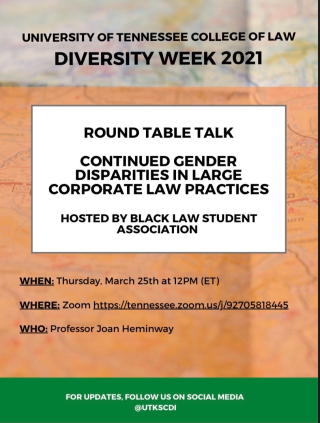
Yesterday, I had the honor of leading a roundtable discussion on women and the practice of business law.  The roundtable was part of a series convened by UT Law’s Student Council on Diversity and Inclusion, and this specific roundtable was hosted by our Black Law Student Association.  Here’s the promotional flyer from the event.

SCDIRoundtableAnnouncement

In preparing for the session, I had occasion to review two ABA reports from the past few years: Roberta D. Liebenberg & Stephanie A. Scharf, Walking Out The Door : The Facts, Figures, and Future of Experienced Women Lawyers in Private Practice (ABA 2019), and Destiny Peery, Paulette Brown & Eileen Letts, Left Out or Left Behind: The Hurdles, Hassles, and Heartaches of Achieving Long-term Legal Careers for Women of Color (ABA 2020). I was reminded of the fall-off in female lawyers in BigLaw over the course of their careers.  Quoting from the first report:

BigLaw is no stranger to the loss of experienced women attorneys. While entering associate classes have been comprised of approximately 45% women for several decades, in the typical large firm, women constitute only 30% of non-equity partners and 20% of equity partners. Women lawyers face many other challenging hurdles

This isn’t the post I had planned to write. In fact, I had two other ideas. But I feel compelled to write this, knowing that it may cause more controversy than it’s worth. 

My colleague Stefan Padfield wrote a post called “The Marxism In Your Diversity Training” that some would call provocative. Others would call it offensive. I had planned to comment on it, but he’s taken it down. Did I agree with everything he said? No. Did I disagree with everything he said? Also no. 

I have a unique perspective. I’m a Black female. I protested about race and gender issues in college and law school. I’ve been a management-side employment lawyer for 25 years both as outside counsel and in house. I still consult with companies, deliver training on EEO laws and polices, conduct discrimination investigations, and advise plaintiffs. I work hard to make sure that companies do the right thing. I’ve posted here before about my skepticism about certain diversity mandates. Not that we don’t need MUCH more work in this area, but I’m not sure the approaches that some states and companies are taking will have long-term benefits.

My law school, like all others, is trying

A job posting that may be of interest to some of our readers.

———

Job Description
BOSTON UNIVERSITY SCHOOL OF LAW, a top-tier law school with an international reputation, is a community of leading legal scholars, teachers, students, and alumni, dedicated to providing one of the finest legal educations in the world. The breadth and depth of our curriculum, especially our clinical program, as well as our innovative spirit are distinctive in American legal education.

Boston University School of Law is seeking to hire a full-time attorney in its Startup Law Clinic (the “Clinic”). The Clinic is part of BU Law’s Entrepreneurship, Intellectual Property, and Cyberlaw Program, which is a unique collaboration between BU Law and the Massachusetts Institute of Technology. The School of Law believes that the cultural and social diversity of our faculty, staff, and students is vitally important to the distinction and excellence of our academic programs. To that end, we are especially eager to hear from applicants who support our institutional commitment to BU as an inclusive, equitable, and diverse community.

The Clinic represents current students at MIT and BU on matters related to a wide range of legal issues faced by early-stage business ventures. The

On Friday night, I finished five days of group oral midterm exam appointments with my Business Associations students.  (I wrote a law review article on these group oral midterms five years ago, in case you are interested in background and general information.)  It is an exhausting week: twenty-one 90-minute meetings with groups of three students based on a specific set of facts.  And this year, of course, the examinations were hosted on Zoom, like everything else.  Especially given social distancing, mask-wearing, and the overall hybrid instructional method for the course (about which I wrote here), I admit that I headed into the week a bit concerned about how it all would go . . . .

The examination is conducted as a simulated meeting of lawyers in the same law office–three junior lawyers assisting in preparing a senior colleague for a meeting with a new client.  The student teams are graded on their identification and use of the applicable substantive law. I was pleased to find that the teams scored at least as well overall and individually as they typically do.  That was a major relief.  I had truly wondered whether students would be less well prepared in

How are you doing? I’m exhausted between teaching, grading, consulting, writing, and living through a pandemic. I actually wasn’t planning to post today because I post every other Friday, as a way to maintain some balance. I may not post next Friday because I’ll be participating in  Connecting the Threads, IV, our business law professor blog annual conference. It’s virtual and you may get up to 8 CLE credits, including an ethics credit. If you love our posts, you’ll get to see us up close and personal, and you won’t even need a mask.

I decided to do this short post today because it may help some of you, whether you’re professors or practitioners. Several years ago, Haskell Murray wrote that he does a mid-semester survey. He asks his students what they like and don’t like. I love this idea … in theory. How many of us really want to know how we’re doing? I’ve done it a couple of times when I knew that the class was going great, but I don’t do it consistently. I decided to do it this year because we are piloting a new program modeled after Emory’s Transactional Law Program. I used