
A reminder that Emory’s 2021 conference on transactional law and skills education is next Friday, June 4, 2021. It is virtual and registration is only $50. Register here.

Today, I’m submitting a guest post by Professor Jen Randolph Reise of Mitchell Hamline School of Law.  On Friday the 11th, I’ll post my reflections from the Emory conference. Jen and I have bonded over our mission to bring practical skills into the classroom. Her remarks are  below:

I’m looking forward to hearing from many leaders in transactional legal education, including keynote speakers Joan MacLeod Heminway, Marcia Narine Weldon, and Robert J. Rhee on the theme of “Emerging from the Crisis: Future of Transactional Law and Skills Education.” Marcia will also be talking about her experience launching a transactional program at Miami, joined by three of her adjunct professors.

For my part, I’ll be presenting a Try-This session sharing how I have used exercises that integrate key technological resources and techniques into teaching doctrinal courses. I’ve written in this blog before in praise of practice problems, especially in the asynchronous or flipped classroom. These exercises take that one step farther by creating a self-paced, guided discovery and low-stakes practice of some skills

In my previous post on the “Study on Directors’ Duties and Sustainable Corporate Governance” (“Study on Directors’ Duties”) that Ernst & Young prepared for the European Commission (Commission), I focused on the transformative power of corporate governance. I said that stakeholder capitalism would have a practical value if supported by corporate governance rules based on appropriate standards such as the ones provided by the Sustainable Development Goals (SDGs).

Some of my pointers for the Commission were the creation of a regulatory framework that enables the representation and protection of stakeholders, the representation of “stakewatchers,” that is, non-governmental organizations and other pressure groups through the attribution of voting and veto rights and their members’ nomination to the management board (similar to German co-determination). I also suggested expanding directors’ fiduciary duties to include the protection of stakeholders’ interests, accountability of corporate managers, consultation rights, and additional disclosure requirements.

In my last guest post in this series dedicated to the Study on Directors’ Duties, I ask the following questions. Do investors have a moral duty to internalize externalities such as climate change and income inequality, for example? Do firm ownership and investor commitment matter? Should investors’ money be “moral” money? 

A number of years ago, I became acquainted with Kate Vitasek, a colleague in The University of Tennessee’s Haslam College of Business.  She introduced me to a way of supply contracting called “vested.”  Vested relationships are characterized by the following attributes that may differentiate them from traditional contractual relationships (as identified in the FAQs on the vested website):

  • “Uses flexible Statements of Objectives, enabling the service provider to determine ‘how’”
  • “Measures success through a limited number of Desired Outcomes”
  • “Uses a jointly designed pricing model with incentives that optimize the overall business and fairly allocates risk/reward”
  • “Focuses on insight, using governance mechanisms to manage the business with the supplier”

When I first talked to Kate and her colleagues about vested, I remember noting for her that the vested approach sounded like a specific type of relational contract . . . .

Recently, Kate and I reconnected.  She informed me about her recent coauthored Harvard Business Review article.  It merits  promotion here.

The main point of the article is to highlight the possible advantages of relational contracting in the current environment. Here’s the crux:

For procurement professionals at large multinational companies, the temptation is to use their company’s clout to

No. You didn’t miss Part 1. I wrote about Weinstein clauses last July. Last Wednesday, I spoke with a reporter who had read that blog post.  Acquirors use these #MeToo/Weinstein clauses to require target companies to represent that there have been no allegations of, or settlement related to, sexual misconduct or harassment. I look at these clauses through the lens of a management-side employment lawyer/compliance officer/transactional drafting professor. It’s almost impossible to write these in a way that’s precise enough to provide the assurances that the acquiror wants or needs.

Specifically, the reporter wanted to know whether it was unusual that Chevron had added this clause into its merger documents with Noble Energy. As per the Prospectus:

Since January 1, 2018, to the knowledge of the Company, (i), no allegations of sexual harassment or other sexual misconduct have been made against any employee of the Company with the title of director, vice president or above through the Company’s anonymous employee hotline or any formal human resources communication channels at the Company, and (ii) there are no actions, suits, investigations or proceedings pending or, to the Company’s knowledge, threatened related to any allegations of sexual harassment or other sexual misconduct by any

As I have been working on a few projects involving law firms and legal education in the pandemic, I have come across a number of fun business law items involving mergers and acquisitions.  The news reports I have noted cover regulatory changes, case law, and planning/drafting.  Both small and large transactions are receiving attention.  I shared these with Business Law Section colleagues in the Tennessee Bar Association about a week ago.  I got some positive response.  So, I am sharing them here, too.  Feel free to post what you are seeing in this regard in the comments.

In the small business arena, a recent American Bar Association (ABA) Business Law Today article focuses in on clawback provisions in equity sale agreements.  These provisions, the article avers, “enable the former owner to participate in the consideration received in a subsequent sale of the business by the remaining owner or owners.” The article lists a number of key things to consider in drafting these kinds of provisions.

Another ABA Business Law Today piece notes the trend toward glorifying deal price in valuation determinations, as evidenced in recent Delaware court opinions on appraisal rights.  The article cites to three leading cases, two in

I recently had occasion to offer background to, and be interviewed by, a local television reporter about a publicly traded firm that owns several health care facilities in East Tennessee and has been financed significantly through loans from and corporate payments made by a member of its board of directors.  The resulting article and news clip can be found here.  Since the story was published, a Form 8-K was filed reporting that the director has resigned from the board and the firm is negotiating with him to cancel its indebtedness in exchange for preferred stock.

In reviewing published reports on the firm, Rennova Health, Inc., I learned that it had been delisted from NASDAQ back in 2018.  The reason?  The firm engaged in too many stock splits.

I also came across an article reporting that another health care firm, a middle Tennessee skilled nursing provider, Diversicare Healthcare Services, Inc., had been delisted in late 2019.  The same article noted two additional middle Tennessee health care firms also were in danger of being delisted from stock exchanges.  One was subsequently delisted. 

Health care mergers and acquisitions also have been in the news here in Tennessee.  A Tennessee/Virginia

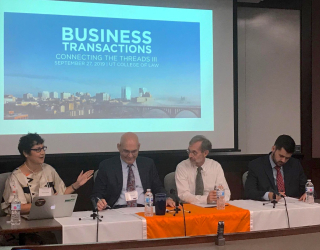
BLPB2019(MergerPanel)

I want to follow on Colleen’s post from yesterday with my own Business Law Prof Blog Symposium commentary.  But first, I want to thank Colleen, Ben, Josh, Doug, Haskell, and Stefan for participating with me in the symposium this year.  Our continuing legal education attendees, as well as our faculty and students, love this symposium each year.  It always turns out to be a wonderful pot pourri of business law topics that literally connect the threads of what we do as business lawyers and business law educators.

Rather than being a featured presenter this year, I chose to present panel-style with two of my UT Law colleagues.  (That’s us, plus our student commentator, Dixon Babb, in the photo above.  Thanks for capturing that, Haskell!)  The panel was designed to describe different conceptions of mergers based on distinct areas of legal expertise, together with related professional responsibility commentary.  I chose my colleagues Don Leatherman and Tom Plank to join me for this session–Don a tax law practitioner and teacher and Tom a property law practitioner and teacher.  The reason for these choices was simple: the three of us had covered this issue before in an informal conversation, and I had found

I’m at the tail end of teaching my summer transactional lawyering course. Throughout the semester, I’ve focused my students on the importance of representations, warranties, covenants, conditions, materiality, and knowledge qualifiers. Today I came across an article from Practical Law Company that discussed the use of #MeToo representations in mergers and acquisitions agreements, and I plan to use it as a teaching tool next semester. According to the article, which is behind a firewall so I can’t link to it, thirty-nine public merger agreements this year have had such clauses. This doesn’t surprise me. Last year I spoke on a webinar regarding #MeToo and touched on the the corporate governance implications and the rise of these so-called “Harvey Weinstein” clauses. 

Generally, according to Practical Law Company, target companies in these agreements represent that: 1) no allegations of sexual harassment or sexual misconduct have been made against a group or class of employees at certain seniority levels; 2) no allegations have been made against  independent contractors; and 3) the company has not entered into any settlement agreements related to these kinds of allegations. The target would list exceptions on a disclosure schedule, presumably redacting the name of the accuser to preserve

Churchill'sPort

Avid BLPB readers may have noticed that I failed to post on Monday of last week.  I was traveling from Portugal to Spain that day.  I did plan to make this post then, but travel scrambles (thanks to the Porto metro) and delays (thanks to Ryanair) prevented me from getting to a computer with Internet access until late in the day.  By then, I was too exhausted to post.  So, you get last Monday’s post this Monday!  No harm done; this post is not time-sensitive.

Ever heard of Graham’s port?  The Graham’s port lodge was founded by brothers William and John Graham back at the beginning of the 18th century.  Fast-forward 150 years, and the Graham family sells the then-very-successful Graham’s port business to another family.  That second family still runs the Graham’s business today.

But a Graham descendant still wanted to be in the port business.  He thought he had a “better way.”  So, 11 years after the Graham family sold Graham’s, John Graham (not the same one, obviously!) established the Churchill port lodge.  Here’s what the Churchill’s website says about its formation as a business:

Churchill’s was founded in 1981 by John Graham, making it

Greetings from sunny Portugal.   I am enjoying some vacation time here after attending and presenting at the European Academy of Management conference in Lisbon this past week.   I will have more to say about that conference in a later post.   But for today, I offer some light thoughts and an Internet “treasure hunt” relating to mergers and acquisitions.

I arrived at my hotel in Sintra earlier today to find a notice in the room stating that “[o]n the 30th June 2019, the Hotel Tivoli Sintra will be changing the legal business entity which will be reflected in future invoices.”  The notice went on to ask that, “to avoid possible delays relating to the billing” each guest pay up his or her bill to date on June 30th “in a partial invoice,” noting that “[t]he remaining services will be invoiced at the departure time with the new entity.”  Apologies were made for “the inconvenience” and thanks were offered for “the understanding.”

Of course, as an M&A practitioner and instructor, I wanted to know what led to this change in “legal business entity.”  I suspected a merger or acquisition transaction.  Was it an asset transaction in which the hotel