
A 2017 opinion related to successor liability just posted to Westlaw.  The case is an EEOC claim “against the Hospital of St. Raphael School of Nurse Anesthesia (“HSR School”) and Anesthesia Associates of New Haven (“AANH”), alleging gender discrimination and retaliation in violation of Title VII of the Civil Rights Act of 1964 . . . .” The plaintiff was seeking to join Yale New Haven Hospital (“YNHH”). MARGARITE CONSOLMAGNO v. HOSPITAL OF ST. RAPHAEL SCHOOL OF NURSE ANESTHESIA and ANESTHESIA ASSOCIATES OF NEW HAVEN, P.C., 3:11CV109 (DJS), 2017 WL 10966446, at *1 (D. Conn. Mar. 27, 2017). 


Apparently, the HSR School trained nurse anesthetists was owned and run by AANH a Connecticut “professional corporation.”  The plaintiff was in the HSR School for about six months before she was dismissed, she claimed, because of ” gender discrimination and retaliation for reporting a staff member’s inappropriate sexual conduct.” Id. The plaintiff sought to join YNHH because that entity took over running an anesthesia school that had been, in some form, the HSR school.  
 
The successor liability part is rather interesting, though largely devoid of facts from the transaction.  The court ultimately concludes that even though YNHH resumed a similar school,
Hundreds of men have resigned or been terminated after allegations of sexual misconduct or assault.  Just last week, celebrity chef/former TV star Mario Batali and the  founder of British retailer Ted Baker were forced to sell their interests or step down from their own companies. Plaintiffs lawyers have now found a new cause of action. Although there a hurdles to success, shareholders file derivative suits when these kinds of allegations become public claiming breach of fiduciary duty, unjust enrichment, or corporate waste among other things. Examples of alleged corporate governance missteps in the filings include: failure to establish and implement appropriate controls to prevent the misconduct; failure to appropriately monitor the business; allowing known or suspected wrongdoing to persist; settling lawsuits but not changing the corporate culture or terminating wrongdoers; and paying large severance packages to the accused. Google, for example, announced earlier this year that it had terminated 48 people with no severance for sexual misconduct, but until it became public, the company did not disclose a $90 million payment to a former executive, who had allegedly coerced sex from an employee. Earlier this week, Google acknowledged another $35 million payment to a search executive who had been accused

This “just in” from BLPB friends Beate Sjåfjell and Afra Afsharipour:

We are thrilled to co-organise a workshop at UC Davis School of Law on 26 April 2019, with the aim of facilitating an in-depth comparative analysis of the relationship between takeovers and value creation.

We invite submissions on themes concerning takeovers and value creation from any jurisdiction around the world as well as comparative contributions. Themes include but are not limited to:

What are the implications of a takeover on sustainability efforts?

What is the scope for using sustainability arguments as a defense by the target board in a takeover?

What should be the role of the bidder board?

What are the implications of large M&A transactions for building/growing a culture of sustainability at a firm?

Is there a distinct difference between planned mergers and uninvited takeovers?

How could takeovers be regulated to promote sustainable value creation?

We especially encourage female scholars and scholars from diverse backgrounds to submit abstracts. Participation at the workshop will be limited to the presenters, to facilitate in-depth discussions. Deadline for submission of abstracts: 27 March 2019!

Please feel free to send this call for papers on to colleagues who may be

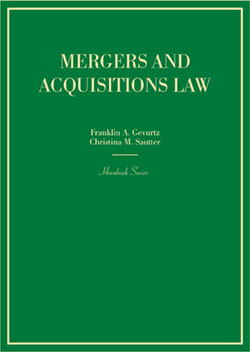
image from images.westacademic.com

West Academic Publishing has just released a new mergers and acquisitions hornbook co-authored by dear friends and business law prof colleagues Frank Gevurtz and Christina Sautter.  I had known that the book was in the offing, but I just got a note from Frank on Saturday confirming its publication and availability.  Here is the synopsis from West:

Gevurtz & Sautter’s Hornbook on Mergers and Acquisitions provides a comprehensive exploration of this important topic. Written in a casual style designed to engage the reader, the book clarifies and critiques critical doctrine. In addition to covering corporate laws governing mergers and acquisitions, the book explores securities, tax, and antitrust laws, as well as addressing the business, financial, and practical lawyering aspects of mergers and acquisitions.

I know these two to be folks with solid backgrounds and interesting insights in this area.  I have requested my online review copy.  Perhaps some of you will want to do that, too.  And for those without that privilege who want this in their libraries, you can get it by clicking on the West Academic Publishing link at the beginning of this post or purchase it on Amazon here.

In Hexion Specialty Chemicals, Inc. v. Huntsman Corp., 965 A.2d 715, 730 (Del. Ch. 2008) – a case I worked on as a judicial clerk – the court wrote, “[m]any commentators have noted that Delaware courts have never found a material adverse effect to have occurred in the context of a merger agreement.”

That statement is no longer true.

Today–in a 3 page opinion–the Delaware Supreme Court affirmed the 240+ page opinion by Vice Chancellor Travis Laster in Akorn, Inc. v. Fresenius Kabi, AG, et al., which held that Akorn triggered the Material Adverse Effect (“MAE”) clause of the merger agreement at issue.

As the Chancery Daily reports, and as is clear looking at the recent opinions, the Delaware Supreme Court opinion does not provide much reasoning for its decision to affirm, but the Court of Chancery opinion does provide plenty of guidance. In the first few pages, the Court of Chancery notes that Akorn experienced a “dramatic, unexpected, and company-specific downturn in…business that began in the quarter after signing.” The Court of Chancery also notes the importance of whistleblower letters and issues with Akron and the FDA. 

Also of interest, the court notes that this

I try not to use this space too often to brag on my students–the folks whose quest for knowledge gets me up in the morning.  But three of my students have been co-authors of two separate pieces in the American Bar Association’s Business Law Today publication since May.  The initiative and the follow-through that these students (two of whom have graduated and are now in private practice) exhibited is truly extraordinary.  And so, I brag . . . .

Most recently, my current student Samuel Henninger has co-authored an article with a practitioner on preference payments in bankruptcy entitled “I Scream, You Scream, We All Scream at Preference Claims.”  Samuel graduates in May 2019. He will clerk for a local bankruptcy court judge next year and then practice with Waller Lansden Dortch & Davis, LLP in Nashville after his clerkship concludes.

Back in May, my former students Brian Adams and Bo Cook co-authored an article together entitled “Limiting the Scope of Post-Closing Actions in Private Mergers & Acquisitions: The Role of Non-Reliance and Integration Clauses in Delaware,” delving into enforcement issues in mergers and acquisitions relating to allegations of fraud based on “extra-contractual representations.”  Brian and Bo

From our friend and BLPB colleague, Anne Tucker, following is nice workshop opportunity for your consideration: 

Dear Colleagues,

We (Rob Weber & Anne Tucker) are submitting a funding proposal to host a works-in-progress workshop for 4-8 scholars at Georgia State University College of Law, in Atlanta, Georgia in spring 2018 [between April 16th and May 8th].  Workshop participants will submit a 10-15 page treatment and read all participant papers prior to attending the workshop.  If our proposal is accepted, we will have funding to sponsor travel and provide meals for participants. Interested parties should email amtucker@gsu.edu on or before November 15th with a short abstract (no more than 500 words) of your proposed contribution that is responsive to the description below. Please include your name, school, and whether you will require airfare, miles reimbursement and/or hotel. We will notify interested parties in late December regarding the funding of the workshop and acceptance of proposals.  Please direct all inquiries to Rob Weber (mailto:rweber@gsu.edu) or Anne Tucker (amtucker@gsu.edu).

Call for Proposals: Organizing, Deploying & Regulating Capital in the U.S.

Our topic description is intentionally broad reflecting our different areas of focus, and hoping to

From an e-mail I recently received:

———

The University of Alabama School of Law seeks to fill multiple entry-level/junior-lateral tenure-track positions for the 2018-19 academic year. Candidates must have outstanding academic credentials, including a J.D. from an accredited law school or an equivalent degree (such as a Ph.D. in a related field). Entry-level candidates should demonstrate potential for strong teaching and scholarship; junior-lateral candidates should have an established record of excellent teaching and distinguished scholarship. Positions are not necessarily limited by subject. However, there is a particular need for applicants who study and/or teach business law (corporate finance, mergers & acquisitions, and business planning are of particular interest); criminal law; insurance law; and torts (including products liability). Family law and labor/employment are also areas of interest. We welcome applications from candidates who approach scholarship from a variety of perspectives and methods (including quantitative or qualitative empiricism, formal modeling, or historical or philosophical analysis).

The University embraces diversity in its faculty, students, and staff, and we welcome applications from those who would add to the diversity of our academic community. Interested candidates should apply online at facultyjobs.ua.edu. Salary, benefits, and research support will be nationally competitive. All applications are confidential

In August, 2015, Chinese conglomerate, Wanda Group, acquired IRONMAN (primarily known for its long distance triathlon races) from a private equity group for $650 million

Last Friday, IRONMAN/Wanda acquired Competitor Group (primarily known for the Rock ‘n Roll Marathon and Half-Marathon series) for an undisclosed amount. 

To start, I had no idea organizing endurance sports had become such big business, but given the increasing popularity and the increasing entry fees, perhaps I should have known. 

Personally, I have mixed feelings about big corporations dominating endurance sports, which, previously, had been much less commercial. On one hand, because of their scale, larger corporations like Competitor Group can conduct their events in a very professional manner, produce slick event shirts, measure the courses precisely, host impressive expos before the races and impressive after-parties, maintain plenty of insurance, take proper precautions, and market effectively to bring new participants into the events.

On the other hand, the big corporations often seem focused on a single, financial line. They raise entry fees as high as they can and often seem to spend an incredible amount on marketing. The races organized by big corporations often lack the individual touch of local races. That said

Here is a rundown of recent business news headlines:

The Yahoo/Verizon deal takes a $350M haircut to compensate for Yahoo data security breaches in 2013 and 2014.

The Snapchat parent company, SNAP, scheduled blockbuster IPO ($20-23B) is plagued with news that it lost  $514.6 million in 2016, there are questions about the sustainability of its user base, and, for the governance folks out there, there is NO VOTING STOCK being offered.

In what is being called a “whopper” of a deal, Restaurant Brands, the owner of Burger King and Tim Hortons, announced earlier this week a deal to acquire Popeye’s Louisiana Kitchen, the fried chicken restaurant chain, for $1.8 billion in cash. 

Kraft withdrew its $143B takeover offer for Unilever less than 48 hours after the announcement amid political concerns over the merger.  While Unilever evaluates its next steps, Kraft is perhaps feeling the effects of its controversial takeover of Britain’s beloved Cadbury

A final item to note, for me personally, is that today is my last regular contribution to the Business Law Professor Blog. I will remain as a contributing editor, but will miss the ritual of a weekly post–a habit now nearly