
Did I lose you with the title to this post? Do you have no idea what a DAO is? In its simplest terms, a DAO is a decentralized autonomous organization, whose decisions are made electronically by a written computer code or through the vote of its members. In theory, it eliminates the need for traditional documentation and people for governance. This post won’t explain any more about DAOs or the infamous hack of the Slock.it DAO in 2016. I chose this provocative title to inspire you to read an article entitled Legal Education in the Blockchain Revolution.

The authors Mark Fenwick, Wulf A. Kaal, and Erik P. M. Vermeulen discuss how technological innovations, including artificial intelligence and blockchain will change how we teach and practice law related to real property, IP, privacy, contracts, and employment law. If you’re a practicing lawyer, you have a duty of competence. You need to know what you don’t know so that you avoid advising on areas outside of your level of expertise. It may be exciting to advise a company on tax, IP, securities law or other legal issues related to cryptocurrency or blockchain, but you could subject yourself to discipline for doing so
Senator Elizabeth Warren last week released her Accountable Capitalism Act. My co-blogger Haskell Murray wrote about that here, as have a number of others, including Professor Bainbridge, who has written at least seven posts on his blogCountless others have weighed in, as well.

There are fans of the idea, others who are agnostic, and still other who thinks it’s a terrible idea. I am not taking a position on any of that, because I am too busy working through all the flaws with regard to entity law itself to even think about the overall Act.

As a critic of how most people view entities, my expectations were low. On the plus side, the bill does not say “limited liability corporation” one time.  So that’s a win. Still, there are a number of entity law flaws that make the bill problematic before you even get to what it’s supposed to do.  The problem: the bill uses “corporation” too often where it means “entity” or “business.”

Let’s start with the Section 2. DEFINITIONS.  This section provides:

 (2) LARGE ENTITY.—

(A) IN GENERAL.—The term ‘‘large entity’’ means an entity that—

(i) is organized under the laws of a State as

We’re a month away from our second annual Business Law Professor Blog CLE, hosted at the University of Tennessee on Friday, September 14, 2018. We’ll discuss our latest research and receive comments from UT faculty and students. I’ve entitled my talk Beyond Bitcoin: Leveraging Blockchain for Corporate Governance, Corporate Social Responsibility, and Enterprise Risk Management, and will blog more about that after I finish the article. This is a really long post, but it’s chock full of helpful links for novices and experts alike and highlights some really interesting work from our colleagues at other law schools.

Two weeks ago, I posted some resources to help familiarize you with blockchain. Here’s a relatively simple definition from John Giordani at Forbes:

Blockchain is a public register in which transactions between two users belonging to the same network are stored in a secure, verifiable and permanent way. The data relating to the exchanges are saved inside cryptographic blocks, connected in a hierarchical manner to each other. This creates an endless chain of data blocks — hence the name blockchain — that allows you to trace and verify all the transactions you have ever made. The primary function of a

Within the past 24 hours, I’ve seen at least three news article that led me to reflect on my past blog posts. Rather than write a full post on each article, I’ve decided to note some observations.

The Tweet That Launched A Boycott (And Maybe a Buycott)

I’ve been skeptical in the past about whether boycotts work.  Perhaps times are changing. This week, Parkland shooting survivor David Hogg tweeted that advertisers on Laura Ingraham’s cable show should pull out after she tweeted,  “David Hogg Rejected By Four Colleges To Which He Applied and whines about it. (Dinged by UCLA with a 4.1 GPA…totally predictable given acceptance rates.) https://www.dailywire.com/news/28770/gun-rights-provocateur-david-hogg-rejected-four-joseph-curl ”  On March 28th, the 17-year old activist responded with “Soooo what are your biggest advertisers … Asking for a friend. .” He then provided a list of her top twelve sponsors.

As of 8:00 p.m. tonight, the following companies dumped the Fox show, eleven after the talk show host had apologized, stating “On reflection, in the spirit of Holy Week, I apologize for any upset or hurt my tweet caused him or any of the brave victims of Parkland… For the record, I believe my

I live in South Florida and have friends who live in Parkland, Florida, the site of the most recent school shooting. Like many, I’ve found solace and inspiration in the young survivors and their families who have taken to the streets and visited Washington, D.C. to demand action to prevent the next tragedy. Who knows whether they will succeed where others have failed. I certainly hope so.

I’m more surprised though, with the reactions of major companies such as WalMart, Dicks, REI, United Airlines, Hertz, Symantec and others that have cut ties with the National Rifle Association or have changed their sales practices. Skeptics have observed that corporations take “controversial” stances only when it’s cheap or easy and that this stance against the NRA isn’t even that controversial. But, it certainly hasn’t been “cheap” for Delta Airlines. Notwithstanding the fact that the airline employs 33,000 people in the state, Georgia has passed a bill to eliminate a proposed $50 million tax break because Delta announced plans to end its discount for NRA members. 

The gun control issue is the latest in a string of public policy debates that have divided corporations over the past year. CEOs have taken positions on

This may be obsolete by the time you read this post, but here are my thoughts on Corporate Governance, Compliance, Social Responsibility, and Enterprise Risk Management in the Trump/Pence Era. Thank you, Joan Heminway and the wonderful law review editors of Transactions: The Tennessee Journal of Business Law. The abstract is below:

With Republicans controlling Congress, a Republican CEO as President, a “czar” appointed to oversee deregulation, and billionaires leading key Cabinet posts, corporate America had reason for optimism following President Trump’s unexpected election in 2016. However, the first year of the Trump Administration has not yielded the kinds of results that many business people had originally anticipated. This Essay will thus outline how general counsel, boards, compliance officers, and institutional investors should think about risk during this increasingly volatile administration. 

Specifically, I will discuss key corporate governance, compliance, and social responsibility issues facing U.S. public companies, although some of the remarks will also apply to the smaller companies that serve as their vendors, suppliers, and customers. In Part I, I will discuss the importance of enterprise risk management and some of the prevailing standards that govern it. In Part II, I will focus on the changing role

I suspect click-bait headline tactics don’t work for business law topics, but I guess now we will see. This post is really just to announce that I have a new paper out in Transactions: The Tennessee Journal of Business Law related to our First Annual (I hope) Business Law Prof Blog Conference co-blogger Joan Heminway discussed here. The paper, The End of Responsible Growth and Governance?: The Risks Posed by Social Enterprise Enabling Statutes and the Demise of Director Primacy, is now available here.

To be clear, my argument is not that I don’t like social enterprise. My argument is that as well-intentioned as social enterprise entity types are, they are not likely to facilitate social enterprise, and they may actually get in the way of social-enterprise goals.  I have been blogging about this specifically since at least 2014 (and more generally before that), and last year I made this very argument on a much smaller scale.  Anyway, I hope you’ll forgive the self-promotion and give the paper a look.  Here’s the abstract: 

Social benefit entities, such as benefit corporations and low-profit limited liability companies (or L3Cs) were designed to support and encourage socially responsible business. Unfortunately, instead

Perhaps I’m a cynic, but I have to admit that I was stunned when the news of hotelier  Steve Wynn’s harassment allegations at the end of January caused a double-digit drop in stock price.  What began as an unseemly story of a $7.5 million settlement to a manicurist at one his of his resorts later morphed into a story about his resignation as head of the finance chair of the Republican National Committee. Not only did he lose that job, he also lost at least $412 million (the company at one point lost over $3 billion in value). His actions have also led regulators in two states to scrutinize his business dealings and settlements to determine whether he has violated “suitability standards.”  Nonetheless, Wynn has asked his 25,000 employees to stand by him and think of him as their father. The question is, will the board stand by him as it faces potential liability for breach of fiduciary duty?

The Wynn board members should take a close look at what happened with the Humane Society yesterday. That board chose to retain the CEO after ending an investigation into harassment allegations. A swift backlash ensued. Major donors threatened

On Wednesday, I spoke with Kimberly Adams, a reporter for NPR Marketplace regarding CSX’s decision to require its CEO to disclose health information to the board. I don’t have a link to post, sorry. As you may know, CSX suffered a significant stock drop in December when its former CEO died shortly after taking a medical leave of absence and after refusing to disclose information about his health issues. CSX has chosen the drastic step of requiring an annual CEO physical in response to a shareholder proposal filed on December 21st stating, “RESOLVED, that the CEO of the CSX Corporation will be required to have an annual comprehensive physical, performed by a medical provider chosen by the CSX Board, and that results of said physical(s) will be provided to the Board of Directors of the CSX Corporation by the medical provider.” Adams asked my thoughts about a Wall Street Journal article that outlined the company’s plans. 

I’m not aware of any other company that asks a CEO to provide the results of an annual physical to the board. As I informed Adams, I hope the board has good counsel to avoid running afoul of the Americans with Disabilities Act, HIPAA, the Genetic Information

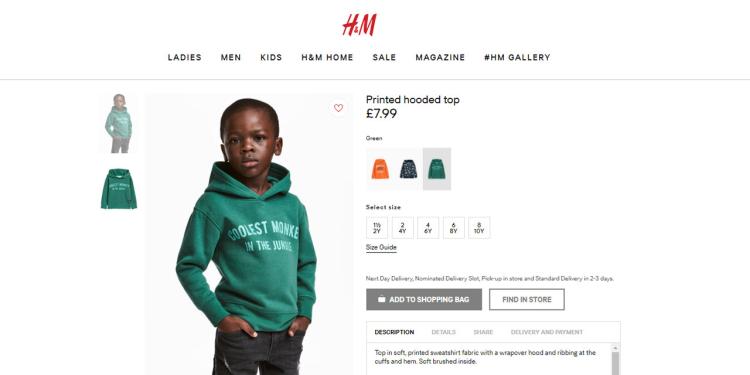
Article-h-m2-0108

Swedish clothing giant H & M caused a huge stir this week with an ad campaign depicting a young black boy in a sweatshirt that proclaimed him the “Coolest Monkey In the Jungle.”  The company’s misstep is surprising given the public condemnations of the use of the word “monkey” in Europe over the past few years when soccer fans have used it as a slur against black players. Notwithstanding H & M’s many apologies, several megastars have denounced the company and some have even pulled their fashion collaborations. As usual, several have called for boycotts of the retailer. But will all of this really matter? The sweatshirt was still for sale in the UK days for days after the controversy erupted, and the Weeknd, one of the megastars who vowed to never work with H & M, still has his 18-piece H & M collection available online and available for purchase on the store’s  U.S. portal.

I’m headed out of the country tomorrow and in my quest for a new sweater, I glanced in the H & M store in my local mall earlier today. The store was packed and likely with fans of the artists who called for a boycott.