I first blogged about this case back when the Supreme Court’s Halliburton Co. v. Erica P. John Fund, Inc. (Halliburton II), 573 U.S. 258 (2014) decision was new, and now we finally have some answers. 

In Halliburton II, the Court held that while securities class action plaintiffs get the benefit of a presumption that any material information – including false information – impacts the price of stock that trades in an efficient market, defendants may, at the class certification stage, attempt to rebut that presumption with evidence that there was no such price impact.

The complicating factor in all of this is that, per Amgen Inc. v. Connecticut Ret. Plans & Tr. Funds, 568 U.S. 455 (2013) and Erica P. John Fund v. Halliburton Co., 563 U.S. 804 (2011) (Halliburton I), defendants cannot rebut that evidence by demonstrating either a lack of materiality or a lack of loss causation.  This, of course, severely ties defendants’ hands, because those are the usual proxies for price impact.  (See prior blog posts for further discussion here and here and here and here.)

The Goldman case has an interesting twist, though.  The basic allegation is that Goldman falsely represented that it behaved with honesty and integrity toward its clients, and its lies were revealed when the SEC filed an enforcement action alleging that Goldman’s transactions involving CDOs were riddled with undisclosed conflicts of interest.  The SEC’s complaint triggered a price drop, and Goldman investors suffered as a result.

Goldman, however, argued it could rebut the presumption of price impact by demonstrating that at multiple times throughout the class period, the media reported on its conflicts, with no market reaction.  Therefore, argued Goldman, it was clear that the initial lies did not impact prices, and the price drop at the end of the class period was not due to the revelation of the truth – all of which was known to the market – but simply due to the SEC’s enforcement action itself.

As I previously argued, much of this was really a disguised attempt to relitigate the materiality of the initial statements, but in a 2018 appeal, the Second Circuit remanded to the district court to give Goldman the opportunity to prove lack of price impact by a preponderance of evidence.  See Ark. Teachers Ret. Sys. v. Goldman Sachs Grp., Inc., 879 F.3d 474 (2d Cir. 2018).  The district court recertified the class, Goldman appealed again, and the Second Circuit’s affirmance, 2-1, issued earlier this week, engages more closely with the substance of Goldman’s argument.

Okay, that sets the stage.  What actually happened here?

(More under the jump)

If you have trouble viewing the embedded Tweets, please try a different browser (I recommend Internet Explorer).

It’s been four weeks since the WHO declared the coronavirus outbreak a pandemic, and the NBA cancelled games. As of this writing, the NY Post reports: Total cases globally = 1,426,096; Deaths = 81,865.

One of the things that’s fascinated me about this strange time we’re living in is how it’s altered our buying habits.

For sure, some alterations were pretty predictable: more demand for work-from-home tools, computers, sanitizers, and protective gear (certainly, some people seem to have made very accurate forecasts.)

But some of the reports are less intuitive.  For example, lots of people have turned to home baking – either because they have more time or because they don’t/can’t buy in stores – leading to a yeast shortage. (Except, as this Twitterer explains, you can always make your own, a philosophy that many have apparently extended to eggs). 

Other people have figured now’s a good time to care for a pet, emptying out NYC’s shelters.  Or to pretend you’re still in college.

People seeking ways to amuse themselves have turned to jigsaw puzzles and, umm, other things.

On Zoom, nobody can tell if you’re drunk.  (Maybe.)  They definitely can’t tell what you’re wearing from the waist down, though (unless you show them). 

You’ve all heard about the toilet paper shortages, but I appreciated this explanation for them.

And

If you have trouble viewing the embedded Tweets, please try a different browser (I recommend Internet Explorer).

It’s been three weeks since the WHO declared the coronavirus outbreak a pandemic, and the NBA cancelled games. As of this writing, the NY Post reports: Total cases globally: 857,487; Deaths: 42,107.

We just reached the part of my M&A class where I teach The Williams Companies v. Energy Transfer Equity LP, 159 A.3d 264 (Del. 2017).  It’s a difficult case – I try to explain the tax aspects which makes part of it a slog – but I do it anyway because I find both the facts and the opinions endlessly fascinating.

The basic set up is that Energy Transfer Equity (“ETE”) and The Williams Companies (“Williams”) had agreed that Williams would be acquired by ETE for a combination of cash and ETE partnership units.  One condition of closing, however, was that ETE’s tax counsel at Latham would issue an opinion to the effect that the second leg of the deal should be non-taxable under IRS regulations.  The Latham Tax Lawyer did not issue the opinion, ETE refused to close, and Williams sued, alleging that ETE breached the merger agreement by failing to use its best efforts to obtain the opinion.  After a trial in Chancery, VC Glasscock ruled for ETE, and the Delaware Supreme Court affirmed, Strine dissenting.

So, the deal itself is complicated but it’s worth explaining.  The actual transaction was to proceed in two steps.  First

If you have trouble viewing the embedded Tweets, please try a different browser (I recommend Internet Explorer).

It’s been two weeks since the WHO declared the coronavirus outbreak a pandemic, and the NBA cancelled games. As of this writing, the NY Post reports: Total cases globally: 417,966; Deaths: 18,615.

Its the moment weve all been waiting for, and I am sorry to say – I was wrong.

(All right, in my heart, I still believe I was right in my account of existing law, and Salzberg v. Sciabacucchi actually changed the law.  But, if law is just a prediction of what judges will do, then okay, fine, yes, I was wrong.)

As you all know by now, I’ve been blogging about this case, and the issue of litigation-limiting bylaw and charter provisions, for a while, and I’ve written an article, and a book chapter, on the subject.  In this post, I’ll assume the reader’s familiarity with the issue and my prior argument.

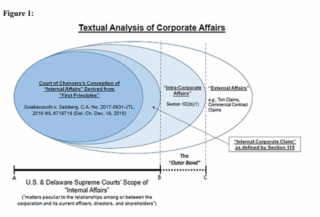
Anyway, the basic logic of the decision is illustrated by this figure from the opinion:

In other words, in the Delaware Supreme Court’s view, there are matters of internal affairs that are governed by the state of incorporation, and then there is a slightly larger category of matters that are still “intra-corporate” but not “internal affairs,” and can be governed by a corporation’s charter, and then there are truly external claims that cannot be the subject of a charter provision.  

Nevada’s Supreme Court recently released an advance opinion providing guidance on when the directors and officers of Nevada corporations may face liability.  This marks the first instance where the Nevada Supreme Court has directly considered Nevada’s unique statute.

Nevada differs from other states because our statute exculpates directors and officers as a default and includes a requirement that the misconduct must involve: “intentional misconduct, fraud or a knowing violation of law.”  This is the relevant portion of the statute:

7.  Except as otherwise provided in NRS 35.230, 90.660, 91.250, 452.200, 452.270, 668.045 and 694A.030, or unless the articles of incorporation or an amendment thereto, in each case filed on or after October 1, 2003, provide for greater individual liability, a director or officer is not individually liable to the corporation or its stockholders or creditors for any damages as a result of any act or failure to act in his or her capacity as a director or officer unless:

      (a) The presumption established by subsection 3 has been rebutted; and

      (b) It is proven that:

             (1) The director’s or officer’s act or failure to act constituted a breach of his or her fiduciary duties as

If you have trouble viewing the embedded Tweets, please try a different browser (I recommend Internet Explorer).

It’s been a week since the WHO declared the coronavirus outbreak a pandemic, and the NBA cancelled games. As of today, the NY Post reports: Total cases globally: 198,179; Deaths: 7,954.