
Margaret Blair just posted a new paper to SSRN, How Trustees of Dartmouth College v. Woodward Clarified Corporate Law.  It’s a fun historical piece on how Trustees of Dartmouth College v. Woodward enshrined the concession theory of the corporation into law.  She argues that although the case is often cited for the contractual theory of the corporation, it also stands for the proposition that corporations result from state-conferred privileges.  She traces the history of business organizations in the United States in order to demonstrate that critical features of the corporate form – separate personhood, asset partitioning, limited liability – were not replicable absent official state recognition, leading up to Dartmouth College’s famous pronouncement that “A corporation is an artificial being, invisible, intangible, and existing only in contemplation of the law. Being the mere creature of the law, it possesses only those properties which the charter of its creation confers upon it either expressly or as incidental to its very existence.”  The notion of a corporation as the product of state privilege was also articulated by Justice Washington in his concurrence, where he wrote, “A corporation is defined by Mr. Justice Blackstone to be a franchise….It amounts to an extinguishment of the King’s prerogative to bestow the same identical franchise on another corporate body….”

Along these lines, I also note that Paul Mahoney has an interesting piece where he doesn’t – exactly – disagree with Blair’s history, but does claim that private contracting mechanisms were not as bad at replicating the corporate form as Blair takes them to be, in part because of early limits on respondeat superior (so that tort liability risk was less of a thing) and because reputational concerns kept everyone out of the courts, so they resolved their differences privately.  See Paul G. Mahoney, Contract or Concession? An Essay on the History of Corporate Law, 34 Ga. L. Rev. 873 (2000).   In his telling, it was the interference of the legislature that arrested the development of privately-created corporations, in part so that the Crown could protect the monopoly rights of those who paid for charters.

Of course, being of the critical-legal-studies sort myself, I just have to add that there is something rather incongruous about arguing whether corporations can be formed “privately” or instead need a “state concession” when the only evidence one way or another comes from judicial recognition – or lack of recognition – of corporate personhood.  Judges are, of course, state actors, so in that sense, one cannot have any of the benefits of the corporate form without the involvement of the state, because ultimately you need a judicial pronouncement to make it so.
FINRA has amended its proposal to reform the expungement process again. I’ve written about this before here and here.  The “straight-in” or “expungement-only” arbitration process can be summarized quickly.  A broker desiring to purge customer dispute information from public records can secure expungement by following an odd process.  The broker first files an arbitration against a current or former employer alleging that the customer who is not a party to the action filed a “false” claim or somehow mistakenly identified a broker who had nothing to do with the matter.  In essence, the arbitration alleges that the non-party customer told lies about the broker.  The broker will then wait until about 30 days before the hearing before sending a vague letter to the customer notifying them of their right to appear at a hearing. (If the amended proposal goes into effect, customers will get notice much earlier in the future.) In my experience, the letters often omit information you’d expect to be included, such as the name of the arbitrator for the case, the time zone for the hearing, or how the customer can dial in to participate.  The process has a lot of problems and statistical evidence indicates that brokers who secure expungements are actually more dangerous to the public than the average broker.

In its letter explaining the additional changes and its response to comments, FINRA recognized that the comments fell into two main veins: (i) incremental suggestions to improve the existing process; and (ii) opposition to continuing to use arbitration to facilitate expungements.  I divided my letter on the amended proposal along this line, breaking down things FINRA could do to improve the existing process while continuing to explain why I believe that arbitration-facilitated expungement is fundamentally broken.  The FINRA response quoted from my letter to categorize the comments:

Some commenters, while expressing general support for the Proposal, expressed their preference for an alternative approach to the current expungement process that would not rely on the FINRA arbitration forum. For example, Edwards 2 stated that “FINRA deserves praise for its attempts to improve the current expungement system and many of the Amended Proposal’s changes would improve the arbitration-facilitated expungement process. The changes it embraced by amending the Proposal will do some real good. Even though the Amended Proposal offers an improvement over the status quo, the changes to the process under consideration do not go far to make arbitration-facilitated expungement acceptable.”

Although making meaningful, changes the second amendment leaves the general framework undisturbed.  FINRA adopted one of my suggestions to allow non-party customers to have access to documents through FINRA’s online portal:

Also in response to comments on the Initial Filing, FINRA amended the Proposal in Partial Amendment No. 1 to require that the Director notify customers of the time, date and place of any prehearing conferences, in addition to the expungement hearing, and clarify that customers are entitled to appear at prehearing conferences. Edwards 2 acknowledged that “these changes will reduce barriers to customer participation,” but stated that “FINRA [should also] allow non-parties to access documents through the DR Portal on equal terms as the parties to an expungement request.” . . .

FINRA agrees that customers who seek to participate in a straight-in request should have access to all documents filed in the arbitration that are relevant to the expungement request. Accordingly, FINRA is proposing in Partial Amendment No. 2 to amend proposed Rule 13805(b)(2) to provide that the Director shall provide the notified customers with access to all documents filed in the arbitration that are relevant to the expungement request. 

This will undoubtedly help non-party customers participate in a more meaningful way.  The language does leave me with a lingering concern about how FINRA will determine which documents are “material” to a non-party customer’s opposition.  Consider one situation I recently dealt with.  We represented a non-party customer in an expungement hearing where the broker sought to expunge about seven different customer’s disputes from the public record in a single stroke.  Although we requested all documents that the broker would use in the hearing, the broker only provide documents from our client’s account.  We were able to review those documents and determine that they were not accurate.  Our client, a septuagenarian widow with only a high school education, had been induced to sign a document stating she had twenty years of experience in trading options.  On cross examination, the broker immediately admitted that the account opening forms were plainly inaccurate and that the hand writing on it also indicated that the brokerage had filled the form out for the client.  If we had been able to see more documents, we might have been able to show that the brokerage routinely induced people to sign forms with false information that brokerage employees put on the forms.  Without access to all the documents and a meaningful opportunity to review them, it’s hard for us to know whether they would be material or not.

While these changes are good and improve the process, real problems remain.  As the persons being called liars are not parties to the proceeding, any time where FINRA’s rules specify that a “party” may do something or have access to something, I expect that non-party customers will continue to struggle to receive fair treatment.  


Last week, I blogged about my new article, The Federal Reserve As Collateral’s Last Resort, in the Notre Dame Law Review.  I mentioned that this shorter work is a first step in a larger normative project on central bank collateral frameworks.  As I progress with this research, I’m adding new articles to my reading list for this new article.  Peter Conti-Brown, Yair Listokin, & Nicholas R. Parrillo recently posted their new work, Towards An Administrative Law of Central Banking, published in the Yale Journal on Regulation.  It immediately made the list!  Here’s the Abstract:

A world in turmoil caused by COVID-19 has revealed again what has long been true: the Federal Reserve is arguably the most powerful administrative agency in government, but neither administrativelaw scholars nor the Fed itself treat it that way. In this Article, we present the first effort to map the contours of what administrative law should mean for the Fed, with particular attention to the processes the Fed should follow in determining and announcing legal interpretations and major policy changes. First, we synthesize literature from administrative law and social science to show the advantages that an agency like the Fed can glean from greater openness and transparency in its interpretations of law and in its long-term policymaking processes. These advantages fall into two categories: (1) sending more credible signals of future action and thereby shaping the behavior of regulated parties and other constituents, and (2) increasing the diversity of incoming information on which to base decisions, thereby improving their factual and predictive accuracy. Second, we apply this framework to two key areas—monetary policy and emergency lending—to show how the Fed can improve its policy signaling and input diversity in the areas of its authority that are most expansive. The result is a positive account of what the Fed already does as an administrative agency and a normative account of what it should do in order to preserve necessary policy flexibility without sacrificing the public demands for policy clarity and rigor.

Brooklyn Law School is hosting a two-day symposium next week to celebrate Roberta Karmel on her retirement. Here is the key part of the promotional blurb:

Join us to celebrate the career of Professor Roberta Karmel, the Centennial Professor of Law at Brooklyn Law School. Professor Karmel has been a pathbreaker in all senses of the word. She was the first female partner at the law firm of Rogers and Wells, the first female Commissioner of the U.S. Securities and Exchange Commission, and, for over 30 years, a teacher, mentor, colleague, and prominent scholar of business and securities law.

The symposium will be held virtually May 13-14 and will include a celebration of Professor Karmel’s career hosted by the Law School with tributes from the BLS community, alumni, and special guests.

Additional information about the program (including a link to the registration form) can be found here, and the agenda can be found here.  I am privileged to be a speaker at this event.  Roberta is a hero of mine and an inspiration to us all.  I hope that you can attend. 

Please note that the organizers have invited folks to leave a short anecdote regarding or tribute to Roberta.  The registration form offers a place to do that.  But I suspect that friend-of-the-BLPB Miriam Baer (who is a coordinator of the program) would be happy to take an email from you if that proves to be best.  Her email address is miriam.baer@brooklaw.edu.

Please join me in participating in Well-Being Week in Law (WWIL), #WellbeingWeekInLaw.  WWIL is a week-long event that is aligned with Mental Health Awareness Month.  (Yes, that’s this month!)  From the event website:

What’s The Purpose of WWIL?

The aim of WWIL is to raise awareness about mental health and encourage action and innovation across the profession to improve well-being. In 2021, the event’s name was changed from “Lawyer Well-Being Week” to Well-Being Week in Law to be more explicitly inclusive of all of the important contributors to the legal profession who are not lawyers.

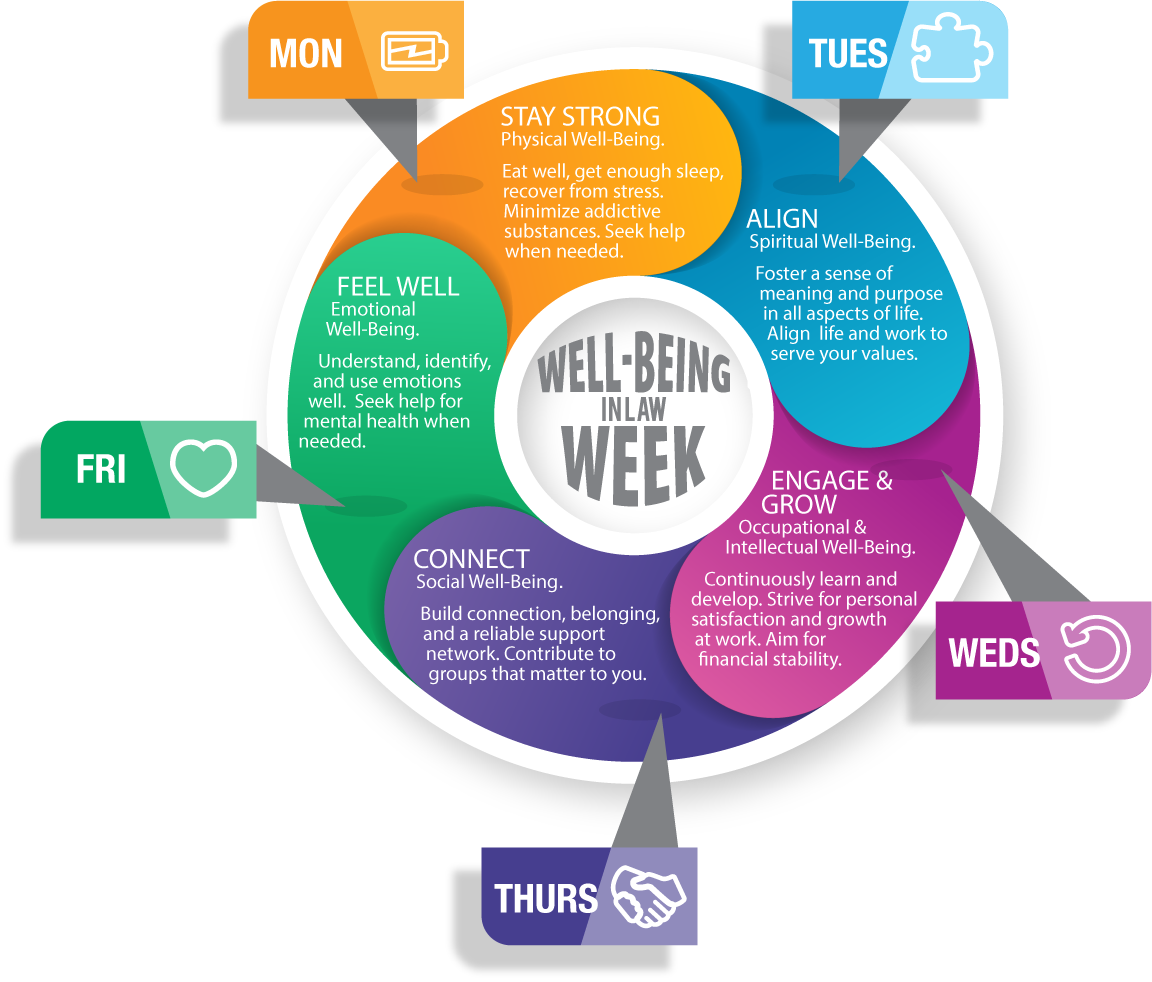
Each day in the week, the WWIL program invites participants to focus on a different aspect of well-being, using this graphic as a guide:


image from lawyerwellbeing.net


I am planning on participating in WWIL activities as much as I can in this busy week filled with exams, papers, and the graduation for our third-year students. 

Today’s WWIL focus is physical well-being.  I had a lovely 10,000+ step walk planned for this morning with a colleague to start the week off right.  Rainstorms put the kibosh on that.  (We are rescheduling . . . .)  But I will try to get a walk in later in the day–outdoors, if the rain lets up for a bit or tapers off.  Moreover, while I have not written about it recently, I do continue to practice and teach yoga.  I also will work some yoga into the day later.  It’s a super antidote to that scrunchy feeling I get sitting at the computer all day!  Both walking and yoga–desk yoga, specifically (check it out!)–are mentioned on a nifty WWIL webpage that offers ideas for how individuals can participate

In addition to these movement-oriented ways of looking out for my physical well-being, now that classes are done for the semester (yay for that!), I have refocused attention on getting at least seven hours of sleep and hydrating more frequently and consistently.  I also am cutting way back on coffee, which has been doing a number on my stomach of late.  I try to eat a balanced diet (I am a meat, fish, and poultry eater and love almost every food imaginable), although I know that I can always use more veggies and fruits in my day!  Perhaps some of these things also represent helpful suggestions for your well-being.

A good diet is hard to come by, however–at least sometimes.  And there are specific health issues that I must focus on as I prepare to start my seventh decade of life in less than two weeks.  (Humbling.)  So, maintaining physical wellness, for me, also involves taking supplements and medications.  I have recently recommenced taking iron supplements for a slightly low iron count that has been dragging my energy level down lately (something I also wrestled with a year ago–cause investigated and still unknown), even though doing that makes me cranky because of the way I have to sequence taking those supplements and a GERD medication that I dutifully take every morning.  I also am restarting omega-3 supplements, which are known to lower high triglyceride levels (something I have contended with in the past).  And I regularly take vitamin D supplements and an anti-cholesterol medication, as prescribed by my doctor.  It’s a lot to focus on, but I am worth it!

Gratefully, there is a lot of solid programming out there for lawyers who desire to improve their well-being.  Even continuing legal education programs now cover this space (I have given two sessions on mindfulness) as part of professional responsibility/ethics training.  And if you are interested in lawyer wellness–or just in avoiding burnout (read on)–you may want to check out a new podcast series that premieres on Wednesday: Leveraging Latitude.  One of the co-hosts, Candice Reed, is an engaging UT Law alum who is the co-founder of a legal services recruitment/placement firm.  She teaches in UT Law’s Institute for Professional Leadership.  (I sat through her “Thriving as  Lawyer” class this semester.  It was truly inspiring.)  On LinkedIn, Candice notes the following about Wednesday’s podcast:

Our first guest is former attorney and resilience expert Paula Davis. We’ll be discussing her new book, Beating Burnout at Work: Why Teams Hold the Secret to Well-being and Resilience. This book is fantastic and full of pragmatic, science-backed strategies for addressing burnout, and Paula is a dynamic speaker and teacher. I hope that you will listen to our conversation.

Sounds like a highly relevant program, especially for us law professors at the end of a difficult semester and academic year.

Finally, I want to give a loving shout-out to co-blogger Marcia Narine Weldon.  If you are not connected with her through LinkedIn, you are missing out in many ways–including as to tips on lawyer well-being. Her latest post, from yesterday, is here.  In that post and the embedded video, Marcia honors Mental Health Awareness Month and advises us to take care of ourselves, especially if we take care of others.  She offers multiple suggestions for ways to accomplish that self-care.  Marcia also has shared wisdom on lawyer well-being here on the BLPB.  She started us off in 2021 by counseling us on how to thrive this year and recently offered information on the business case for promoting, supporting, and even prioritizing attorney well-being.  The courage and candor she shows in all of these communications is laudable and evidence of her caring nature and support for the legal community.   Her work is an inspiration for this post.

Be well, y’all.

Last year, I blogged about the Boeing decision in the Northern District of Illinois.  In sum, a district court ruled that Boeing’s forum selection bylaw – requiring that all derivative actions be filed in Delaware Chancery – applied even to federal securities claims brought under Section 14(a) of the Exchange Act.  That matters because Delaware Chancery has no jurisdiction to hear Section 14(a) claims; dismissal in favor of the Delaware forum, as a practical matter, was a holding that the forum selection bylaw defeated plaintiffs’ ability to bring derivative Section 14(a) claims at all. Which would seem to be in tension with the anti-waiver provisions of the Exchange Act, which voids “[a]ny condition, stipulation, or provision binding any person acquiring any security to waive compliance with any provision of this title.” 15 U.S.C. § 78cc(a).

The Boeing plaintiffs have appealed to the Seventh Circuit and while we all await the outcome of that case, another court has just reached a similar result – this time, a magistrate decision in Lee v. Fisher, N.D. Cal., No. 3:20-cv-06163.  Section 14(a) claims were brought derivatively against The Gap and, just as in Boeing, the court dismissed the claims due to a forum selection bylaw designating Delaware Chancery as the forum for all derivative actions.

If you’ve been following this issue, you can guess what follows.  First, the court assumed that a forum selection bylaw is enforceable as a contract in the first place, offering no analysis beyond a footnote that “the Delaware Supreme Court recently ruled that forum-selection clauses governing shareholder claims are valid and enforceable under Delaware’s General Corporation Law.” But Delaware law applies as a matter of corporate law and the internal affairs doctrine; the court made no attempt to determine whether Delaware law should apply as a matter of contract law when we’re outside the internal affairs doctrine.

Assuming the bylaw was a contractual provision, the court relied on Yei A. Sun v. Advanced China Healthcare, Inc., 901 F.3d 1081 (9th Cir. 2018) to hold that contractual forum selection provisions defeat anti-waiver provisions in the substantive governing law.  Here is the court’s reasoning:

The Ninth Circuit has made clear that the strong federal policy in favor of enforcing forum-selection clauses supersedes the anti-waiver provisions in state and federal statutes… Because the anti-waiver provision standing alone does not supersede the forum-selection clause, “in order to prove that enforcement of such a clause would contravene a strong public policy of the forum in which suit is brought, . . . [P]laintiff must point to a statute or judicial decision that clearly states such a strong public policy.” …. Plaintiff does not point to any statute or judicial decision that clearly states that enforcing the forum selection clause would contravene a strong public policy. 

(quoting Yei A. Sun, 901 F.3d at 1090).

In other words, the forum selection bylaw would be enforced because the plaintiff was unable to find evidence of a federal policy against enforcing it, other than the explicit anti-waiver provision in the Exchange Act itself.  As the court put it:

[T]he Ninth Circuit has made clear that existence of an anti-waiver clause in a statute that the plaintiff intends to prosecute is insufficient to demonstrate the required strong public policy for purposes of overcoming a forum selection clause. Yei A. Sun, 901 F.3d at 1090 (“Because an antiwaiver provision by itself does not supersede a forum-selection clause, in order to prove that enforcement of such a clause would contravene a strong public policy of the forum in which suit is brought, . . . the plaintiff must point to a statute or judicial decision that clearly states such a strong public policy.”)

I’ve got to say, the logic – which originates in Yei A. Sun – baffles me.  As I understand it, the federal policy in favor of forum selection clauses is so great that even if the statute says ‘’you may not waive this claim,” waivers that occur via the operation of a forum selection clause will still be respected unless there’s an additional statute or judicial decision that says “no, seriously, we weren’t kidding about the anti-waiver thing.”  Why should the additional affirmation on top of the explicit anti-waiver provision be necessary?  And if we’re talking about a federal rather than state anti-waiver provision (the original Yei A. Sun case dealt with a state law anti-waiver provision), aren’t the federal courts – in this case, the very federal court in which the plaintiff brought her claims – equipped to make a substantive determination as to what federal policy requires, which is evidenced by the anti-waiver provision in the federal statute?  Why is it necessary for another court to do that first before the anti-waiver provision can be enforced, and which court should it be, if every federal court is waiting for another one to be the first mover?  It’s one thing if you’re interpreting a state law rule so you need a state court to make clear how the state interprets its own policy, but if it’s a federal cause of action, isn’t a federal court competent to make a determination on its own? 

Plus, all of this reasoning – about forum selection provisions trumping anti-waiver provisions – descends from the Lloyd’s of London cases, which I discussed in my prior post. You can go back and read that one if you’re interested, but my argument is they arose in a very different context and are quite distinguishable.

Anyway, yes, I do feel a bit like Don Quixote at this point – or perhaps the analogy should be more along the lines of Sisyphus – but I’m left kind of dumbstruck as I watch federal courts slowly develop a new rule that you can contractually waive securities law claims – despite literal decades of precedent holding that you can’t – if you’re clever enough to designate the waiver as a forum selection clause.  Even arbitration law doesn’t go that far, and there actually is a federal statute that has been interpreted to represent a federal policy in favor of arbitration, unlike this “policy” in favor of forum selection which is entirely based on federal common law.

Finally, I just have to reiterate my concern about Delaware eating the world.  Delaware decides how charters get amended, how bylaws get amended, what counts as an interested-party transaction, and how it will or will not be cleansed, whether it gets business judgment review or entire fairness or enhanced scrutiny, which means, so long as this line of cases continues, Delaware will be deciding critical questions regarding the validity of these bylaws and thus how federal securities law is administered.  And since part of the federal courts’ reasoning is that it’s okay if shareholders waive federal claims so long as Delaware provides some similar state law remedy, they’re functionally delegating to Delaware the power to delineate the substantive contours of what federal securities law requires.  I previously blogged about Omari Simmons’s article arguing that Delaware functions as a de facto federal agency, but this is a whole ’nother ballgame.

I’ve addressed the recent social-media-driven retail trading in stocks like GameStop in prior posts (here and here). In both posts, I focused on evidence that at least some of this trading seems to pursue goals other than (or in addition to) profit. For example, some of these retail traders claim that they are buying and holding stocks as a form of social, political, or aesthetic expression. My coauthors Jeremy Kidd, George Mocsary, and I recently posted a forthcoming article on this subject, Social Media, Securities Markets, and the Phenomenon of Expressive Trading, to SSRN. The article introduces the emerging phenomenon of expressive trading. It considers some of the challenges and risks expressive trading may pose to issuers, markets, and regulators–as well as to our traditional understanding of market functioning. Ultimately, the article concludes that while innovations like expressive trading “can be disruptive and demand a reimagining of the established order,” market participants, issuers, and regulators would be wise to pause and observe before rushing to adopt defensive strategies or implement reforms. Here’s the abstract:

Commentators have likened the recent surge in social-media-driven (SMD) retail trading in securities such as GameStop to a roller coaster: “You don’t go on a roller coaster because you end up in a different place, you go on it for the ride and it’s exciting because you’re part of it.” The price charts for GameStop over the past few months resemble a theme-park thrill ride. Retail traders, led by some members of the “WallStreetBets” subreddit “got on” the GameStop roller coaster at just under $20 a share in early January 2021 and rode it to almost $500 by the end of that month. Prices then dropped to around $30 dollars in February before shooting back to $200 in March. But, like most amusement park rides that end where they start, many analysts expect market forces will ultimately prevail, and GameStop’s share price will soon settle back to levels closer to what the company’s fundamentals suggest it should. Conventional wisdom counsels that bubbles driven by little more than noise and FOMO—fear of missing out—should eventually burst. There are, however, signs suggesting that something more than market noise and over-exuberance is sustaining the SMD retail trading in GameStop.

There is evidence that at least some of the recent SMD retail trading in GameStop and other securities is not only motivated by the desire to make a profit, but rather to make a point. This Essay identifies and addresses the emerging phenomenon of “expressive trading”—securities trading for the purpose of political, social, or aesthetic expression—and considers some of its implications for issuers, markets, and regulators.

FINRA recently released a new regulatory notice seeking comments on how to support diversity and inclusion efforts in the brokerage industry.  The notice asks for commenters to identify any FINRA rules or regulations which might be having a disparate impact on certain groups within the industry.

My sense is that the diversity and inclusion struggles industry firms face may be driven more by firm and industry culture than particular FINRA rules.  Susan Antilla wrote about the challenges women face in the industry.  Brokers of color have also faced real challenges. As Forbes covered, the numbers in asset management are particularly stark:

But in one industry, diversity numbers seem like they’re straight out of the 19th century: Firms owned by white men manage a stunning 98.7% of the $69 trillion managed by the U.S. asset management industry. That’s according to a 2019 Knight Foundation analysis, and includes hedge funds, mutual funds, real estate funds, and private equity funds. 

The FINRA notice also seems consistent with the SEC initiative on ESG reporting.

I’m delighted to share with BLPB readers that my new Essay, The Federal Reserve As Collateral’s Last Resort, 96 Notre Dame L. Rev. 1381 (2021) is now available (here).  Its focus is central bank collateral frameworks, a critical and timely topic that has thus far received scant attention from legal scholars.  I recently blogged about Professor Skinner’s Central Bank Activism.  Regardless of one’s perspective on this issue, it’s crucial to realize that a central bank’s collateral framework is the mechanism that promotes or limits such activism.  The institutional features of these frameworks are a combination of legislation and central bank policy, with the latter arguably being the most important influence on the Fed’s framework.   

As the first paragraph of my Essay explains “Central bank money or liquidity is at the heart of modern economies.  It is issued against collateral designated as eligible by, and on terms defined by, central bank collateral frameworks…what is often underappreciated is that the ultimate practical difference between an illiquid and insolvent firm is whether a firm has assets a central bank, such as the Federal Reserve, will accept as collateral for lending or for purchase, and at what valuation.  What ultimately constitutes “good” or central bank “eligible” collateral, how best to assess its value, and whose perspective on these questions matters most are critical issues at the heart of central bank collateral frameworks.” (footnotes in Essay omitted throughout this post). 

In the financial crisis of 2007-09, the Fed rescued both Bear Stearns and American International Group, but not Lehman Brothers.  Fed officials explained that Lehman did not have collateral sufficient to secure its lending assistanceSome economists have disagreed with this assessment.  Yet regardless of who is right about this issue, “the respective histories of these firms attest to the centrality of collateral and central bank collateral frameworks in modern credit markets.”

Central bank collateral frameworks also impact “the production, liquidity and pricing of assets that markets use as collateral…[and] market discipline and enable indirect bailouts of firms and governments.”  In other words, central bank collateral frameworks can potentially incentivize the production of junk assets. 

Much of my research has focused on clearinghouses.  If the Fed were to provide funding assistance under Dodd-Frank’s Title VIII to a distressed, designated clearinghouse, an important consideration would be the collateral securing such funding.  The loan might be “fully collateralized,” but the type of collateral actually securing the loan and its valuation would bear upon whether the assistance amounted to emergency liquidity provision or a bailout.  As I note in The Federal Reserve As Last Resort, it’s curious that while Dodd-Frank added collateral related provisions to the Fed’s longstanding Section 13(3) emergency authority, it included no such provisions with the Fed’s new liquidity authority in Title VIII for designated financial market utilities such as clearinghouses. 

As the importance of the shadow banking system has increased, so too has the role of collateral in financial markets.  The Fed provided extensive assistance to the shadow banking system in the financial crisis of 2007-09 and in the ongoing COVID-19 pandemic.  Although economists and legal scholars have written about the shadow banking system and the Fed’s emergency liquidity facilities, there has been little focus on central bank collateral frameworks.  More work is needed in this area.  Manmohan Singh’s Collateral Markets and Financial Plumbing and Kjell G. Nyborg’s Collateral Frameworks: The Open Secret of Central Banks are important (and some of the only) contributions in this general area.   

In sum, my Essay is meant to be a “first step in a broader normative project analyzing the proper balance between legislation and central bank policy—between architecture and implementation—in shaping the Federal Reserve’s collateral framework to best promote market discipline and to minimize credit allocation.  Its modest aim is twofold. First, it provides the first analysis of central bank collateral frameworks in the legal scholarship. Second, it analyzes the equilibrium between legislation and central bank policy in the Federal Reserve’s collateral framework in the context of its section 13(3) emergency liquidity authority, lending authority for designated financial market utilities, and swap lines with foreign central banks, and general implications of these arrangements.”        

My article, The Federal Reserve’s Use of International Swap Lines, was the first law review piece to analyze the Fed’s central bank swap lines.  It started with the following quote from an article by John Dizard in the Financial Times: “Always define every issue as just a technical problem.”  Central bank swap lines are anything but a mere technical issue.  Similarly, BLPB readers should understand that the collateral framework of the Fed and other central banks is much more than just a technical central banking problem.  It is a topic that should be of interest to all.

Finally, I’d like to thank NYU School of Law’s Classical Liberal Institute and the Notre Dame Law Review for the opportunity to participate in their workshop on The Public Valuation of Private Assets (additional articles here).  And I’d also like to thank Zachary Pohlman, Editor-in-Chief, Lauren Hanna, Symposium Editor, and all of the other members of the Notre Dame Law Review who edited my Essay for their superb work!

The ESG movement (or EESG, if you want to follow Leo Strine on this) has been in the business and legal news quite a lot recently.

In a Bloomberg article about the tax perks of trillions of dollars in Environmental, Social, and Governance investing by Wall Street banks, tax specialist Bryen Alperin is quoted as saying: “ESG investing isn’t some kind of hippie-dippy movement. It’s good for business.”

This utilitarian approach to ESG, and social enterprise in general, has made me uncomfortable for a while. The whole “Doing Well by Doing Good” saying always struck me as problematic.

ESG and social enterprise are only needed when the decisions made are not likely to lead to the most financially profitable outcomes. Otherwise, it is just self-interested business.

Over my spring sabbatical, I have been reading a fair bit about spiritual disciplines and the one that is most relevant here is “Secrecy.” The discipline of secrecy is defined as “Consciously refraining from having our good deeds and qualities generally known, which, in turn, rightly disciplines our longing for recognition.” In The Spirit of the Disciplines, Dallas Willard (USC Philosophy) writes, “Secrecy at its best teaches love and humility…. and that love and humility encourages us to see our associates in the best possible light, even to the point of our hoping they will do better and appear better than us.”

As a professor with active social media accounts, the discipline of secrecy is not an easy one for me. But I do think it is a good aspiration for all of us. Not every good deed has to be kept in secret. There can be good reasons for broadcasting good deeds (for example, to encourage others.) However, regularly performing good deeds in secret can help us build selfless character.

Similarly, socially conscious businesses and investors should be focused on the broader good being done, not on the personal benefits. Granted, I don’t think investors can blindly trust the ESG funds or benefit corporations — the screens are simply unreliable. Also, it may be difficult to determine which companies are really doing social good if they are practicing much of it in secret. But the truth has a tendency of leaking out over time and investors can focus on companies they see doing the right thing without excessive marketing.

As for the companies themselves, I remain optimistic that there are at least a few businesspeople who truly want to benefit society for mostly selfless reasons. Combatting selfishness is not easy, but the discipline of secrecy is one way to fight it.