“Peer assessment score” – the opinion of deans and certain faculty about the overall quality of a law school – accounts for 25% of a school’s score in the U.S. News ranking. It is the most heavily weighted item. Bar passage, for comparison, is just a bit over 2%. When told this my pre-law students almost inevitably say — “why would I care what deans and faculty at other schools think?”  

Below are the 25 schools that have the lowest peer assessment relative to overall rank and the 25 schools with the highest peer assessment relative to overall rank. Tier 2 schools are not included because they do not have a specific overall rank. TaxProfBlog provided the data

I am not unbiased here. I teach in the business school at Belmont University, and our law school has the biggest negative gap between peer assessment and overall rank. There are some reasonable reasons for this gap — e.g., the school is young (the law school founded in 2011, though the university was founded in 1890) and a lot of deans/faculty may not know that the law school is doing well on incoming student credentials, bar passage, and employment. FIU, the #2 school is also relatively young (founded in 2000). But it seems to me that the fact Belmont University is a Christian school and (former attorney general under George W. Bush) Alberto Gonzales is our dean is doing at least some of this work. 

10 out of the 25 biggest gaps are among religious law schools (in bold below). George Mason also likely gets hit for being openly conservative. Granted, this cannot be the only driver of the gaps . Also, there are 6 religious schools among the list of schools that have a high peer assessment relative to rank, so religion doesn’t seem disqualifying. That said, there are exactly 0 Protestant schools among the high relative peer assessment score list (and I am not sure any of them are significantly conservative in reputation…so maybe it is the conservative reputation more than the religious reputation doing the work). 

Anyway, I’m pretty interested in these gaps. Peer Assessment is supposed to measure overall quality of the school. What part of that “overall quality” is not already captured in the rest of the measures? Faculty research? Faculty Twitter followers? Faculty SEALS/AALS attendees? Moot Court National Championships? Something else? Feel free to leave comments below.  

Updated to correct confusion between FIU and Florida Coastal (H/T Matt Bodie); Updated to show San Diego and Seattle are religious.

Low Peer Assessment v. Overall Rank

  1. Belmont (-43)
  2. Florida Int’l (-31)
  3. New Hampshire (-31)
  4. Wayne State (-30)
  5. Baylor (-25)
  6. Drake (-25)
  7. Texas Tech (-25)
  8. Cleveland-Marshall (-25)
  9. BYU (-23)
  10. George Mason (-23)
  11. Missouri (Columbia) (-23)
  12. Penn State-Dickinson (-23)
  13. St. John’s (-23)
  14. Dayton (-22)
  15. Duquesne (-22)
  16. Villanova (-20)
  17. Samford (-20)
  18. Pepperdine Caruso (-18)
  19. Washburn (-18)
  20. Tulsa (-16)
  21. South Dakota (-16)
  22. St. Thomas (MN) (-15)
  23. Cincinnati (-14)
  24. Drexel (-14)
  25. Penn State-University Park (-13)

High Peer Assessment v. Overall Rank

  1. Santa Clara (+53)
  2. Howard (+43)
  3. Seattle (+43)
  4. Loyola-New Orleans (+37)
  5. American (+33)
  6. San Diego (+30)
  7. Indiana (McKinney) (+28)
  8. Rutgers (+27)
  9. Hawaii (+25)
  10. Denver (+22)
  11. Georgia State (+22)
  12. Baltimore (+22)
  13. Gonzaga (+22)
  14. Arkansas-Little Rock (+22)
  15. Tulane (+20)
  16. Miami (+20)
  17. Idaho (+20)
  18. New Mexico (+19)
  19. Chicago-Kent (+18)
  20. Brooklyn (+17)
  21. Maine (+17)
  22. Memphis (+17)
  23. UC-Irvine (+16)
  24. Loyola-L.A. (+16)
  25. Oregon (+16)


As a teaser to a forthcoming article I coauthored with two of my students (who co-presented with me) for the Business Law Prof Blog symposium back in the fall, I offer a short excerpt on business interruption insurance litigation resulting from governmental actions forcing business closures as a result of the pandemic, focusing on a recently decided Tennessee case.

In general, business lawyers got inventive in bringing legal claims of many kinds. A federal district court case recently decided in Tennessee, Nashville Underground, LLC v. AMCO Insurance Company, No. 3:20-cv-00426 (M.D. Tennessee, March 4, 2021), offers a notable example involving the interpretations of a business interruption insurance policy. The plaintiff in the action, a Nashville bar, restaurant, and entertainment venue, claimed coverage under the food contamination endorsement in its business interruption insurance policy for the damages suffered when it was forced to close its doors by governmental orders issued in March 2020 in response to the COVID-19 pandemic. The insurer denied coverage. The court held for the defendant insurer on its motion to dismiss for failure to state a claim, finding the contract language unambiguous. The court’s conclusion in its opinion noted sympathy, in spite of the outcome.

Like many Americans, the undersigned can sympathize with Plaintiff and so many of our other small to medium-sized businesses that seem to have borne much of the brunt of the effects of the COVID-19 pandemic. One could understand if Plaintiff (or anyone else) lamented that it simply is not right that this should be the case. But it also is not right, or lawful, for a business’s insurer to be on the hook for coverage it simply did not contractually commit to provide. Presumably like a myriad of other enterprises throughout this nation, Plaintiff in retrospect perhaps would have bargained for broader coverage but simply did not foresee such need before the unprecedented pandemic conditions arose in 2020. Accordingly, Plaintiff was unfortunately left without the coverage it now asks this Court to find in an insurance policy that simply does not provide it.

Nashville Underground, supra.  Sympathy notwithstanding, cases of this kind are decided on the basis of specific contract language. Although overall insurers tend to be winning in these contract interpretation battles, insureds are prevailing in some cases, at least in pretrial and summary judgment motion battles. See, e.g., Kenneth M. Gorenberg & Scott N. Godes, Update on Business Interruption Insurance Claims for COVID-19 Losses, NAT’L L. REV. (Oct. 29, 2020), https://www.natlawreview.com/article/update-business-interruption-insurance-claims-covid-19-losses; Richard D. Porotsky Jr., Recent Federal Cases in the N.D. Ohio Split on COVID-19 Business Interruption Insurance Coverage, NAT’L L. REV. (Jan. 26, 2021), https://www.natlawreview.com/article/recent-federal-cases-nd-ohio-split-covid-19-business-interruption-insurance-coverage; Jim Sams, Judge Rules in Favor of 3 Policyholders With COVID-19 Claims in Consolidated Case, CLAIMS J. (Feb. 21. 2021), https://www.claimsjournal.com/news/national/2021/02/24/302197.htm.

The opinions in these cases constitute an interesting emergent body of decisional law relevant to contract and insurance law and practice.  Along with litigation relating to, e.g., force majeure and material adverse change/effect, the legal actions interpreting language in business interruption insurance contracts are bound to offer important lessons and tips for legal counsel and their clients–a legacy likely to affect practice and litigation for many years to come.

The article from which the above quoted text (reformatted for posting here) comes, Business Law and Lawyering in the Wake of COVID-19, is scheduled for publication later this spring in Transactions: Tennessee Journal of Business Law.  I will promote the article here once the final version is available and has been posted to SSRN.  In the meantime, you have a a short preview of one part of the article in this post!

This past Friday and Saturday, The Tobias Leadership Center at Indiana University, the Center for Legal Studies and Business Ethics at the Spears School of Business at Oklahoma State University, and the American Business Law Journal hosted the online symposium “Ethical Leadership and Legal Strategies for Post-2020 Organizations.”  I wanted to share with readers the program slides Download 2021-Symposium-Slides for “details of the interesting topics and diverse approaches that were taken to the symposium’s theme.” 

The American Business Law Journal anticipates publishing a special issue on the symposium’s theme.  I’ll be sure to keep readers posted!

This week, I offer brief comments on a couple of different things:

1.  I’ve previously blogged about courts that stretch the definition of “forward-looking statement” in order to preclude defendants from claiming the protections of the PSLRA safe harbor.  But probably the more common scenario runs in the other direction.  Behold Police and Fire Retirement System of Detroit v. Axogen, 2021 WL 1060182 (M.D. Fla. Mar. 19, 2021), where the plaintiffs alleged that Axogen claimed that the potential demand for its medical products was very large because of the sheer number of nerve repair surgeries performed every year in the U.S.  As it turned out, far fewer surgeries were performed annually; in effect, the plaintiffs argued that Axogen overstated the size of its market.  Here’s what the court said in its dismissal order:

Plaintiff … [focuses] in particular on statements made in Axogen’s offering materials and elsewhere that a certain number of people in the United States “each year…suffer”  traumatic PNI [peripheral nerve injuries], which “result in over 700,000 extremity nerve repair procedures,” and that “[t]here are more than 900,000 nerve repair surgeries annually in the U.S.”  Plaintiff argues these statements refer to “present existing conditions.” But the number of injuries occurring “each year” reflects an ongoing state of affairs extending from the present into the future, rather than an observable state of affairs in existence at the specific point in time when the statement is made. Such a statement cannot be determined to be true or false by reference to “present existing conditions,” and is therefore analogous to other present tense statements the Eleventh Circuit has held to be forward-looking.

Thus is a representation about ongoing conditions – the number of nerve repair surgeries performed annually – transformed into a projection about future nerve repair surgeries.  The court did not even appear to consider whether a reader would interpret Axogen’s statements as implying recent past annual figures in this range (a range that, according to the plaintiffs, was wildly inflated).

The problem here is that, in the Seventh Circuit’s words, “Investors value securities because of beliefs about how firms will do tomorrow, not because of how they did yesterday.”  Wielgos v. Commonwealth Edison Co., 892 F.2d 509 (7th Cir. 1989); see also Glassman v. Computervision Corp., 90 F.3d 617 (1st Cir. 1996).  Any representation of current conditions is relevant to investors because they will extrapolate from that to predict future conditions, but if that were enough to make the statement “forward-looking,” well, everything would be protected by the safe harbor.  

2.  Tesla is being sued again, this time by a stockholder who claims that Elon Musk’s … colorful … behavior on Twitter violates his settlement with the SEC, is a threat to corporate value, and that the Board’s failure to rein him in represents a violation of its duty of good faith (and hey, as I was drafting this very post Musk did it again).  While I’m sure there are many things one could say about the lawsuit, the part that struck me was where the plaintiff alleged that the Board is dependent on Musk, in part, because Musk is indemnifying its members for any legal liability.  As the plaintiff puts it:

the Board is insured, and thus indemnified, by Musk personally for a majority of the harm caused by Musk alleged herein. The Board cannot be considered independent in any way from Musk in these circumstances. Musk could refuse to pay out the ‘insurance policy’ if the Board elected to proceed with an investigation of him, and the Board would have every incentive to abandon that investigation.

It is my understanding from Tesla’s SEC filings that the personal indemnification arrangement ended in 2020 and the Board now has an ordinary insurance policy, but the plaintiff is, as I read it, claiming that Musk still provides the coverage for certain acts that occurred in 2020.  The insurance arrangement raised a lot of eyebrows when it was first disclosed, and at the time I wondered what its legal significance would be for Board dependence.  I now look forward to finding out. 

(I should note that when the indemnification agreement was first disclosed, Tesla claimed that Musk’s performance was nondiscretionary, but that still raises questions about what Musk can and can’t dispute – and how interested the Board is in ensuring his solvency).

3.  WeWork!  In addition to the news that the plans to go public are back on – this time via SPAC – it’s the subject of another lawsuit, this time by the former shareholders of a private company that WeWork acquired, using its own stock as currency.  Unsurprisingly, the former shareholders argue that various WeWork officers, including Adam Neumann, overstated the value of WeWork shares when negotiating the deal.  What is surprising, to me anyway, is that the claims are solely brought under Section 10(b) of the Exchange Act.  Section 10(b) claims are very difficult to bring – apart from the higher pleading standards of the PSLRA, they are also relatively narrow in terms of the type of conduct that is deemed prohibited.  Their only real advantage over state claims – whether common law or even blue sky – is their availability for secondary market purchases, and the fraud-on-the-market presumption of reliance.  So I’m wondering why the plaintiffs elected to bring claims solely under Section 10(b), in a case where neither of these advantages are relevant.

4.  Insider trading!  A guy named Jason Peltz was recently indicted for insider trading and related offenses, arising out of trades in companies rumored to be the subject of takeover interest.  What makes this indictment unusual, however, is that it claims that an unnamed Reporter for a “financial news organization” was one of Peltz’s sources, providing Peltz with information about upcoming news stories.  (The indictment tactfully declines to name the Reporter or the news organization, but the stories are identified with sufficient particularity that deducing his identity is a relatively simple task).  So here’s the thing: Though Peltz is charged under 10b-5 for “misappropriating” confidential information, the indictment makes no reference to fiduciary obligations or the duty of trust and confidence.  Meaning, it’s unclear whether the claim is that Peltz misappropriated information from the Reporter, or whether the claim is that the Reporter misappropriated from his publication and intentionally tipped Peltz (echoing the dispute at the heart of United States v. Carpenter, 791 F.2d 1024 (2d Cir. 1986)).  On this point, I note that nothing in the indictment suggests any kind of longstanding close friendship between the Reporter and Peltz, but the indictment does mention that the scheme began when Peltz obtained inside information about a takeover bid, purchased the target’s stock, and then tipped the Reporter, who was able to publish a scoop (causing the target’s stock price to rise, and allowing Peltz to cash out).

And … that’s all!

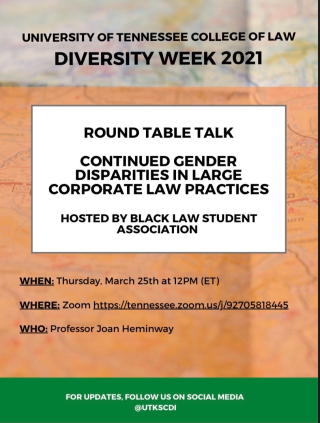
Yesterday, I had the honor of leading a roundtable discussion on women and the practice of business law.  The roundtable was part of a series convened by UT Law’s Student Council on Diversity and Inclusion, and this specific roundtable was hosted by our Black Law Student Association.  Here’s the promotional flyer from the event.

SCDIRoundtableAnnouncement

In preparing for the session, I had occasion to review two ABA reports from the past few years: Roberta D. Liebenberg & Stephanie A. Scharf, Walking Out The Door : The Facts, Figures, and Future of Experienced Women Lawyers in Private Practice (ABA 2019), and Destiny Peery, Paulette Brown & Eileen Letts, Left Out or Left Behind: The Hurdles, Hassles, and Heartaches of Achieving Long-term Legal Careers for Women of Color (ABA 2020). I was reminded of the fall-off in female lawyers in BigLaw over the course of their careers.  Quoting from the first report:

BigLaw is no stranger to the loss of experienced women attorneys. While entering associate classes have been comprised of approximately 45% women for several decades, in the typical large firm, women constitute only 30% of non-equity partners and 20% of equity partners. Women lawyers face many other challenging hurdles as they seek to advance into senior roles: the number of lawyers named as new equity partners at big firms has declined by nearly 30% over the past several years, and firms are increasingly relying on the hiring of lateral partners, over 70% of whom are men.

At the event, I noted this data and the principal reasons why women self-reported that they left practice. These include: care-taking obligations, workplace stress levels, responsibilities for marketing/originating business, billable hour requirements, loss of the desire to practice law, work/life balance dissatisfaction, and concerns about personal or family health.

I also noted specific difficulties faced by women of color.  In that regard, I referenced the following quote from a Black female lawyer in her late 40s (included in the second ABA report mentioned above).

Some of the barriers you can’t do [anything] about—like the(mis)perceptions people have in their own minds about your race or your sex or your background. So you start by having to overcome those negative assumptions, stereotypes, and presumptions. And then there’s the ‘black tax’ of having to demonstrate outsized achievements just to get the same opportunities as everyone else. It’s not by accident that at the firms at which I worked, every single black associate had at least two Ivy League degrees. Majority associates? Not so much.

There were no real surprises for me in these two reports. Having said that, I must note that they capture important data and reflections.  I recommend that everyone read them.

Of course, only some female law graduates (a relatively small number/percentage) start their careers in business finance or governance.  The number/percentage of female lawyers in large business law practices typically does not increase over time; it decreases.  Therefore, the number/percentage of women in those practice areas at the partner/shareholder/senior leadership level is relatively small.  (By the way, please let me know if you know where I can find some recent reliable data on all this.)  

I noted the relatively small percentage of women who enroll in my upper division advanced business law courses (a maximum in any course of 33-1/3%, and that’s pretty rare).  I asked the student participants for their ideas on why more women do not take these courses or, in general, express a desire to practice business law.  Among the responses were the following: not having been exposed to business lawyers or business operations, being intimidated by the subject matter, and being concerned that too much math may be involved.  I also asked them how we might work to correct the imbalance in business law and more generally.  Students volunteered their observations and ideas.  The were thoughtful, reflecting on their own experiences while also working hard to appreciate the circumstances of others.  One of the female students pressed her male colleagues to contribute.  It was a super discussion.  Several students contacted me after the roundtable to follow up on some points.

We only had an hour together, which was barely enough time to begin to scope out these issues.  There was certainly more that could have been said had there been more time.  I invited students to continue the conversation among themselves and with me and other faculty.  I have hope they will do that.  I want to ensure that business law knowledge and practice is accessible to all, and I could use their help in accomplishing that goal.

Earlier today, a number of law school securities clinics met online with the SEC thanks to its Office of the Investor Advocate to talk about what they have been seeing in their cases.  By the most recent count, we’re down to only about 12 securities clinics nationwide.  Jill Gross has written about these disappearing clinics.  In my role, I teach business organizations, securities regulation, professional responsibility, and also offer a clinic from time to time.  At UNLV, clinics are not always offered every semester because our faculty also teach other courses.  With the need to turn a clinic on and off, I can’t run the kind of investor protection clinic I ran when I was at Michigan State because the cases just don’t wrap up in a semester.  Although we’ve done it in the past at UNLV with good results for clients and students, it’s not something that works well without attorney support to carry the cases and provide broader assistance when we’re not in session.  With that in mind, we’ve offered a “Public Policy”clinic here this semester with a focus on helping non-profits in preparing comment letters and advocating for their own goals.  This new offering focuses mostly on the advocacy work that other investor clinics do in their comment letters, only with a broader portfolio.  We’ll tackle a few things outside the securities realm as well.  It’s also been challenging because the federal rulemaking environment has been in flux with the Presidential transition.

Still, we’ve also been able to get students some real speaking experience.  A few weeks ago, we had a student team represent a non-party customer in an expungement hearing within the FINRA forum.  They were able to do openings, closings, and cross examinations–even cross examining the CEO of a brokerage firm.  These matters are intense because they happen on an expedited basis.  But they also don’t require the kind of long-term commitment that an ordinary customer arbitration does.  Today, that same student team was able to turn around and present to the SEC about the experience and interact with sitting SEC Commissioners.  Although outside the securities realm, we also had another student team prepare a white paper and present at the Consumer Product Safety Commission, sharing views on how the CPSC might regulate consumer products with AI and machine learning technology embedded in the devices.  This work gets us into some fascinating areas and gets the students writing, presenting, and having client experiences. 

But there are still too few of these clinics and we need more of them.  They play a vital role because the economics don’t make sense for most ordinary securities attorneys to take cases with relatively smaller damages or take on matters where there isn’t any money to recover.  If you get swindled out of a million dollars, attorneys will fight for you.  If you get taken for forty grand, many lawyers will pass because they have to put food on their own tables.  Of course, this leaves bad actors free to continue to take people for significant amounts without much fear that they’ll be held accountable for swindling investors.

A short time ago, the SEC’s Investor Advisory Committee recommended financial support for law school clinics.  I know that if we had funding, I could hire counsel, help more people, help a broader class of people, and provide more opportunities for our students.  We might eventually get something similar for securities law to what already exists for tax clinics, but it’s still uncertain whether we’ll get there.  Absent that, it seems likely that these kinds of clinics are going to continue to vanish.  

I always learn a ton in reading Professor Julie Andersen Hill’s banking articles.  A TON!  Hence, I’m excited to see that she recently posted her new piece, Cannabis Banking: What Marijuana Can Learn from Hemp (forthcoming 2021, Boston University Law Review).  This is her second article on cannabis banking, the first being an excellent symposium piece, Banks, Marijuana, and Federalism.  As both houses of Congress have recently reintroduced the SAFE Banking Act, these articles couldn’t be more timely.  Here’s the abstract for Cannabis Banking:

Marijuana-related businesses have banking problems. Many banks explain that because marijuana is illegal under federal law, they will not serve the industry. Even when marijuana-related businesses can open bank accounts, they still have trouble accepting credit cards and getting loans. Some hope to fix marijuana’s banking problems with changes to federal law. Proposals range from broad reforms removing marijuana from the list of controlled substances to narrower legislation prohibiting banking regulators from punishing banks that serve the marijuana industry. But would these proposals solve marijuana’s banking problems?

In 2018, Congress legalized another variant of the Cannabis plant species—hemp. Prior to legalization, hemp-related businesses, like marijuana-related businesses, struggled with banking. Some hoped legalization would solve hemp’s banking problems. It did not. By analyzing the hemp banking experience, this Article provides three insights. First, legalization does not necessarily lead to inexpensive, widespread banking services. Second, regulatory uncertainty hampers access to banking services. When banks were unsure what state and federal law required of hemp businesses and were unclear about bank regulators’ compliance expectations for hemp-related accounts, they were less likely to serve the hemp industry. Regulatory structures that allow banks to easily identify who can operate cannabis businesses and verify whether the business is compliant with the law are more conducive to banking. Finally, even with clear law and favorable regulatory structures, the emerging cannabis industry still presents credit, market, and other risks that make some banks hesitant to lend.


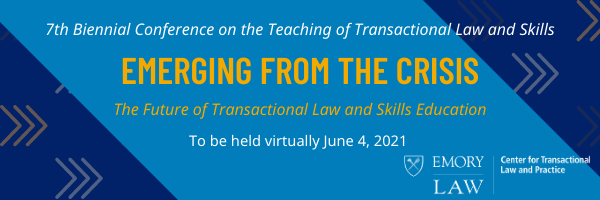
EmoryConference2021

Registration is Open!

It is our great pleasure to announce that registration is now open for the seventh biennial transactional law and skills education conference to be held virtually on June 4, 2021. Please join us to celebrate and explore our theme – Emerging from the Crisis: The Future of Transactional Law and Skills Education with you. This year, we have reduced the registration fee to $50 per person. Secure your space today!

Call for Proposals

Please take a moment to review the Call for Proposals and submit your proposal here. Also, please share the CFP with your colleagues who may not have attended the Conference before. Consider forwarding it to adjuncts and professors teaching relevant subjects. Can you also think of any teachers who might be interested in attending or presenting?

The Call for Proposals deadline is 5 p.m. April 15, 2021. We look forward to receiving your proposals.

Last, but certainly not least, at this year’s Conference, we will announce the winner of the second Tina L. Stark Award for Teaching Excellence. Would you like to nominate yourself or a colleague for this award? More information will be forthcoming regarding award eligibility and the nomination process.

If you have questions regarding any of this information, please contact Kelli Pittman, Program Coordinator, at kelli.pittman@emory.edu or 404.727.3382.

We look forward to “seeing” you in June!

Sue Payne | Executive Director

Katherine Koops | Assistant Director

Kelli Pittman | Program Coordinator

A speculative frenzy appears to have taken hold of markets, extending to everything from GameStop shares to sports cards and anything blockchain (again).  Caught up in the mania are SPACs – specifically the blank-check firms trading before an acquisition target has been identified.

The difficulty, as the Financial Times recently reported, is that retail shareholders caught up in the SPAC craze aren’t necessarily interested in voting their shares when it comes time to consummate a merger.  Worse, a large number of them may have sold their shares after the record date, leaving no one to actually cast the ballot.

Which is why Switchback Energy Acquisition Corporation recently issued the most extraordinary press release:

  • Stockholders as of the Close of Business on December 16, 2020 Should Vote Their Shares Even if They No Longer Own Them

Switchback Energy Acquisition Corporation (NYSE: SBE) (“Switchback”) today announced that it convened and then adjourned, without conducting any other business, its virtual Special Meeting of Stockholders to February 25, 2021 at 10:00 a.m., Eastern time (the “Special Meeting”), to allow for more time for stockholders to vote their shares to reach the required quorum and approve the required proposals….

Switchback has received overwhelming support for the Business Combination. At the time the Special Meeting was convened, approximately 99.9% of the proxies received had been voted in favor of the transaction. However, since holders of approximately 45% of the outstanding shares submitted proxies to vote, the necessary quorum of a majority of the outstanding shares was not present. Switchback requests that any investor who held shares of stock in Switchback as of the close of business on December 16, 2020 and has not yet voted do so as soon as possible in order to avoid additional delays….

Can I still vote if I no longer own my shares?

Yes, if you owned shares as of the close of business on December 16, 2020, the record date for the Special Meeting, you can still vote your shares even if you no longer own them.

This is, I must say, quite remarkable.  I mean, there have long been concerns about “empty voting,” i.e., casting ballots for shares in which you have no economic interest, including casting ballots for shares that have since been sold.  See, e.g., Henry T.C. Hu & Bernard Black, The New Vote Buying: Empty Voting and Hidden (Morphable) Ownership, 79 S. Cal. L. Rev. 811, 835 (2006).  Here, everyone’s assuming that the vote was a mere formality and the reason the shares were not voted was that retail shareholders are indifferent, but what if some shareholders disfavored the merger?  Pushing the deal through with the ballots of former shareholders would hardly be fair to them.

Which gets to the legal question of whether this is even okay.  Delaware has vaguely suggested, you know, maybe not.  For example, in In re Appraisal of Dell, 2015 WL 4313206 (Del. Ch. July 13, 2015), VC Laster held:

even the right to control how shares vote transfers with the shares, notwithstanding the legal expedient of the record date, because the subsequent holder can compel the seller to issue him a proxy (assuming the seller can be identified)

In support, he cited Commonwealth Assocs. v. Providence Health Care, Inc., 641 A.2d 155 (Del. Ch. 1993), where Chancellor Allen expressed “doubt” that a contract for the sale of shares that allowed the seller to retain the right to vote would be “be a legal, valid and enforceable provision, unless the seller maintained an interest sufficient to support the granting of an irrevocable proxy with respect to the shares.”  See also In re Canal Construction Co., 182 A. 545 (Del. Ch. 1936) (“As between a transferror who has parted with all beneficial interest in stock and his transferee, the broad equities are all in favor of the latter in the matter of its voting.  While the transferee may not himself be qualified to vote because he had not caused the stock to be registered in his name …, it does not necessarily follow that the transferror may exercise the voting right in defiance of the transferee’s wishes. So far have courts recognized the equity of the true owner of stock to control its voting power as against the registered holder, that the latter has been required to deliver a proxy to the former.”); In re Giant Portland Cement Co., 21 A.2d 697 (Del. Ch. 1941) (“A mere nominal owner naturally owes some duties to the real beneficial or equitable owner of the stock; and even if the right to demand a proxy is not exercised, if the vendor exercises his legal right to vote in such a manner as to materially and injuriously affect the rights of the vendee, he is, perhaps, answerable in damages in some cases.”)

Those cases were about disputes between the transferor and the transferee regarding the manner in which shares would be voted, but it should also be noted that in the context of “vote-buying” allegations, Delaware has suggested that it is illegitimate to divorce economic interest in shares from the voting rights attached to them.  See Crown EMAK Partners, LLC v. Kurz, 992 A.2d 377 (Del. 2010).

Anyhoo, we can add this to the growing list of “concerns about SPACs,” which is why the SEC is reportedly taking a closer look.  Of course, if the world is finally opening up post-covid, speculative trading may also subside, and the problem may take care of itself.

The University of Connecticut School of Business hosts The Business and Human Rights Initiative, which “seeks to develop and support multidisciplinary and engaged research, education, and public outreach at the intersection of business and human rights.” Professor Stephen Park, Director of the Business and Human Rights Initiative, invited me to be a discussant at the most recent meeting of the Initiative’s workshop series. The workshop focused on Rachel Chambers’ and Jena Martin’s excellent paper, A Foreign Corrupt Practices Act for Human Rights. Here’s an abstract:

The global movement towards the adoption of human rights due diligence laws is gaining momentum. Starting in France, moving to the Netherlands, and now at the European Union level, lawmakers across Europe are accepting the need to legislate to require that companies conduct human rights due diligence throughout their global operations. The situation in the United States is very different: on the federal level there is currently no law that mandates corporate human rights due diligence. Civil society organization International Corporate Accountability Roundtable is stepping into the breach with a legislative proposal building on the model of the Foreign Corrupt Practices Act to prohibit corporations from engaging in grave human rights violations and to give the Securities and Exchange Commission and the Department of Justice the power to investigate any alleged violations.

The draft law, called the Foreign Corrupt Practices Act – Human Rights (FCPA-HR) follows the general framework of the FCPA, but with certain enumerated human rights violations as the prohibited conduct rather than bribery and corruption. The FCPA-HR continues where the FCPA left off by requiring companies to engage in substantive conduct to prevent any human rights violations from occurring in their course of business and to make regular reports regarding their compliance and success. This paper situates the draft law within the current picture for business and human rights legislation both in the United States and in Europe, identifies the strengths of using the FCPA model, and analyzes the FCPA-HR proposal, addressing the likely critiques of the proposal.

Though I have been following developments in the area of business and human rights for years, I must admit that I have not paid sufficient attention to the movement in my classroom and scholarship. Chambers’ and Martin’s paper reminds us all of the need for reform, and of the reality that legislation in this area is imminent (at home and abroad). Imposing civil and criminal liability on corporations and individuals for their direct or indirect involvement in human rights violations would force dramatic changes in corporate compliance practices. If the SEC will have primary responsibility for enforcement (as it does for the FCPA), then we can expect dramatic organizational changes at the Commission as well. With so much at stake, there is a real need for collaboration among human rights experts, lawyers, scholars, regulators, and issuers to find the right model. There’s a lot of work to do, and Chambers’ and Martin’s paper offers an excellent start. The paper remains a work in progress, but it will be available soon—I look forward to its publication!