
After Ben posted about the GameStop Affair last week, Joan predicted that the saga would be a “great gift to law professors.”  That seems about right, because here I am with a post about the subsidiary issue of Robinhood, or rather, Robinhood’s platform.

FINRA just issued a report on its current Risk Monitoring and Examination Activities, which highlights certain areas that FINRA will be investigating going forward.  It doesn’t mention Robinhood by name, but it flags some of Robinhood’s practices for special attention and, in particular, its game-like user interface.  In specific, it says:

we are increasingly focused on communications relating to certain new products, and how member firms supervise, comply with recordkeeping obligations, and address risks relating to new digital communication channels. This focus includes risks associated with app-based platforms with interactive or “game-like” features that are intended to influence customers, their related forms of marketing, and the appropriateness of the activity that they are approving clients to undertake through those platforms (e.g., under FINRA Rule 2360 (Options)).

While such features may improve customers’ access to firm systems and investment products, they may also result in increased risks to customers if not designed with the appropriate compliance considerations in mind. Firms must evaluate these features to determine whether they meet regulatory obligations to…comply with any Reg BI and Form CRS requirements if any communications constitute a “recommendation” that requires a broker-dealer to act in a retail customer’s “best interest”…

Brokers must act in the customer’s best interest when making investment recommendations.  Interfaces that encourage more trading simply to generate revenue for the platform – rather than based on a personalized assessment of the customer’s needs – aren’t going to comply with that standard, so the question is whether these kinds of encouragements are, in fact, recommendations.

This is an issue more broadly for electronic platforms that use algorithms to do everything from bringing certain items to the customer’s attention to providing responses to customer-initiated searches.  For example, Regulation Crowdfunding creates a new kind of entity known as a Funding Portal; basically, a website where investors can browse available offerings by issuers.  Funding Portals are exempt from broker-dealer registration as long as they limit their activities, including refraining from giving investment advice or making any investment recommendations.

The problem is that when you’re talking about a website, where algorithms determine the order in which investments appear on a page and which ones are highlighted at a particular time and which ones pop up when you type in search words, it’s very hard to tell what counts as “investment advice.”  Is it “advice” to say “These investments are trending”?  To say “These companies have been profitable for a year”?  Does it matter if the customer first searched for these criteria, or if they just popped up on the screen, unprompted?  What if the platform itself contains suggested search criteria?

The SEC tried to address this problem in Regulation CF Rule 402(b), which permits portals to highlight particular offerings based on “objective criteria.”  The adopting release contains a long discussion of the issues, and as you can see, this is … not easy to resolve.

Back to Robinhood.  As readers are probably aware, Massachusetts is currently suing Robinhood over its interface, and that’s the gravamen of the complaint as well: That Robinhood’s interface is functionally making recommendations to customers when it highlights particular securities based on purportedly objective criteria, like “100 most popular,” “Food and Drink,” and so forth.  The app even says things like “Can’t decide which stocks to buy? Check out the most popular stocks.” 

And then, of course, there’s the question whether more subtle aspects of the platform – like confetti graphics congratulating customers on a trade – are encouraging more trading and therefore are also, in a sense, making recommendations (i.e., a recommendation of churning).

All of which is to say, this is apparently what FINRA plans to confront going forward.

Finally, I’ll add, if it turns out the Robinhood interface was designed with little regard for FINRA’s rules, it might turn out to be relevant that Robinhood’s CEO is not registered with FINRA, and there’s a legitimate question whether he’s improperly managing Robinhood’s operations.  Per CNN:

Unless granted an exemption, FINRA generally requires that the CEOs of registered broker-dealers be registered with the agency….

The CEO of a parent company that owns a broker-dealer does not necessarily need to be registered. ​

In this case, Tenev is the CEO of Robinhood Markets, the parent company that is not registered with FINRA. Robinhood Markets owns a broker-dealer and a clearing broker.

Robinhood told CNN Business that Tenev does not directly manage the FINRA-registered leaders of the broker-dealer or clearing broker — but declined to say who does. None of Tenev’s direct reports appear to be registered with FINRA. ​…

So, we can perhaps put that on the list of issues as well.
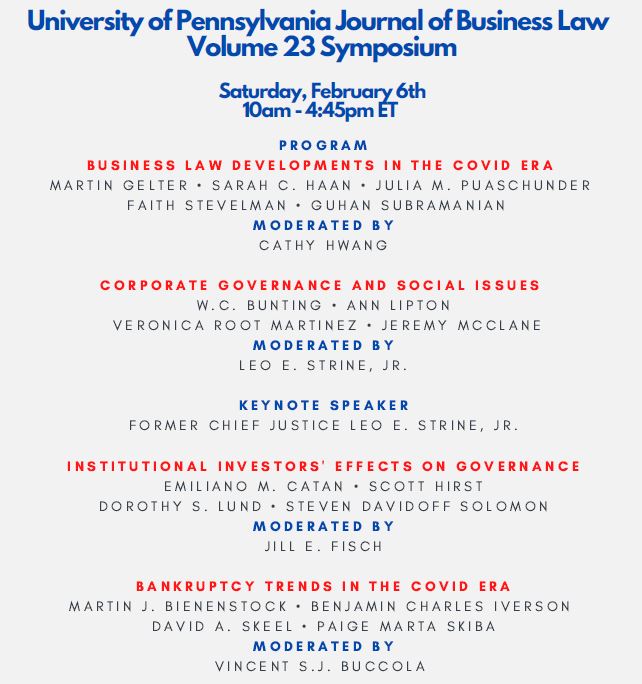
Dear BLPB readers:

The Wharton School of the University of Pennsylvania will host its annual Wharton Financial Regulation Conference on April 16, 2021, virtually. The conference will include keynote addresses from Greg Ip, Chief Economics Commentator, The Wall Street Journal, and an as-yet confirmed senior policymaker in financial regulation.

We issue a call for papers to any scholars from any discipline—law, economics, political science, history, business, and beyond—to submit papers on any topic related to financial regulation, broadly construed. Special attention will be paid to junior scholars and those new to the financial regulation community, but we welcome all submissions, including from those who have presented before. Here’s the complete announcement: Download 2021 FinReg Call for Papers

Over the years, I have been contributor to the Texas A&M Journal of Property’s annual oil and gas law survey. This year’s article (available here) took a little longer to post than usual, but given all that’s gone on in the past year, that’s pretty much unavoidable.  For those who wonder what oil and gas law as to do with business law, well, I humbly submit that access to energy is, in the modern world, the foundation upon which virtually all business is built. 

I don’t think that’s overstating it, though it may be overstating the importance of this particular piece. Nonetheless, hopefully it will have value for some folks.  The abstract for my Oil & Gas Survey: West Virginia (2020) follows: 

This Article summarizes and discusses important recent developments in West Virginia’s oil and gas law as determined by recent West Virginia Supreme Court of Appeals cases. There were no substantial legislative changes in the covered period.

The discussed cases considered:

(1) whether hydraulic fracturing and horizontal drilling were allowed when an old lease could not have contemplated such methods were not permissible;

(2) proper interpretation of deed language;

(3) whether all oil and gas leases have implied rights of pooling;

(4) whether partial, but regular, tax payments precluded a tax sale; and

(5) whether the West Virginia Code allowed for a cap placed on operating expense deductions and if the cap can be described as both a percentage and dollar figure.

Wow.  All I can say is . . . wow.  Last Monday, GameStop Corp. was, for me, just a dinosaur in the computer gaming space–a firm with a bricks-and-mortar retail store in our local mall that I have visited maybe once or twice.  What a difference a week makes . . . .

Now, GameStop is: frequent email messages in my in box; populist investor uprisings against establishment institutional investors; concern about students investing through day-trading accounts; news and opinion commentary on all of the foregoing (and more); compulsion to inform an under-informed (and, in some cases, bewildered) community of friends and family.  This change of circumstances, which is centered on, but not confined to, the volatile market for GameStop’s common stock, raises many, many questions–legal questions and factual questions.  Some are definitively answerable, others are not.

The legal questions run the gamut from possibilities of securities fraud (including insider trading) and market manipulation, to the governance of trading platforms, the propriety of trading limitations and halts, and the authority and control of clearinghouses.  Co-blogger Ben Edwards published a post here last Thursday on the trading halts in GameStop stock, the role of clearinghouses, and the possibility of market manipulation.  Others also have written about these and other legal issues–including the role of the U.S. Securities and Exchange Commission as the cop on the beat (see, e.g., here and here).

But there are few answers to these legal queries given that many facts remain unknown.  Who are the short-sellers in these stocks?  Who are the community members on electronic bulletin boards (and elsewhere) urging active trading in the stock of GameStop and other firms that have been subject to significant short-selling that has led to perceived under-valuation by others in the market?  Who are the populist traders actively bidding up the price of these firms?  What knowledge do all of these people have about GameStop and the trading of its securities?  Assumptions are being made about all of these things and more.  However, our current knowledge is limited and, as time progresses, the composition of these groups undoubtedly has changed and will continue to change as traders rapidly enter and exit the market for these securities.  

As many of our law schools hold forums on the GameStop phenomenon (UT Law has a roundtable featuring some of your favorite BLPB editors on Wednesday), more legal and factual questions will be raised.  The situation will be dynamic, and regulators and policymakers will enter the fray in unknown (and perhaps unanticipated) ways.  As I teach Securities Regulation and Advanced Business Associations this semester, all of this will be happening.  Some of the topics of conversation would not normally be part of my course plans.  But, like others I know who teach business law courses, I am pivoting to meet the need to respond to these evolving circumstances in our securities markets.  Throughout, there are many roles that lawyers (and law professors) are playing and will continue to play.  I suspect GameStop will be an asset this semester in educating our students on securities law and much more.

Tulane Law School invites applications for a Forrester Fellowship. Forrester Fellowships are designed for promising scholars who plan to apply for tenure-track law school positions. The Fellows are full-time faculty in the law school and are encouraged to participate in all aspects of the intellectual life of the school. The law school provides significant support, both formal and informal, including faculty mentors, a professional travel budget, and opportunities to present works-in-progress in various settings.


Tulane’s Forrester Fellows teach legal writing in the first-year curriculum in a program coordinated by the Director of Legal Writing. Fellows are appointed to a one-year term with the possibility of a single one-year renewal. Applicants must have a JD from an ABA-accredited law school, outstanding academic credentials, and significant law-related practice and/or clerkship experience. Candidates should apply through Interfolio at http://apply.interfolio.com/82676. If you have any questions, please contact Erin Donelon at edonelon@tulane.edu.


The law school aims to fill this position by March 2021. Tulane is an equal opportunity employer and encourages women and members of minority communities to apply.

Paul Mahoney and Adriana Robertson just posted a fascinating new paper arguing that many index providers are, in fact, investment advisers under the legal definition, and therefore should be deemed to owe fiduciary duties to the mutual funds who license their indices. 

The paper builds on Robertson’s earlier work studying index funds, including her finding that many indices are “bespoke”; they are created in order to be licensed to a single fund.  Notice how the fees work in that scenario: the fund itself can charge a low management fee for a purported “passive” fund, and then bundled with other fees is an additional fee to license the index – often created by an affiliate of the fund.  And, in fact, she finds that ETFs that call themselves passive but license an index from an affiliate charge higher fees than those that do not use an affiliated license provider.

Anyhoo, the new paper with Mahoney takes this to the next logical conclusion: in these kinds of cases, the index provider is serving as an investment adviser to the fund, and should be regulated that way.

Please join me for this ABA Conference on February 10-11. I’m excited to serve as a mock board member on the 11th as well as on the plenary panel on “Leading Voices in ESG Initiatives” with representatives from United Airlines, Microsoft Asia, and others focusing on the many and sometimes conflicting imperatives of implementing ESG goals. I’ll be particularly interested in the session by the General Motors GC, who will speak about the plan to go away from gasoline-powered vehicles, which GM just announced.

You can register by clicking here.

About the Virtual Conference:

The state of New York, on December 9, 2020, announced that its pension fund with over $226 billion in assets would divest its oil and gas stocks in companies that, in its view, contribute to global warming. The announcement emphatically highlights how ESG factors (Environmental, Social and Governance) across borders represent business risks but also opportunities for companies, their stockholders, and their other stakeholders. In-house legal departments are the first line of defense to re-orient business operations to address global ESG issues and to identify risks. These challenges, risks and opportunities are creating additional demands on legal departments with constrained resources as they navigate this “New Normal” in addition to their traditional responsibilities to stockholders.  This two-day conference will provide in-depth critical analysis through three tracks that efficiently canvas each of the ‘E’, ‘S’ and ‘G’ elements. Through these three tracks, the conference will identify, explore, and evaluate key areas of relevance to in-house counsel wanting to navigate the numerous complex legal and operational issues raised by ESG in jurisdictions around the globe.

Key Speakers:

  • Craig Glidden, Executive Vice President and General Counsel, General Motors
  • Tim O’Connor, Senior Director, Environmental Defense Fund
  • Olga V. Mack, CEO, Parley Pro
  • Ashley Scott, Senior Counsel, Lime
  • In-House Executives: Several current and former General Counsel, along with numerous senior in-house counsel across various industries, including Google, Nestle, Microsoft, General Motors, Accenture, LexisNexis, Chubb, United Airlines, Liberty Mutual, OPEC, Lazard, Iron Mountain, Willis Towers Watson, Norsk Hydro, and Equinor.
  • ESG leaders: Leading ESG voices from law firms, non-profit organizations, and universities

What to Expect

This two-day cutting-edge conference will provide opportunities for-in-depth analysis of these issues through three tracks of interactive panel discussions that canvas each of the ‘E’, ‘S’ and ‘G’ elements, including how COVID-19 is accelerating ESG trends. Key areas of relevance to in-house counsel wanting to navigate the numerous complex legal and operational issues raised by ESG in jurisdictions around the globe, including NGO and government stakeholder perspectives, will also be examined.

CLEs will be available. I hope to see you there!

If you haven’t been living under a rock, you probably know about the rally in GameStop’s stock price now causing losses for hedge funds and dominating the news cycle.  Today, major retail brokerages began to restrict trading activity in the stock, limiting their customers ability to place additional buy orders for the stock.  

The increase in GameStop’s stock’s trading price from about $4 a share in July 2020 to a brief high of $492 today seems plainly disconnected from any fundamental value thesis.  Many retail investors may have been simply buying the stock on the theory that because other people are buying the stock they’ll be able to sell at a profit amid the continuing rise.  Of course, it’s impossible to know with certainty when this obvious bubble will pop.  

A variety of reasons may explain the decision to no longer execute buy orders into the expanding GameStop bubble.  Some of it may be simple paternalism.  Regulators might ask why brokerages are letting retail investors commit possible financial suicide by buying into the bubble.  Of course, this makes unknowable assumptions about the sources of capital being used to fuel the rally.  We don’t know how many people are actually putting everything they have behind this trade.  It may just be a vast crowd of people throwing some cash at GameStop because they think it’s funny.  

Brokerages might also stop facilitating buy orders simply to protect themselves.  In particular, retail brokerages may have also restricted trading in these stocks because of their own, or their clearing firms’, concerns about risk.  As this obvious bubble grows, the potential for the bubble to burst and GameStop’s price to collapse may create real risk for market makers and clearing firms.  They may not be able to manage their inventory with the rapid price changes.   Many brokerages operate as introducing firms and use clearing firms on the back end to actually execute the trades their customers place.  If a clearing firm tells an introducing firm that they don’t feel comfortable taking any more buy orders on GameStop, the introducing firm won’t be able to offer that option to its customers.  Self-clearing firms like Robinhood may make this decision on their own.  Some news reports now indicate that Robinhood has tapped capital recently, borrowing hundreds of millions.  It’s probably doing this because it thinks it may need it as the dust settles from this.

Update Bloomberg’s Matt Levine explains how clearing difficulties likely led to the stoppage:

You don’t think about it much, but every stock trade involves an extension of credit. You see a price on the stock exchange and push a button and instantaneously get back a confirmation that you bought some shares of stock, but you actually get the shares, and pay the money for them, two business days later. This is called “T+2 settlement,” and it might seem a little silly in an age when a “share of stock” is an entry in an electronic database and “money” is also an entry in an electronic database. Why not just update the databases when you push the button? T+2 settlement feels like a vestige of the olden days, when traders agreed to trades on the stock exchange but then had to go back to their vaults to dig up stock certificates to hand over in exchange for sacks of cash. Back when I worked on Wall Street it was T+3. These days it is not hard to find people who want to talk to you about moving to instantaneous settlement on the blockchain. Bitcoin trades settle immediately. But U.S. stocks, for now, settle T+2.

This means that the seller takes two days of credit risk to the buyer.[4] I see a stock trading at $400 on Monday, I push the button to buy it, I buy it from you at $400. On Tuesday the stock drops to $20. On Wednesday you show up with the stock that I bought on Monday, and you ask me for my $400. I am no longer super jazzed to give it to you. I might find a reason not to pay you. The reason might be that I’m bankrupt, from buying all that stock for $400 on Monday.

The way that stock markets mostly deal with this risk is a system of clearinghouses. The stock trades are processed through a clearinghouse. The members of the clearinghouse are big brokerage firms—“clearing brokers”—who send trades to the clearinghouses and guarantee them. The clearing brokers post collateral with the clearinghouses: They put up some money to guarantee that they’ll show up to pay off all their settlement obligations. The clearing brokers have customers—institutional investors, smaller brokers—who post collateral with the clearing brokers to guarantee their obligations. The smaller brokers, in turn, have customers of their own—retail traders, etc.—and also have to make sure that, if a customer buys stock on a Monday, she’ll have the cash to pay for it on Wednesday.[5]  

This is not stuff most people worry about most of the time. Generally if you buy a stock on Monday you still want it on Wednesday; even if you don’t, we live in a society, and you’ll probably cough up the money anyway because that’s what you’re supposed to do. But at some level of volatility things break down. If a stock is really worth $400 on Monday and $20 on Wednesday, there is a risk that a lot of the people who bought it on Monday won’t show up with cash on Wednesday. Something very bad happened to them between Monday and Wednesday; some of them might not have made it. You need to make sure the collateral is sufficient to cover that risk. The more likely it is that a stock will go from $400 to $20, or $20 to $400 for that matter,[6] the more collateral you need.

Some investors may have bought the stock or call options on the stock in hopes of forcing market makers and others to buy the stock and drive the price up.  This seems as though it might run afoul of the Securities & Exchange Act’s prohibition on market manipulation.  Section 9(a)(2) of the Securities and Exchange Act makes it unlawful to “effect . . . a series of transactions in any security registered on a national securities exchange . . .  for the purpose of inducing the purchase or sale of such security by others.”  As James Fallows Tierney has explained, “regulators have tools beyond “fraud” at their disposal to get at other objectionable market practices,” including Section 9(a)(2).

If brokerages take the view that most of the increase has been driven by market manipulation, they may decide not to facilitate these trades and become knowingly complicit in the short squeeze.  To be sure, many of the posts on WallStreetBets, the Reddit message board behind the rally, seem fixated on forcing short sellers to close their positions and drive the price up.  Whether the SEC will take action against the posters remains to be seen.

There have also been news reports about Robinhood and others selling out retail investors and closing their positions.  This seems unsurprising.  Many retail investors likely bought GameStop on margin–that is to say by borrowing funds from Robinhood.  In these arrangements, the customer’s stock portfolio provides collateral for the loan.  Robinhood and other retail brokers likely legitimately fear that margin collateral — GameStop Stock will decline rapidly in value.  They’re likely to sell these positions in order to prevent themselves from taking a loss as the bubble collapses.

How will this all shake out?  I don’t know.  With more news breaking, it looks as though the brokerage firm trading stops were predominantly related to clearing requirements.  

But I do have a few thoughts on where it’s going to shake out.  Brokerage firms must all join FINRA in order to operate.  FINRA maintains its own arbitration forum for individual claims.  It does not allow brokerage firms to include class action waivers in their account agreements.  This means that the customer actions against brokerages will happen in two places, FINRA arbitration for individual actions and public courts for the class actions.  When it comes to the arbitrations, investors will likely struggle to win any claim so long as they don’t actually have any net losses on the trade.   As a practical matter, FINRA arbitrators only rarely award damages if the investor made money.  Showing that they should receive even more money usually requires showing much more than these traders will be able to manage.  

Have you heard about the idea of central bank digital currencies (CBDCs) and stablecoins?  Are you interested in learning more… but maybe just the basics, briefly and quickly (because you’re not focused on banking like some of us)?  I’ve got a great solution for you!  Today I read Clifford Chance’s thought leadership piece, Central Bank Digital Currencies and Stablecoins – How Might They Work in Practice?  It’s a mere 7 pages of text, incredibly accessible, and provides a great introduction to these topics and even includes some banking and payment systems history.  It will take you 15 minutes to read.  You’ll be glad that you did!  Here’s the abstract:

Payment media, from gold coins to stablecoins, exist to be used, and in practice their use requires payment systems. In my paper ‘Central Bank Digital Currencies And Stablecoins – How Might They Work In Practice?’ I consider the way in which existing payment infrastructures and particularly payment banks — might reconfigure their services to accommodate Central Bank Digital Currencies (CBDCs) and stablecoins.

For this purpose, it is probably irrelevant whether the ‘coins’ concerned are created by central banks or private providers, or for that matter what the form is of the technology by which they are constituted. What does matter is that they are capable of being directly owned by the user without any intermediation. The question is whether that is how they will be dealt with in practice.

There are two possible ways in which this intermediation could be structured. One is where the intermediary provides a ‘custody’ service. This will involve the customer being charged for the service, since the custodian derives no benefit from his holding of the asset. The other is where title to the coin is passed to the intermediary. This will enable the intermediary to use the asset in his business, and therefore result in the customer paying lower or no fees for the intermediation.

Since a legal structure involving a ‘custody’ structure — where the customer retains direct ownership of the coin — will be a more expensive offering for that customer, it seems unlikely that this will be the prevalent model. However, a structure involving a transfer of ownership of the coins to the bank would seem to have no benefits over the existing bank account offerings, and would arguably be worse for the customer, in that the customer potentially loses the benefit of deposit insurance (since a deposit of stablecoins is arguably not a ‘deposit’ for that purpose).