
Few of the ten preceding posts I have offered on teaching during the COVID-19 pandemic (links provided at the end of this post) have even mentioned assessment.  Given that the semester’s classes have ended almost everywhere, now seems like a good time to say a few words on that topic, focusing in on written final examinations.  As with everything else in the COVID-19 era, the traditional written, timed final (f/k/a “in class”) examination has received some serious scrutiny and reconsideration in 2020.  The UT Law faculty shared ideas and opinions on the topic of online examinations in a number of faculty meetings and forums.  Perhaps predictably, faculty members teaching in different parts of the curriculum (substantively and otherwise) had individualized views about how their own learning objectives could best be met in an online assessment environment.

After much discussion, UT Law ended up offering multiple options to instructors.  For essay questions, we had the choice of using our proprietary portal’s exam feature (with download/upload capabilities and full use of all computer functionality, including the Internet) or exam software.  We had the choice of engaging monitoring or not.  Multiple choice questions could be submitted electronically on the portal and hand-graded by the instructor or submitted electronically using exam software and machine-graded.  Bonus: in the end, our Dean of Students offered us the opportunity to have our exams printed–an unexpected (and, in my case, welcomed) addition to the mix.

My Business Associations students took my two-hour written final exam twelve days ago.  I chose a portal-based essay exam with machine-graded multiple choice questions.  I had the exams printed out.  I have not heard back yet from students on the exam process or anything else (for obvious reasons).  But from my standpoint, the exam submission and transmission process seemed to work smoothly.  It differed little, in the end, as a matter of process, from exams I have given in person in the past.  I am so grateful to our academic deans (and the rest of the faculty), our Dean of Students, and the staff from our student records office for all they did to make this exam period safe, manageable, and (yes) possible.

Of course, until I finish grading and can talk to students about their part of the experience, this is about all I can say.  Student views may be wildly different.  I did learn (in the process of working through the exam details with them) that they are not fond of using our exam software for essay questions, since they cannot be looking at the question as they type their answer.  In any event, I will look forward to sharing anything I hear in a later post.

What were your experiences with online written exams this semester?  What are your preferences as to how they are best set up and managed–and why?  I am interested in what others are doing in this regard and what they are learning from those experiences.  Post comments or send me an email message if you have thoughts on any of this.

+++++

Links to prior posts on Teaching Through the Pandemic
(Note: Since I only began adding subtitles after the fourth post, I have added parenthetical topic information for the first four posts.)

Teaching Through the Pandemic – Part I (early distance education and Zoom tips)

Teaching Through the Pandemic – Part II (Zoom connectivity tips)

Teaching Through the Pandemic – Part III (questions about a greater movement to online education)

Teaching Through the Pandemic – Part IV (advanced Zoom tips)

Teaching Through the Pandemic – Part V: First Impressions of a Hybrid Classroom

Teaching Through the Pandemic – Part VI: Labor Day

Teaching Through the Pandemic – Part VII: Technology Experiments

Teaching Through the Pandemic – Part VIII: A Three-Ring Circus

Teaching Through the Pandemic – Part IX: Students Teaching Themselves, Each Other, and Us

Teaching Through the Pandemic – Part X: Hollywood Squares and Giving Thanks!
This is my second post in a series of blog posts on the “Study on Directors’ Duties and Sustainable Corporate Governance (“Study on Directors’ Duties”) prepared by Ernst & Young for the European Commission.

In 2015, the world gathered at the United Nations Sustainable Development Summit for the adoption of the Post-2015 development agenda. That Summit was convened as a high-level plenary meeting of the United Nations General Assembly. At this meeting, Resolution A/70/L.1, Transforming our World: The 2030 Agenda for Sustainable Development, was adopted by the General Assembly. In 2016, the Paris Agreement was signed. In my last post, I called both the United Nations 2030 Agenda and the Paris Agreement trendsetters because they kicked-off a global discussion on sustainable development at so many levels, including at the financial level.

During the 2015 United Nations Sustainable Development Summit, I recall that the Civil Society representatives called for a UN resolution on sustainable capital markets to tackle the absence of concrete actions regarding global financial sustainability following the 2008 Great Recession.

At the end of 2016, the European Commission (Commission) created the High-Level Expert Group on Sustainable Finance (HLEG). In early 2018, the HLEG published its report. Shortly after, in 2018, the European Union (EU) published the Action Plan: Financing Sustainable Growth (EU’s Action Plan) based on the HLEG’s report. I want to focus for a bit on Action 10 of the EU’s Action Plan: Fostering Sustainable Corporate Governance and Attenuating Short-Termism in Capital Markets. Action 10 sets forth the following:

1.To promote corporate governance that is more conducive to sustainable investments, by Q2 2019, the Commission will carry out analytical and consultative work with relevant stakeholders to assess: (i) the possible need to require corporate boards to develop and disclose a sustainability strategy, including appropriate due diligence throughout the supply chain, and measurable sustainability targets; and (ii) the possible need to clarify the rules according to which directors are expected to act in the company’s long-term interest.

2.The Commission invites the ESAs to collect evidence of undue short-term pressure from capital markets on corporations and consider, if necessary, further steps based on such evidence by Q1 2019. More specifically, the Commission invites ESMA to collect information on undue short-termism in capital markets, including: (i) portfolio turnover and equity holding periods by asset managers; (ii) whether there are any practices in capital markets that generate undue short-term pressure in the real economy.

Under the EU’s Action Plan, in 2019, the Commission called the three European Supervisory Authorities (ESAs) to collect evidence of undue short-term pressure from the financial sector on corporations. These supervisory authorities include the European Banking Authority (EBA), the European Securities and Markets Authority (ESMA), and the European Insurance and Occupational Pension Authority (EIOPA). The reports from EBA, ESMA, and EIOPA reviewed the relevant financial literature and identified potential short-term pressures on corporations.

In 2019, the European Commission Directorate-General Justice and Consumers organized a conference on “Sustainable Corporate Governance” that reunited policy-makers to discuss policy developments on corporate governance within Action 10 of the EU’s Action Plan.

The Study on Directors’ Duties builds on Action 10. As it reads in the Study:

[T]he need for urgent action to attenuate short-termism and promote sustainable corporate governance is clearly identified in the Action Plan on Financing Sustainable Growth, 137 put forward by the European Commission in 2018. The Action Plan recognises that, despite the efforts made by several European companies, pressures from capital markets lead company directors and executives to fail to consider long-term sustainability risks and opportunities and be overly focused on short-term financial performance. Action 10 of the Action Plan is therefore aimed at “fostering sustainable corporate governance and attenuating short-termism in capital markets.” The present study implements Action 10, together with other studies aimed at investigating complementary aspects of short-termism,138 which shows European Commission’s commitment to explore this complex problem from different angles and find an integrated response.

Before moving forward, it is pressing to define short-termism. In this context, obtaining empirical evidence to infer causation is important for policy advice. When it comes to defining short-termism, in a recent Policy Workshop on Directors’ Duties and Sustainable Corporate Governance, Zach Sautner defined short-termism as a reflection of actions (e.g., investment, payouts) that focus on short-term gains at the expense of the long-term value of the corporation. The concept of short-termism encompasses a certain form of value destruction, an undue focus on short-term earnings or stock price, and a notion of market inefficiency. Suppose a CEO favors short-term earnings or makes decisions (e.g., buybacks) to the detriment of the corporation’s long-term value. Then, if the market is efficient, it should signal that something is not right.

Still, I cannot avoid asking: is short-termism the right problem that needs fixing? The discussion around short-termism is puzzling because there is a vehement academic debate whether there even exists short-termism or whether it is as harmful as it sounds. For example, in their paper, Long-Term Bias, Michal Barzuza & Eric Talley explain how corporate managers can become hostages of long-term bias, which can be as damaging for investors as short-termism.

If short-termism and its effects are as negative as they sound, what kind of incentives do managers have to overcome it? Corporate managers act based on incentives such as executive compensation, financial reporting, and shareholders’ ownership. Is this bad news for those who firmly stand behind stakeholders who can be undoubtedly impacted by the corporation’s performance?

The bottom line is this. We need a clearer perspective on short-termism. Suppose one says that excessive payouts are not the problem. They are the symptom. However, even this bold statement needs to be taken with a grain of salt. It is difficult to assess if payouts (e.g., dividends, buybacks) are excessive if we do not know if there is a short-termism problem.

In 2018, a securities class action was filed against Allergan, alleging that the company concealed risks associated with breast implants.  Boston Retirement System was appointed lead plaintiff, and the case survived a motion to dismiss.  The court refused to certify the class, however, because of perceived misconduct by lead counsel Pomerantz.  See In re Allergan PLC Sec. Litig., 2020 WL 5796763 (S.D.N.Y. Sept. 29, 2020).

Specifically, Judge McMahon held that Pomerantz had defied her original order appointing it as lead counsel by taking on another firm – Thornton – as a kind of shadow co-lead counsel.  When Pomerantz was appointed, McMahon specifically rejected its request to name Thornton as co-lead because, in her words, “the involvement of multiple firms tends to inflate legal fees.”  Despite her order, well:

Thornton has not only remained involved in this litigation, albeit under the rubric of “additional counsel,” but that it has effectively played the role of co-lead counsel – to the point that BRS’ corporate representative has testified under oath that Thornton’s responsibilities did not change at all in response to the lead plaintiff order. It is clear that Thornton has been fully involved in every aspect of this case to date. It has duplicated the efforts of Pomerantz by working on the CAC (it signed the pleading, so it has to have worked on it) and the motions to dismiss and for class certification (ditto), by joining in meet and confer sessions with defense counsel, participating in depositions, and by getting (and so obviously reviewing) all correspondence.

Moreover, I have learned, in connection with the prosecution of this motion, that the Pomerantz and Thornton firms have entered into an agreement to split any fee earned from the prosecution of this lawsuit almost down the middle. The agreement calls for the fee earned by lead counsel to be split with 55% going to Pomerantz and 45% to Thornton – a division that is so close to the firms’ original agreement of a 50-50 split, reached at a time when they anticipated being appointed co-lead counsel as to be a rather transparent substitute for co-lead counsel status.  This amended agreement between the two firms was dated six days after BRS designated Pomerantz as lead counsel.  The court was not informed about this arrangement, by BRS or anyone else.

This Court is not fooled by the rebranding of Thornton as “additional counsel.”

So, McMahon refused to allow Pomerantz and Boston Retirement System to continue to represent the class, and she reopened applications for lead plaintiff.

In response, one of the original movants – DeKalb County Pension Fund, represented by Faruqi & Faruqi – renewed its petition, along with several new movants, including Union Asset Management Holding AG represented by BLBG and the General Retirement System of Detroit represented by Abraham, Fruchter & Twersky. 

On December 7, McMahon granted the DeKalb petition – despite the fact that other movants had larger losses, which is the typical requirement for lead plaintiff status – because she believed it would be improper to appoint a plaintiff who had not moved for lead status when the case was originally filed.  And in her order, she specified:

DeKalb’s motion to have Faruqi and Faruqi appointed as lead class counsel is granted, on the condition that the Faruqi firm and none other serve as lead counsel and perform all services for which recompense may some day be sought.

So.

Here’s the thing.

The way McMahon describes it, it does sound like Pomerantz and Thornton defied her original order, and that is certainly a legitimate grounds for refusing to appoint Pomerantz as class counsel.

But the fact is, in securities cases, plaintiffs’ firms always coordinate with other firms.  Not necessarily as co-lead, but to perform tasks like routine discovery, or depositions in other cities, or smaller motion practice.  Plaintiffs’ firms tend to have fewer attorneys than defense firms, and they often don’t have the staff to maximize the value of a large case without getting at least some additional assistance.  And while I won’t deny that these arrangements, like any billing arrangement, may be abused, that isn’t necessarily the case; much of the work is legitimate, and takes some of the burden off the lead firm.  When it comes to co-leads specifically, they may ultimately be valuable – I have no opinion on their general worth – but at least one way they may inflate fees is that every decision has to get approval from partners on both sides, which, while done in good faith, may add to the hours billed.  But that isn’t a concern if additional counsel are brought on to handle discrete tasks.

Point being, even among the best plaintiffs’ firms, a complete bar on enlisting other firms could be burdensome.

Faruqi & Faruqi is … not among the best plaintiffs’ firms.  In the merger context, they’ve been repeatedly accused of filing nuisance cases and settling for immaterial disclosures without engaging in meaningful discovery.  Their recoveries in securities class actions, specifically, are less than spectacular. 

That doesn’t mean they can’t prosecute the Allergan action effectively, but it does suggest they’d derive significant benefit from being able to obtain at least some assistance from other firms.

McMahon’s decision, in other words, may represent an appropriate rebuke to Pomerantz, but it is not in the best interests of the class.

And to me, it all highlights the fallacy of California Public Employees’ Retirement System v. ANZ Secs., Inc (which I blogged about here).  There, the Supreme Court held that the filing of a securities class action does not toll the repose period for subsequently filed individual actions.  Which means that any Allergan class member who trusted Pomerantz, but not Faruqi, to lead the litigation will have to worry about the clock if they want to file their own individual suit.  And down the line, if Faruqi ultimately seeks to settle the action on the class’s behalf, dissatisfied class members can object but by then, they may not have any realistic chance of opting out; they’ll be stuck with whatever deal the court approves – a fact that will be known to both Faruqi and to the Allergan defendants at the outset of negotiations.

That’s right – it’s the moment we’ve all been waiting for.  The Court has granted cert in Goldman Sachs v. Arkansas Teachers Retirement System.  (Oh, I think there was some other stuff about not throwing out 20 million presidential votes in four states).

In any event, here are the questions presented by the petition:

(1) Whether a defendant in a securities class action may rebut the presumption of classwide reliance recognized in Basic Inc. v. Levinson by pointing to the generic nature of the alleged misstatements in showing that the statements had no impact on the price of the security, even though that evidence is also relevant to the substantive element of materiality; and (2) whether a defendant seeking to rebut the Basic presumption has only a burden of production or also the ultimate burden of persuasion.

I may or may not have more to say later but for those interested, my blog post about the Second Circuit opinion is here, and you can read all of the cert briefing here.


Many of us have been looking for new opportunities to raise and discuss issues of diversity and inclusion (including, but not limited to, race, gender, and LGBTQ issues) in our Business Associations and Securities Regulations classes. Along these lines, I’ve been inspired by a number of my BLPB co-editors’ recent posts. (See, e.g., here, here, and here—just in the last week!) With these thoughts in mind, and as we start preparing our course syllabi for the spring semester, I recommend you read Professor Ellen Podgor’s forthcoming article, Carpenter v. United States, Did Being Gay Matter?, 15 Tenn. J. L. Pol’y 115 (2020). Here’s the abstract:

Carpenter v. United States (1987) is a case commonly referenced in corporations, securities, and white collar crime classes. But the story behind the trading of pre-publication information from the “Heard on the Street” columns of the Wall Street Journal may be a story that has not been previously told. This Essay looks at the Carpenter case from a different perspective – gay men being prosecuted at a time when gay relationships were often closeted because of discriminatory policies and practices. This Essay asks the question of whether being gay mattered to this prosecution.

This article was written for the same symposium on insider trading stories held at the University of Tennessee College of Law that my BLPB co-editor Joan Heminway wrote about here and here.

Oh, and while I’m touting the excellent work of Professor Podgor, I should note another of her forthcoming articles recently posted to SSRN: The Dichotomy Between Overcriminalization and Underregulation, 70 Am. U. L. Rev. __ (forthcoming 2021). Here’s an edited version of the abstract:

The U.S. Securities and Exchange Commission (SEC) failed to properly investigate Bernard Madoff’s multi-billion-dollar Ponzi scheme for over ten years. Many individuals and charities suffered devastating financial consequences from this criminal conduct, and when eventually charged and convicted, Madoff received a sentence of 150 years in prison. Improper regulatory oversight was also faulted in the investigation following the Deepwater Horizon tragedy. Employees of the company lost their lives, and individuals were charged with criminal offenses. These are just two of the many examples of agency failures to properly enforce and provide regulatory oversight, with eventual criminal prosecutions resulting from the conduct. The question is whether the harms accruing from misconduct and later criminal prosecutions could have been prevented if agency oversight had been stronger. Even if criminal punishment were still necessitated, would prompt agency action have diminished the public harm and likewise decreased the perpetrator’s criminal culpability? …

This Article examines the polarized approach to overcriminalization and underregulation from both a substantive and procedural perspective, presenting the need to look holistically at government authority to achieve the maximum societal benefit. Focusing only on the costs and benefits of regulation fails to consider the ramifications to criminal conduct and prosecutions in an overcriminalized world. This Article posits a moderated approach, premised on political economy, that offers a paradigm that could lead to a reduction in our carceral environment, and a reduction in criminal conduct.

Earlier this year, the North American Securities Administrators Association released a draft Model Whistleblower Act.  As I wrote when the draft act emerged, the draft model legislation seemed to closely track the federal whistleblower-bounty program enacted as a part of Dodd-Frank.  In cribbing from Dodd-Frank, the initial draft picked up one of the problems with Dodd-Frank in that it contained language which had been interpreted to only protect whistleblowers who went to the regulator–not whistleblowers who reported internally.

To help states avoid the problem, Andrew Jennings led a comment letter effort, which I joined along with Andrew Baker and Samantha Prince.  Our comment letter (one of only seven submitted) explained that the draft language could be improved to address two concerns: (i) explicitly protecting internal reporting; and (ii) making clear that whistleblowers may anonymously report via counsel.

NASAA amended the draft model legislation to address these concerns.   The final model legislation now explicitly protects internal whistleblowers and contemplates anonymous whistleblowing through counsel.

I’m enormously grateful to Andrew Jennings for taking on drafting the letter at a time when he could have otherwise been pursuing purely academic scholarship.  This kind of involvement matters and has a real impact.  In the future, some financial services employee will undoubtedly suffer retaliation for reporting wrongdoing internally.  Once states adopt the model legislation, these internal reporters will have some protection. 


In doing my weekly SSRN search, I was absolutely delighted to see Professor Ron Berndsen’s Five Fundamental Questions on Central Counterparties (here) (note: these institutions are sometimes also referred to as CCPs or clearinghouses).  Berndsen has produced an extensive and invaluable review of the “booming literature on CCPs, of which about 60% is published in the last five years.”  As he notes, this area “can be considered as the most important niche of financial economics.” 

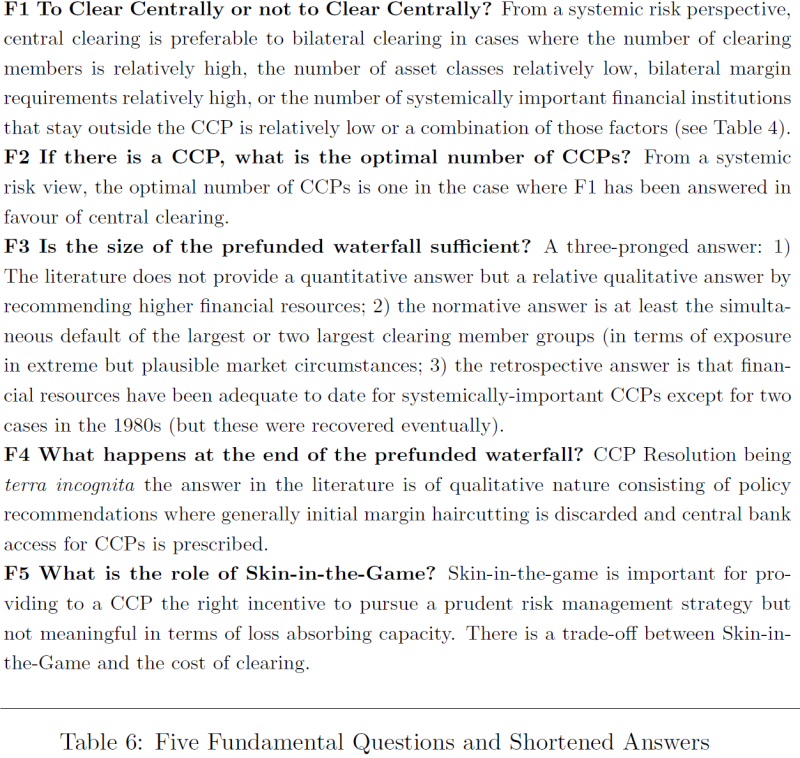
Berndsen organizes the review through “asking five fundamental questions about CCPs.”  Table 6 on p.30 (copied below) provides these questions and shortened answers.


Berndsen_Table6


I am grateful to Berndsen for writing this article, proposing future research topics based on his extensive review of the literature, and providing a comprehensive bibliography (even if it has increased my “to read” list!).  An abstract of the article is below:           

Central counterparties (CCPs) are designed to reduce aggregate counterparty credit risk and function as market infrastructures for capital markets in securities and derivatives. Although CCPs, also known as clearing houses, exist for well over a century, they have gained prominence since they became the main international public policy response to the Lehman crisis of making over-the-counter derivative transactions safer. This G20’s response to the Lehman crisis of making central clearing mandatory for standardized over-the-counter derivative transactions has been translated into law, Dodd-Frank for the US and EMIR for the EU. However, CCPs remain to some extent controversial with adversaries claiming that they potentially increase systemic risk and proponents viewing them as systemic risk reducing when properly designed and maintained. In this article I review the booming literature on CCPs, of which about 60% is published in the last five years, by asking five fundamental questions about CCPs. The aim is to construct a broad, academically substantiated, synthesis about CCPs and to propose directions for future research in what can be considered as the most important niche of financial economics.

A recent federal court order gets the basics of entity law representation right, but it’s pretty murky on exactly what entity is involved.  The case involves a claim of trademark infringement in which the plaintiff, International Watchman, Inc., sued OnceWill, LLC.  The order explains: 

In OnceWill’s Motion, OnceWill indicated that it “is a sole proprietorship consisting of proprietor Ryan Sood.” (Id.) OnceWill’s Motion also showed that it was filed by Ryan Sood, acting pro se. (Id.) The Court granted OnceWill’s Motion that same day.

Subsequently, also on November 12, 2020, Plaintiff filed its Motion, requesting that the Court strike OnceWill’s Motion and reconsider its order granting the requested extension of time for OnceWill to respond to Plaintiff’s Complaint. (Doc. No. 13.) Plaintiff asserts that OnceWill is a limited liability company (“LLC”), not a sole proprietorship as OnceWill represented. (Id. at 2.) In support of this assertion, Plaintiff provided a printout from the Washington Secretary of State’s website showing that OnceWill is listed as an LLC. (Id.; Doc. No. 13-1.) As a result of OnceWill’s status as an LLC, Plaintiff argues that OnceWill only can maintain litigation or appear in court through an attorney and cannot file pleadings or motions in Court on its own behalf pro se as it has attempted to do here.

INTERNATIONAL WATCHMAN, INC., Plaintiff, v. ONCEWILL LLC, et al., Defendants., No. 1:20-CV-02290, 2020 WL 7138650, at *1 (N.D. Ohio Dec. 7, 2020).
 
As I have noted previously, though some people don’t like the idea, the need for an entity to be represented by counsel is generally understood to be required.  The court corrects the initial misstep of allowing the LLC’s apparently sole member to appear pro se for what he claimed was a sole proprietorship. If it’s a properly created LLC, it is an LLC.  
 
So, what, again is an LLC? I am glad I asked.  An LLC is a “limited liability company,” which is an entity distinct from a corporation.  At least, that’s what state law tells us. Some courts like to merge the two, as evidenced in this case.:
“The law is well-settled that a corporation may appear in federal courts only through licensed counsel and not through the pro se representation of an officer, agent, or shareholder.” Nat’l Labor Relations Bd. v. Consol. Food Servs., Inc., 81 F. App’x 13, 14 n.1 (6th Cir. 2003). “This rule also applies to limited liability corporations.” Barrette Outdoor Living, Inc. v. Michigan Resin Representatives, LLC, No. 11-13335, 2013 WL 1799858, at *7 (E.D. Mich. Apr. 5, 2013), report and recommendation adopted, 2013 WL 1800356 (E.D. Mich. Apr. 29, 2013); accord Perry v. Krieger Beard Servs., LLC, No. 3:17-cv-161, 2019 U.S. Dist. LEXIS 27311, at *2 (S.D. Ohio Feb. 21, 2019) (“[L]imited liability companies may not appear in this Court pro se and, thus, may only appear through a licensed attorney admitted to practice in this Court.”); Hilton I. Hale & Associates, LLC v. Gaebler, No. 2:10–CV–920, 2011 WL 308275, at *1 (S.D. Ohio Jan. 28, 2011) (“[A] limited liability corporation is another example of an artificial entity that should retain legal counsel before appearing in federal court.”).
Id. (emphasis added). In this instance, it is accurate that the representation rule that applies is the same for LLCs and corporations, but that does not make LLCs and corporations the same.  Really! 
 
It really does seem proper to me not to allow pro se representation of entities, even when they are owned and operated by a single person (though I have noted elsewhere that I would be okay with pro se representation for administrative matters, as long as allowed for by statute or rule).  Note that here, Mr. Sood almost certainly does not want to be a “sole proprietorship” because if he were, he could be held personally liable for OnceWill’s trademark infringement. (Of course, it is possible he might be, anyway, but one certainly would not want to make it easier to be held personally liable.)  In fact, the plaintiffs here might have be wise to request amend their complaint to also name Mr. Sood, individually, to the lawsuit, in case the court did allow the pro se appearance. Appearing pro se, it seems to me, suggests personal liability.  
 
Lastly, a comment on the last citation from the excerpted part of the order:  What is an artificial entity?  Are certain entities real?  Like maybe general partnerships? But even those partners can be corporations and LLCs.  Or are is this distinguishing natural persons from “artificial” entities?  I imagine this is intended to be similar to the “fictional person” concept for the corporation, thus further justifying the requirement that an entity must be represented by an attorney. But if so, it would be good to be clear about that.   
 
Oh well.  Such is life. 
 

Over at Defining Ideas, Richard Epstein notes:

This past week, Nasdaq announced that it had applied to the Securities and Exchange Commission for authorization to impose diversity requirements on the boards of directors of its listed companies. The substantive proposal requires that each company include on its board at least two diverse directors, one of whom must be a woman (or, more precisely, one who self-identifies as female) and one who self-identifies as a member of an underrepresented minority, including “Black or African American, Hispanic or Latinx, Asian, Native American or Alaska Native, Native Hawaiian or Pacific Islander, two or more races or ethnicities,” or as “LGBTQ+.” Whenever these targets are not met, the listed company must offer a public explanation as to why that is the case…. In defense of its diversity mandate, Nasdaq tries to bring itself within … traditional rationales by claiming that increasingly diverse boards will help “prevent fraudulent and manipulative acts and practices.” Such avoidance of fraud and manipulation purportedly follows from a decrease in groupthink that comes from airing diverse perspectives.

This made me wonder whether we’ll soon be seeing a similarly structured viewpoint diversity proposal from Nasdaq, given that according to the Free Enterprise Project:

The vast majority of members of the boards of directors of the largest companies in the United States are, where their viewpoints are discernable, demonstrably left of center. As Baron Political Affairs, LLC revealed in 2019, every single director of a Fortune 1-10 company who had been elected to political office or who had worked for an administration was (or had worked for) a Democrat. The ratio shifted to 2 Democrats for every Republican in the Fortune 100 generally, but only to 5:1 for financial or tech firms within that group. FEP’s own research, as part of a proposal-review proceeding this past winter, confirmed this trend at AT&T, where every member of the board of directors who had held elective or appointed office had done so as a Democrat or with a Democratic administration.

Turning back to the Defining Ideas piece, Epstein further notes that:

it is appropriate to ask whether the SEC, as a government agency, should give its explicit approval to a policy that introduces explicit racial and gender classifications…. Government imprimatur might give rise to serious constitutional challenges that the Nasdaq report never addresses, let alone resolves.

Several weeks ago, I posted about VC Laster’s opinion in the busted Anthem-Cigna merger.  Ever since then, I continued to mull the case and – in particular – I had questions about what might happen if the Cigna shareholders sued Cigna’s management over the deal’s failure.  I planned to post about it as a hypothetical thought experiment, but then – what ho! – the Cigna shareholders did in fact file such a lawsuit – though, as I explain below, not quite the one I was contemplating. 

Anyhoo, now I am finally getting around to posting my thoughts, though I’m almost hesitant to do so because I’m afraid the answer to my questions may be really obvious and I’m simply splattering my ignorance over the internet, but, well, that’s what blogging is for, so, here goes.

It all starts with Laster’s conclusions after the Anthem-Cigna trial. He found that Cigna’s CEO, David Cordani, intentionally tried to sink the deal by refusing to honor Cigna’s commitments under the merger agreement.  And Cordani did so not out of concern for Cigna’s stockholders, but because he was resentful of not being chosen to lead to the combined entity.  For example, after an agreement was struck – one that granted Anthem more board members and relegated Cordani to the COO role – Cigna’s chair congratulated Cordani on taking “the right step for our shareholders,” and Cordani responded, “Brain knows yes. Heart is heavy.”  Later, Cordani emailed that though the deal was the “correct” outcome, he was “still struggling to accept it all.”

Sadly, that struggle was lost, which – according to Laster’s findings – led Cordani to embark on a campaign of sabotage.  But Laster also concluded that the merger was doomed to fail for regulatory reasons regardless of Cordani’s behavior.  And that failure was very expensive to Cigna’s stockholders; it cost them a 35% premium over market price.

What I’ve been trying to imagine, then, is what would happen if Cigna’s shareholders tried to sue Cordani for breaching his duty of loyalty, thus costing them valuable merger consideration.  Leaving aside any issues about limitations periods, what result?

To begin, we have to determine whether this claim would be direct or derivative.  Because if it’s derivative, we next have to ask if the stockholders would be estopped from bringing their claim in the right of the corporation.  After all, Cigna litigated the case against Anthem, and took the position – on which it prevailed – that the merger was doomed to fail no matter what Cordani did.  So, would Cigna (and thus any derivative plaintiff) now be bound by that finding?  (Of course, the case is on appeal to the Delaware Supreme Court, so there could be a reversal, etc etc, but let’s assume the finding stands).

Preclusion would seem awfully unfair under these facts, because when Cigna litigated the Anthem case, its choices were made by its management – including Cordani – whose interests were not aligned with those of the stockholder-plaintiffs in my hypothetical loyalty action.  Which really only suggests that perhaps this kind of claim should be direct in nature, because the harm isn’t to the corporate entity, but to shareholders themselves, in that they were unable to collect the merger consideration that should have been their due.  But does that really state a direct claim?

In In re Coty Stockholder Litigation, 2020 WL 4743515 (Del. Ch. Aug. 17, 2020), a controlling shareholder increased its stake from 40% to 60% via tender offer, and when stockholders sued directly and derivatively (arguing certain process failures, and breach of a stockholders’ agreement regarding post-tender offer conduct), their claims were sustained.  Defendants argued that any non-tendering stockholders were not harmed, since they continued to hold stock in a company with a controlling stockholder both before and after the deal.  Chancellor Bouchard rejected that argument, recognizing as a direct harm the fact that the non-tendering stockholders – who held their shares throughout the transaction – “no longer have any expectation of receiving a control premium for their shares in a future buyout” (emphasis added).

Similarly, in Louisiana Municipal Police Employees’ Retirement System v. Fertitta, 2009 WL 2263406 (Del. Ch. July 28, 2009), stockholder plaintiffs were permitted to bring direct claims alleging that the company’s Chairman intentionally sank a merger with an entity that he controlled, which would have netted the shareholders a 41% premium over market price.

On the other hand, VC Zurn just decided Mark Gottlieb, et al., v. Jonathan Duskin, where shareholders alleged that the directors improperly rejected a merger offer with a 33% premium above the trading price.  That case was brought directly, but Zurn determined that it should have been filed as a derivative action.  See also In re NYMEX Shareholder Litigation, 2009 WL 3206051 (Del. Ch. Sept. 30, 2009) (“A breach of fiduciary duty that works to preclude or undermine the likelihood of an alternative, value-maximizing transaction is treated as a derivative claim because the company suffers the harm…”).

On the third hand, there’s the original Tooley v. Donaldson, Lufkin, & Jenrette, Inc., 845 A.2d 1031 (Del. 2004), where an improper delay in receipt of merger consideration was held to state a direct claim – or would have, if the shareholders had a contractual right to payment, which they didn’t.  Is that relevant here?  Perhaps once the merger agreement was signed, Cigna shareholders had a contractual right – or something that would ripen into a contractual right – to consideration, which was personal to them, and Cordani interfered with that right by sabotaging the deal.

I don’t know how any of this would play out, and I’d be interested to hear any thoughts – especially if there’s some very obvious answer that I am missing.  That said, when it comes to the actually-filed case against Cigna’s management, the plaintiff sidestepped all of these contortions.  Instead of seeking damages in the form of lost merger consideration, the plaintiff claims that Cordani’s conduct caused the company to forfeit the reverse termination fee it otherwise would have obtained from Anthem due to the merger’s failure on regulatory grounds.  That’s pretty clearly a derivative harm, and the best part is, the plaintiff would presumably be quite happy for estoppel to apply – because it matches up with Laster’s findings in the original trial quite nicely.