

IMG_8728(1)

A few months ago, I mentioned taking the free Yale University online course The Science of Well Being taught by Professor Laurie Santos.

Before jumping into the substance of the course, I wanted to talk a bit about the format. The course was likely filmed with better equipment than most of us will have in the fall. The videos were mostly under 15 minutes each, and the videos usually had quiz questions to keep you engaged. Then there were longer quizzes at the end of sections and discussion boards.

Even though this was a Yale course, on an interesting subject, with a gifted professor, I probably would not have paid even $1 for this course. The material was surely worth more than $1, but there is simply too much good free information online, in this format, for me to pay anything for it. This fact is sobering to me as a professor, given that at least some of my students will be online-only this fall. The real value, I think, springs from interaction – between professor and student, and between the students themselves. As such, I need to plan my courses with a fair bit of this interaction.

Moving to the substance, Professor Santos noted eight things that the science shows improves well-being:

  1. Sleep
  2. Exercise
  3. Gratitude
  4. Meditation
  5. Social Interaction
  6. Savoring
  7. Kindness
  8. Meaningful Goals

Professor Santos’ ReWi application helps you track these things.

Think all of us know that those eight things are good for us, even if we do not always prioritize them.

Most helpful for me was the discussion of savoring. Previously, I simply had not paused long enough to dwell on the many good things in life. In The Plague, Dr. Rieux and his friend Tarrou savor nature before swimming during a brief break fighting disease. Camus describes it as follows:

Once they were on the pier they saw the sea spread out before them, a gently heaving expanse of deep-piled velvet, supple and sleek as a creature of the wild. They sat down on a boulder facing the open. Slowly the waters rose and sank, and with their tranquil breathing sudden oily glints formed and flickered over the surface in a haze of broken lights. Before them the darkness stretched out into infinity. Rieux could feel under his hand the gnarled, weather-worn visage of the rocks, and a strange happiness possessed him. (256)

Pausing long enough to watch the sea and feel the rocks on his hand is what Professor Santos is talking about when she describes savoring. Think we could all benefit by stopping, noticing, and savoring more  I am committed to doing so  

(Photo taken savoring the scene at Bass Lake in Blowing Rock, North Carolina)
Greetings from Miami, Florida, COVID19 hotspot. Yesterday, 33% of those tested had a positive result. Although my university still plans to have some residential instruction as of the time of this writing, most of us are preparing to go fully online at some point. In Part I,   Part II, and Part III, I provided perspectives from experts in learning. I’m still gathering that information.

This week, however, I spoke to the real experts — students. Yesterday, I had the opportunity to hear from students studying business and human rights from all over the world courtesy of the Teaching Business and Human Rights Forum. I’ve also been talking to research assistants and other current and former students. Here’s a summary of their conclusions:

  • We know that Spring was hard for everyone and that everyone is still learning how to teach online. Do not be worried about making mistakes. 
  • Don’t assume that we are all digital natives. Some of us are older students or not used to the technology that you have decided to use. Make sure that the interface is intuitive and use tech in fun and interesting ways. (One professor used Jeopardy online and students loved it).
  • Be flexible with assignments. Many of us are dealing with health and financial issues and we will need extensions. Some students will be in different time zones if you’re requiring group work. It’s not business as usual.
  • If you have teaching assistants, have them monitor the chat functions if you use it and have them pop into breakout rooms (if you’re using Zoom). TAs can be very helpful, especially in large classes.
  • Add a COVID component to the lessons if you can. It helps us make sense of things and provides real-world context to what we are doing.
  • Offer breaks. Time moves much slower in an online class.
  • Use guest speakers who wouldn’t be able to visit class. It makes class more interesting and allows us to hear from thought leaders from around the world. 
  • Consider using Slack or other tools other than for communications and group work.
  • Use screen sharing during synchronous classes and allow others to share when appropriate.
  • Make use of the chat function during synchronous classes. It keeps our attention and makes sure that we are engaged. 
  • Do not just talk over powerpoint slides. Many students simply download the slides if they found that professors were reading the slides word for word without adding new content.
  • Make sure the slides have enough information to be useful. Some professors put only a few words on a slide and this doesn’t facilitate learning.
  • Use breakout rooms often and appoint a reporter to inform the class of the room’s conclusions. Make sure that everyone understand the assignment before sending students off to breakout rooms. 
  • Breakout rooms help build community and encourage shy students to speak more. 
  • Communicate rubrics for assignments clearly and often. Let us know exactly what you expect us to learn in each module. Make the objectives clear. 
  • Try to forecast what you’re going to teach and do a summary at the end of the lesson, if possible. 
  • Require us to keep our cameras on. We will pay more attention.
  • Keep us engaged with polls, quizzes, and surveys.
  • Post slides in advance if you can for synchronous classes so that we can take better notes or annotate them.
  • Consider a WhatsApp group or other communication mechanism to share newspaper articles or current events. Make it optional for students to participate.
  • Consider having the class watch a movie in class instead  of on our own. It helped build community.
  • Please do not do a 6 hour lecture over powerpoint. 
  • Make sure to use powerpoint. Even a short lecture is hard to watch if it’s just the professor sitting there. 
  • Pay special attention to your foreign students, who may be living in a different reality. Consider having small group office hours for them. 
  • Depending on the time of the day, invite students to have a coffee hour via Zoom.
  • Make sure to have virtual office hours. Students will need to feel a connection outside of class. Also consider coming to class early and opening the Zoom (or other room) early and staying after class as you would in person. 
  • Videos should not be longer than 10 minutes.
  • The length of the video matters less if the professor is engaging. Some of the most engaging professors in person look dead on camera. Their lack of enthusiasm for teaching online comes through. 
  • It’s nice to have good looking slides, but if the professor isn’t enthusiastic, it doesn’t matter how good the slides look.
  • Use whiteboards, graphs, or diagrams if possible if you’re explaining complex topics. This is really important for visual learners. If you used to use the board in person, try to find a way to do it online. 
  • Group projects are ok as long as there is built in accountability. We are ok working with others but it’s harder online and worse if everyone gets the same grade and there is no penalty for students who don’t do any work. 
  • Show videos within videos for asynchronous and synchronous classes. You can stop the video in class and ask questions, just as you would if we were in person. 
  • Make sure to stop for questions regularly. Remember there’s a lag when people unmute or as you look to see who is raising a hand. 
  • Ask for our feedback. We all want to make online learning work.

Next week, I will add more from the teaching experts. Everyone stay safe and healthy. 

The Delaware Supreme Court has, shall we say, an uneven relationship with the concept of market efficiency.

For many years, it entirely ignored or even disdained the concept.  See Verition Partners Master Fund Ltd. v. Aruba Networks, Inc, 2018 WL 922139, at *30 n.305 (Del. Ch. Feb. 15, 2018).  However, beginning with DFC Glob. Corp. v. Muirfield Value P’rs, L.P., 172 A.3d 346 (Del. 2017), the Court began to endorse the concept in the context of appraisal proceedings, though the significance it placed on efficiency was not entirely clear.  When Vice Chancellor Laster relied entirely on market efficiency to value shares for appraisal purposes, the Delaware Supreme Court rejected his analysis, emphasizing that market price is but one aspect of an appraisal valuation, and that “informational” market efficiency is not equivalent to “fundamental value” efficiency.

The Delaware Supreme Court’s new decision in Fir Tree Value Master Fund LP et al. v. Jarden Corporation seems to muddy the waters further.

Originally, VC Slights held that a target’s market price was the best evidence of standalone value, mainly because the other potential measures were lacking.  The deal price was flawed because the target CEO had arguably run an inadequate process, and in any event, there were likely synergies to which the petitioners were not entitled.  It was impossible to determine exactly how those synergies had influenced the deal price, so they could not simply be deducted, and the parties had wildly divergent DCF analyses.  Under these conditions, VC Slights awarded petitioners the unaffected market price – which was, unsurprisingly, below the deal price.

On appeal, the Delaware Supreme Court affirmed.  Most of the opinion emphasizes that Chancery courts have broad discretion to consider multiple valuation methods – including deal price and market price – and Slights did not abuse his when he determined that market price was most appropriate in this case.  The court quoted its earlier holding in DFC, explaining, “Like any factor relevant to a company’s future performance, the market’s collective judgment of the effect of regulatory risk may turn out to be wrong, but established corporate finance theories suggest that the collective judgment of the many is more likely to be accurate than any individual’s guess.”

We might ask how well Jarden squares with Aruba.  After all, in Aruba there were also synergies to discount, an unreliable sales process, and a concern about DCF calculations, but the Delaware Supreme Court rejected VC Laster’s reliance on market price.  The Delaware Supreme Court explained itself in Aruba by saying that VC Laster erred by holding that he was compelled to rely on market price, when, in fact, other evidence was available.  What really seemed to be troubling the court, though, was discomfort with a blanket endorsement of market efficiency, particularly because of the likelihood that acquirers have better information than the market in general.  VC Slights’s Jarden opinion, by contrast, did not seem to the Supreme Court as categorical, and thus did not, ahem, take Delaware out of the public-company appraisal business entirely.

But the court didn’t leave things there.

In affirming VC Slights, the Delaware Supreme Court also cited an article by Jonathan Macey and Joshua Mitts, Asking the Right Question: The Statutory Right of Appraisal and Efficient Markets, 74 Bus. Law. 1015 (2019).  This was an odd choice, because that article strongly endorses the use of market price as a starting point for virtually all appraisal proceedings, and offers an extreme defense of market efficiency.  In the section of the article quoted by the Delaware Supreme Court, Macey and Mitts write, “[B]ecause informational efficiency and fundamental efficiency are not the same thing, the share price of a company’s stock, even when informationally efficient, may diverge occasionally from the stock’s fundamentally efficient price. This divergence occurs, however, only when and to the extent that there is material nonpublic information that is not impounded in a company’s share prices.”

That is… not the same analysis as the one in DFC.  The Mitts and Macey quote suggests that if a market is informationally efficient, courts should assume the market price reflects fundamental value unless there’s identifiable material nonpublic information, in which case price is adjusted accordingly.  By contrast, DFC holds that market judgments can be wrong even if everyone’s working off the same information, though the collective judgment is probably right.  DFC, in other words, allows for the possibility that markets may misapprehend the significance of the information with which they are supplied; in practical effect, it gives courts more wiggle room.  And in Aruba, of course, the Delaware Supreme Court did not suggest that VC Laster should have awarded market price adjusted for nonpublic information.

More perplexingly, a second Jarden footnote quotes Mitts and Macey’s pronouncement that “Delaware Courts are correct in affording primacy to the [efficient capital market hypothesis] in valuation cases,” while contrasting with Lynn Stout on problems with the ECMH.  Is the court … endorsing Mitts and Macey’s interpretation of its own caselaw, that market prices have “primacy”?  I can’t really tell, but other aspects of the decision seem to take the Mitts and Macey view, because, in rejecting the petitioner’s challenge to the use of market prices, the court highlights (1) petitioners did not identify material nonpublic information and (2) differences among analysts reflected mere judgment differences rather than informational differences, which – in the court’s view – made them irrelevant.  (See, e.g., op. at 32-33).

There are, of course, well-known difficulties with assuming that informationally-efficient markets reflect fundamental values.  First, it’s hard to tell when you’re actually in such a market in the first place.  That’s a longstanding problem in the fraud-on-the-market context, which is why the Supreme Court recently explained that perfect efficiency is not necessary for fraud-on-the-market plaintiffs.  Mitts and Macey acknowledge this point in their article, and suggest that courts simply start with the inefficient prices and adjust them for any unaccounted-for information, but that presupposes that courts can detect such inefficiencies, detect the missing information, and make the appropriate adjustment. 

The other problem is that of the irrational market, even when all information is clearly available.  As I previously posted, we’re seeing precisely these kinds of markets right now, as retail traders turn to RobinHood to get their gambling fix and apparently engage in price manipulation for the lulz.  As pandemic-related uncertainties cause wild gyrations in stock price, this is, perhaps, not the best moment for a full-throated endorsement of market efficiency.  Mitts and Macey largely suggest that if markets are irrational in general, investors don’t deserve an appraisal remedy anyway, but I am not certain that view accords with Delaware precedent.

In any event, I don’t want to overstate things; in general, I think the takeaway from Jarden is likely to be that Chancery judges have leeway to use the evidence they think most appropriate to the situation, and unaffected market price is acceptable at least when deal-price-minus-synergies is incalculable.  It’s just striking that, in support of this holding, the court quoted an article making, umm, the opposite argument, which may create uncertainty with respect to the great “deal price versus market price” debate.

Yesterday, Randal K. Quarles, the Vice Chair of the Board of Governors of the Federal Reserve System and Chair of the Financial Stability Board (FSB), gave a speech at the Exchequer Club entitled “Global in Life and Orderly in Death: Post-Crisis Reforms and the Too-Big-to-Fail Question” (here).  As he notes, the catchy first part of this title harkens back to the 2010 words of Mervyn King, then Governor of the Bank of England, who stated that “most large complex financial institutions are global—at least in life if not in death.”  Quarles asserts that “In this pithy sentence, he [King] summed up the challenge policymakers faced.” 

The context of Quarles’ speech is the FSB’s recent consultation report: Evaluation of the effects of too-big-to-fail reforms (here).  Two major challenges post-crisis banking reforms sought to address were: 1) the market’s assumption that big banks would not be allowed to fail, and the moral hazard this created, and 2) the absence of effective resolution frameworks for global banks, which lead to bank rescues.   There’s lots of good news here, including that prior to the current crisis, globally systemically important bank capital ratios had doubled since 2011 to 14%.  As a result of this and other reforms, such banks have fared much better in the current crisis, and “[t]his has allowed the banking system to absorb rather than amplify the current macroeconomic shock.”  Good news indeed!

At the same time, the challenges of the current crisis are not over.  The International Monetary Fund projects that the global economy will contract by 4.9% in 2020 (a steeper decline than with the 2007-08 financial crisis).  And Quarles notes that “The corporate sector entered the crisis with high levels of debt and has necessarily borrowed more during the event.  And many households are facing bleak employment prospects.  The next phase will inevitably involve an increase in non-performing loans and provisions as demand falls and some borrowers fail.” 

Corporate and consumer bankruptcies are almost certain to increase as a result of the current crisis.  Should a wave of such bankruptcies materialize, this could lead not only to a broader financial crisis, but also to the overwhelming of bankruptcy courts, including a need for additional bankruptcy judges (here).  In the U.K., banks have been told to “rethink handling of crisis debt” (here), and the need for related, effective dispute resolution systems has also been noted. 

Once again, the necessity of effective resolution frameworks is likely to be front and center in banking regulation.  However, this time, it is likely to be a need for effective dispute resolution frameworks so that banks can speedily deal with consumer and corporate bankruptcies to promote economic recovery.              

The dreaded “limited liability corporation” strikes again.  In today’s find, the United States District Court for the North District California makes a boo boo. In assessing whether a court had jurisdiction over an LLC (limited liability company), the court proceeded through the following:
 
As to the first element, the Court agrees that the Eastern District of Michigan would have subject matter jurisdiction pursuant to the Class Action Fairness Act, 28 U.S.C. § 1332(d)(2). The Class Action Fairness Act vests federal courts with original jurisdiction over class actions that meet the following prerequisites: (1) “the matter in controversy exceeds the sum or value of $5,000,000, exclusive of interest and costs”; (2) the parties meet minimal requirements for diversity such that “any member of a class of plaintiffs is a citizen of a State different from any defendant”; and (3) the class equals to or exceeds 100 individuals in the aggregate. 28 U.S.C. § 1332(d). Those requirements are satisfied here. … [A]t least one class member is a citizen of a different state from Defendant: Plaintiff Esquer is a citizen of California, id. ¶ 17, whereas Defendant is a Michigan limited liability company with its principal place of business in Michigan, id. ¶ 26; Rollins Decl. ¶ 11. Accordingly, the Eastern District of Michigan would have subject matter jurisdiction under the Class Action Fairness Act.
As to the second element, Defendant StockX, LLC would be subject to personal jurisdiction in Michigan as a Michigan limited liability corporation with its principal place of business in Michigan, as set forth above.
 
Esquer v. StockX, LLC, 19-CV-05933-LHK, 2020 WL 3487821, at *3 (N.D. Cal. June 26, 2020) (emphasis added).
 
Except that, unlike corporations, “the citizenship of an LLC is determined by the citizenship of its members.” Zambelli Fireworks Mfg. Co., Inc. v. Wood, 592 F.3d 412, 420 (3d Cir. 2010). The principal place of business and the state of formation matter for corporations, not LLCs, in jurisdictional determinations.  Perhaps that slip — calling the LLC a “limited liability corporation,” instead of correctly using “limited liability company” (as the court had done previously) — led to this mistake.  
 
This decision may be correct, if any of the LLC’s members are also Michigan citizens. But the rationale is unquestionably wrong.   
 

The title of this post is the title of a panel discussion I organized for the 2019 Business Law Prof Blog symposium, held back in September of last year.  (Readers may recall that I posted on this session back at the time, under the same title.)  The panel experience was indescribably satisfying for me.  It represented one of those moments in life where one just feels so lucky . . . .

Why?  Because it fulfilled a dream, of sorts, that I have had for quite a while.  Here’s the story.

About ten years ago, I ended up in a conversation with two of my beloved Tennessee Law colleagues while we were grabbing afternoon beverages.  One of these colleagues is a tax geek; the other is a property guy.  Somehow, we got into a discussion about mergers and acquisitions.  I was asked how I would define a merger as a matter of corporate law, and part of my answer (that mergers are magic) got these two folks all riled up (in a professional, academic, nerdy way).  The conversation included some passionate exchanges.  It was an exhilerating experience.

I have remembered that exchange for all of these years, vowing to myself that some day, I would work on publishing what was said.  When the opportunity arose to hold a panel discussion to recreate our water-cooler chat at the symposium last fall, I jumped at the chance.  I was tickled pink that my two colleagues consented to join me in the recreation exercise.  They are good sports, wise lawyers, and excellent teachers.

My objective in convening the panel was two-fold.  

First, I thought that students would find the conversation illuminating.  “Aha,” they might justifiably say.  “Now I know why I am confused about what a merger is.  It’s because the term means different things to different lawyers, all of whom may have a role in advising on a business combination transaction.  I have to understand the perspective from which the question is being asked, and the purpose of answering the question, before I can definitively say what a merger is.”  Overall, I was convinced that a recreation of the conversation through a panel discussion could be a solid teaching tool.

But that’s not all.  Faculty also can earn from our dialogue.  It helped me in my teaching to know how my tax colleague (who teaches transactional tax planning and business taxation) and my property colleague (who teaches property and secured transactions) define the concept of a merger and what each had to say about his definition as it operates in practice.  I like to think my two colleagues similarly benefitted from an understanding of my definition of a merger (even if neither believes in statutory magic) . . . .

Now, you and your students also can benefit from the panel.  Although it is not quite as good as hearing us all talk about mergers and acquisitions in person (which one can do here), Transactions: The Tennessee Journal of Business Law, recently published an edited transcript of the panel discussion as part of the symposium proceedings.  It also is titled “What is a Merger Anyway?”  And you can find it here.  (The entire volume of the journal that includes the symposium proceedings can be found here.  Your friends from the BLPB are the featured authors!)  I am sure that your joy in reading it cannot match my joy in contributing to the project, but I hope you find joy in reading it nonetheless.

What remains when the intoxicating distractions of life are removed?

Albert Camus in The Plague (1947) engages this question, and nearly 70 years later, so does Doctor Paul Kalanithi in When Breath Becomes Air (2016).

I read both of these books on vacation at Ocean Isle, NC late last month; this was not exactly light, uplifting beach reading.

Before the plague engulfed the Algerian coastal town of Oran, Camus’ narrator notes that:

Our citizens work hard, but solely with the object of getting rich. Their chief interest is in commerce, and their chief aim in life is, as they call it, “doing business.” Naturally they don’t eschew such simpler pleasure as love-making, sea bathing, going to the pictures. But, very sensibly they reserve these past times for Saturday afternoons and Sundays and employ the rest of the week in making money, as much as possible . . . . Nevertheless there still exist towns and countries where people have now and then an inkling of something different. In general it doesn’t change their lives. Still they have had an intimation, and that’s so much to the good. Oran, however, seems to be a town without intimations; in other words, completely modern.

In sharp contrast to the citizens of Oran, Ben Ellis had steadier footing in advance of tragedy. Ben Ellis was a teacher at the private school connected to our church in Nashville (CPA). Our current pandemic has been clarifying for me in many ways, and it has convinced me that Saint Paul was correct when he wrote that faith, hope, and love are the things that remain. Ben Ellis was already building his life on those three things prior to his cancer diagnosis. As his condition worsened in September of 2016, over 400 students gathered outside of his home to sing worship songs with him. Ben Ellis died about 10 days later. Difficulties can clarify, and Ben’s death clarified that he spent his time focused on meaningful things outside of himself. Watch the clip below to see clear evidence of a man who loved God, his students, and his family well. (His daughter is so poised and thoughtful, and the headmaster obviously valued him).  

But for many of the citizens of Oran, and many of us in the individualistic, materialistic United States, difficulties can also show that we rest on a shaky foundation. If we are focused primarily on financial success and personal status, something like a pandemic or cancer can destroy the entire endeavor in short order.

In terms of “success,” as it is typically defined in the United States, few could be said to surpass Doctor Paul Kalanithi. He followed an undergraduate and masters degree at Stanford University with medical school at Yale. At the time of his cancer diagnosis, he was in his last year of neurosurgical training as the chief resident back at Stanford University. But even with just a few months left to live, Paul went back to work. The purpose of work does not have to be centered on finances and status. In Paul’s case, he returned to work, I think, primarily because he was doing meaningful work with people he cared about. Impending death clarified that status was of little importance, and he turned down a prestigious and lucrative job offer far from family. I do wonder if he would have taken that job in Wisconsin, but for his diagnosis. From his writing, it sounds like he probably would and that may have been a mistake given his underlying priorities. We often lean toward finances and status, even if our highest priorities lie elsewhere. Hopefully, this pandemic can give us all some time for reflection and help us make decisions that elevate those things that are most important.

It seems we’re all talking about VC Laster’s recent opinion in In re Dell Technologies Class V Stockholder Litigation.  Stefan posted about Laster’s taxonomy of coercion earlier this week; for me, I want to focus on another aspect of the case, the one that Stephen Bainbridge latched onto as indicative of his “director primacy” view.

The basic set up in Dell was that controlling shareholders – Michael Dell and Silver Lake – engineered a transaction whereby Dell would redeem Class V stock from its holders, and they wanted to cleanse the deal using Kahn v. M&F Worldwide Corp., 88 A.3d 635 (Del. 2014) (“MFW”) procedures to ensure it would receive business judgment review.  To that end, they conditioned the transaction on special committee approval and unaffiliated shareholder approval.  Dissatisfied stockholders sued, claiming that despite those efforts, the MFW conditions were not satisfied, and, for the purposes of a 12(b)(6) motion, Laster agreed. 

Laster actually found that, as alleged, the departures from MFW were many and varied, but there’s one aspect in particular I want to focus on, namely, the curious role of the “stockholder volunteers.”  After months of negotiation, the special committee reached a deal with the company that met with immediate objection from Class V stockholders.  Rather than go back to the committee, Dell instead started negotiating directly with a selection of six large investors until a new deal was struck.  At least according to the plaintiffs, the committee perfunctorily approved the revised deal, and it was that deal that was finally presented to the stockholders generally for their vote.  When Class V shareholders sued, Dell argued that the committee-plus-stockholder negotiations were sufficient to satisfy MFW.  In their view, this set up presented the best of all worlds: independent committee protection with direct input from sophisticated shareholders bargaining in their own interests.

Laster disagreed.  He observed that corporate directors are the ones charged with protecting shareholder interests, and that task cannot be delegated to individual shareholders who have no fiduciary obligations to the company and do not have the information available to insiders.  In so doing, he cited several academic articles (including, umm, one of mine, Shareholder Divorce Court) discussing how individual shareholders have private interests that may not match those of the shareholders collectively. 

It was this portion of the opinion that Stephen Bainbridge highlighted as endorsing his “director primacy” theory, which posits that shareholders have a very subordinate role in corporate managerial decisionmaking, even in the context of large transactions.

The part that I’m interested in, however, is Laster’s attention to the varying incentives of even the “disinterested” stockholders.  That’s what I was discussing in Shareholder Divorce Court, namely, how large institutional shareholders are likely to have cross-holdings that affect their preferences, and lead them to favor nonwealth maximizing actions at a particular company if they benefit the rest of the portfolio (after the article was published, I posted about additional empirical work in this area here).  Laster has historically been especially sensitive to these kinds of conflicts.  He authored In re CNX Gas Corp. S’holders Litig., 4 A.3d 397 (Del. Ch. 2010) (which I highlight in Shareholder Divorce Court), where T. Rowe Price was found to be “interested” for cleansing purposes because, across its mutual funds, it held stock in both a target and the acquiring company.  Laster also wrote the opinion in In re PLX Tech. Stockholders Litigation, 2018 WL 5018535 (Del. Ch. Oct. 16, 2018), which I discussed here, where he concluded that a hedge fund’s “short-term” outlook caused its interests to differ from the other shareholders (even though those other shareholders had voted to put the hedge fund’s representatives on the company’s board).  In his Dell opinion, Laster mentions another relevant type of cross-holding, namely, the distinction between investors who own both debt and equity, and investors who own equity alone.  

The problem, though – as I discuss in Shareholder Divorce Court and What We Talk About When We Talk About Shareholder Primacy– is that if you’re going to recognize the heterogeneity of shareholder interest due to these different types of portfolio-wide investments, it’s unclear why a majority vote should be permitted to drag along the minority in a particular deal.  Which conflicts will we recognize as generating bias, and which will we ignore?  That’s the problem that cases like Corwin v. KKR Fin. Holdings LLC, 125 A.3d 304 (Del. 2015) and MFW are forcing Delaware to confront.  Laster’s far more willing to engage here; so far, other judges have, umm, avoided the issue.  For example, Laster cites In re AmTrust Financial Services, Inc. Shareholder Litigation, 2020 WL 914563 (Del. Ch. Feb. 26, 2020), where a controller negotiated directly with Carl Icahn when it seemed shareholders were unlikely to approve a deal endorsed by the special committee, but, as Laster notes, Chancellor Bouchard refused to decide whether such actions forfeited MFW protection.  Similarly – as I wrote about in Shareholder Divorce Court – VC Slights, entertaining a stockholder challenge to Tesla’s acquisition of SolarCity, failed to reach the question whether institutions like BlackRock who owned shares in both entities counted as “disinterested” votes for Corwin purposes. 

In practical effect, it seems, Laster is less about director primacy than judicial primacy, in a way that often puts him at odds with other members of the Delaware judiciary.  (See, e.g., my discussion of Salzberg v. Sciabacucchi, and the differing views of the nature of the corporation expressed by Laster and the Delaware Supreme Court).  Because once you hold that shareholders are too biased to make decisions, that doesn’t necessarily lead to director primacy; instead, it creates more space for the judiciary to step in to protect the interests of the abstract notion of shareholder, distinct from the ones who actually cast ballots.  Or perhaps, we should call it state primacy.  Which was the point of my post last week (as well as the thesis of my post about the PLX case and my What We Talk About When We Talk About Shareholder Primacy essay.  I do have a theme).

And that segues nicely into – happy July 4th, and the birth of the American government!

It seems that every day, more schools are announcing that they will re-open either totally or mostly online in the Fall. If you’re still debating whether opening face-to-face in the Fall is safe, I recommend that you read this compelling essay by my colleague, Bill Widen. I live in a COVID hotspot in Miami, Florida, and fortunately, I had already been assigned to teach online. Unlike many of you who may find out about your school’s plans at the end of July, I’ve already been focusing on upping my online game.

Last week, in Part II of this series, I promised to summarize what I have learned from some of my readings from  Learning How to LearnSmall Teaching Online, and Online Learning and the Future of Legal Education. Alas, I haven’t even had time to look at them because I’ve been teaching two courses, watching webinars on teaching, and taking two online courses for my own non-legal certifications. But it wasn’t a waste of time because it allowed me to look at online learning from a student’s perspective. Next week, I’ll summarize the readings in the sources listed above, but this week, I’ll provide some insight from the experts and from my perspective as a student.

First, we need to understand the basics about learning styles. If you want to know your learning style, try this. Under the VARK model, learners have a primary style, although everyone has a mix:

Visual (spacial) learners learn best by seeing

Auditory (aural) learners learn best by hearing

Reading/writing learners learn best by reading and writing

Kinesthetic (physical) learners learn best by moving and doing

I know there’s a lot of controversy on learning styles, but I believe that students do learn differently, and that we need to plan for multiple types of activities to accommodate for those differences. Accordingly, each year, I conduct an online survey before the semester starts to ask the students their learning style, among other things. The students appreciate my asking and it reminds me to use different teaching methods. According to the VARK site, teachers and students often have different styles and we tend to teach in the way that we like to learn. Teaching online will highlight the need to plan for the different learning styles as we compete with the distractions from home.

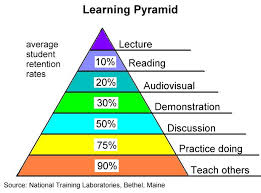
It’s also important to understand the difference between active and passive learning. In active learning, the student learns by doing. Students learn passively when they listen to lectures or read textbooks. Students engage in active learning when they are analyzing, defining, creating, and evaluating information. Students learn using both modalities, but as educators, we want them to retain the information. This learning pyramid provides a helpful illustration.

My university provided us with the following statistics, which look at active learning from a slightly different perspective, but still gets to the same conclusion – teachers need to focus more on active learning. Apparently, people remember:

10% of what they read- passive learning

20% of what they hear- passive learning

30% of what they see- passive learning

50% of what they see and hear- passive learning

70% of what they say and write- active learning

90% of what they do- active learning

My experiences as a learner and teacher over the past few weeks leads me to believe that learning styles and active learning really do make a difference. For example, even though I had some of the world’s experts as panelists over the past few weeks in my compliance and corporate governance online course, I found during my scans of the Zoom squares that students who weren’t asking questions often look distracted after a period of time. The more they interacted with the panelists, the more engaged the class was as a whole. Having students use the chat feature increased engagement with the speakers as well (just make sure to disable private chat). But even during the most interesting discussions, some students tended to drift away and were clearly doing other things online. On the other hand, when I did sessions with the same students using breakout groups or requiring them to act as board members in a mock meeting, their engagement level appeared higher, even though they always commented favorably on the guest speakers.

Similarly, when I’ve watched webinars or taken certification courses, I found that if I didn’t see a person’s face during a video at least part of the time, then I needed a more engaging presentation style and slides with embedded videos of people doing something. If I didn’t have activities to do to test my understanding or put in practice what I had learned, I quickly lost interest. Reading  too much made my eyes glaze over, especially after a day of teaching and holding student meetings on Zoom. Zoom fatigue is real and we need to take that into account when designing our courses. Remember, we may be on Zoom for a few hours a day but our students will be on Zoom for many more hours with different professors using different teaching styles. If we thought they were exhausted after a day of face-to-face class, imagine how they will feel after a day on Zoom learning complex topics from teachers with varying degrees of online proficiency.

With that in mind, here are some things we should consider over the next few weeks:

  • How do we break our modules down to chunks of learning activities? How do we tie those learning activities to our stated learning objectives? Even though it may seem like we’re dumbing it down, should we say “Read/Watch This Before Class” “Do This In Class” “Do This After Class” each week in the modules? I’ve learned that you can never make it too simple for students.
  • How do we ensure that we have activities where students discover, discuss, and then do/demonstrate?[1]
  • Are we mixing things up in our synchronous class every 15-20 minutes with polls, breakout groups, or some other non-lecture activity?
  • Are we using the tools that work in a synchronous, asynchronous, and combination environment such as team-based learning, peer review, retrieval practice[2], and asynchronous videos?[3]

I use team-based learning by having students work in law firms throughout the semester on graded and ungraded assignments and then requiring them to evaluate themselves and each other on specific criteria. More formally, team-based learning can involve more complex features such as readiness assuredness testing, which I don’t do, so I can’t comment on the effectiveness. The Team-Based Learning Collaborative and InteDashboard both come highly recommended.

I have used peer review occasionally in live classes and on discussion boards for my transactional drafting course, but I plan to use it even more in the Fall, likely using Google docs. I’ve found that my students’ work product improves significantly after they’ve marked up someone else’s draft, and this corresponds with the learning pyramid assertion that students remember 75% of what they do and 90% of what they teach others. Other professors I know have used Peerceptiv, Eli Review, and other tools. I’ve watched demos and think they’re great, but I’m trying to keep things simple for myself this Fall.

Finally, I’ve found that polls and no-stakes quizzes are highly effective for keeping students engaged during class, especially in courses like Business Associations. I’ve used polls and test your understanding quizzes through Echo 360 in both synchronous and asynchronous class sessions. Requiring short answers in the Echo 360 quizzes ensures that the students aren’t just guessing. Using multiple choice questions shows me how many students are answering correctly and gives me an idea of where the knowledge gaps are. I also have a record by student of the number of questions they have answered correctly. The quizzes, which only count for class participation, also provide formative assessment, which the students really need in an online environment.

Students also really like polls. It wakes them up and gives me an idea of what they actually understand or think about the material. During class, I’ve tended to use Zoom polls or Echo 360, but in the Fall, I will use a variety of tools including Kahoot for polling and creating instant word clouds, Poll Everywhere, which has more features than Kahoot, and Mentimeter, which offers greater functionality than Zoom. Poll Everywhere has put together a chart comparing it to its competitors but the best way to determine what works for your teaching style and objectives is to test drive them yourself. I’ve been on webinars where presenters have used all four tools, and I liked them all. I will probably use them all during the semester, but no more than two different mechanisms during a synchronous class session. According to our instructional designers, students respond well when professors use one or more polling feature in a class session. Some of the tools require students to use their cell phones to participate and you may have concerns about that, but let’s face it, they may be on their phones anyway, especially if you don’t require them to keep cameras on, as I do.

I’ve now flooded you with information. Next week, the flooding continues. I’ll continue talking about student engagement focusing on evidence-based theories in learning and the do’s and don’ts of breakout rooms. If you have any suggestions or experiences with any of these tools, please leave your comment below.


[1] Recommendation courtesy of Professor  Linda J. Hiemer

[2] Retrieval practice is more complex and deals with learning science, which I will address in another post. I will also discuss best practices for asynchronous videos in a future post.

[3] Recommendation courtesy of Professor Tracy Norton

The states and XY Planning have failed in their bid to stop Regulation Best Interest.  The Second Circuit found that the SEC had discretionary authority to enact a regulation short of a uniform fiduciary standard.  It also found that the states lacked standing to sue because their theory that their tax revenue would decline was “speculative.”

With Reg BI going into effect, states must decide whether to simply pass their own statutes and rules.  As it stands, Nevada remains the nation’s only state to have a state fiduciary statute.  Other states, notably New Jersey and Massachusetts have pursued administrative rule making approaches. The next fight will likely be about the scope of state authority to regulate securities sales practices.  

Industry lawyers will likely do all they can to forestall the promulgation of state regulation or, if that fails, seek to have it struck down as somehow preempted by federal law. Some academic work has begun to explore this issue.  Columbia Law’s Yerv Melkonyan has a forthcoming Note exploring the topic (it was also featured on Andrew Jennings’s podcast here).  In a symposium piece, I took a close look at one preemption argument industry representatives made in comment letters sent to state regulators here.  If states do move forward on their own, I expect courts will ultimately have to sort out the scope of state power.