
The AALS Section on Securities Regulation distributed two calls for papers earlier today.
Both are included below.

+++++

AALS Call for Papers:
What Can Securities Regulation Contribute to
Environmental Law, and Vice Versa?

The AALS Sections on Environmental Law and Securities Regulation are delighted to present a joint session at the 2021 AALS Annual Meeting, titled “What Can Securities Regulation Contribute to Environmental Law, and Vice Versa?” We are awaiting final scheduling information from AALS, but we anticipate receiving a three-hour joint program slot. We are planning an innovative format that will include short (5-7 minute) paper presentations in plenary session, followed by collaboration in “table discussion” groups.

The political vicissitudes of environmental policy in recent years have led to increased focus on the potential of private mechanisms to achieve environmental results that had traditionally been sought by government action. At the same time, investors and market regulators have become increasingly aware of the need for corporations to grapple with environmental risks, particularly with respect to global climate disruption.

This joint session will bring together leading scholars from the fields of environmental and securities law to discuss the reciprocal influences that environmental and securities law exert on each other, including a discussion of the following questions: How do the goals of securities regulation intersect with environmental policy? Are the securities laws an effective means of advancing environmental policy? What are the regulatory implications, both for securities regulation and environmental law, of this intersection? What are innovative investors and companies doing in response to the risks of climate change?

We invite papers that explore these questions from a diversity of perspectives, both theoretical and applied. The authors of the selected papers will present short, TED-style talks at the 2021 Annual Meeting and engage in dialogue with each other and attendees about the ideas presented.

By August 15, 2020, please send your submission to Professor Steve Gold at stgold@law.rutgers.edu and Professor Wendy Couture at wgcouture@uidaho.edu. We welcome submissions at any stage of development, although preference may be given to more fully developed papers over abstracts and paper proposals. The authors of the selected papers will be notified by September 15, 2020. 

The Call for Paper presenters will be responsible for paying their registration fee and travel expenses.  Please note that AALS anticipates that the Annual Meeting will proceed in person as planned in San Francisco, (https://am.aals.org/), and the theme is The Power of Words.
AALS Call for Papers:
Emerging Voices in Securities Regulation

The AALS Section on Securities Regulation is delighted to bring together junior and senior securities regulation scholars for the purpose of providing junior scholars feedback on their scholarship and helping them prepare their work for submission for publication. Junior scholars’ presentations of their drafts will be followed by comments from senior scholars and further audience discussion.

If you would like to present your draft as a junior scholar, by August 15, 2020, please send your draft to Professor Wendy Couture at wgcouture@uidaho.edu. We welcome submissions at any stage of development, although preference may be given to more fully developed papers over abstracts and paper proposals. The authors of the selected papers will be notified by September 15, 2020. 

If you would like to volunteer to provide feedback as a more senior scholar, please let Professor Couture know, at wgcouture@uidaho.edu, by August 15, 2020. Thank you in advance for your generosity.

The Call for Paper presenters will be responsible for paying their registration fee and travel expenses.  Please note that AALS anticipates that the Annual Meeting will proceed in person as planned in San Francisco, (https://am.aals.org/), and the theme is The Power of Words.

Call for Papers
AALS Section on Agency, Partnership, LLCs & Unincorporated Associations 

Entrepreneurship and the Entity 

January 5-9, 2021, AALS Annual Meeting 

The AALS Section on Agency, Partnership, LLCs & Unincorporated Associations will sponsor a panel on “Entrepreneurship and the Entity” at the 2021 AALS Annual Meeting in San Francisco, California. This panel will showcase scholarship on subjects relating to business law and entrepreneurship, including entity choice throughout a company’s evolution, financing alternatives, and how legal rules promote and discourage different kinds of entrepreneurship. Scholars are encouraged to interpret the subject of the Call for Papers broadly and creatively. 

SUBMISSION PROCEDURE: Scholars should send a summary of a work or a work-in-progress of no more than 600 words to Professor Sarah C. Haan at haans@wlu.edu on or before Friday, August 21, 2020. The summary should be a pdf or Word document that has been stripped of information identifying the author; only the cover email should connect the author to the submission. The subject line of the email should read: “Submission—[author name & title].” Papers will be selected through an anonymous review by the Section’s Executive Committee. 

SPECIAL NOTE: Interested parties are encouraged to submit even if they are not certain at this time that they will attend the AALS Annual Meeting in person. 

ELIGIBILITY: Scholars at AALS member law schools are eligible to submit. Pursuant to AALS rules, faculty at fee-paid non-member law schools, foreign faculty, adjunct and visiting faculty (without a full-time position at an AALS member law school), graduate students, fellows, and non-law school faculty are not eligible to submit. Please note that all program presenters are responsible for paying their own annual meeting registration fees and, for those attending the AALS Annual Meeting in person, travel expenses. 

Any inquiries about the Call for Papers should be submitted to: Professor Sarah C. Haan at haans@wlu.edu. 

This past week, I had occasion to return to the Financial Stability Board’s (FSB) recent Consultative document, Guidance on financial resources to support CCP resolution and on the treatment of CCP equity in resolution (Guidance), which I wrote a brief post about several weeks ago (here).  In doing so, I spent more time thinking about the possibility of clearinghouse shareholders raising “no creditor worse off than in liquidation” (NCWOL) claims in a resolution scenario.  I’m struggling with this idea.  Shareholders are not creditors.  I’ve decided to research this issue more and plan to write a short article.  Stay tuned.

The Guidance notes the principle:

that in resolution CCP [clearinghouse] equity should absorb losses first, that CCP equity should be fully loss-absorbing, and that resolution authorities should have powers to write down (fully or partially) CCP equity. 

It also notes that:

actions in resolution that expose CCP equity to larger default or non-default losses than in liquidation under the applicable insolvency regime could, based on the relevant counterfactual, enable equity holders to raise NCWOL claims.  This may be inconsistent with the other Key Attributes principle that equity should be fully loss absorbing in resolution.  This may also raise moral hazard concerns by allowing equity holders to maintain their equity interest in a CCP post resolution while participants are made to bear losses.

I’ll provide a very brief bit of background in this post and encourage readers interested in learning more about this area to review my work on clearinghouses (for example, here and here). 

Most clearinghouses – for example ICE Clear Credit, a clearinghouse for CDS, and CME Clearing, a clearinghouse within CME Group – are now part of publicly traded global exchange group structures.  Historically, clearinghouses were owned by their users/participants.  Post Dodd-Frank, some clearinghouses, including the two just noted, have been designated as systemically significant financial market utilities (here). 

Over a long period of time, clearinghouses have proven themselves to be robust risk management institutions.  However, they can and have failed.  Clearinghouses can experience losses due to the default of a clearing member(s), due to non-clearing member default issues (for example, cybersecurity problems, investment or custody losses, operational problems etc.), or due to a combination of both default and non-default issues.

Clearinghouses have rulebooks (contractual arrangements between the clearinghouse and clearing members/participants) that delineate how losses will be handled in the event that a clearing member were to default.  Typically, clearinghouse default waterfalls in rulebooks direct that if the defaulting member’s performance bond (initial margin) does not cover its obligations, then a limited amount of funds contributed by the clearinghouse itself would be used to cover losses, and then any remaining losses would be covered by a common default fund which all clearing members are required to contribute to.  Were the default fund to be exhausted, rulebooks generally permit clearinghouses to make an additional “cash call” to members.  Were losses then still outstanding, the clearinghouse would initiate a recovery process. 

Clearing members have called for clearinghouses to put additional capital at risk in this default waterfall structure (here) and to be required to hold additional capital.  There is an obvious tension/conflict of interest between clearing members of a publicly traded clearinghouse being largely responsible for default losses and the clearinghouses’s shareholders benefiting from the clearinghouse’s profits and managing its risk.  Of course, if clearinghouses were owned by their users as they were historically, this conflict of interest would not exist.  An alternative to the remutualization of clearinghouses would be for the clearinghouse to be responsible for any default losses that exceeded the defaulting member’s initial margin.  From my perspective, this would make a lot more sense.   I’m unaware of other examples in which the customers (clearing members) of a publicly traded institution, rather than its shareholders, are responsible for losses created by other customers.   

Were a systemically important clearinghouse to become distressed, a resolution authority (RA) could step in – perhaps prior to the completion of the clearinghouse’s recovery process – to ensure the continuity of the clearinghouse’s operations and financial market stability.  Systemically important clearinghouses are too critical to fail.  Were the RA to take actions resulting in the shareholders experiencing larger losses than they would “in liquidation under the applicable insolvency regime,” there is a concern that such action by the RA could “enable equity holders to raise NCWOL claims.”  I would think that this concern would largely disappear if the odd situation of having customers paying for the losses of other customers at a publicly traded institution did not exist or if clearinghouses were owned by their users. 

At least for now, in my pre-NCWOL claims by clearinghouse shareholders article world, it’s unclear to me why given that shareholders are not creditors that shareholders would (or should) be able to make credible “NCWOL” claims as shareholders in resolution.  I understand that a RA could step in before a clearinghouse recovery process were complete and that shareholders might lose more than they would were the rulebook procedures followed.  I also understand that clearinghouse rulebooks generally require clearing members – rather than shareholders – to absorb the majority of the losses from the default of a clearing member.  But at the end of the day, shareholders are simply not creditors.  Perhaps if it were clear ex-ante that clearinghouse shareholders would be unable to make NCWOL claims in a clearinghouse resolution, it might help to rationalize the incentive conflicts in the clearinghouse area.  If clearinghouse shareholders want to make “no shareholder worse off than in liquidation” claims, then the case should be made for that.

Both as a corporate governance scholar and an American citizen, I’ve spent the last few days riveted by Twitter’s decision to go to war with the President of the United States.

And it was a decision; after Twitter posted its first fact-check of a Trump tweet, its VP of Global Communications said, “We knew from a comms perspective that all hell would break loose.”

All hell did.  Trump responded with an executive order (whose legal effect is, ahem, questionable), and Twitter’s stock price plummeted.  But Twitter doubled-down, hiding a Trump tweet for glorifying violence, and doing the same when the White House twitter account repeated the same quote.

We’ve talked a lot here about corporate political stances, and – especially in the context of Nike and Colin Kaepernick — how despite appearances, they’re often justifiable on a theory of shareholder value maximization.

A similar argument could be made about Twitter’s conduct.  It has come under increasing pressure to control its platform; trolls and bots and harassment by some users have driven away others.  Trump’s tweets about Joe Scarborough specifically led to a torrent of criticism, essentially begging Twitter to hold Trump to the same standards as any other user.  Twitter’s efforts to impose discipline – on any chaos agent, including the President – could easily be viewed as part of a larger strategy to ensure that the platform remained usable for everyone else.  Merely choosing to join battle may attract users and attention, which is Twitter’s main asset.

At the same time, Twitter’s actions here feel different.  They feel like an recognition of civic responsibility, to keep political discourse civil and truthful, regardless of whether that is the most profitable course for the company.

Facebook, of course, has ostentatiously distanced itself from Twitter, proclaiming on Fox News that it does not  want to be an “arbiter of truth.” (well, not anymore). 

The Wall Street Journal recently reported that Facebook dropped its own initiative to minimize polarization and political falsehoods on its platform, in part because “some proposed changes would have disproportionately affected conservative users and publishers, at a time when the company faced accusations from the right of political bias.”  Shira Ovide, commenting in the New York Times, wrote, “If Facebook made these decisions on the merits, that would be one thing. But if Facebook picked its paths based on which political actors would get angry, that should make people of all political beliefs cringe….there should be a line between understanding the political reality and letting politics dictate what happens on your site.”

That’s such an odd statement.  Facebook isn’t a state actor, it’s a private company, and a private company exists to benefit shareholders, which, among other things, may mean placating politicians – right?

And yet when these things come up, I often see people offering takes like these:


They’re wrong, but also – they’re kind of right, in the popular sense that large corporations often have public responsibilities and therefore the public demands their decisionmaking reflect public values.

But then there’s Scott Rosenberg’s view that Facebook’s hands-off policy is analogous to a government neutrally facilitating free speech, while Twitter is behaving more like a property owner trying to maintain order in its mall.

The flaw in Rosenberg’s analogy is that Facebook is not a neutral platform; the point of the Wall Street Journal piece is that Facebook’s own algorithms privilege certain types of speech over others in order to maximize user engagement – much like a mall owner who makes sure there are plenty of amenities on the property so no one ever leaves.

That said, I often experience this kind of gestalt switch when I think about corporate social responsibility; categorizing the behavior as privately oriented or publicly oriented is often simply a matter of perspective.  Large corporations are, in fact, a hybrid of the two, a product of both public systems and individual choices.  Which is why it’s so hard to put the conflict here into a neat little box.

The North American Securities Administrators Association just released proposed model whistleblower legislation.  At first glance, the legislation looks similar to the federal whistleblower bounty program enacted as a part of Dodd-Frank, only at the state level:

Among other provisions, the proposed model act provides a state’s securities regulator with the authority to make monetary awards to whistleblowers based on the amount of monetary sanctions collected in any related administrative or judicial action, up to 30 percent of the amount recovered. The model act also would protect whistleblower confidentiality, prohibit retaliation by an employer against a whistleblower, and create a cause of action and provide relief for whistleblowers retaliated against by their employer.

NASAA seeks comments by June 30, 2020.  Hopefully, they’ll get plenty of insightful comments informed by studying the flaws with the SEC’s bounty program. 

As Andrew Jennings pointed out to me, the language seems to track the federal language.  This may generate some of the the same difficulties for internal reporters.  At the federal level, whistleblowers who try to work within the organization to fix a problem do not receive the same protection from retaliation as those that go directly to the SEC. 

Although federal law may make it difficult for states to include an anti-arbitration provision for retaliation claims, states should probably also think about where any anti-retaliation claim will be heard.  It may be valuable to have state regulator insight into those hearings somehow, particularly if the main idea is to get information to state regulators.

If you have trouble viewing the embedded Tweets, please try a different browser (I recommend Internet Explorer).

It’s been 11 weeks since the WHO declared the coronavirus outbreak a pandemic, and the NBA cancelled games. As of this writing, the NY Post reports: Total cases globally = 5,589,626; Deaths = 350,453.

Yesterday, I posted the AALS Section on Business Associations Call for Papers for the New Voices in Business Law program.  Today, I am posting the section’s general call for papers, which focuses on a very salient topic: Corporate Boards in the Age of COVID-19.  There certainly is a lot that we can say about that from the advisory, compliance, and litigation (prevention and management) angles.

+     +     +

Call for Papers for the
Section on Business Associations Program on
Corporate Boards in the Age of COVID-19

2021 AALS Annual Meeting

The AALS Section on Business Associations is pleased to announce a Call for Papers for its program at the 2021 AALS Annual Meeting in San Francisco, California. The topic is Corporate Boards in the Age of COVID-19. Up to three presenters will be selected for the section’s program.

The COVID-19 pandemic has put corporate boards under tremendous stress. In the midst of unprecedented financial and operational challenges, boards must comply with legal obligations that are often complex, uncertain, and contested. This panel will explore the impact of COVID-19 on the corporate board. How should boards exercise their oversight and disclosure responsibilities during these times? Should boards reevaluate the corporate purpose, especially considering the increased vulnerability of employees and other stakeholders? Should boards rethink their dividends and stock buyback policies? And, as market instability continues, how should boards approach planned transactions and use defensive mechanisms? We hope to facilitate a robust conversation that connects corporate law theory to the immediate challenges facing corporate boards.

Submission Information:

Please submit an abstract or a draft of an unpublished paper to Jessica Ericsson, jerickso@richmond.edu, on or before August 3, 2020. Authors should include their name and contact information in their submission email but remove all identifying information from their submission.

Papers will be selected after review by members of the Executive Committee of the Section. Authors of selected papers will be notified by August 28, 2020. Presenters will be responsible for paying their registration fee, hotel, and travel expenses.

Please direct any questions to Jessica Erickson, University of Richmond School of Law, at jerickso@richmond.edu.

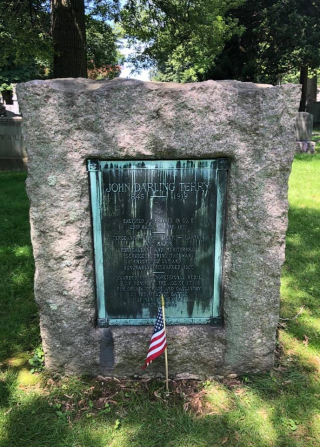
JohnDarlingTerryGravestone

As we close out the holiday weekend, I offer simple words of respect, admiration, and thanks for those who have sacrificed their lives for all of us.  Amidst the barbecues and beer and whatnot, it is sometimes difficult to remember that we take today to honor our fallen heroes.  Although I spent today working (grades for all courses due tomorrow!), I took time out to remind myself that life is not all about business law prof’ing and contemplate the importance of the day.

The photo above (taken by my brother last year) depicts a gravestone honoring one of our family’s military heroes.  He did not die in combat, but he was wounded and received the Congressional Medal of Honor.  Although we honor those kinds of commitments more directly on Veteran’s Day, I was thinking about him today–and about the thin line that divides life and death, especially in times of military conflict.

My heart goes out to all who have lost family and friends in the line of battle or otherwise in service to our country.  May those lost servants rest in peace.  And may those who remain take pride in their ultimate sacrifice.

Call for Papers

AALS Section on Business Associations

New Voices in Business Law

January 5-9, 2021, AALS Annual Meeting

The AALS Section on Business Associations is pleased to announce a “New Voices in Business Law” program during the 2021 AALS Annual Meeting in San Francisco, California. This works-in-progress program will bring together junior and senior scholars in the field of business law for the purpose of providing junior scholars with feedback and guidance on their draft articles.

FORMAT:  Scholars whose papers are selected will provide a brief overview of their paper, and participants will then break into simultaneous roundtables dedicated to the individual papers.  Two senior scholars will provide commentary and lead the discussion about each paper.

SUBMISSION PROCEDURE:  Junior scholars who are interested in participating in the program should send a draft or summary of at least five pages to Professor Megan Shaner at mshaner@ou.edu on or before Friday, August 21, 2020.  The cover email should state the junior scholar’s institution, tenure status, number of years in their current position, whether the paper has been accepted for publication, and, if not, when the scholar anticipates submitting the article to law reviews.  The subject line of the email should read: “Submission—Business Associations WIP Program.”

Junior scholars whose papers are selected for the program will need to submit a draft to the senior scholar commentators by December 16, 2020.

ELIGIBILITY:  Junior scholars at AALS member law schools are eligible to submit papers.  “Junior scholars” include untenured faculty who have been teaching full-time at a law school for ten or fewer years.  The Committee will give priority to papers that have not yet been accepted for publication or submitted to law reviews. 

Pursuant to AALS rules, faculty at fee-paid non-member law schools, foreign faculty, adjunct and visiting faculty (without a full-time position at an AALS member law school), graduate students, fellows, and non-law school faculty are not eligible to submit.  Please note that all presenters at the program are responsible for paying their own annual meeting registration fees and travel expenses.

The World Bank and IMF recently released a joint note, COVID-19: The Regulatory and Supervisory Implications for the Banking Sector (here).  It’s a great resource for those focused on banking, offering “a set of high-level recommendations that can guide national regulatory and supervisory responses to the COVID-19 pandemic” and “an overview of measures taken across jurisdictions to date.”  Annex 1: Overview of Statements and Guidance Provided by Standard-Setting Bodies in Response to the COVID-19 Pandemic is a particularly helpful reference.  

Yesterday’s post by Ann Lipton about DoorDash and pizza arbitrage reminded me that food is a really fun, relatable topic for legal/classroom discussion, especially in a transactional or entrepreneurial law course.  In the current issue of Food & Wine, I enjoyed “From the Lawyer’s Desk,” a short blurb attached to the article, Positive Partnerships One reason why chefs are partnering with hotels to open restaurants? Risk reduction, in which hospitality lawyer, Jasmine Moy, discussed common chef-hotel partnership deals.  Unfortunately, I couldn’t find a link to this for readers, but I did see other legally oriented possibilities (for example, Don’t Open a Restaurant Until You Read This).   

Breath.  Both Joan Heminway and I have posted about the importance of paying attention to your breath (here).  Whether you’re blogging, barbecuing, biking, prepping a summer course or just chilling this weekend, you can’t go wrong in paying attention to your breath: The Healing Power of Proper Breathing.

I want to wish all BLPB readers a very happy, healthy Memorial Day weekend! 

Above all this Memorial Day weekend, I want to remember, honor, and thank all of the brave military men and women who died while serving our country.