
Although this is a little off-brand for the BLPB, I thought readers might appreciate a puppy break.  This is Lucky, the newest addition to the family.

RenderedImage

She’s excellent at giving me so much to worry about that I stop thinking about the pandemic!  But that does not mean that stuff stops happening!

Notably, FINRA has a rule proposal out to alter its exiting suitability standard in light of the SEC’s new Regulation Best Interest. FINRA summarized the proposal as doing two things:

  1. amend the FINRA and CAB suitability rules to state that the rules do not apply to recommendations subject to Regulation Best Interest (“Reg BI”), and to remove the element of control from the quantitative suitability obligation; and
  2. conform the rules governing non-cash compensation to Reg BI’s limitations on sales contests, sales quotas, bonuses and non-cash compensation.

Because Reg BI so closely resembles the FINRA Suitability Rule, firms may not have to do too much to comply with the text of the rule.  This leaves me wondering about guidance.  FINRA has many notices to members and other explanations available to give context to the suitability rule.  With regulation moving from the self-regulator to the regulator, will the guidance move as well and will it have the same force?  This may be unknowable because so many customer issues get resolved in arbitrations without explained decisions.

What will happen in the future when FINRA has to manage compliance or enforcement for activity covered by Reg BI?  In the past, FINRA could simply determine what its own rules meant.  Now, new issues may need to be addressed by the SEC instead.  FINRA may still simply opt to apply Rule 2110 for conduct it would have deemed over the line under the suitability standard.  Essentially, it’s a catch-all for requiring all members to “observe high standards of commercial honor and just and equitable principles of trade.”  

Regulation Best Interest is now set to go into effect this July.  Whether the date will get bumped back remains uncertain.  Financial Planning has reported that the SEC is now mulling whether to extend the deadline.  My bet is that the SEC will probably extend the deadline event though there probably isn’t much of a need to because it didn’t seem as though Reg BI actually required any major changes to most firms’ business practices.
If you have trouble viewing the embedded Tweets, please try a different browser (I recommend Internet Explorer).

It’s been two weeks since the WHO declared the coronavirus outbreak a pandemic, and the NBA cancelled games. As of this writing, the NY Post reports: Total cases globally: 417,966; Deaths: 18,615.

I am taking a free online course from Coursera and Yale University on the Science of Well-Being. The course is taught by Professor Laurie Santos.

Join me.

I may blog about the course at a later date. I am taking the course both for the content and for online teaching strategies.

Update (1/2/21): While I found some suggestions in this course helpful, I think philosopher Jennifer Frey makes a thoughtful critique of this course and the happiness hacking it promotes. In relevant part, Professor Frey writes:

“Happiness, pagan and Christian philosophers agreed, requires something more than technique or self-help; it requires the transformation of the person that comes with the acquisition of virtue: wisdom, prudence, justice, courage, and temperance. Wisdom gives us a clear vision of what is truly good, prudence allows us to deliberate well so as to attain and maintain that vision, justice to realize it in our actions, and courage and temperance to preserve it in the face of fears and temptations. Acquiring virtue is not about hacking oneself or engaging in other forms of self-manipulation; it is about the proper habituation of one’s thoughts, feelings, and desires so that one becomes existentially ready to seek what is truly good and beautiful. In this view, there is a truth about the human desire for happiness, which is that it can either be properly directed toward the possession of what is actually beautiful and good, or it can be improperly directed, remaining within the prison of the self and closed off from transcendence.”

Like so many law schools, we’re navigating our way to online and other remote teaching and learning in a rapid and unexpected way.  We started classes yesterday, and it’s gone fairly well.  Our faculty has worked hard, and our students have been incredibly resilient in the face this adversity we all, unfortunately, share. It does, though, impact people in many different ways.  

Some people face additional health risks, financial challenges, childcare problems, technology limitations, learning disabilities, and more, and I have been so impressed with the strength and composure I have seen in our community. I suspect it’s that way a lot of places, and I hope so, but it has been remarkable to see.  

The Harvard Business Review posted a piece yesterday that framed this whole COVID-19 experience in a way I had not considered. The piece is titled, That Discomfort You’re Feeling Is Grief. I would not have framed it the way, but I think it’s an important perspective.  The whole piece is worth a read, but here are some important points worth considering: 

Anticipatory grief is the mind going to the future and imagining the worst. To calm yourself, you want to come into the present. This will be familiar advice to anyone who has meditated or practiced mindfulness but people are always surprised at how prosaic this can be. You can name five things in the room. There’s a computer, a chair, a picture of the dog, an old rug and a coffee mug. It’s that simple. Breathe. Realize that in the present moment, nothing you’ve anticipated has happened. In this moment, you’re okay. . . . .

You can also think about how to let go of what you can’t control. What your neighbor is doing is out of your control. What is in your control is staying six feet away from them and washing your hands. Focus on that.

Finally, it’s a good time to stock up on compassion. Everyone will have different levels of fear and grief and it manifests in different ways. A coworker got very snippy with me the other day and I thought, That’s not like this person; that’s how they’re dealing with this. I’m seeing their fear and anxiety. So be patient. Think about who someone usually is and not who they seem to be in this moment.

This all makes sense to me, and it is a helpful way to think about things when everything feels a little off.  And right now, that seems to be often.  Another thing I have tried to do is find some routine and ways to share with one another.  We have been having family dinners and family movie night most nights. And we have been reconnecting with friends around the country via phone calls, but more often on Zoom. Sharing some time with friends works remarkably well, at least now that we lack other options interaction.  

In the interest of sharing, here are a few recommendations.  As to movies and music, if periodic coarse language, drug references, etc., are not for you, my recommendations may not be for you.  So in closing, I will share some (mostly new) songs you may not have heard (and I think you should).  Be safe, be well, and be good to each other.   

1. I think I’m OKAY, Machine Gun Kelly, et al., — seems about right. 

2. how will i rest in peace if i’m buried by a highway?, KennyHoopla (for old guys like me, there’s a modern edge with an old techno, maybe New Order, feel)

3. Hit the back, King Princess (sultry, smooth, with a 70s dance vibe, not too sappy). 

4. Celoso, Lele Pons (chill Latin dance that’s upbeat yet goes well with a cocktail) 

5. Don’t You (Forget About Me), beabadoobee (Okay, you’ve probably heard this one, but not this version.  Like I said, I’m Gen X).  

I am publishing this call for papers below with permission from the editor.

In 2018, I published with the Virginia Sports & Entertainment Law Journal (out of UVA), and I think it is fair to say that they are a leader in this specialty area. 

—–

My name is Blake Steinberg and I am the current Editor-in-Chief of the Virginia Sports & Entertainment Law Journal at UVA Law. I am reaching out to you because you have published with our Journal in the past. We are currently looking for submissions, and would be glad to review any piece that you hope to publish.

Although we received a large number of student notes this year, our Journal has received fewer pieces from professors and practitioners than we would like. If you are a professor or practitioner who focuses on legal issues arising in the sports or entertainment industries, we would be especially interested in reviewing a submission from you.

In the past, published pieces have addressed topics such as video game licensing, basketball arena and team owners’ tort liability for spectator injuries, negotiations over cell phone ringtone revenue, and copyright law’s treatment of entertainers as compared to its treatment of other types of authors.

To submit a piece, please send an email to me at bjs4me@virginia.edu, with a Word document version of your submission along with your resume. If you know of anyone else who might be interested in publishing with our Journal, feel free to forward this email to them as well.

I write today to share some Zoom connectivity tips that I have accumulated since my first post on this topic.  I spent class time before (and personal time during) Spring Break, which concluded for us yesterday, testing Zoom connections with students–working with them to overcome barriers to clear Internet communications using Zoom.  My collected tips, which I shared with my students yesterday, are pasted in below.  

Some items on my tip list may not be applicable to you and your students.  Most are mentioned elsewhere; and if you already have been teaching using Zoom for a week or more, you may well have already figured all this out in any case.  Nevertheless, I thought it might be useful to share my “top five” here.

1. Close out of open files and applications before you join in on our class meeting.  Allow your computer to focus its activity on our class exclusively.1

2.  If you are sharing bandwidth in your household, ask your household members if they can schedule their usage around your class meetings.  Internet speed issues can have a real effect on the performance of video conferencing software.2

3.  Log in through the campus’s Zoom page, [the url for that page was included here in the original].  It seems to work better than logging in through the Zoom app directly.  But each of us may want to try each way on our own to see if it makes a difference.3

4.  Download the Zoom app for your phone.  If your Internet connection fails, you may be able to join or re-join class from your phone, assuming your data plan can support that use.4

5.  Remember that you can test your audio or video on Zoom by clicking on zoom-us in the tool bar and clicking on Audio or Video.  You will see the test options there.  Please run those tests before class!5

I also reminded my students to log into class about ten minutes early to best ensure that their links to the class meeting are as strong as possible once class begins.

Nothing in my tip list is Earth-shattering.  But if you are troubleshooting Zoom connection issues with a student, perhaps one or more of these tips will help.  Regardless, I hope that everyone settles into a productive, happy online teaching experience.  If you are like me, you’ll figure out a way to ensure that your students are getting what they need, one way or another. 

Leave your own tips in the comments.  They are appreciated.  Footnotes are included below.

____

From the Zoom blog:

During a meeting, other applications have a way of intruding and asking for attention from your CPU or broadband connection. While downloading information through a broadband connection, the application doing the downloading is competing with Zoom. The same occurs when you use CPU-intensive applications: they steal precious ticks from your processor.

When streaming 30 frames per second, your camera is taking 30 pictures of you each and every second, then sending them to the processor with instructions to forward the images through Zoom. Zoom uses your processor to send the images to your network card, which transmits the data to its destination. This process requires the energy of your CPU. To engage in the smoothest possible meetings, close any applications you don’t need to use for the meeting itself. It’s that simple.

2 Zoom’s recommended system requirements can be found here.

3 Our campus has a super webpage dedicated to Zoom with a list of linked support documents.  Yours probably does, too.

4 Zoom has a webpage dedicated to information for mobile users.

5 Zoom offers a streamlined process for testing audio and video from the view screen at this webpage (which includes, among other things, a brief video).

This follows on my post from last week regarding the 2020 National Business Law Scholars Conference, scheduled for June 18-19, 2020 at The University of Tennessee College of Law.  The planning committee conferred a few days ago and, in recognition of the current state of affairs, determined to extend the deadline for paper submissions to Friday, April 24.  We hope that this takes some pressure off faculty who would like to submit a paper for inclusion in the conference but are wrestling with new challenges and stressors in transitioning to teaching online.

Again, please contact me at jheminwa@tennessee.edu or any other member of the planing committee listed below with questions.  Eric Chaffee handles paper submissions and scheduling.  Accordingly, he is the best person to contact if you need to address specific submission issues or scheduling constraints.  His email address is eric.chaffee@utoledo.edu.

Afra Afsharipour (University of California, Davis, School of Law)
Tony Casey (The University of Chicago Law School)
Eric C. Chaffee (The University of Toledo College of Law)
Steven Davidoff Solomon (University of California, Berkeley School of Law)
Joan MacLeod Heminway (The University of Tennessee College of Law)
Kristin N. Johnson (Tulane University Law School)
Elizabeth Pollman (University of Pennsylvania Carey Law School)
Jeff Schwartz (University of Utah S.J. Quinney College of Law)
Megan Wischmeier Shaner (University of Oklahoma College of Law)

In today’s post, I wanted to call BLPB readers’ attention to two blog posts related to current events that I’ve found helpful.

First, a few weeks ago, I was really excited to learn that Psychology Today had asked my OU management colleague Dr. Mark Bolino, the Michael F. Price Chair in International Business, to start blogging for them.  He recently posted, Managing Employee Stress and Anxiety During the Coronavirus: Some practical, evidence-based advice for managers (here).  Although the post’s target audience is likely business managers, I think its wisdom is applicable to a wide variety of work environments.

Second, University of Chicago Booth’s Initiative on Global Markets (IGM) has a Forum (here) on COVID-19 that’s definitely worth checking out.  IGM Directors have also posted “Economic Policy Principles for Combating the Covid-19 Crisis” (here).  A summary paragraph from this insightful document is below.  Thanks to Professor Kathryn Judge for bringing the site to my attention! 

We organize our discussion around three pillars. First, following the advice of medical experts, we must do all we can to spread out the number of infections over time, or “flatten the curve.” Second, policies should facilitate production and decision-making in a temporarily socially distanced world. Third, we should prepare to make the post-virus recovery as rapid as possible. Even though these three aspects of the policy response will play out in sequence, policymakers should start acting on all three now.       

Its the moment weve all been waiting for, and I am sorry to say – I was wrong.

(All right, in my heart, I still believe I was right in my account of existing law, and Salzberg v. Sciabacucchi actually changed the law.  But, if law is just a prediction of what judges will do, then okay, fine, yes, I was wrong.)

As you all know by now, I’ve been blogging about this case, and the issue of litigation-limiting bylaw and charter provisions, for a while, and I’ve written an article, and a book chapter, on the subject.  In this post, I’ll assume the reader’s familiarity with the issue and my prior argument.

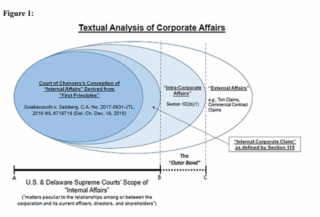
Anyway, the basic logic of the decision is illustrated by this figure from the opinion:

In other words, in the Delaware Supreme Court’s view, there are matters of internal affairs that are governed by the state of incorporation, and then there is a slightly larger category of matters that are still “intra-corporate” but not “internal affairs,” and can be governed by a corporation’s charter, and then there are truly external claims that cannot be the subject of a charter provision.   Federal forum provisions for Section 11 claims, at least facially, count as intra-corporate claims because “FFPs involve a type of securities claim related to the management of litigation arising out of the Board’s disclosures to current and prospective stockholders in connection with an IPO or secondary offering. The drafting, reviewing, and filing of registration statements by a corporation and its directors is an important aspect of a corporation’s management of its business and affairs and of its relationship with its stockholders.” Op. at 11.

I’d love to do a full analysis of the decision but to be terribly honest, I’m just a wee bit distracted right now and also I found the opinion itself kind of … elliptical in its reasoning.  Point being, I’ll give it a more thorough read at a later date but for now I’ve only got a series of quick points:

As I understand it, those matters that are sufficiently intracorporate to be the subject of a charter provisions, but not within the category of internal affairs, are to be determined case by case.  But, per the Court’s earlier decision in ATP Tour, Inc. v. Deutscher Tennis Bund, 91 A.3d 554 (Del. 2014), even provisions related to antitrust lawsuits are at least facially permissible, so it’s going to be really interesting to find out what the court does, and does not, believe can be governed by corporate charters – and even more interesting to see if any other states (hello, California) push back.  I’ll note that simply as a matter of terminology, I find the logic puzzling because the court quotes its own decision in McDermott v. Lewis, 531 A.2d 206 (Del. 1987), where the phrase “intracorporate” is treated as coextensive with “internal affairs.”  Op. at 37.  Moreover, apparently because the court couldn’t find better precedent, in explaining how external matters would be distinguished from intracorporate-but-not-internal-affairs matters, the court cited – well, Mohsen Manesh on the definition of the internal affairs doctrine. Op. at 47-48.  Suffice to say, for those of us trying to figure out what falls into this middle category of “intracorporate” matters, a definition that distinguishes only between internal affairs and external affairs is not helpful.

As Larry Hamermesh says of the decision, “I thought we were in a predictable room, but the door has opened up into very uncertain challenges and positions.”

The case largely focuses on charter provisions, even going so far as to mention charter provisions specifically in its discussion of why forum selection clauses do not violate federal policy.  Op. at 45.  But occasionally, the decision cites to DGCL 109, regarding the bylaw power. I … do not know how to interpret this.  And this is not a minor issue: Part of the reason I have been arguing that corporate constitutive documents cannot govern “external” claims is precisely because there’s no vocabulary outside the corporate law context to discuss whether a waiver, say, of a jury right, or an agreement to pay litigation expenses, should be in bylaws, charters, or both, or subject to supermajority voting provisions, or what happens if someone has dual-class stock or is a controller, etc.  We know how to answer those questions when they concern matters of corporate law; we don’t when we step outside that realm.

The opinion very much hangs the NJAG out to dry.  As I previously blogged here, here, and here, Professor Hal Scott has been pushing for bylaw at J&J which would mandate arbitration of all federal securities claims, including ones brought under Section 10(b)/10b-5.  J&J is chartered in New Jersey.  As part of the dispute over whether the proposal could be included on J&J’s proxy under Rule 14a-8, NJ’s Attorney General argued that such provisions violate NJ law, relying on Chancery’s Sciabacucchi decision.  Now, that decision has been reversed.  Professor Scott’s lawsuit will go forward and New Jersey will … I don’t know.

I think? there’s a basis for distinguishing Section 11 and 10b-5 in the opinion.  The court emphasizes that Section 11 necessarily involves directors (“Section 11 claims are ‘internal’ in the sense that they arise from internal corporate conduct on the part of the Board and, therefore, fall within Section 102(b)(1)”), but 10b-5 does not.  The court also says that tort claims are “external,” and 10b-5 is akin to common law fraud.  But, umm … then there’s the antitrust thing so I really don’t know.

Further to this, the decision opens with a description of how both Section 11 and Section 12 claims operate.  Section 12, like 10(b), also does not necessarily involve directors.  But the opinion doesn’t discuss whether such claims count as intracorporate, even though the forum provisions at issue in the case cover both types of claims.

So, yeah. I got nothing.

I note that since the decision permits charters to govern securities claims, there is now apparently no barrier to inserting a loser-pays provision in corporate constitutive documents for federal securities claims.  After all, the DGCL only bars loser-pays for internal claims.  So, Professor Bainbridge’s preferred policy may yet (mostly) prevail.  Which again highlights why I think this is a problem.  If a corporation adopts such a provision, Delaware will have to decide if it’s permissible, if it violates public policy, whether the provision must be in the charter or the bylaws, what to do if there are nonvoting shares, etc, and that’s just way outside of its area of expertise.  What happens when a director invokes a loser-pays provision and a shareholder argues that, under the circumstances, doing so was a breach of the director’s fiduciary duty?  How will Delaware make the call?  The Supreme Court has not, umm, demonstrated much savvy with respect to the difference between Section 11 and Section 12 claims (or, if you read some decisions, even the difference between a Schedule 14D-9 filing and a Schedule 14A), so I’m not confident of its ability make these judgments.

The Delaware Supreme Court should maybe start boning up on PSLRA pleading standards now, is what I’m saying.

Which brings us to arbitration.  At the very end of the opinion, in Footnote 169, the court mentions that even though this case only involved forum selection provisions, many commenters – and I’d fall into this category, naturally – are concerned about using charters and bylaws to force individualized arbitration of shareholder claims.  The court dismisses this concern on the grounds that DGCL 115 would prohibit mandatory arbitration for internal affairs claims.  The problem here is twofold: First, the court opens the door to corporations adopting arbitration provisions for federal securities claims – precisely as Prof. Scott is currently arguing – but secondly, there looms the possibility that DGCL 115 is invalid under the Federal Arbitration Act.

Now, I wrote a whole long paper explaining why I believe the Federal Arbitration Act does not apply to corporate constitutive documents, but the basis for that article is that corporations are not ordinary contracts within the meaning of the FAA.  Every decision – like this one – that expands the boundaries of the corporate “contract” and applies ordinary contract law principles to define its scope not only, ahem, renders my article less relevant, but also undermines the basis for excluding corporations from FAA’s purview.  This is not an abstract issue; Professor Scott’s lawsuit, for example, argues that the FAA renders arbitration bylaws valid, regardless of any New Jersey law to the contrary.  Again, his lawsuit only deals with a bylaw mandating arbitration of federal claims, but there is no reason the logic would not extend to bylaws purporting to mandate arbitration of internal affairs claims.

In other words, this decision hands corporations the keys to challenging the viability of DGCL 115, and in that respect, I have a sinking fear that it signs Delaware’s death warrant.

But people have made that prediction before, so who knows.

My final observation is this: I think the contrast between the Supreme Court and Chancery decisions as a matter of corporate theory are quite striking.  The Chancery decision is a fairly stark example of the concession theory of the corporation: Laster makes very clear that Delaware, as sovereign, is intimately involved in establishing corporations, designing their operations, and articulating their limits.  The Supreme Court, by contrast, is a model of contracts theory; it treats the corporation as simply a private arrangement among its constituents, with few prohibitions on what that arrangement may entail.  I have been thinking about designing a corporate theory seminar; if it comes to fruition, I’ll likely include excerpts of both opinions.

CNN recently ran a story entitled – the pandemic risks bringing out the worst in humanity.

Rather than focus on the negative, I decided to collect some of the positive business responses to COVID-19. This is probably just a small sampling of the positive responses. I may update this list from time to time; please feel free to add more in the comments or email me. [Updated with some suggestions from my business ethics students and to include some of the highlights from this excellent, more extensive list that a reader e-mailed.]

Also related to COVID-19, I just came across this article about David Lat (founder of “Above the Law“). David is an acquaintance of mine and many of our readers. According to the article, David has COVID-19 and has been dealt a particularly harsh case. David is an incredibly kind person, with a beautiful family, and his case has made me take the virus even more seriously.