
Nevada’s Supreme Court recently released an advance opinion providing guidance on when the directors and officers of Nevada corporations may face liability.  This marks the first instance where the Nevada Supreme Court has directly considered Nevada’s unique statute.

Nevada differs from other states because our statute exculpates directors and officers as a default and includes a requirement that the misconduct must involve: “intentional misconduct, fraud or a knowing violation of law.”  This is the relevant portion of the statute:

7.  Except as otherwise provided in NRS 35.230, 90.660, 91.250, 452.200, 452.270, 668.045 and 694A.030, or unless the articles of incorporation or an amendment thereto, in each case filed on or after October 1, 2003, provide for greater individual liability, a director or officer is not individually liable to the corporation or its stockholders or creditors for any damages as a result of any act or failure to act in his or her capacity as a director or officer unless:

      (a) The presumption established by subsection 3 has been rebutted; and

      (b) It is proven that:

             (1) The director’s or officer’s act or failure to act constituted a breach of his or her fiduciary duties as a director or officer; and

             (2) Such breach involved intentional misconduct, fraud or a knowing violation of law.

The Nevada Supreme Court used the opportunity to walk back language from Shoen, a much earlier decision.  That decision had said that “[w]ith regard to the duty of care, the business judgment rule does not protect the gross negligence of uninformed directors and officers.”  In Chur, the Nevada Supreme Court explained that it was concerned that “language in Shoen has misled lower courts about the law surrounding individual liability for directors and officers.”  It went on to disavow Shoen‘s language about different processes for duty of loyalty and duty of care claims.  

Instead, Nevada has one standard for liability, a director or officer must know that “alleged conduct was wrongful in order to show a ‘knowing violation of law’ or ‘intentional misconduct'” under the Nevada statute.  Interestingly, although “knowing violation of law” and “intentional misconduct” are two different terms, the Nevada Supreme Court now uses the same definition for them.  (Thanks to Stefan Padfield for that point!)

How much does it take for a court to find that the director of a Nevada corporation knew he acted wrongfully or engaged in intentional misconduct?  This isn’t entirely clear.  At the least, the decision seems to require more than gross negligence, which, drawing on Black’s Law Dictionary, the Nevada Supreme Court defined as “reckless disregard of a legal duty.” 

If you’re like me, you may be wondering where does this leave oversight liability claims under Nevada law?  Would the Nevada Supreme Court view a board of directors consciously disregarding their duties as more significant than merely recklessly disregarding them?  The issue appears open for now.
 

If you have trouble viewing the embedded Tweets, please try a different browser (I recommend Internet Explorer).

It’s been a week since the WHO declared the coronavirus outbreak a pandemic, and the NBA cancelled games. As of today, the NY Post reports: Total cases globally: 198,179; Deaths: 7,954.

Like all of us, the past few weeks have been hard. The past few days, harder. Still, I am fortunate that my challenges are nothing compared to so many. My family and I are healthy so far; my job is challenging, but not currently threatened; and the people I love are, generally, safe.  I am truly fortunate.

Complaining about courts messing up LLCs is not at the top of my mind right now, even though it remains both satisfying and important to me. Today, all I have are some thoughts.  That all I’ve got, and it will have to be good enough.

So, here are some things I think:

  • It was right to cancel March Madness, and it still makes me sad.
  • Other than being a father and a spouse, I have the most important job I have ever had.
  • I love our students. Every day. 
  • My family is the best and far more than I deserve.
  • Women are widely over scrutinized, over worked, and underappreciated.
  • I am proud to be a lawyer.
  • Lawyers lawyering everything is exhausting, and too often, wrong (i.e., bad lawyering)
  • I hate racism, and I need to work harder to be anti-racist.
  • Babies are the best.
  • Sometimes, it is better to be happy than to be right.
  • I’m proud to be Irish.
  • Law school rankings suck.
  • Online teaching and learning is more work than a lot of people think.
  • We all need to give each other a break. 
  • We can have high expectations and still be compassionate and forgiving.

I think a lot more things, but it’s time to pay attention to my family. There is no question I am the weak link in this group, and they deserve more. I guess that’s one more thing I think. Be well, friends.

Thanks to all who have been registering and submitting papers for this year’s National Business Law Scholars Conference, scheduled for June 18-19 at The University of Tennessee College of Law.  I posted on the conference last month.  The conference planning committee, like so many others, is monitoring the COVID-19 situation.  At present, the conference is still a “go,” and we remain excited about it!

The deadline for paper submissions is March 31.  We hope that you are inspired to submit.  The conference website can be found here.  The planning committee understands that many (most?) of us are currently subject to institutionally imposed travel restrictions.  Please know that if you submit a paper and are unable to attend due to travel restrictions, you may withdraw your paper.

Comments can be left here, or feel free to email me or any other planning committee member for more information.  Paper submission questions are best directed to Eric Chaffee.  The planning committee members are listed again below, for your convenience.

Afra Afsharipour (University of California, Davis, School of Law)
Tony Casey (The University of Chicago Law School)
Eric C. Chaffee (The University of Toledo College of Law)
Steven Davidoff Solomon (University of California, Berkeley School of Law)
Joan MacLeod Heminway (The University of Tennessee College of Law)
Kristin N. Johnson (Tulane University Law School)
Elizabeth Pollman (University of Pennsylvania Carey Law School)
Jeff Schwartz (University of Utah S.J. Quinney College of Law)
Megan Wischmeier Shaner (University of Oklahoma College of Law)

To help support the economy as the nation grapples with the coronavirus, the Federal Reserve announced today its decision to take a number of actions (here), including lowering the fed funds target rate to 0 to 1/4%, increasing its holdings of Treasury securities and agency mortgage-backed securities, and taking coordinated measures with foreign central banks (I’ve written about the Fed’s use of central bank swap lines, here).  Today’s announcement is the Fed’s second interest rate cut in two weeks.  On March 3, 2020, it lowered the fed funds target rate to 1 to 1.25%.  Economist Carola Binder recently posted (here) an interesting paper, Coronavirus Fears and Macroeconomic Expectations, related to this first March 2020 interest rate cut.  Here’s the abstract:

The Federal Reserve cut interest rates by 50 basis points on March 3, 2020, in response to concerns about the coronavirus (COVID-19). On March 5 and 6, I conducted an online survey of over 500 U.S. consumers that asked about their attention to, concerns about, and responses to the coronavirus, their awareness of the Fed’s policy move, and their inflation and unemployment expectations. I then provided respondents with information about the Fed’s policy announcement, and re-elicited inflation and unemployment expectations. Most consumers were somewhat or very concerned about effects of coronavirus on the U.S. economy, their health, and their personal finances; 28% had cancelled or postponed travel and 40% purchased food or supplies in response to these concerns. About 38% were aware that the Fed had cut interest rates. I show how concerns and awareness of the rate cut depend on consumer characteristics and news sources. Greater concern about coronavirus is associated with higher inflation expectations and more pessimistic unemployment expectations. Provision of information about the Fed announcement leads some consumers to become more optimistic about unemployment and revise inflation expectations downward, consistent with recent research showing that many consumers associate bad times with high inflation.   

Univ. of Idaho (Moscow location) Seeks Tax Visitor


The University of Idaho College of Law seeks entry-level or experienced faculty members interested in serving as a full-time, temporary faculty member for the 2020-2021 academic year at its Moscow location. We are specifically hiring for a professor to teach various Tax law courses and, possibly, courses on Estate Planning and/or Wills. For more information and to apply, go here: https://uidaho.peopleadmin.com/postings/28443 Questions can be directed to Associate Dean David Pimentel at dpimentel@uidaho.edu.


Univ. of Idaho (Boise location) Seeks Visitor to Direct Entrepreneurship Law Clinic

The University of Idaho College of Law seeks entry-level or experienced faculty members interested in serving as a full-time, temporary faculty member for the 2020-2021 academic year to direct the College’s Entrepreneurship Law Clinic at its Boise location. The Entrepreneurship Law Clinic is devoted to outreach to the startup and small business community in Idaho. For more information and to apply, go here: https://uidaho.peopleadmin.com/postings/28557 Questions can be directed to Associate Dean Wendy Couture at wgcouture@uidaho.edu.


Univ. of Idaho (Boise location) Seeks Visitor to Teach IP & Contracts

The University of Idaho College of Law seeks entry-level or experienced faculty members interested in serving as a full-time, temporary faculty member for the 2020-2021 academic year to teach first-year Contracts and several Intellectual Property Law courses (potentially including Introduction to Intellectual Property, Copyrights, Trademarks & Trade Dress, Patents, Internet Law, and/or Antitrust). For more information and to apply, go here: https://uidaho.peopleadmin.com/postings/28556 Questions can be directed to Associate Dean Wendy Couture at wgcouture@uidaho.edu.

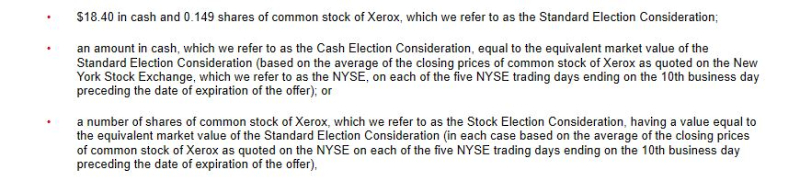
For the last several weeks, Xerox has been pursuing a takeover over HP.  At first, its overtures were friendly, and more recently it turned hostile (well, sort of hostile).  It has put the campaign on hold in light of the pandemic – it says, because it is unsafe to travel and conduct meetings with shareholders – but before that, it filed a Schedule TO and an S-4 with the details of the offer.  As relevant here, the S-4 explains that Xerox is proposing a tender offer followed by a second-step merger under DGCL 251(h).  Shareholders who do not tender their shares, and thus are merged out, will receive the same consideration as shareholders who tender.  Which is:

Election 1

That said, Xerox plans to pay a total of $27,326,000,706 in cash.  Therefore, if shareholders’ elections would result in a different figure, these elections are capped:

Election 2

In other words, shareholders have a choice of whether they receive stock, cash, or a combination of both, but only up to a point; if too many shareholders select one or the other, Xerox will rebalance.

Which brings us to the right of appraisal.  According to the S-4:

Election 3

So, what’s the law on this?  Delaware provides that public company shareholders who lose their shares in the second-step of a 251(h) merger are entitled to appraisal if they are “required by the terms of an agreement of merger or consolidation… to accept for such stock anything except” public company shares.  See DGCL 262.  In other words, cash consideration gets you appraisal; public company stock consideration does not.  And, per Delaware caselaw, a combination of the two entitles shareholders to appraisal.  See Louisiana Municipal Police Employees’ Retirement System v. Crawford, 918 A.2d 1172 (Del. Ch. 2007).

Where does Xerox’s offer fit?

On first glance, it doesn’t require anyone to accept anything; HP shareholders can choose stock, cash, or a combination of the two.  Thus, according to at least once Delaware decision, appraisal should be unavailable.  See Krieger v. Wesco Financial Corp., 30 A.3d 54 (Del. Ch. 2011).

But wait!  Xerox contemplates that some shareholders might be required to accept cash, if it turns out that too many elect stock.  We don’t know yet whether that will happen, and so Xerox is assuming that there will be appraisal rights.  Which could mean that even if everyone makes the exact right election, no one is forced to accept any particular combination of cash or stock, second-step shareholders could still seek appraisal no matter what they elected, simply because of the ex ante possibility that some shareholders might have been required to accept cash.  Cf. Krieger (appraisal is unavailable where “[t]he merger agreement did not contemplate proration or impose any cap on the number of shares available for individual stockholders or the class as a whole.”)

Is that the law?  Maybe.  Or maybe appraisal is only available if Xerox pulls the trigger and actually does force some shareholders to accept cash. Or maybe appraisal is only available to those particular shareholders who elected stock and were forced to accept cash, but not to shareholders who elected cash and received it.  But cf. Krieger (“The General Corporation Law in fact makes appraisal rights available on a transactional and class-wide (or series-wide) basis. Stockholders can choose individually whether to perfect and pursue their appraisal rights, but the underlying statutory availability of appraisal rights is not a function of individual choice.”)

Or something.

We don’t know!

Now, that in itself is not shocking; lots of times you have a statute and it covers some scenarios but not others and caselaw fills in the gaps.  And when there’s a question of first impression, lawyers step in and use a combination of arguments based on statutory language, precedent, and policy to persuade the court to go their way.

But here’s where Delaware law fails us.  As I’ve previously argued, there is no policy.  The appraisal statute is a mess; there is no clear reason why Delaware permits appraisal in the first place, let alone why it distinguishes between public company stock and cash.  To quote, ahem, me:

[Appraisal] can’t just be about liquidity because it applies to publicly-traded stock, it can’t just be about conflict transactions because it’s available in nonconflict transactions – even if it’s more available in 90% controller squeezeouts – and the distinction Delaware draws between receipt of cash versus receipt of publicly traded stock is incoherent.  See Charles Korsmo & Minor Myers, Reforming Modern Appraisal Litigation, 41 Del. J. Corp. L. 279 (2017).  It’s a Frankenstein’s monster of different impulses that act at cross-purposes.

That’s why we’ll never see agreement on how to reform the current system, and it’s also why it’s unclear how the Xerox/HP merger should be treated under existing law.  One of the critical tools we use to make these kinds of predictions – a functional analysis of the purposes behind the statutory scheme – is entirely absent; it’s a crap shoot.

My point is, this is no way to run a railroad.  I know Delaware has contemplated reforms to its appraisal statute and methodology but before we can see movement on that score, Delaware needs to answer the fundamental question of why we have appraisal in the first place.  From that, everything else will (mostly) follow.


So glad Colleen published the Skadden information in her post earlier today.  I had considered doing that, too.  Instead, I will add two links to the growing knowledge base.  They both relate to teaching during these challenging times.  Then, I will offer a few thoughts of my own.

First, friend-of-the-BLPB Seth Oranburg alerted me to some distance education tips he has posted.  They can be found here.  I appreciate him taking time to write his ideas out and get this essay posted.

Second, Josh Blackman posted tips on teaching using Zoom here.  Some of us are more familiar with videoconferencing technology than others.  I have not taught more than a few classes online, but I am comfortable with Zoom.  A few of Josh’s ideas were new to me and seem very useful in the emergent online teaching environment.

Since most law students will be taking all of their courses (as well as conducting meetings and continuing to do much or all of their reading and written work) online, the possibility of boredom and internet overload/online burnout is very real.  As someone who recently suffered from digital eye strain (a/k/a computer vision syndrome), I also am concerned about the possibility that some students will have to combat that.  It will be more important than ever that we take time away from our electronic devices to ensure good physical, psychological, and emotional health.  

Nevertheless, I am toying with continuing to teach my Wednesday law school yoga class online (students already have asked about it) while UT Law is closed to students, since maybe just hearing my voice and doing yoga together could be helpful and healing.  (And at least they would not have to check their phones or computers visually unless they had a question about a pose!)  Not sure about that yet . . . .

I expect to write more about this.  And maybe some of my co-bloggers will do the same.  Comments are always appreciated, too.  Let’s all support each other in the brave new teaching world so many of us are facing.


In reading today’s Financial Times, Kate Beioley’s Corporate lawyers in high demand as coronavirus hits businesses (here -subscription required) caught my attention.  The informative article mentioned a recent Skadden report, Coronavirus/COVID-19 Update (here).  I thought the report provided a helpful overview of ways in which the coronavirus “may impact their [businesses’] operations and employees,” in areas including M&A activity, securities disclosures, securities litigation, annual meetings, supply chain disruptions, equity derivatives, commercial agreements, employment, and cybersecurity.  In particular, I found the discussion in the M&A section of a review of MAC provisions in 31 recent purchase agreements really interesting.  I encourage BLPB readers to review the report.

Over at Law & Liberty, Richard Reinsch reviews (here) Christopher Caldwell’s new book, The Age of Entitlement: America Since the Sixties.  As Reinsch puts it, Caldwell’s premise is that we are currently battling over “two irreconcilable constitutions: the constitution of 1788 and of 1964.”  What follows is an excerpt from the review.  Given the emphasis on diversity in corporate governance, the connection to this blog should be relatively obvious.  Since I am not an expert in the area, I’m curious if readers will identify any misstatements of fact in the excerpt or linked-to materials.

As many legal scholars have observed, the Rehnquist and Roberts Courts have aimed to return to the “color-blind” understanding of equal protection that inspired the Brown decision and the civil rights movement of the 1960s. Of course, many of these same scholars reject such an understanding as a just one …. But the colorblind position is on solid ground ….

As Shep Melnick argues, “the NAACP lawyers who brought the long string of cases culminating in Brown” endorsed the “colorblind” interpretation of the Fourteenth Amendment. It was chief counsel Thurgood Marshall before the Court who argued that the Fourteenth Amendment denies states authority “to make any racial classification in any government field.” Leaders in the Civil Rights movement in the late 1960s argued against the collection of any hiring or employment data regarding blacks and whites. Of course, the Rehnquist and Roberts Court, the NAACP, and those who claim this argument stand on Justice John Marshall Harlan’s legendary dissent in Plessy v. Ferguson (1896) that argued the government use of racial classifications is an invitation to majority tyranny. Justice Thomas therefore is correct to argue in his concurring opinion in Parents Involved v. Seattle School District (2007) “what was wrong in 1954 cannot be right today.” In his majority opinion in the same case, Chief Justice Roberts memorably wrote “The way to stop discrimination on the basis of race is to stop discriminating on the basis of race.” Case closed.

