The University of Michigan Law School invites junior scholars to attend the 6th Annual Junior Scholars Conference, which will be held on April 17-18, 2020, in Ann Arbor, Michigan. The conference provides junior scholars with a platform to present and discuss their work with peers, and to receive detailed feedback from senior members of the Michigan Law faculty. The Conference aims to promote fruitful collaboration between participants and to encourage their integration into a community of legal scholars. The Junior Scholars Conference is intended for academics in both law and related disciplines. Applications from graduate students, SJD/PhD candidates, postdoctoral researchers, lecturers, teaching fellows, and assistant professors (pre-tenure) who have not held an academic position for more than four years, are welcomed.

Applications are due by January 3, 2020.  Conference flyer here: Download CfP for Michigan Law 2020 Junior Scholars Conference

Further information can be found at the Conference website: https://www.law.umich.edu/events/junior-scholars-conference/Pages/2020conference.aspx

I want to wish all BLPB readers a Happy Thanksgiving!

Below, I’ve excerpted information about the upcoming Law and Ethics of Big Data research symposium.  The call for papers is here: Download BIG DATA CALL FOR PAPERS March 27-28 2020 at GA Tech

Law and Ethics of Big Data

Hosted and Sponsored by: Cecil B. Day Program for Business Ethics Machine Learning @ Georgia Tech (ML@GATECH)Georgia Institute of Technology, Scheller College of Business Co-Hosted by: Virginia Tech Center for Business Intelligence Analytics The Department of Business Law and Ethics, Kelley School of Business March 27th and 28th 2020 at the Scheller College of Business, Georgia Institute of Technology, Atlanta, GA

Abstract Submission Deadline: February 1, 2020

We are pleased to announce the research colloquium, “Law and Ethics of Big Data,” at the Scheller College of Business, Georgia Institute of Technology, Atlanta, GA, co-hosted by Professor Deven R. Desai, Assistant Professor Angie Raymond of Indiana University, and Professor Janine Hiller of Virginia Tech.

Due to the success of this multi-year event that is in its seventh year, the colloquium will be expanded and we seek broad participation from multiple disciplines; please consider submitting research that is ready for the discussion stage. Each paper will be given detailed constructive critique. We are targeting cross-discipline opportunities for colloquium participants, and the Scheller and ML@GATECH community has expressed interest in sharing in these dialogues. A non-inclusive list of topics that are appropriate for the colloquium include: Technical Realities of Transparency, Best Practices for Ethical Gathering and Use of Data and/or Algorithm Construction, Machine Learning for Good, Ethics of Data Commons, Ethical Principles for the Internet of Things, Health Privacy and MHealth, Employment and Surveillance, National Security, Civil Rights and Data, Smart Cities and Privacy, Cybersecurity and Big Data, and Data Regulation. We seek a wide variety of topics and methods (e.g., law, computer science, empirical, sociological, anthropological, etc.) that reflect the broad ecosystem created by ubiquitous data collection and use, and its effect in society. 


Many of us teach Francis v. United Jersey Bank, 432 A. 2d 814 (N.J. 1981), in Business Associations courses as an example of a substantive duty of care case.  The case involves a deceased woman, Lillian Pritchard, who, in her lifetime, did nothing as a corporate director to curb her sons’ conversions of corporate funds.  The court finds she has breached her duty of care to the corporation, stating that:

Mrs. Pritchard was charged with the obligation of basic knowledge and supervision of the business of Pritchard & Baird. Under the circumstances, this obligation included reading and understanding financial statements, and making reasonable attempts at detection and prevention of the illegal conduct of other officers and directors. She had a duty to protect the clients of Pritchard & Baird against policies and practices that would result in the misappropriation of money they had entrusted to the corporation. She breached that duty.

Id. at 826.  In sum:

by virtue of her office, Mrs. Pritchard had the power to prevent the losses sustained by the clients of Pritchard & Baird. With power comes responsibility. She had a duty to deter the depredation of the other insiders, her sons. She breached that duty and caused plaintiffs to sustain damages.

Id. at 829.

Francis is followed in our text by a number of additional fiduciary duty law cases, including Delaware’s now infamous Smith v. Van Gorkom, 488 A.2d 858 (Del. 1985), Stone v. Ritter, 911 A.2d 362 (Del. 2006), and In re Walt Disney Derivative Litigation, 907 A 2d 693 (Del. 2005).  In covering these cases and discussing them with students during office hours, I became focused on the following passage from the Disney case:

The business judgment rule . . . is a presumption that “in making a business decision the directors of a corporation acted on an informed basis, . . . and in the honest belief that the action taken was in the best interests of the company [and its shareholders].” . . . .

This presumption can be rebutted by a showing that the board violated one of its fiduciary duties in connection with the challenged transaction. In that event, the burden shifts to the director defendants to demonstrate that the challenged transaction was “entirely fair” to the corporation and its shareholders.

In re Walt Disney Co. Derivative Litigation, 907 A.2d 693, 746-47 (Del. Ch. 2005).  I have some significant questions about the application of the “entire fairness” standard of review in certain types of cases.  In thinking those through with some of my colleagues (including a few of my co-bloggers), I realized I was curious about the answer to a related question: How would the Francis case be pleaded, proven, and decided as a breach of duty action under Delaware law?  

I have my own ideas.  But before I share them, I want yours.  How would you categorize/label the breach(es) of duty as a matter of Delaware law?  What standard of conduct and liability would you expect a Delaware court to apply as a matter of Delaware law?  And what standard of review would you expect that court to use?  Leave your ideas on any or all of the foregoing in the comments, please!

Last Friday, a new opinion from the United States Court of Appeals for the First Circuit tackled a complex application of the Employee Retirement Income Security Act of 1974 (ERISA) law that required an analysis of “federal partnership law,” which assessed whether two entities had created a “partnership-in-fact, as a matter of federal common law.”  Sun Capital Partners III, LP v. New England Teamsters & Trucking Indus. Pension Fund, No. 16-1376, 2019 WL 6243370, at *5 (1st Cir. Nov. 22, 2019). I hate the idea of “federal partnership law,” but I concede it is a thing for determining certain responsibilities under the tax code and ERISA. I still maintain that rather than discussing federal entity law and entity type in these cases, we should instead be discussing liability under certain code sections as they apply to the relevant persons and/or entities.  Nonetheless, that’s not the state of the law.

Even though I don’t like the concept of federal partnership law, I can work with it. As such, I think it is fair to ask courts to respect entity types if they are going to insist on using entity types to determine liability. Alas, this is too much to ask.  Friday’s opinion explains:

The issue on appeal is whether two private equity funds, Sun Capital Partners III, LP (“Sun Fund III”) and Sun Capital Partners IV, LP (“Sun Fund IV”), are liable for $4,516,539 in pension fund withdrawal liability owed by a brass manufacturing company which was owned by the two Sun Funds when that company went bankrupt. The liability issue is governed by the Multiemployer Pension Plan Amendments Act of 1980 (“MPPAA”). Under that statute, the issue of liability depends on whether the two Funds had created, despite their express corporate structure, an implied partnership-in-fact which constituted a control group. That question, in the absence of any further formal guidance from the Pension Benefit Guaranty Corporation (“PBGC”), turns on an application of the multifactored partnership test in Luna v. Commissioner, 42 T.C. 1067 (1964).

Id. at *1 (emphasis added). The court continued: “To the extent the Funds argue we cannot apply the Luna factors because they have organized an LLC through which to operate SBI, we reject the argument. Merely using the corporate form of a limited liability corporation cannot alone preclude courts recognizing the existence of a partnership-in-fact.” Id. at *6. (emphasis added).

LLCs are not corporations, and they do not have a corporate form or structure! They are limited liability companies, which are totally different entities from corporations.  

It seems I am often saying this, but the court does seem to get to the right conclusion despite the entity errors:

The fact that the entities formally organized themselves as limited liability business organizations under state law at virtually all levels distinguishes this case from Connors and other cases in which courts have found parties to have formed partnerships-in-fact, been under common control, and held both parties responsible for withdrawal liability.

Id. at *8.

That courts tend to get it right, even when using improper entity language, does not mean it’s not a big deal. It simply means that judges (and their clerks) understand the distinctions between entities and entity types, even if their language is not perfect. That seems to be generally okay as applied in the individual cases before each court. However, these cases communicate beyond just the parties involved and could influence poor drafting decisions that could have impacts as between individual members/partners/shareholders down the road.  It sure would be great if  more courts would take the chance when there is an opportunity to be clear and precise. 


Recently, these stories caught my eye:

Neptune Says Readying for IPO Means Readying Low-Carbon Strategy

Neptune Energy Group Ltd. said that preparing to go public, possibly within the next two years, means it has to explain to potential investors how its fossil fuel-based business model is sustainable.

The company is putting together an ESG strategy, a term encompassing environmental, social and governance issues, which it will publish along with its annual report in April. The move reflects growing concern about climate change among investors in the sector, many of whom are demanding a stronger response from oil producers amid a gradual shift toward cleaner energy….

John Browne [the former BP Plc chief] who helped create the largest privately held oil company in Europe — Wintershall DEA — has said an ESG strategy is now crucial to attracting investment.

Indeed, even oil behemoth Saudi Aramco has been touting its relatively low carbon intensity — the level of emissions per unit of energy produced — to woo investors to its initial public offering.

These Agencies Want to Check Who’s Naughty and Who’s Nice

Credit rating companies are muscling their way into the burgeoning world of responsible investing, purchasing smaller outfits that provide environmental, social and governance (ESG) scores….

The 159-year-old ratings provider is also leaving the door open for more acquisitions in the future, as data is “enormously important” for companies that want to lead in the sector…

The explosion of investment products that are marketed as being environmentally and socially responsible is fueling the demand for ESG data and scores….

ESG ratings have been mostly used by investment-grade bond and loan issuers who tie their sustainability performance to transaction terms or pricing. This year, usage of ESG scores started to spread to leveraged loans, collateralized loan obligations,…

Green Bonds Get Rubber-Stamped as Investors Question the Label

Global investor enthusiasm for saving the planet has helped spur record issuance of green bonds. It’s also driving a surge in third-party verification that proceeds from the debt sales are actually destined for environmentally friendly projects, as fears of “greenwashing” mount….

Sustainalytics issued 35% more second-party opinions for green bonds in the third-quarter of this year compared to the same period a year ago. That included a 20-page opinion on Verizon’s green bond framework before the phone giant sold $1 billion in green bonds in February.

The benefit of getting the second party opinion outweighed the cost, according to Kee Chan Sin, Verizon’s assistant treasurer….

Some borrowers are going a step further and asking auditors to review the use and management of proceeds, as well as reporting after the bond is issued. Assurance that funds raised are being allocated to the right projects could help the market grow, said Kristen Sullivan, sustainability and KPI services leader at Deloitte, which provides assurance to green bond issuers.

Some investors are also doing their own audits.

It is obvious that investors are clamoring for reliable ESG data – at the very least regarding climate change vulnerability – and they are desperate enough to be willing to pay for it.  This is not some kind of social cause movement; these investors are seriously, financially concerned about the long-term viability of certain industries and industrial practices.

Still, due to coordination problems, there’s a lack of standardization of metrics, and a lack of comparability of data.

Which is why I stand in absolute amazement that (at least some) SEC Commissioners take all this as evidence that the SEC should not develop a disclosure framework, because the current metrics are too inconsistent.  We would normally take that as a sign of the need for coordination by regulators.  After all, when the federal securities laws were passed in 1933 and 1934, there wasn’t much in the way of accounting standards – it took a federally mandated disclosure regime coupled with decades of cooperation with the private sector to settle on a unified framework.

I mean, I suppose it’s great business for the private ratings industry, which gets to sell investors different analyses, but isn’t that kind of standardization the raison d’etre of the securities disclosure regime?

The broker-dealer community enjoys unusual influence over its regulation because Congress made an industry trade-association the primary regulator for broker-dealers.  FINRA’s member firms elect much of its governing board and influence how FINRA will allocate its resources and set priorities.  This includes decisions about how many resources to devote to enforcement and supervision activities which might prevent significant investor losses.  Giving the industry collective responsibility for making harmed investors whole might cause the organization to devote more resources to enforcement and investor protection.

Unpaid arbitration awards may escalate if changing market conditions reveal that brokerage firms have sold investors interests in frauds and ponzi schemes.  Consider the recent case of Taylor Capital Management.  Taylor’s representatives reportedly sold interests in  “an alleged $283 million loan fraud” run though a company known as 1 Global Capital.  The allegations remind me of the Woodbridge Ponzi scheme that collapsed last year.  Now that Taylor Capital Management has closed its doors, the investors harmed by its conduct may not be able to recover.  We may never know the true scope of the harm because investors won’t file arbitration claims against an entity that cannot pay them.

It’s difficult to know whether these early collapses will be isolated events or the beginning of a growing trend.  A strong stock market can hide misconduct and allow Ponzi schemes to continue longer than they would otherwise.  If the market reverses, it would not surprise me if we discovered that many more Ponzi schemes have developed and been fed by commission-chasing brokerage firms.

Today, I read about at least two interesting fintech regulation-related news items.

First, the New York State Department of Financial Services “has granted a charter under New York Banking Law to Fidelity Digital Asset Services, LLC (FDAS), to operate as a limited liability trust company as part of the state’s rapidly growing virtual currency marketplace.” (here)

Second, CFTC Chairman Heath Tarbert published an op-ed, Fintech Regulation Needs More Principles, Not More Rules, in Fortune magazine (here).  The title aptly summarizes this short piece.  In general, I tend to agree with Tarbert that “a principles-based approach is the best way to govern this emerging market,” but that some areas, such as customer protection, might be “more suited to a rules-based approach.”  Tarbert also notes that “CFTC staff is currently considering how the core principles applicable to exchanges…and clearinghouses…can be better tailored for fintech,” and that “core principles have been central to our evaluation of clearinghouses that would clear derivatives resulting in delivery of Bitcoin” (information about ICE’s physically settled Bitcoin contracts here).

In a former post (here), I wrote:

A participant [at the December 2018 MRAC meeting] briefly remarked that clearinghouse default funds for crypto assets should be kept separate from default funds for other assets.  From my perspective, this makes complete sense, at least for the near future.  However, the CME explains: “Bitcoin futures will fall into CME’s Base Guaranty Fund for futures and options on futures, as any newly listed futures.”  The CME, Inc. (because of its division, CME Clearing) is a designated, systemically significant financial market utility under Title VIII of Dodd-Frank.  This issue of crypto asset clearing is itself worthy of its own post!    

In need of much more discussion – at least from my perspective – are the increased cryptocurrency-related offerings (including clearing) of some of the most important infrastructures in our global financial markets: trading exchange groups (and their clearinghouses).  I definitely still think crypto asset clearing deserves much more focus and its own post.  Maybe I’ll write that soon.  In the meantime, I’d love to see more debate by academics and others about the potential benefits and risks of the continued march down this path.      

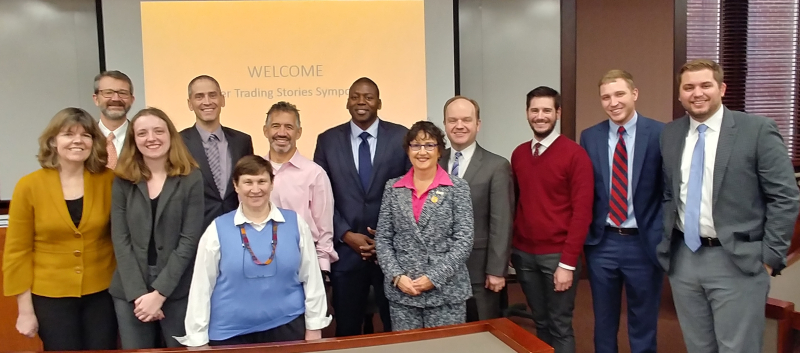
TJLP(InsiderTradingStories2019)

I was thrilled to be with so many wonderful colleagues and students (pictured above) at the Tennessee Journal of Law and Policy‘s symposium at UT Law last Friday.  The symposium, “Insider Trading: Stories from the Attorneys,” featured presentations about famous and not-so-famous insider trading cases.  Presenters included Michael Guttentag (Loyola, Los Angeles), me, Jeremy Kidd (Mercer), Ellen Podgor (Stetson), John Anderson (Mississippi College), Eric Chaffee (Toledo), Kevin Douglas (Scalia), and Donna Nagy (Maurer).  The papers presented highlight a variety of salient issues (including observations about the impact of gender and sexual orientation in specific cases or types of cases) involving or touching insider trading regulation.  They are being published in 2020 by the Tennessee Journal of Law & Policy.

The idea for the symposium came from a Southeastern Association of Law Schools (SEALS) discussion session convened last summer by John and me.  I described it in this post.  Let me or John know if you are working in the insider trading area and would like to join us for our 2020 SEALS discussion group, “Insider Trading: Is It All about the Money?”  The SEALS conference is scheduled to be held July 30 – August 5, 2020.  The discussion is always lively!