Gregg D. Polsky, University of  Georgia Law, recently posted his paper, Explaining Choice-of-Entity Decisions by Silicon Valley Start-Ups. It is an interesting read and worth a look. H/T Tax Prof Blog.  Following the abstract, I have a few initial thoughts:

Perhaps the most fundamental role of a business lawyer is to recommend the optimal entity choice for nascent business enterprises. Nevertheless, even in 2018, the choice-of-entity analysis remains highly muddled. Most business lawyers across the United States consistently recommend flow-through entities, such as limited liability companies and S corporations, to their clients. In contrast, a discrete group of highly sophisticated business lawyers, those who advise start-ups in Silicon Valley and other hotbeds of start-up activity, prefer C corporations.

Prior commentary has described and tried to explain this paradox without finding an adequate explanation. These commentators have noted a host of superficially plausible explanations, all of which they ultimately conclude are not wholly persuasive. The puzzle therefore remains.

This Article attempts to finally solve the puzzle by examining two factors that have been either vastly underappreciated or completely ignored in the existing literature. First, while previous commentators have briefly noted that flow-through structures are more complex and administratively burdensome, they did not fully appreciate the source, nature, and extent of these problems. In the unique start-up context, the complications of flow-through structures are exponentially more problematic, to the point where widespread adoption of flow-through entities is completely impractical. Second, the literature has not appreciated the effect of perplexing, yet pervasive, tax asset valuation problems in the public company context. The conventional wisdom is that tax assets are ignored or severely undervalued in public company stock valuations. In theory, the most significant benefit of flow-through status for start-ups is that it can result in the creation of valuable tax assets upon exit. However, the conventional wisdom makes this moot when the exit is through an initial public offering or sale to a public company, which are the desired types of exits for start-ups. The result is that the most significant benefit of using a flow- through is eliminated because of the tax asset pricing problem. Accordingly, while the costs of flow-through structures are far higher than have been appreciated, the benefits of these structures are much smaller than they appear.

Before commenting, let me be clear: I am not an expert in tax or in start-up entities, so my take on this falls much more from the perspective of what Polsky calls “main street businesses.” I am merely an interested reader, and this is my first take on his interesting paper. 

To start, Polsky distinguishes “tax partnerships” from “C Corporations.”  I know this is the conventional wisdom, but I still dislike the entity dissonance this creates.  Polsky explains: 

Tax partnerships generally include all state law entities other than corporations. Thus, general and limited partnerships, LLCs, LLPs, and LLLPs are all partnerships for tax purposes. C corporations include state law corporations and other business entities that affirmatively elect corporate status. Typically, a new business will often need to choose between being a state-law LLC taxed as a partnership or a state-law corporation taxed as a C corporation. The state law consequences of each are nearly identical, but the tax distinctions are vast.

 As I have written previously, I’d much rather see the state-level entity decoupled from the tax code, such that we would 

have (1) entity taxation, called C Tax, where an entity chooses to pay tax at the entity level, which would be typical C Corp taxation; (2) pass-through taxation, called K Tax, which is what we usually think of as partnership tax; and (3) we get rid of S corps, which can now be LLCs, anyway, which would allow an entity to choose S Tax

As Dinky Bosetti once said, “It’s good to want things.” 

Anyway, as one who focuses on entity choice from (mostly) the non-tax side, I dispute the idea that “[t]he state law consequences of each [entity] are nearly identical, but the tax distinctions are vast.”  From governance to fiduciary duties to creditor relationships to basic operations, I think there are significant differences (and potential consequences) to entity choice beyond tax implications. 

 I will also quibble with Polsky’s statement that “public companies are taxed as C corporations.”  He is right, of course, that the default rule is that “a publicly traded partnership shall be treated as a corporation.I.R.C. § 7704(a). But, in addition to Business Organizations, I teach Energy Law, where we encounter Master Limited Partnerships (MLPs), which are publicly traded pass-through entities. See id. § 7704(c)-(d).

Polsky notes that “while an initial choice of entity decision can in theory be changed, it is generally too costly from a tax perspective to convert from a corporation to a partnership after a start-up begins to show promise.”  This is why those of us not advising VC start-ups generally would choose the LLC, if it’s a close call. If the entity needs to be taxed a C corp, we can convert.  If it is better served as an LLC, and the entity has appreciated in value, converting from a C corp to an LLC is costly.  Nonetheless, Polsky explains for companies planning to go public or be sold to a public entity, the LLC will convert before sale so that the LLC and  C Corp end up in roughly the same place:  

The differences are (1) the LLC’s pre-IPO losses flowed through to its owners while the corporation’s losses were trapped, but as discussed above this benefit is much smaller than it appears due to the presence of tax-indifferent ownership and the passive activity rules, (2) the LLC resulted in additional administrative, transactional, and compliance complexity (including the utilization of a blocker corporation in the ownership structure), and (3) the LLC required a restructuring on the eve of the IPO. All things considered, it is not surprising that corporate classification was the preferred approach for start-ups.

This is an interesting insight. My understanding is that the ability pass-through pre-IPO losses were significant to at least a notable portion of investors. Polsky’s paper suggests this is not as significant as it seems, as many of the benefits are eroded for a variety of reasons in these start ups.  In addition, he notes a variety of LLC complexities for the start-up world that are not as prevalent for main street businesses. As a general matter, for traditional businesses, the corporate form comes with more mandatory obligations and rules that make the LLC the less-intensive choice.  Not so, it appears, for VC start-ups.  

 I need to spend some more time with it, and maybe I’ll have some more thoughts after I do.  If you’re interested in this sort of thing, I recommend taking a look.
FS(CDanielCartoon)

*          *          *

“A lawyer, as a member of the legal profession, is a representative of clients, an officer of the legal system and a public citizen having special responsibility for the quality of justice.

Am. Bar Assoc., Model Rules of Prof. Conduct Preamble ¶ 1 (emphasis added)

Although we business lawyers do not talk about this much–at least not in forums like this–as licensed attorneys, we have an obligation to speak out publicly on matters of justice.  Paragraph 6 of the Preamble to the Model Rules of Professional Conduct offers details on this role.  Among my favorite parts of this paragraph from the Preamble are the following duties that most commonly impact my work:

  • “As a public citizen, a lawyer should seek improvement of the law, access to the legal system, the administration of justice and the quality of service rendered by the legal profession.”
  • “As a member of a learned profession, a lawyer should cultivate knowledge of the law beyond its use for clients, employ that knowledge in reform of the law and work to strengthen legal education.”
  • “In addition, a lawyer should further the public’s understanding of and confidence in the rule of law and the justice system because legal institutions in a constitutional democracy depend on popular participation and support to maintain their authority.”
  • “A lawyer should be mindful of deficiencies in the administration of justice . . . .”

Also, from Preamble ¶7, I note the lawyer’s obligation to “strive to attain the highest level of skill, to improve the law and the legal profession and to exemplify the legal profession’s ideals of public service.”  And Preamble ¶5 notes the lawyer’s duty “to challenge the rectitude of official action.”  Although the Model Rules themselves focus little attention on the lawyer’s role as a public citizen, I have always taken that role quite seriously.

I have been a consistent servant to bench and bar over much of my career, both in Tennessee (where I hold an active license to practice) and in Massachusetts (where I first practiced law and continue to have an inactive law license).  I am proud to say that The University of Tennessee College of Law recently honored me for that service.  This public service work sometimes involves speaking Truth to Power: telling policy makers they have the law wrong or are interpreting it incorrectly or improvidently in context.  This service also comprises (among other things) informing the public about important matters of law and policy as they impact various constituencies, educating oneself about new developments that impact law and law reform, and seeking improvements to the law that best align with desired policy objectives.  Having worked on all of the business entity law reform projects in Tennessee since 2000, my continuously developing skills in these areas have been battle-tested many times.  I have written in this space about some of the battles and issues (see herehere, and here, e.g.), in part as a means of complying with these public-facing duties.

Of course, the licensed attorney who also is a university professor is not exempt from these obligations.  For these lawyers, however, especially those employed by public universities, the number of touch-points with matters of public justice may increase.  I teach primarily in the same subject matters that inform my service to the bench and bar–business law.  However, my work as a law professor encompasses not only business law matters, but also matters relating to the administration of justice in the educational setting both in and outside the College of Law.  In particular, as our campus Faculty Senate President (2010-11) and as a faculty advisor to campus student organizations in and outside the law school over the course of my 18.5 years of law teaching, I have found myself faced with a fascinating array of legal issues that intersect with public policy, public education, and educational policy–legal issues that, for example, implicate “the administration of justice,” raise questions about “the public’s understanding of and confidence in the rule of law and the justice system,” and represent or reveal potential “deficiencies in the administration of justice.”  My obligation to speak out on these matters has required me to “cultivate knowledge of the law” in new areas related to (among other things) law reform and, on occasion, improvements to legal education.

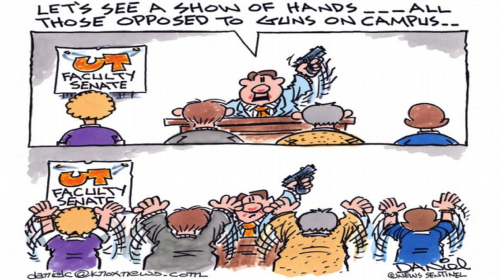
As a Faculty Senate leader, for example, I confronted important legal issues relating to same-sex employee benefits and state-proposed legislation allowing faculty and staff with gun permits to carry their guns on campus.  (The cartoon above portrays me moderating the Faculty Senate debate on the guns-on-campus issue.  Unfortunately, as you can see, the cartoonist failed to accurately depict my gender. He later apologized for the oversight.)  But perhaps most prominently, I have had to enhance and use my knowledge of the First Amendment and free speech precepts in my work as a faculty advisor to Sexual Empowerment and Awareness at Tennessee, the student group that plans, funds, and implements our campus Sex Week, a week-long set of events focusing on sex-positive sex education produced by students for students.  (I will skip here the story of how I came to advise that group, in the interest of space. But let’s just say that the founders of the organization made a compelling case for more and better sex education on our campus and I had some skills and connections that they thought could be of help.) These are but a few examples.  My professional obligation to speak out on legal matters involving justice has been triggered many times over the years.

I also should note here that, for law professors who are licensed to practice, debates on matters of justice not only implicate the lawyer’s professional responsibility but also interact with academic freedom and First Amendment rights.  This post is already getting too long, so I will not get into those matters here. Suffice it to say, they are different protections, but either or both could apply to the public communication of matters involving the administration of justice, law reform, legal education, and public education on matters of legal significance.

The protections of academic freedom and the First Amendment certainly are helpful to university professors of all sorts, including law professors who are licensed to practice.  However, my main purpose in this post is to shed a bit of light on the professional responsibility obligations that a licensed business lawyer has to speak out in various contexts.  While we do not often think of business lawyers as justice and law reform advocates, licensed attorneys practicing business law are bound by the same professional duties that bind all licensed attorneys–including the important obligations a lawyer has as a public citizen responsible for the quality of justice.  For a business law professor who is licensed to practice law, these obligations extend beyond teaching and scholarship and into the law professor’s public, university, and campus service.  I submit that this makes the lives of business lawyers–like all lawyers–challenging.  Yet, I can personally testify that the obligation to speak also can be both enlightening and rewarding.

Wenqian Huang at the Bank for International Settlements recently posted a new version of her working paper: Central counterparty capitalization and misaligned incentives.  Here’s its abstract:

Financial stability depends on the effective regulation of central counterparties (CCPs), which must take account of the incentives that drive CCP behavior. This paper studies the incentives of a for-profit CCP with limited liability. It faces a trade-off between fee income and counterparty credit risk. A better-capitalized CCP sets a higher collateral requirement to reduce potential default losses, even though it forgoes fee income by deterring potential traders. I show empirically that a 1% increase in CCP capital is associated with a 0.6% increase in required collateral. Limited liability, however, creates a wedge between its capital and collateral policy and the socially optimal solution to this trade-off. The optimal capital requirements should account for clearing fees.

For those who understand the different incentive structures associated with member versus investor owned clearinghouses, some of the model’s finding will be unsurprising: in the absence of capital requirements (such as in the U.S.), member-owned clearinghouses hold more capital than investor-owned institutions.  This has important public policy implications.  Nevertheless, as I noted in an earlier post, there has been a surprising lack of attention to clearinghouse ownership structure in the global conversations that have been taking place for several years now about what to do with a distressed clearinghouse (the problem of clearinghouse recovery and resolution). 

A welcome recent development was the attention to ownership structure in the Financial Stability Board’s November 2018 consultation paper on “Financial resources to support CCP resolution and the treatment of CCP equity in resolution.”  And I did a jig as I read the following language in the joint response letter to this consultation by The International Swaps and Derivatives Association, The Futures Industry Association, and The Institute of International Finance (who collectively “represent the largest number of participants in national and global clearing, banking and financial markets”):

Current legislative proposals on resolution and CCP [clearinghouse] rulebook provisions disproportionately allocate the burden of recovery and resolution on clearing participants in general and clearing members in particular.  On the other hand, in recovery from large defaults, the CCP will solely lose its SITG [skin in the game – any capital the clearinghouse has put in the default waterfall].  While profits in business are privatized by the CCP equity holders, losses in recovery and resolution will be socialized to clearing participants and in extremis the tax payer.  It is inappropriate and in contrast to basic corporate finance principles that clearing participants are asked to “bail out” a CCP yet future profits that the CCP would not have had without the support from participants go to the shareholders of the CCP.

AGREED!  Let’s just be sure to apply such sound thinking to all areas of global financial markets!


I’ve previously posted that judges sometimes suggest that markets are efficient to a degree that borders on the mystical.*  But on the opposite end of the spectrum, it often seems as though Congress does not believe in efficient markets at all.  For example, the PSLRA’s “crash damages” provision contains the implicit assumption that when negative information comes to light, it will take 90 days for the stock to appropriately internalize it.  15 U.S.C. §78u-4(e)(1).  Dodd Frank requires all public companies to disclose information on their compliance with the Federal Mine Safety & Health Act (I amuse myself by highlighting for my class the “mine safety disclosure” in the Starbucks 10-K, for example), even though that information is public via other channels.  (Spoiler alert: the disclosures apparently make a difference, so Congress may be right!) 

And most recently, we have the Improving Corporate Governance Through Diversity Act of 2019, introduced by Representative Meeks in the House and Senator Menendez in the Senate.

These identical bills would require public companies to disclose “Data, based on voluntary self-identification, on the racial, ethnic, and gender composition of the board of directors of the issuer;  nominees for the board of directors of the issuer; and the executive officers of the issuer.”  The bills would also require disclosure of veteran status, and any policies for promoting diversity among boards of directors and corporate executive officers.  And then, oddly, the bills would require the Commission’s Director of the Office of Minority and Women Inclusion to publish “best practices with respect to compliance with this subsection,” in consultation with a newly established advisory council of issuers and investors (I say “oddly” because – they want to publish best practices for disclosing diversity information?  I’m guessing that’s not what they’re going for, but that’s how it’s drafted.)

In any event, these bills represent something of a challenge to the efficient markets hypothesis because in most (if not all) cases, the racial, gender, etc characteristics of board members, board nominees, and top officers is readily available to investors.  What may not be available, of course, are policies for promoting diversity, absent a rule requiring disclosure – which it turns out, we already have, at least with respect to director nominations.  See 17 CFR § 229.407(c)(2)(vi); see also Developments on Public Company Disclosures Regarding Board and Executive Diversity.

Of course, the reality is these “disclosure” rules are not about disclosure at all; they’re about substantively pressuring companies to diversify their management teams – which explains, I assume, the bit about “best practices”; the goal is to craft guidelines for best practices in hiring, not best practices in disclosure.  (Relatedly, Congress has begun to express concern about diversity in finance more generally.)  For this reason, it is not at all surprising that the Chamber of Commerce has firmly endorsed this legislation, viewing it (explicitly) as a less-intrusive alternative to mandated diversity requirements, such as the ones adopted by California.

And yeah, there’s nothing unusual about securities disclosure requirements functioning in this manner, it’s just that you’d usually expect those requirements to force disclosure of things investors don’t already know.

It seems to me that a much more helpful – and more radical – proposal would be to force disclosure of things investors don’t know, such as general information about diversity throughout the company (a proposal made most recently by Jamillah Williams).  This kind of data is usually confidential, though it is reported to the EEOC.  Interested parties can request it via FOIA for firms that contract with the government, and companies like Oracle and Palantir have fought fierce – and ultimately losing – battles to keep it secret, ostensibly because diversity data is a “trade secret,” but more likely because the true numbers are embarrassingThat’s information that is much more likely to enlighten.

*a critique, among others, that I elaborate upon in my forthcoming essay, Fact or Fiction: Flawed Approaches to Evaluating Market Behavior in Securities Litigation

The Business Law Clinic (Clinic) is part of a comprehensive curriculum in transactional law that is comprised of the Clinic, the Business Law Center (Center) and certificate and degree conferring programs. The Clinic, established in 1999, offers students a unique opportunity to develop essential lawyering skills in a professional, interactive environment. Loyola seeks a dynamic Clinic Co-Director/Center Executive Director to work collaboratively with the Clinic Co-Director and the Director of the Business Law Center to provide strategic leadership, teach the Clinic class, supervise student work with clients, and to assist the Center Director in the development of the business and transactional law curriculum, scholarly conferences and programming.

The Co-Director/Executive Director will serve as the Randy L. and Melvin R. Berlin Clinical Professor of Law that is a presumptively renewable long-term contract position with voting privileges within the Loyola University Chicago School of Law. Loyola University Chicago School of Law is a student-focused law center inspired by the Jesuit tradition of academic excellence, intellectual openness, and service to others. Our mission is to educate diverse, talented students to be responsible leaders in a rapidly changing, interdependent world, to prepare graduates who will be ethical advocates for justice and the rule of law, and to contribute to a deeper understanding of law and legal institutions through a commitment to research, scholarship and public service.

The Clinic is a focal point of student development of essential lawyering skills in a professional, interactive live-client environment. Students work under the direct supervision of the Co-Directors to represent entrepreneurs and small business owners, as well as individuals who are seeking legal assistance with not-for-profit organizations. The not-for-profit clients represented by the Clinic include organizations that encompass animal welfare, sports clubs, museums, community organizations, religious organizations, etc. The for-profit clients are entrepreneurs, inventors, service providers, and web-based business owners who are involved in a variety of industries. The Clinic Co-Directors work collaboratively to provide supervision and professional oversight of the work completed by law student clinicians in addition to teaching the Clinic classroom component. Business Law Center The Center is the hub for School of Law’s curriculum, research and programming related to business and transactional law. The Center is led by a nationally and internationally renowned Director that is a full-time tenured faculty member along with other esteemed scholars in business law. The Center Director works in close collaboration with the Business Law Clinic to ensure that students have access to a full and wide breadth of educational opportunities and programs.

The Center is a part of larger initiatives across the University, the Quinlan School of Business and the Chicago community that seek to implement Loyola’s social justice mission as it relates to providing access to business ventures and initiatives to underserved and minority communities. The Center includes the Institute for Investor Protection, The Rooftops Project, the JD Certificate in Transactional Law, and the Master of Laws (LLM) in Business Law degree.

Position Essential Duties and Responsibilities: The duties and responsibilities of the Co-Director/Executive Director include, but are not limited to the following: Strategic planning for the future direction of the Clinic for continued growth and development; Serve as the external advocate and collaborator for the Clinic in its work with the Center, the Quinlan School of Business and other community partnerships; Assist in the administration of the Clinic and the development of the Center; Supervision of law students, summer interns, and fellows in skill development and client representation including supervising students in client meetings, drafting contracts and other legal documents, conducting legal research, determining client legal issues, and advising and counseling clients; Teach and assist in the development of curriculum as part of the classroom component for the Clinic, the Transactional Law Certificate and the LLM in Business Law; Mentor and act as faculty advisor to student members of the Business Law Society; Assist the Center Director in organizing conferences, workshops and seminars in business and transactional law; and Engaging in scholarly research (preferred but not required).

Qualifications: The candidate must have the ability to engage successfully and work collaboratively with a diverse group of stakeholders including the Clinic Co-Director, the Center Director, students, clients, administrators, and community members. Excellent judgment, including sensitivity to the needs of clients, cultural nuances and confidential information. A commitment to serving not-for-profit clients and underserved and minority communities. Experience as a clinician or former clinical teaching fellow in a business/transactional law clinic or as a lawyer with significant practice experience in business law. Ability to work independently with minimal supervision and as part of an interprofessional team. Demonstrated commitment to detail and a process-oriented approach to supervision of clinic work. Demonstrated ability to organize and manage conferences, workshops and seminars. Flexible work attitude, ability to work effectively in a fast-paced environment with a small staff and frequent student turnover (due to semester long courses and graduation). Bachelor’s degree and a JD from an ABA accredited law school degree required. Admission/eligibility for admission to the Illinois Bar. Adept user of internet, case management systems, e-mail and other office automation systems.

Selection Process: Review of applications will begin March 1, 2019 and continue until the position is filled. The position will begin on July 1, 2019. Applicants are to submit (1) a letter of interest describing the candidate’s reasons for applying for the position, (2) a curriculum vitae, (3) samples of scholarly or other written work if available, and (4) the names and contact information of three individuals prepared to provide professional references. Applications should be submitted through Loyola’s Careers website at https://www.careers.luc.edu/postings/10391. Inquiries should be directed to Professor Steven A. Ramirez, Director of Business Law Center, Loyola University Chicago, 25 E. Pearson, Chicago, IL, 60611, sramirez3@luc.edu.

Loyola University Chicago is an Equal Opportunity/Affirmative Action employer with a strong commitment to hiring for our mission and diversifying our faculty. As a Jesuit Catholic institution of higher education, we seek candidates who will contribute to our strategic plan to deliver a Transformative Education in the Jesuit tradition. To learn more about LUC’s mission, candidates should consult our website at www.luc.edu/mission/. Applications from women, minorities, veterans, and persons with disabilities are especially encouraged and preference will be given to candidates who can mentor female law students and those from communities that are underrepresented in the legal profession. Candidates are encouraged to consult our website to gain a clearer understanding of Loyola’s mission at www.luc.edu/mission/index.shtml and our focus on transformative education at www.luc.edu/transformativeed/.

Da Lin recently posted Beyond Beholden, a paper tackling a new issue in director independence.  Although most corporate law focuses on whether there is a stick a controlling shareholder can use to punish directors if they fail to follow orders, Lin looked to see if she could see any carrots a controlling shareholder could use to lead a director around.  This bit from the article captures it nicely:

Corporate governance scholarship focuses extensively on the incentives generated by the controlling shareholder’s ability to retaliate against insubordinate directors. What the literature overlooks, however, is that directors may also be influenced by the prospect of reward. What happens when the controlling shareholder is not angered but instead pleased?

The result, it turns out, is often new opportunities or future benefits from the controlling shareholder to the favored directors. Controlling shareholders can direct their resources or those owned by the controlled company in ways that reward friends.

Lin’s article looks at how controlling shareholders may reward ostensibly independent directors by appointing them to other lucrative board positions under their control.  A director who approves a sale of the company may soon find herself out of a six-figure job when the company gets absorbed through a merger.   In theory this fact cuts against the argument that the independent director simply approved the transaction to please a controlling shareholder.  If the punishment a controlling director could apply would simply be the loss of the board seat–approving the sale has the same result.  Lin looks further than others and sees that an independent director might also be motivated by the prospect of future board seats at other companies also controlled by the controlling stockholder.  To get a sense about how this works, she looked at recent freezeouts with Delaware targets.  Her research found that controllers often reappoint cooperative directors to other firms:

I find that some controlling shareholders regularly re-appoint cooperative “independent” directors to executive and board positions at other firms under their control.  36 percent of the controlling shareholders in my sample have re-appointed at least one nominally independent director in this way. Illustrating this point from a different angle, 20 percent of the directors in my data have served on the board or as an executive in at least two different companies controlled by the same controlling shareholder. In many cases, the director was independent in the conventional sense when he negotiated the freezeout, meaning that he had no ongoing or prior connections with the controller at that time. But after the freezeout closed, he obtained a job at another company that the controlling shareholder controlled. From a director’s perspective, these findings mean that he can obtain future benefits from the controlling shareholder if he acts in the controlling shareholder’s interests.

She closes by highlighting the implications for doctrine focused strictly on evaluating whether supposedly independent directors are “beholden” to controllers:

Judges and scholars miss half the story when they view independence solely through the lens of beholdenness and retribution.  I show that controlling shareholders can and do form repeat relationships with the nominally independent directors who serve on their boards, and the prospect of this patronage can compromise those directors’ ability to prevent controlling shareholder opportunism.

I saw Lin present the paper in 2018 at the National Business Law Scholar’s Conference.  It changed how effective I thought the “beholden” standard may be as well as how to think about special litigation committees.  She was also kind enough to let me steal some slides from her presentation for when I taught director independence.  Some of the graphics in the paper may help students or executives get a real sense about these ties.  For example, this illustration shows webs of interconnected companies and director relationships:

Beholden Networks


She will be joining University of Richmond School of Law in the fall.

Boston University School of Law, in conjunction with the University of Illinois College of Law, UCLA School of Law, and the University of Richmond School of Law, invites submissions for the Seventh Annual Workshop for Corporate & Securities Litigation. This workshop will be held on Friday, September 27 and Saturday, September 28, 2019 at Boston University School of Law.

Overview

This annual workshop brings together scholars focused on corporate and securities litigation to present their scholarly works. Papers addressing any aspect of corporate and securities litigation or enforcement are eligible, including securities class actions, fiduciary duty litigation, and comparative approaches. We welcome scholars working in a variety of methodologies, as well as both completed papers and works-in-progress.

Authors whose papers are selected will be invited to present their work at a workshop hosted by Boston University.  Hotel costs will be covered.  Participants will pay for their own travel and other expenses.

Submissions

If you are interested in participating, please send the paper you would like to present, or an abstract of the paper, to corpandseclitigation@gmail.com by Friday, May 24, 2019. Please include your name, current position, and contact information in the e-mail accompanying the submission.  Authors of accepted papers will be notified by late June. 

Questions

Any questions concerning the workshop should be directed to the organizers: David Webber (dhwebber@bu.edu), Verity Winship (vwinship@illinois.edu), Jim Park (James.park@law.ucla.edu), and Jessica Erickson (jerickso@richmond.edu).

Westlaw recently posted an interesting Massachusetts case at the intersection of criminal law and business law.  Massachusetts (the Commonwealth) sought to commit a defendant as a sexually dangerous person. Commonwealth v. Baxter, 94 Mass. App. Ct. 587, 116 N.E.3d 54, 56 (2018). The defendant was (at the time) an inmate because of a probation violation related to offenses of rape of a child and other crimes.  The Commonwealth retained Mark Schaefer, Ph.D., for an expert opinion, and Dr. Schaefer concluded that the defendant was, under state law, a sexually dangerous person. The hearing judge found probable cause to think the defendant was a sexually dangerous person and had him temporarily committed for examination by two qualified examiners, as required by law. Dr. Joss determined that the defendant was sexually dangerous, and Dr. Rouse Weir determined he was not.

Here’s where the business law part comes in: 

After the reports of the qualified examiners were submitted to the court, the defendant moved to exclude Dr. Joss from providing evidence at trial, or in the alternative, to appoint a new qualified examiner to evaluate the defendant. As grounds therefor, the defendant alleged that Dr. Joss and Dr. Schaefer were both among six “member/partners in Psychological Consulting Services (‘PCS’), a limited liability corporation [LLC] based in Salem, Massachusetts.” He argued that the members of the LLC have a fiduciary duty of loyalty to the company and are necessarily “dedicated to [its] financial and professional success.” Because Dr. Schaefer and Dr. Joss were “intertwined both professionally and financially,” through their partnership in PCS, the defendant claimed that their relationship “create[d] a conflict of interest and raise[d] a genuine issue of Dr. Joss’s impartiality in his role as a [qualified examiner].” The defendant offered no affidavit in support of his motion, and did not request an evidentiary hearing.

Commonwealth v. Baxter, 94 Mass. App. Ct. 587, 116 N.E.3d 54, 56 (2018) (emphasis added).  A substitute expert was substituted for Dr. Joss, and that expert determined that defendant was not sexually dangerous, and the Commonwealth appealed. 
 
In addition to the obvious error of calling an LLC a corporation (this is an error was in defendants allegations) and LLC members “partners”, there is more here.  
 
The court noted that the expert reported was not admitted in the lower court “based on ‘the appearance of an inappropriate and avoidable conflict,’” stating further the lower court judge even stated expressly, “This isn’t about actual bias.”  The court then states that “where a party seeks to disqualify an attorney for a conflict of interest, the mere appearance of impropriety without attendant ethical violations is insufficient to support an order of disqualification.” The defendant was arguing that the “partnership” (meaning membership in the LLC) worked to incentivize Dr. Joss to have the same conclusion as Dr. Schaefer so there would be no “public perception” that Dr. Schaefer was “proven wrong.” Id.
 
The court then explains that this is not a situation where the “reliability or validity” of the expert’s methods or experience were in question. As such, “In the absence of evidence suggesting that the reliability of the witness’s testimony is in doubt or that the witness is under an actual conflict of interest, the remedy for the defendant’s concerns is in forceful cross-examination and argument, not in exclusion.” Id. at 59. 

This is interesting to me.  It seems to me this is not like traditional attorney conflicts, where we want to impute knowledge of one attorney to another in the same firm because the knowledge of the first attorney could harm the client of the second.  This case is more analogous to getting a second opinion from a doctor in the same practice (or maybe network). It’s possible that the second doctor could be influenced by the first, but it’s not clearly the case. 
 
That said, I think there is something to the idea that members of a firm might have a bias in favor of the other members of the firm. But I appreciate the court’s point that it needs to be more than a mere association of the doctors.  The fiduciary duty claim here fails, in my view, without more because there is no showing that the firm benefits from a particular outcome. That is, in any given case, multiple qualified experts can come to different conclusions (as this case makes clear) and that’s plainly acceptable.  
 
Separately, this case also underscores how close a call such things are. Various experts came to different conclusions, and to some degree, at least in this case, the luck of the draw (of experts) is outcome determinative for both the Commonwealth and the defendant. I am sure there are cases where that’s less true, in favor of either side, but I suspect it’s close a lot of the time.  
 
Ultimately, this seems like the court got the rule right for future cases, though I am also not entirely clear why the order of discharge cannot stand. That is, it seems to me that just because the lower court ordered another expert review, there is no showing that the replacement expert was somehow not qualified or proper in their report. At least to the extent the standard was unclear, I might have been inclined to let the prior decision stand because I’d apply the same standard of review to all the experts in the case before excluding their work.  Perhaps the reviewing court was concerned that the lower court was expert shopping or something similar, but that’s not clear.  Regardless, it’s usually interesting when entity law works its way into criminal law. 
 

A bunch of us sensed that it was coming.  I raised the question in an October 8, 2018 post here.  Now, it has actually happened.

Tesla Chief Executive Officer Elon Musk has finally caught the negative attention of the U.S. Securities and Exchange Commission (SEC) with yet another of his reckless tweets.  The WaPo reported earlier tonight that “[t]he Securities and Exchange Commission . . . asked a federal judge to hold Tesla CEO Elon Musk in contempt for violating the terms of a recent settlement agreement . . . .”  That settlement agreement, as readers will recall, relates to SEC allegations that Musk lied to investors when he posted on Twitter that he had secured the funding needed to take Tesla private.  The settlement agreement provides for the review and pre-approval of Musk’s market-moving public statements.

Ann Lipton and I, as BLPB’s resident fraud mongers, have been following the Musk affaire de Twitter for a number of months now.  (See, e.g., here, here, and here.)  Based on our prior posts, it seems clear the world was destined for this moment–a moment in which the SEC not only catches Musk in a tweeted misstatement but also can prove that the tweet was not pre-approved, as required under the terms of the settlement agreement.  The WaPo article notes evidence that breaches of the agreement may be the rule rather than the exception.  (Why does that not surprise me?)

Let’s see where this goes next . . . .