Back in May, I noted my dislike of the LLC diversity jurisdiction rule, which determines an LLC’s citizenship “by the citizenship of each of its members” I noted, 

I still hate this rule for diversity jurisdiction of LLCs.  I know I am not the first to have issues with this rule. 

I get the idea that diversity jurisdiction was extended to LLCs in the same way that it was for partnerships, but in today’s world, it’s dumb. Under traditional general partnership law, partners were all fully liable for the partnership, so it makes sense to have all partners be used to determine diversity jurisdiction.  But where any partner has limited liabilty, like members do for LLCs, it seems to me the entity should be the only consideration in determing citizenship for jurisdiction purposes. It works for corporations, even where a shareholder is also a manger (or CEO), so why not have the same for LLCs.  If there are individuals whose control of the entity is an issue, treat and LLC just like a corporation. Name individuals, too, if you think there is direct liability, just as you would with a corporation. For a corporation, if there is a shareholder, director, or officer (or any other invididual) who is a guarantor or is otherwise personally liable, jurisdiction arises from that potential liability. 
I am reminded of this dislike, once again, by a recently available case in which an LLC is referred to as a “limited liability corporation” (not company).  

Dever v. Family Dollar Stores of Georgia, LLC, No. 18-10129, 2018 WL 5778189, at *1 (11th Cir. Nov. 2, 2018). This is so annoying. 
 
The LLC in question is Family Dollar Stores of Georgia, LLC, which involved a slip-and-fall injury in which the plaintiff was hurt in a Family Dollar Store. Apparently, that store was located in Georgia. The opinion notes, though, that the LLC in question was “organized under Virginia law with one member, a corporation that was organized under Delaware law with its principal place of business in North Carolina.” Id. 
 
It seems entirely absurd to me that one could create an entity to operate stores in a state, even using the state in the name of the entity, yet have a jurisdictional rule that would provide that for diversity jurisdiction in the state where the entity did business (in a brick and mortar store, no less) where someone was injured.  (Side note: It does not upset me that Family Dollar Stores of Georgia, LLC, would be formed in another state — that choice of law deals with inter se issue between members of the LLC. )  
 
I’ll also note that I see cases dealing with LLC diversity jurisdiction incorrectly referring to LLCs as “limited liability corporations.” For example, these other cases also appeared on Westlaw within the last week or so: 

  • Util Auditors, LLC v. Honeywell Int’l Inc., No. 17 CIV. 4673 (JFK), 2018 WL 5830977, at *1 (S.D.N.Y. Nov. 7, 2018) (“Plaintiff … is a limited liability corporation with its principal place of business in Florida, where both of its members are domiciled.”).
  • Thermoset Corp. v. Bldg. Materials Corp. of Am., No. 17-14887, 2018 WL 5733042, at *2 (11th Cir. Oct. 31, 2018) (“Well before Thermoset filed its amended complaint, this court ruled that the citizenship of a limited liability corporation depended in turn on the citizenship of its members.”).
     
    ALLENBY & ASSOCIATES, INC. v. CROWN “ST. VINCENT” LTD., No. 07-61364-CIV, 2007 WL 9710726, at *2 (S.D. Fla. Dec. 3, 2007) (“[A] limited liability corporation is a citizen of every state in which a partner resides.”).
Coincidence? Maybe, but it’s still frustrating. 

 

Today, in honor of my Dad, my father-in-law, my cousin, my administrative assistant, many friends, and others who have honored us with their military service, I am posting a link to a recent episode of The Home Team with Jared Allen’s Homes for Wounded Warriors.  The episode features an interview by my former student, Betty Rhoades, of one of my new military buddies, Captain Chris Davis, USMC.  Chris is a 3L at UT Law and a super guy.  He founded a nonprofit last year, Vols for Vets, of which I (and others) are very proud.

Thanks to all who have served in our armed forces for helping to protect us from enemies far and near.  Your service is to be honored and cherished.  We thank you for our lives and our freedom.

ComplianceNetLogo

Friend of the BLPB Josephine Nelson informs us of the following:

The second-annual ComplianceNet conference will take place on June 3-4, 2019. Villanova University Charles Widger School of Law and its Girard-diCarlo Center for Ethics, Integrity and Compliance will host the conference. Like the highly successful inaugural conference at UC Irvine in 2018, this conference will allow scholars from across disciplines and different legal and regulatory topics to exchange research and explore connections for collaboration.

The timing of this year’s conference is designed to follow on the heels of the Law & Society meeting in nearby Washington, D.C. If you are already headed to Law & Society, Villanova is a short train-ride away and easily accessible by public transportation. Regardless of whether you will be attending Law & Society, Villanova is in a beautiful location right outside Philadelphia, easily serviced by major international airports (Philadelphia (PHL), Newark (EWR), Baltimore (BWI), two more in NYC, and two more in DC); 90 minutes from NYC; and two hours from D.C.

The theme of this year’s conference is Business Ethics, although we welcome additional papers discussing compliance across diverse settings. This year’s theme seeks to engage the question of how to run ethical companies, and how to encourage ethical behavior within organizations. The conference welcomes attempts to explore the strengths and limitations of various approaches, to identify how measurement strategies have shaped practices, and to understand how we can improve outcomes, for instance through new technology and combining methods. Submissions do not need to align with the meeting theme, but we encourage you to consider relating to it. The conference is also open to scholars and other experts who want to attend without presenting a paper.

The conference will host a business meeting of ComplianceNet, during which members may discuss future activities.

To register for the conference either as a presenter or attendee, please fill out the form by following this link. The URL is https://www.eventbrite.com/e/the-second-annual-compliancenet-conference-tickets-50784542935.

For individual papers, please submit the paper title and abstract (up to about 200 words). For panels (3 papers minimum with a maximum of 5 per panel), please submit an integrative statement explaining the panel (approximately 200 words), the titles of each paper and their authors, and an abstract for each paper (approximately 200 words). At our website, ComplianceNet.org, there is also a form to nominate papers for awards. Papers may be considered for awards whether they come through the nomination link or are presented at the conference.

The early registration discount deadline to submit papers and panels is January 25, 2019. The regular registration deadline for papers and panels is February 22, 2019. The registration deadline to attend without a paper or panel (as space available) is March 29, 2019. Registration for the conference includes the yearly membership in ComplianceNet. If you have questions regarding the call for proposals or about the conference, please contact Benjamin van Rooij (bvanrooij@law.uci.edu).

 . . . 

—For conference updates, please refer to the ComplianceNet website at www.ComplianceNet.org 

Sounds like a great event.  I note (and informed Josephine) that this conference overlaps with the Impact Investing Legal Working Group (IILWG)/Grunin Center for Law and Social Entrepreneurship’s 2019 Conference on “Legal Issues in Social Entrepreneurship and Impact Investing – in the US and Beyond,” scheduled for June 4-5 at the NYU Schools of Law in NYC.  More on that conference later.  In any event, it looks like there is a lot to do up North after the Law and Society Association conference!  One could spend the whole week away presenting papers. . . .

Jonathan Macey and Joshua Mitts have just posted an intriguing new article, Asking the Right Question: The Statutory Right of Appraisal and Efficient Markets, regarding calculation of value for the purposes of an appraisal action.

As I’ve posted about previously (here and here), Delaware is in the midst of a judicial reinterpretation of its appraisal statute, placing new emphasis on market pricing for determining the value of publicly traded stock.  Currently, one open question is whether “market” pricing refers to the deal price, assuming the process was relatively clean, or the unaffected trading price of the stock. 

Macey & Mitts begin by agreeing with VC Laster’s opinion in Verition Partners Master Fund, Ltd., et al. v. Aruba Networks, Inc., that valuation should be based on the trading price, and not the deal price, and their discussion after is where things get interesting.

First, they point out that apparently, Delaware courts only will consider trading price relevant to an appraisal action if price is efficient.  But they argue that even prices of stock that trades inefficiently would serve as a better indicator of value than more traditional calculations like discounted cash flow, in part because there are many different types of “inefficient” markets and some will process the most important information about the company and produce a reasonably accurate price – perhaps with the judge adjusting for any information that was not assimilated.  The test for market efficiency in an appraisal action is, in their view, too demanding.

Part of the reason I find this argument so interesting is that it mirrors the same kind of arguments we’ve been having in the fraud on the market space for over a decade, namely, how efficiently must the stock trade before plaintiffs are entitled to the fraud on the market presumption?  In that context, just like Mitts and Macey, Donald Langevoort (among others) has argued that courts have demanded too high a standard of efficiency when a lesser one would do for the purposes of the inquiry – a point that the Supreme Court seems to have found persuasive.  Of course, in the Section 10(b) context, we’re talking about informational efficiency; Mitts and Macey’s argument depends on markets being efficient for fundamental value, or at least more accurate than other types of analysis.

The second argument that Macey and Mitts make is that the stock price reaction of the acquirer may indicate whether the deal price was too high, in which case, any appraised value should be lower.  I.e., if the acquirer’s stock price drops in response to announcement of the deal, that would suggest that the market believes the target was overvalued.  That’s a really clever suggestion, though I do wonder about their argument that the analysis holds even for private targets – we might legitimately ask whether the market knows enough about private targets to make an informed assessment of the appropriateness of the deal price and the target’s effect on the acquirer’s value.

Of course, overall, their argument would push Delaware’s law even further toward eliminating appraisal for all but the most egregious cases; in recent years, many scholars have argued that appraisal can be used as a kind of substitute for a broken system of fiduciary duty litigation.  Macey and Mitts believe that if fiduciary litigation is broken, it should be fixed, rather than substituting in a different cause of action to do that work.

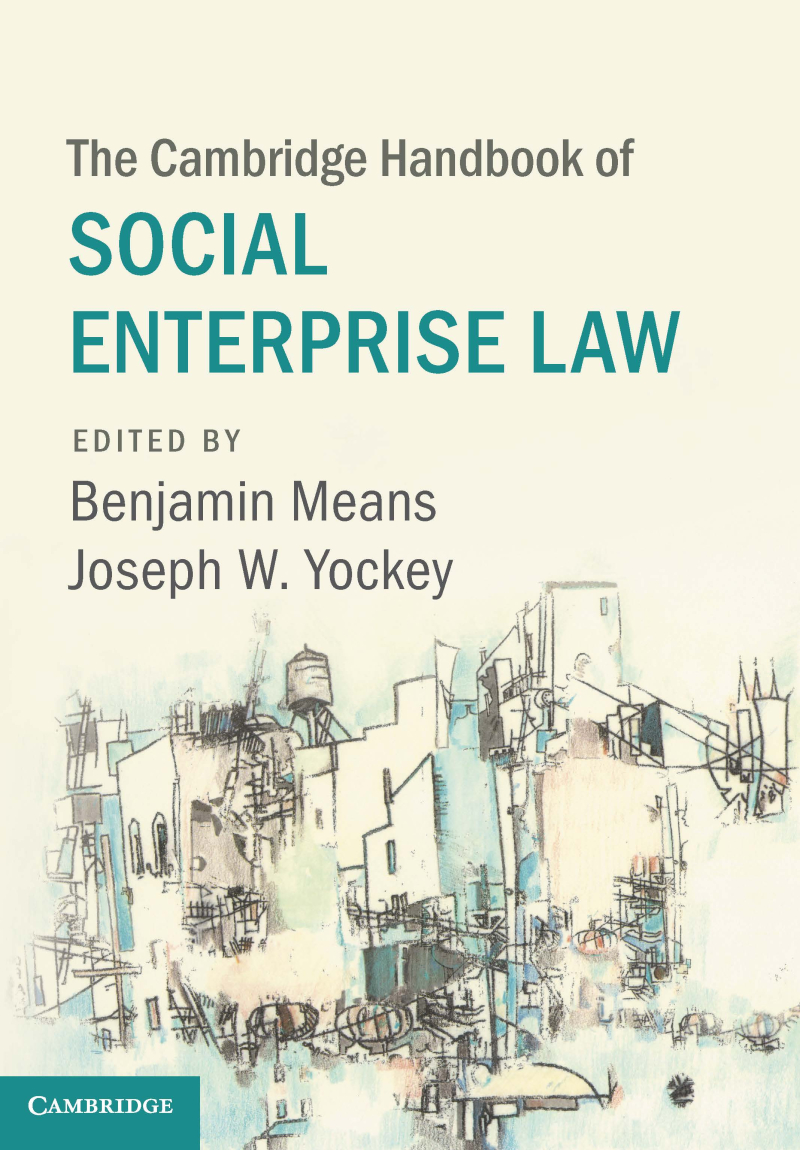
The Cambridge Handbook of Social Enterprise Law, edited by Ben Means (South Carolina) and Joe Yockey (Iowa) is at the printers and should be ready for orders in early 2019. 

My fellow BLPB editor Joan Heminway and I both have chapters in the book, along with many others. 

The introduction is posted on SSRN, for those who are interested. Also, editor Ben Means has many talents, as he did the cover artwork below as well.

The Cambridge Handbook of Social Enterprise Law_Cover

The Theranos collapse and Elizabeth Holmes’ indictment makes me wonder about what investor biases may have played a role in allowing Theranos to operate as long as it did.  In an op-ed in The Hill, Ann McGinley and I point out that it might have been her seemingly deliberate projection of an idealized masculinity:  

Presenting the right identity may unlock millions in funding and bypass close, critical reviews. Consider Elizabeth Holmes, the recently indicted founder of Theranos. Flanked by a board sporting retired military officers, she presented herself as a masculinized take on the Steve Jobsian ideal — aping his wardrobe choices with a black turtleneck sweater.

Her costume was often complimented by a blazer’s broad shoulders, and she spoke with a startlingly deep voice.  The presentation exuded a hard-charging masculinity, allowing backers to see her as a Jungian fantasy of Jobs’ second coming. 

The op-ed ties back to the bigger law review article discussing the ways in which a bias toward favored identities causes founders to perform their and their entities’ identities to please sources of capital. 

Gender bias (and other forms of implicit bias) likely does more than just raise capital costs for founders.  It also seems to saddle venture capital funds with risks.  The same techniques legitimate founders may embrace to raise capital might also be used by fraudsters looking to increase their odds on a con.  In essence, uncorrected implicit biases may make it easier to dupe VCs into buying into frauds.

There may be ways to mitigate this risk. Implementing some blind or purely paper-based screening process to vet initial ideas without in-person presentations may provide a check similar to the techniques used in orchestral auditions. After all, research has led Cass Sunstein and others to conclude that job interviews do more harm than good.  Getting a diverse committee to consider and approve investments might also also provide another check because a diverse group might not share the same biases.  Of course, some biases are strong and widely shared.  For example, investors generally tend to prefer investments pitched by masculine voices.  

Ultimately, I don’t know how to perfectly solve the problem.  At the least, being aware of it and proceeding deliberately may allow some funds to reduce the role bias plays in their decisions.


With just a few hours left to vote, I am taking this opportunity to ask you, if you have not already, to vote.  Please. It is our opportunity to be heard.

So often people complain about money in politics, and I agree that raises concerns. But we always have the power to choose. We, the voters, always have the final say. We can impose term limits any time we want, by voting people out.  If it is really a concern for us, we can overcome money in politics by choosing those who reject corporate interests. Either way, it is up to us. So, if you haven’t already, please, please vote. 

And if you already voted, thank you.  Good work.  

By the time many of you read this, Election Day 2018 will be upon us (or even over).  I have had elections on my mind for some time now–elections of the political and corporate kind.  As a result of an invitation to participate in last week’s symposium on women and corporate governance hosted by the George Washington Law Review (“Women and Corporate Governance: A Conference Exploring the Role and Impact of Women in the Governance of Public Corporations), my election-oriented thoughts somehow became infused with gender reflections . . . .

1992 was dubbed the political “Year of the Woman.” The appointment of Clarence Thomas to the U.S. Supreme Court in 1991 after hearings focused on sexual harassment allegations and revelations of Bill Clinton’s extramarital sexual conduct during his first campaign for election as U.S. President were and are credited with the record number of women elected to federal legislative positions in 1992. “When the ballots were counted, America had elected a record-breaking four women as senators and 24 women as representatives to Congress.” Li Zhou, The striking parallels between 1992’s “Year of the Woman” and 2018, explained by a historian, VOX, Nov 2, 2018, https://www.vox.com/2018/11/2/17983746/year-of-the-woman-1992 (interview with Georgetown University professor Michele Swers).

2018 has again been a hallmark year for women in politics—and in the public company boardroom. The #MeToo movement (and along with it yet another U.S. Supreme Court appointment tinged with allegations of sexual misconduct and a U.S President with a history of philandering and lechery) undoubtedly has been a factor in both the record-breaking number of women seeking political office in 2018 and a simultaneous renewed interest in gender diversity on corporate boards of directors. Perhaps this is not surprising. #MeToo largely emanates from the abuse of gendered power in government and business firms (which together are responsible for the fundamental regulation of our economic and social lives).

Given these parallels, there may be some value to looking at both the political and business management reactions to #MeToo.  Specifically, I am interested in comparing, contrasting, and reflecting on the gender effects of the #MeToo movement on public company board composition in relation to the gender effects of the #MeToo movement on the composition of legislative bodies. I have determined to write a symposium essay along those lines for the George Washington Law Review.  Your reflections and ideas on content are welcomed.