
On of the many interesting things discussed during the social enterprise law workshop at Notre Dame Law School was the “FairShares Model.” Nina Boeger (University of Bristol-UK) brought the model to the group’s attention, and the model was new news to me.

The FairShares Model was “created during a research programme on democratising charities, co-operatives and social enterprises involving academics at Sheffield Hallam University and Manchester Metropolitan University in the UK.”

The FairShares Model cites the “Social Enterprise Europe Ltd” when noting that social enterprises “aim to generate sustainable sources of income, but measure their success through:

  • Specifying their purpose(s) and evaluating the impact(s) of their trading activities;

  • Conducting ethical reviews of their product/service choices and production/consumption practices;

  • Promoting socialized and democratic ownership, governance and management.”

To address theses aims, the FairShares Model offers social audits and suggests the issuing some combination of (1) founder shares, (2) labour shares, (3) investor shares, (4) user shares.
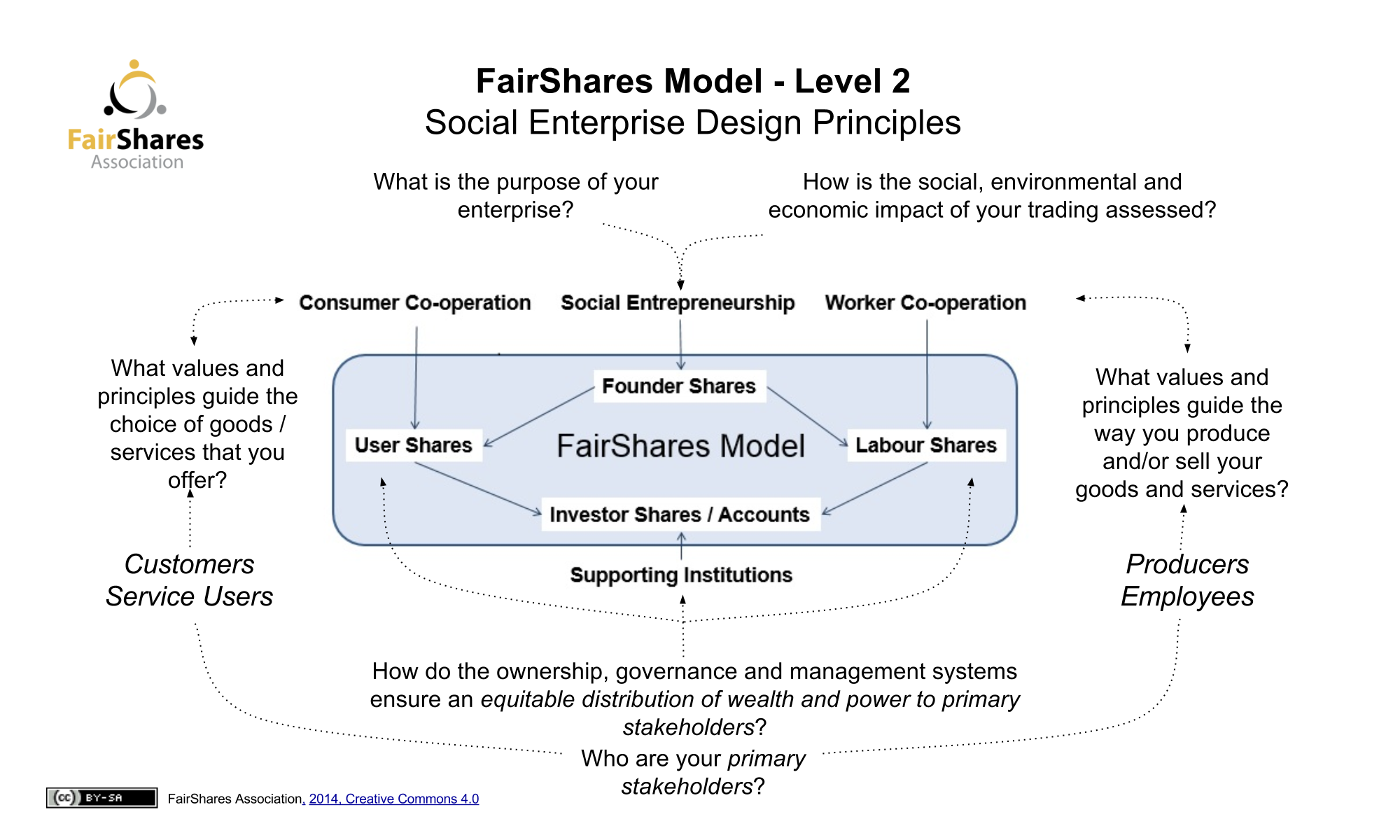
While I agree that significant corporate governance changes should be considered, at first glance this model seems a bit unwieldy if all four types of shares are issued. Still, I am interested in learning more. 

Virginia E. Harper Ho has posted “The SEC’s Sustainability Imperative” on SSRN.  You can download the paper here.  Here is the abstract:

In 2016, the Securities and Exchange Commission (SEC) for the first time sought public comment on whether financial disclosure reform should address indicators of firms’ sustainability risks and practices. Securities disclosure reform now appears poised to take a deregulatory turn, and innovations at the intersection of sustainability and finance appear unlikely in the face of new policy priorities. Whether the SEC should take any steps to improve how sustainability-related information is disclosed to investors is also deeply contested.

This Article argues that the SEC nonetheless faces a sustainability imperative, first to address this issue in the near term as part of its ongoing review of the reporting framework for financial disclosure, and second, to promote disclosure of material sustainability information within financial reports in furtherance of its core statutory mandate. This conclusion rests on evidence that the current state of sustainability disclosure is inadequate for investment analysis and that these deficiencies are largely problems of comparability and quality, which cannot readily be addressed by private ordering, nor by deference to policymaking at the state level. This Article highlights the costs of agency inaction that have been largely ignored in the debate over the future of financial reporting and concludes by weighing potential avenues for disclosure reform and their alternatives.

Every year, I offer my students the option of writing an extra credit paper on what Hollywood gets wrong about business. They can also apply what they’ve learned to a popular movie, television show, or book (the Godfather, Game of Thrones, and Sex and the City have provided some of the more interesting analogies). Often I provide a list of TV shows or movies that they can consider. Today, I’m asking my co-bloggers and our readers for their binge-worthy movie or TV choices. Some movie lists for business students are here, here, here, and here but I welcome your suggestions. For those of you who aren’t in my class and just want a break from the news, these lists may come in handy.

George Mocsary has an interesting paper that is officially in print. He makes some great points, but I think it undervalues the role of the business judgment rule. More on that later. I disagee, at least on the margins, but it’s worth a look.


Freedom of Corporate Purpose

77 PagesPosted: 13 Apr 2016Last revised: 2 Feb 2017

George A. Mocsary 

Southern Illinois University at Carbondale – School of Law

Date Written: 2017

Abstract

Every few decades, there erupt political and academic debates over the proper nature and purpose of the corporation. It is black letter law, according to most scholars, that corporations exist to maximize shareholder wealth. Others maintain that the corporation should exist for the benefit of multiple constituencies, regardless of what current black letter law may say. The current discourse of corporate purpose, however, is incomplete and misleading. The disarray has resulted from insufficient reliance on historical context in (1) analyzing the firm under modern theories of corporate governance, and (2) interpreting the “purpose” language in corporate charters and corporation-law statutes.

Modern conceptions of corporate governance, and by extension, corporate purpose, have failed to account for the historical evolution of the firm. Significantly, they characterize the corporation along too few dimensions, typically treating the firm as merely, and exclusively, a contract- or property-based entity; and they neglect to treat the later stage corporation as a historical entity that inherits characteristics and restrictions, including its purpose, from the time of its founding. 

Corporations are a triality of property, contractual, and associational rights. Firms can simultaneously and independently be described along each dimension. The triality of rights should entitle shareholders to form general corporations to pursue the ends of their choosing — shareholder wealth maximization or otherwise. Focusing on one aspect of the firm at the expense of the other two, however, obscures the central place of shareholder ends in the corporation. At its inception, the corporation is nearly indistinguishable from its shareholders, who possess the special talents or resources around which the enterprise is started. They possess all the property, financial, and control sticks in the corporate bundle of rights. They associate via the corporate form to better achieve some end than they could without it. Shareholders necessarily give up ever more control as the firm grows. But even at later stages in a firm’s life, shareholders retain enough rights to entitle them to have their corporations run in pursuit of the purposes they established at the firm’s founding (or later modified via the proper procedures).

This Article distinguishes two understandings of the corporate “purpose” language that is a statutorily required component of every corporate charter. The first is what the Article terms the corporation’s “tactical,” or operating, purpose. A corporation engages in its operations as it pursues its “strategic” purpose. The strategic purpose is the telos of the corporation or its board of directors. Shareholder wealth maximization is the archetypical strategic purpose, and the one most naturally derived from the corporate bundle of rights.

The Article addresses the assertion that corporate law does not, at least by default, require directors to maximize shareholder wealth, and concludes that this claim is indefensible when viewed in proper context. This fundamental stockholder right established, the Article proposes expanding existing law to allow stockholders to charter corporations for any lawful strategic purpose, given sufficient notice to potential mid-stream shareholders. It thus argues for a clarification of the marked uncertainty in corporate law as to whether nonwealth corporate ends are cognizable. Corporate law provides the pieces to maximize the social benefit enabled by the corporate form. This Article offers a flexible yet simple way to join those pieces together by permitting, but not requiring, stockholders to depart from the wealth maximization norm. 


Keywords: corporate governance,corporate law,shareholder wealth maximization,corporate purpose,shareholder primacy,director primacy,team production


Suggested Citation

Most of us editors here at the Business Law Prof Blog obsess and blog in one way or another about disclosure issues.  Marcia has written passionately about conflict minerals disclosure (see a recent post here) and the SEC’s efforts to revamp–or at least reconsider–Regulation S-K (including here).  Anne also wrote about the Regulation S-K revision efforts here.  Ann wrote about mining industry disclosures here and focuses ongoing attention on securities litigation issues in the disclosure realm (including, e.g. here).  Josh wrote about the intersection of corporate governance and disclosure regulation in this post.  I have written about “disclosure creep” here and most of my research and writing has a disclosure bent to it, one way or another . . . .

Last summer, at the National Business Law Scholars Conference at The University of Chicago Law School, I listened with some fascination to the presentation of an early-stage project by Todd Henderson (whose work always makes me think–and this was no exception).  His thesis¹ was a deceptively simple one: that the age-old disclosure debate could best be solved by creating a contextual market for disclosure (rather than by, e.g., continuing its the current system of “federal government mandates and issuer pays” or leaving market participants to their own devices as to what to disclose and punishing malfeasance merely through fraud and misstatement liability or state sanctions).  The paper resulting from that presentation, coauthored by Todd and Kevin Haeberle from the University of South Carolina School of Law (but moving to William & Mary Law School in July), has recently been released on SSRN.  The title of the piece is Making a Market for Corporate Disclosure, and here’s the abstract:

One of the core problems that law seeks to address relates to the sub-optimal production and sharing of information. The problem manifests itself throughout the law — from the basic contracts, torts, and constitutional law settings through that of food and drug, national security, and intellectual property law. Debates as to how to best ameliorate these problems are often contentious, with those on one end of the political spectrum preferring strong government intervention and those on the other calling for market forces to be left alone to work.

When it comes to the generation and release of the information with the most value for the economy (public-company information), those in favor of the command-and-control approach have long had their way. Exhibit A comes in the form of the mandatory-disclosure regime around which so much of corporate and securities law centers. But this approach merely leaves those who value corporate information with the government’s best guess as to what they want. A number of fixes have been offered, ranging from more of the same (adding to the 100-plus-page list of what firms must disclose based on the latest Washington fad), to the radical (dump the federal regime and its fraud and insider-trading overlays altogether in favor of state-level regulation). This Article, however, offers an innovative approach that falls in middle of the traditional spectrum: Make relatively small changes to the law to allow a market for tiered access to disclosures, thereby allowing firm supply and information-consumer demand to interact in a way that would motivate better disclosure. Thus, we propose a market for corporate disclosure — and explains its appeal.

I have skimmed the article and am looking forward to reading it in full over my spring break in a week’s time.  I write here to encourage you to make time in your day/week/month to read it too–and to consider both the critiques of federally mandated disclosure and the article’s response to those critiques.  I am confident that the thinking it will make me do (again) will sharpen my teaching and scholarship; it might just do the same for you . . . .

_____

¹ After publishing this post, I learned that the paper actually was drafted by Kevin well before Todd presented it last summer. My apologies to Kevin for leaving him out of this part of the story!  :>)

This Saturday, I point you to a colorful long read: Sheelah Kolhatkar’s deep dive into William Ackman’s short bet against Herbalife.  Unabashedly sympathetic to Ackman, the article describes how Herbalife was brought to his attention (there are analyst firms that just identify shorting opportunities?  Who knew?  Please don’t answer that everybody knew; that would be embarrassing) and ultimately ended up as something of a crusade to expose what Ackman believes is a pyramid scheme. (And the FTC believes is a scheme that is awfully like a pyramid scheme but without actually using those words.)  According to Kolhatkar, Ackman and his people want to make money, sure, but they also want to expose a fraud that – like Trump’s universities (a comparison Kolhatkar explicitly makes) – robs desperate people of their savings.  

The article describes the titanic battle between Herbalife and Ackman (Herbalife’s CEO is described as having an “air of PTSD”), including how Ackman even tried to enlist Latino civil rights groups to advocate on his behalf.  It’s reminiscent of that time the NAACP involved itself in the epic battle over debit card swipe fees.

Ackman has held on to this bet for a while, combatting other investors and Herbalife’s own extensive public relations campaign.  In a few months, however, the settlement that Herbalife reached with the FTC will take effect, and Herbalife will be forced to ensure that most of its sales are made to actual retail customers, and not distributors hoping to resell the product.  One question mark raised by the piece is whether the settlement will finally allow Ackman’s bet to pay off, or whether Herbalife will manage to survive, perhaps by focusing its operations in other countries, where the settlement doesn’t apply.

With co-editor Joan Heminway (and Anne Tucker via Skype), I am at Notre Dame for a symposium on social enterprise law. I will be presenting on aforthcoming book chapter, which builds on my stakeholder advisory board idea. My article Adopting Stakeholder Advisory Boards article was recently published in the American Business Law Journal and I posted it to SSRN this week. The abstract is reproduced below.

———–

Over the past decade, interest in socially responsible business has grown exponentially. The social business movement seeks to have firms focus on the interests of all corporate stakeholders, rather than solely the financial interests of shareholders. Coupled with the social business movement of the past decade has been the passage of social enterprise statutes by over thirty states. The social enterprise statutes provide legal frameworks for firms that seek profit alongside broader social and environmental ends. A plethora of social enterprise legal forms have been created in the United States since 2008, including benefit corporations, public benefit corporations, benefit LLCs, low-profit limited liability companies (L3Cs), general benefit corporations, specific benefit corporations, sustainable business corporations, and social purpose corporations.

Despite the interest in social business and the passage of numerous social enterprise laws, the basic corporate governance framework has stayed largely the same. In both socially-focused traditional companies and in newly formed social enterprises, the corporate governance system is one that empowers directors, officers, and shareholders, but largely ignores other stakeholders such as employees, customers, vendors, creditors, the environment, and the community at large.

This Article explores the shortcomings of the current corporate governance framework, reveals inadequacies in previous proposals to focus firms on all stakeholders, and proposes a stakeholder advisory board as a solution. As proposed, the stakeholder advisory board will give all major stakeholders a more direct voice in firm governance and will grant more stakeholders limited but significantly powers, without harmfully disrupting the efficiency of the board of directors. If adopted, the stakeholder advisory board will better align the corporate governance framework with the recent social business movement by including representatives of all stakeholder groups in decision-making. This proposal suggests mandating adoption of a stakeholder advisory board for large social enterprises, and encourages the voluntary adoption of a stakeholder advisory board by all firms that take their social commitments seriously.

My Akron Law colleague Camilla Alexandra Hrdy has posted “The Reemergence of State Anti-Patent Law” on SSRN.  You can download the paper here.  Here is the abstract:

The majority of states have now passed laws prohibiting bad faith assertions of patent infringement. The laws are heralded as a new tool to protect small businesses and consumers from harassment by so-called patent trolls. But state “anti-patent laws” are not a new phenomenon. In the late nineteenth century, many states passed regulations to prevent rampant fraud by patent peddlers who aggressively marketed fake or low value patents to unwitting farmers. However, courts initially held the laws were unconstitutional. Congress, courts reasoned, had power under Article I, Section 8, Clause 8 to “secure” patent rights. If states could tax patents or alter the terms on which patents were sold and enforced, this risked destroying a federal property right and nullifying an Article I power. In the early twentieth century, the U.S. Supreme Court finally held that states retained some authority to regulate, and to tax, patent transactions. But the Court made clear that states could never impose an “oppressive or unreasonable” burden on federal rights. The Federal Circuit has completely ignored this preemption law. But it has never been overruled and must be consulted today in assessing the constitutionality of states’ current efforts to combat patent trolls.

Businesses from small farmers to cruise lines are anxiously awaiting President Trump’s policy on Cuba and how/if he will rescind President Obama’s Executive Orders relaxing restrictions on doing business with the island.

If you’re in the South Florida area next Friday March 10th, please consider attending the timely conference on Doing Business in Cuba: Legal, Ethical, and Compliance Challenges from 8:00 am-4:30 pm at the Andreas School of Business, Barry University. The Florida Bar has granted 6.5 CLE credits, including for ethics and for certifications in Business Litigation and International Law. The Miami-Dade Commission on Ethics and Public Trust is organizing the event.

As a member of the Commission and an academic who has just completed my third article on Cuba, I’m excited to provide the opening address for the event. I’m even more excited about our speakers John Kavulich, President, U.S. Cuba Trade and Economic Council Inc;  the general counsel of Carnival Cruise Lines;  mayors of Miami Beach, Coral Gables, and Doral; director of the Miami International Airport; a number of academic experts from local universities; Commissioners Nelson Bellido and Judge Lawrence Schwartz; and outside counsel  from MDO Partners, Akerman LLP, Holland & Knight, Greenberg Traurig, Squire Patton Boggs, and Gray Robinson.

It promises to be a lively and substantive discussion.

Registration closes on Monday, March 6th. The $50 admission fee includes breakfast, lunch, and all materials. Go to ethics.miamidade.gov or call 305-579-2594 to register or for more information.  You can also leave comments below or email me at mnarine@stu.edu.