Well, restoring Elon Musk’s 2018 pay package and awarding $1 in nominal damages instead is, I suppose, one way of distracting from the Epstein files.

No one needs a recap of where we were on Elon Musk’s 2018 pay package, but just in case: in 2024, Chancellor McCormick concluded after a trial that Elon Musk was a controlling shareholder of Tesla, and that the pay package was a conflicted transaction that was not entirely fair to the stockholders. In particular, she found that Musk himself controlled the process by which the compensation committee set his pay, and largely made up his own contract with the comp committee serving as a rubber stamp. As a remedy, she ordered that the pay package be rescinded.

Today, the Delaware Supreme Court did not question any of Chancellor McCormick’s actual findings regarding how Musk’s 2018 pay package was negotiated, the control and interference that Musk exercised over the process, or even the unfairness of the award itself. Instead, the sole basis for the holding is a kind of Rumpelstiltskin argument: the plaintiffs used the word “rescission” when requesting a remedy, but this case does not meet the technical requirements for rescission – because rescission requires that both parties be restored to the status quo ante, and there’s no way to give Musk back his years working for Tesla after 2018. “It is undisputed,” said the Court, “that Musk fully performed under the 2018 Grant, and Tesla and its stockholders were rewarded for his work.”

(It was disputed, actually. Per Chancellor McCormick, “Defendants failed to prove that Musk’s less-than-full time efforts for Tesla were solely or directly responsible for Tesla’s recent growth, or that the Grant was solely or directly responsible for Musk’s efforts.” Details.)

Nor could the appreciation in value of his preexisting equity stake serve as a substitute to restore the status quo, because, per the Court, “[t]he benefits from his preexisting equity stake were not the compensation he was promised if he achieved the 2018 Grant milestones.” Which is an argument that proceeds on the assumption that Tesla’s “promise” was a fair one achieved at arm’s length, rather than one manipulated by Musk himself – which is … not what Chancellor McCormick found.

Okay, so the plaintiffs can’t technically receive rescission, because both parties can’t be restored to their 2018 positions. What about remedies like disgorgement or rescissory damages, then, would they be appropriate? A ha! Plaintiffs used the word “rescission,” not “rescissory damages” and not “disgorgement,” so the Court need not ponder such unlikely hypotheticals.

Which is to say, in the grand tradition of Paramount v. Time, widely viewed as a response to Martin Lipton’s Interco memo, the opinion reeks of political expediency (an impression buttressed by the fact that it was issued per curiam – no individual judge wanted to be associated). The Court took a hot potato and found a way to toss it without saying anything at all.

But one difference between Tornetta and the Paramount v. Time decision is that in Paramount, the Court found a way to protect the interests of corporate stakeholders from a rapacious form of shareholder wealth maximization. In Tornetta it … did the other thing.

And … a Very Special Shareholder Primacy podcast! Me and Mike Levin close out the year with a crossover episode with our sister pod, Proxy Countdown, featuring Matt Moscardi and Damion Rallis of Free Float LLC. Here on Spotify, here on Apple, and here on YouTube.

The White House Executive Order is out, and it largely tracks what I previously expected based on prior reporting. It isn’t self executing, but it directs the FTC, the SEC, and the DoL to review rules pertaining to proxy advisors and revise them, and/or take enforcement action.

The FTC is ordered to investigate potential antitrust violations.

The Department of Labor is ordered to consider revising rules pertaining to ERISA funds’ reliance on proxy voting advice (i.e., impose paperwork burdens that will inhibit funds’ ability to rely on proxy advisors).

The SEC is directed to ensure that proxy advisors register as investment advisors (too late!), and then use that status to incapacitate them with paperwork (I’m reading between the lines), and to somehow treat voting recommendations as the equivalent of coordinating a 13d group. It’s also directed to ascertain whether the recommendations themselves are misleading (the Business Roundtable has previously argued that it is proxy fraud for a proxy advisor to characterize a director as not independent when the company designates them as independent for exchange listing purposes).

Also included is a direction to the SEC to revise and rescind guidance surrounding Rule 14a-8.

Anyway, these are largely the moves I discussed in my prior posts, here and here. Now it just depends on how far the agencies go and the extent to which ISS and Glass Lewis fight back in court.

And another thing. On this week’s Shareholder Primacy podcast, Mike Levin and I talk about what activists are doing this time of year. Here at Apple, here at Spotify, and here at Youtube.

And still another thing. I participated in this blog post at the Harvard Law School Forum on Corporate Governance, along with Jill Fisch, Sarah Haan, and Amelia Miazad, arguing for the legality (and advisability) of precatory shareholder proposals under Delaware law.

Obviously, the big business news today is the Netflix/Warner merger agreement, coupled with party-crasher Paramount.

This is not, of course, the first time that Paramount has interrupted a Warner merger deal. As probably everyone reading this post already knows, back in the late 80s, Time signed a merger agreement with Warner, and Paramount parachuted in with an offer to take over Time instead. When Time locked up the merger agreement too tightly for Paramount to get a foothold, it sued in Delaware, and lost before the Delaware Supreme Court in Paramount v. Time.

A lot of the mainstream news reporting is presenting Paramount’s topping bid for Netflix as a “hostile” tender offer, echoing Paramount’s claim that it is taking its bid directly to the shareholders. That is … not exactly accurate.

No one does hostile tender offers anymore, in the sense of an actual for-real offer to buy shares without approval of the target board. That’s because, after cases like Paramount v. Time, boards have fairly broad powers to prevent unapproved acquisitions – like, poison pills, and DGCL 203. So, this Paramount offer is actually a proposal for a friendly 251(h) merger, conditioned explicitly on the approval of Warner’s board:

Consummation of the Offer is conditioned upon, among other things, the following conditions: (i) Warner Bros. shall have entered into a definitive merger agreement with Paramount and the Purchaser substantially in the form of the merger agreement submitted by Paramount to Warner Bros. on December 4, 2025 and attached to the Offer to Purchase as part of Annex A (the “Paramount/Warner Bros. Merger Agreement”), other than changes required to reflect completion of the Offer followed by a second-step merger under Section 251(h) of the DGCL and any other changes mutually agreed between Warner Bros. and Paramount

Which means, Paramount is only taking its bid to the shareholders in the sense that it’s hoping Warner shareholders will pressure Warner’s board into terminating the Netflix deal and accepting Paramount’s offer.

Beyond that, is there any way Paramount – or Warner shareholders – can actually force Warner to accept Paramount’s bid if it remains adamant about the Netflix deal?

Well, there’s always the possibility of a lawsuit alleging breach of fiduciary duty – Paramount has already suggested that Warner prefers Netflix’s bid because David Zaslav personally favors Netflix. And Paramount could run a proxy contest to replace Warner’s board.

Beyond that, though, the only legal leverage Paramount has is that the Netflix transaction requires a shareholder vote. Presumably, if shareholders vote down that deal – and take Netflix off the table – that would persuade Warner to come back to Paramount. That is, of course, largely what happened when JetBlue made a topping bid for Spirit Airlines after Spirit signed a deal with Frontier. When it became clear that shareholders preferred JetBlue’s offer and would vote down the Frontier transaction, Spirit’s board broke it off with Frontier and signed with JetBlue (which ended … badly).

Back in the old Paramount v. Time fight, Time, too, was worried that its shareholders would prefer Paramount’s offer to the Warner deal, and vote down Warner. So, it actually restructured the transaction to avoid a vote of its own shareholders.

Can Warner do that? Actually, yes, in a way. Remember, the Netflix deal has two parts. A spinoff of the news assets into a separate company, after which Netflix buys the remainder. The current merger agreement contemplates a shareholder vote before any reorganization measures take place. But I don’t believe there’s any legal reason why the vote can’t take place after the spinoff, which itself doesn’t (I think???) require a vote at all (let me know if that’s wrong, by the way).

If that were to happen, well, after the spinoff, Warner would be a different company, and presumably Paramount’s offer would be dead, or at least have to be substantially revised – which would functionally force Warner’s shareholders into Netflix’s loving arms.

But if Warner were to revise the agreement in that way, it would almost certainly draw legal challenge – and very likely Warner would lose. When Time restructured an agreement to avoid a shareholder vote, it was doing so in contemplation of a long-term plan subject to business judgment; Warner, however, is in Revlon-land, and it can’t justify, essentially, cutting off a bidding war and coercing a transaction on the grounds that it believes the company has a brighter long term future in the new structure.

Now, let’s take a moment to go back to the lawsuit idea. Presumably, if Warner remains adamant, Paramount (or Warner shareholders) could sue Warner’s board alleging breach of fiduciary duty because Warner unreasonably has favored Netflix. That’s a difficult argument because, dollar for dollar, the Netflix transaction might offer more value to shareholders (Netflix is offering less than Paramount, but Warner shareholders get to keep the spun off news business). So, the argument would have to be something like unreasonable process (i.e., Warner just liked Netflix better for improper reasons), and higher regulatory barriers/less deal certainty for the Netflix merger.

But then we run into the problem I blogged about when Pfizer, Metsera, and Novo were dancing this dance – namely, the implicit (and sometimes explicit) argument in Paramount’s favor is that the Trump Administration wants the Ellisons to buy Warner so they can kill CNN. If that’s what ends up in Delaware, how is a Chancery judge supposed to weigh it?

I guess it’s a two post kind of week.

I previously predicted that one way the Trump Administration could attack proxy advisors would be from the client side, i.e., to make it more difficult from a regulatory perspective for clients to follow proxy advisor recommendations, but I didn’t anticipate this from Commissioner Uyeda:

With regard to proxy voting, practices that directly or indirectly result in coordinated voting should be evaluated with respect to compliance with reporting requirements under the Securities Exchange Act. Shareholders form a group if they act together for the purpose of voting the equity securities of an issuer. Depending on the facts and circumstances, funds and asset managers using PVABs for voting decisions may have formed a group for purposes of Section 13(d)(3) or Section 13(g)(3) of the Securities Exchange Act.  Indeed, the Commission itself raised this issue in 2020 when it stated that “[u]se of a proxy voting advice business by investors as a vehicle for the purpose of coordinating their voting decisions regarding an issuers’ securities” would raise issues under the SEC’s beneficial ownership rules. Of course, a group is not formed simply because a shareholder independently determined how it wants to vote on an issue, announced its voting decision, or advised others on how it intended to vote. The key is that the vote is based on an independent decision by the shareholder itself. If, in lieu of such independent decision-making, funds and asset managers automatically vote shares solely based on PVAB recommendation regarding shareholder proposals that have the purpose or effect of influencing control over the company and the aggregated voting power of such persons exceeds 5% beneficial ownership, such persons may have formed a group and need to file a Schedule 13D even if they beneficially own less than 5% on an individual basis.

To the extent that funds and asset managers are engaging in “robo-voting” based on PVAB recommendations, such practices should be reviewed to determine whether they comply with the Exchange Act and SEC rules. The evaluation of whether a group has been formed should take into account the business realities of the arrangements, particularly if robo-voting results in coordination of voting practices where owners of the same securities vote in tandem with each other with the effect of influencing control of an issuer. The substance of such arrangements has implications under Section 13(d) of the Exchange Act and we should not shy away from scrutinizing such consequences.

Now, let’s leave aside the issue of how common it is for shareholders to blanketly accept proxy advisor recommendations with no further analysis or refinement (my guess is, not very common, but it does exist among smaller funds).

The suggestion, as I understand it, is even if the shareholders have no agreement with each other, so long as they have individually and independently decided to defer to the recommendations of Glass Lewis, they are now all a 13(d) group.

It’s not clear to me where the agreement is, exactly.  The shareholders have no understanding with each other.  They don’t even have an understanding with the proxy advisor – Glass Lewis doesn’t care if you actually take its recommendation, it gets paid regardless.

At best, the theory here is something like what Delaware calls a “daisy chain” in the context of advance notice bylaws and poison pills – if Shareholder A has an agreement with Shareholder B, and Shareholder B has an agreement with Shareholder C, then Shareholder A and C are in agreement.  Here, it would be a kind of hub and spoke model, I guess, with Glass Lewis at the center.

Well, when these daisy chain provisions come up in Delaware law, courts tend to become concerned that they demand more of shareholders than they reasonably know or could discover.  See, e.g., Kellner v. AIM Immunotech, 320 A.3d 239 (Del. 2024); Wright v. Farello, 2025 WL 3012956 (Del. Ch. Oct. 27, 2025).

More relevantly, though, federal courts interpret 13(d) and Rule 13d-5 to require an actual agreement among the shareholders. See e.g., Wellman v. Dickinson, 682 F.2d 355 (2d Cir.1982) (requiring “a formal or informal understanding between Dickinson and others holding beneficial ownership of more than 5% of Becton stock for the purpose of disposing of the shares under their control”; “an express or implied understanding…between the group members”; “the touchstone of a group within the meaning of Section 13(d) is that the members combined in furtherance of a common objective”); Corenco Corp. v. Schiavone & Sons, Inc., 488 F.2d 207 (2d Cir.1973) ( “[A]bsent an agreement between them a ‘group’ would not exist.”).

Under this standard, it is not sufficient to say that an understanding exists merely because putative group members are aware that other putative members are behaving a certain way.  Indeed, Section 13(d) does not even capture “conscious parallelism,” whereby members are not only aware of each other but intentionally coordinate. See John C. Coffee, Jr. & Darius Palia, The Wolf at the Door: The Impact of Hedge Fund Activism on Corporate Governance, 41 J. Corp. L. 545 (2016).  The SEC has taken the position that conscious parallelism counts, but, oddly, though it proposed amending the rules to say that explicitly, it didn’t actually adopt those amendments, and the judicial definition under current law doesn’t back the SEC up.

And in this case, of course, Commissioner Uyeda proposes to go much further than conscious parallelism (or even SEC guidance, which requires shareholders act with a “purpose” to do something), since no one is intending to parallel anyone; at best, it’s merely consciousness.  But even under that standard, we fall short: no one Glass Lewis client has any knowledge that any other Glass Lewis client is voting a particular way – at best, they know in an abstract sense that some Glass Lewis clients take Glass Lewis recommendations, but they have no insight into the level of process those shareholders employ before adopting the recommendation, which (according to Commissioner Uyeda) should be the touchstone for determining coordination.

(Sorry, just had a moment imagining advance notice bylaws and poison pills that triggered when enough investors followed a Glass Lewis recommendation.)

So, you know.  I don’t think the SEC can get there without, at minimum, more rulemaking, and possibly not even that – but it can certainly make life difficult for investors and proxy advisors along the way.

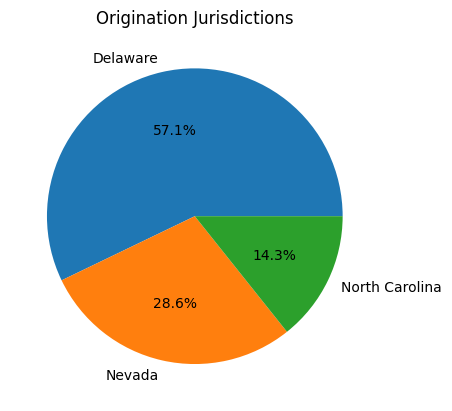
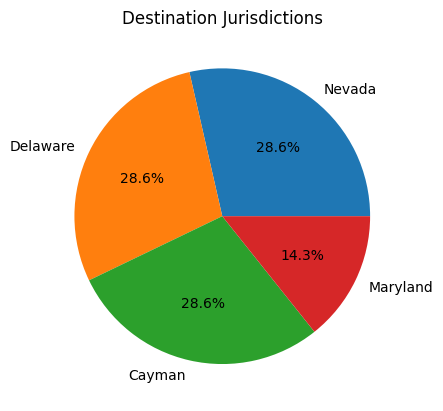
There has been some movement since the last update. Here are the new proposed moves. It’s one more for Nevada, and two puzzlers for Texas. One recent announcement and one newly discovered.

Nevada

Nevada picks up Classover Holdings. It’s another nano-cap stock with a current market cap of around $9 million. Classover flags the franchise fees as an issue and should update its [bracket] placeholders with figures by the time of the final proxy to reveal how much it pays now. Given the market cap, I expect the franchise fee may be a material factor.

Classover also flags a concern about the Delaware litigation environment:

The increasing frequency of claims and litigation directed towards directors and officers has greatly expanded the risks facing directors and officers of public companies in exercising their duties. The amount of time and money required to respond to these claims and to defend these types of litigation matters can be substantial.

Classover also expresses a preference for Nevada’s statutory approach.

Though Delaware corporate law has recently been amended to, among other things, increase protections for officers of a corporation, we believe Nevada is more advantageous than Delaware because Nevada has pursued a statute-focused approach that does not depend upon judicial interpretation, supplementation and revision, and is intended to be stable, predictable and more efficient, whereas much of Delaware corporate law still consists of judicial decisions that migrate and develop over time.

Two Texas Puzzles

Eightco Really Wants To Go

There are actually two newly identified Texas puzzles. The first is Eightco Holdings. It declared for Texas on December 1. The puzzle here is where do I put Eightco? I had them on the Nevada list for 2025 because they declared for Texas in late 24 and had the unsuccessful vote in 25. Now, it appears I may have to put them on the Texas list. Maybe I just count “attempts” instead of companies attempting. The vote is set for December 16.

This is Eightco’s stated rationale:

 Delaware and Texas provide substantially equivalent bundles of economic, governance, and litigation rights for stockholders, balancing relevant considerations against one another and as relevant to the Company. However, there were two differentiating factors: (1) Texas statutory law on corporate constituencies would better align with the Company’s mission-driven culture; and (2) Delaware has an established and respected business court and the largest body of corporate case law in the country, whereas relatively recently Texas has created a business court, but the Texas statutes are more favorable to the Company and its shareholders. The Board balanced these considerations and concluded that, in its business judgment, it is in the best interests of the Company and all its stockholders for the Company to reincorporate in Texas. The Board, in this evaluation, included an examination of the effect of redomestication on the economic, governance, and litigation rights of stockholders.

Don’t get too attached to Eightco Texas; it was proposing to Nevada just last year and voting on it earlier this year. Plus, Nevada must still be on Eightco’s mind because the proxy has this lovely Freudian slip on page 11 instructing shareholder-nominated directors to include “a written statement executed by the nominee acknowledging that as a director of the Company, the nominee will owe fiduciary duties under Nevada law with respect to the Company and its stockholders.” I’m not sure how that would happen unless Eightco is planning to run off to Vegas.

The drafting is interesting because when it originally proposed to come to Nevada at the end of 2024, the language read that “the nominee will owe fiduciary duties under Delaware law (or Nevada law after the Redomestication) with respect to the Company and its stockholders.”

The Solidion Technology Mystery

Lora Kolodny brought Solidion to my attention. I haven’t had enough time to dig into what happened yet, but here is what I know. This is a company with a market cap over $60 million. It recently received a grant from the U.S. Department of Energy. The last proxy is a preliminary one filed on January 8, 2025. It contains a previously unreported proposal to shift to Texas. It gives usual reasons, franchise fees, the Texas Business Court, and settles on Texas because of its operational connection to the state.

I haven’t found a final, definitive proxy and have not found an 8-K disclosing the results of any vote. I’m not an expert in proxies, but Donnelly Financial is and they seem to think companies have to file definitive proxies. Solidion has filed them in the past. I did find 8-Ks stating that people should not rely on prior financial statements. The most recent quarterly report identifies Solidion as a Delaware corporation. I haven’t verified whether its in good standing in Delaware or not yet, but I would be interested to hear if anyone pays the Delaware Secretary of State’s office for the goods. I ran a search in Texas and didn’t find an entity with the name. It terminated Deloitte for CBIZ CPAs as its auditor. CBIZ only executes deficient audits 50% of the time. Nothing to see here.

And now for some wild speculation about what might have happened. I have no source on this, I’m just spitballing. With the unreliable accounting figures, I’m guessing that there is some drama behind the scenes. The curious absence of a final proxy or information about the vote makes me guess that some lawyers probably withdrew from representation. The new legal team or whoever was handling that period probably just dropped the ball on the filings. I’ll poke around some more and see if I can figure this out.

The Search Method

Now that I’ve been going on EDGAR and running searches for some time, I thought it might be helpful to put out how I do it and flag a strange wrinkle in EDGAR.

To check for moves, I tend to run this search. Essentially, I look at recent proxy materials for Delaware-incorporated companies and search for the word “Nevada.” If you want to check for Texas or any other state, just change the search term. You get a lot of false positives, but it narrows it down and it’s quick to click through. You can get a broader set and capture moves from other states by leaving the state of incorporation field blank.

This brings me to the strange wrinkle. EDGAR does not appear to update the state of incorporation when companies move from one state to another. For example, Cannae has been a Nevada corporation for some time, but all of its materials keep showing up because EDGAR incorrectly identifies it as a Delaware corporation. I should probably start filling out the feedback forms that the SEC pops up when you visit the website.

And with that, I have the updated lists below.

2025 Nevada Domicile Shifts
 FirmResultNotes
 1Fidelity National FinancialPass 
 2MSG SportsPass 
 3MSG EntertainmentPass 
 4Jade BiosciencesPassJade merged with Aerovate.
 5BAIYU HoldingsPassAction by Written Consent
 6RobloxPass 
 7Sphere EntertainmentPass 
 8AMC NetworksPass 
 9Universal Logistics Holdings, Inc.PassAction by Written Consent
 10Revelation BiosciencesFail97% of votes cast were for moving.  There “were 1,089,301 broker non-votes regarding this proposal”
 11Eightco HoldingsFailVotes were 608,460 in favor and 39,040 against with 763,342 broker non-votes.
 12DropBoxPassAction by Written Consent
 13Forward IndustriesFailThis is New York to Nevada. Votes were 427,661 for and 96,862 against with 214,063 Broker Non-Votes.  Did not receive an affirmative vote of the majority of the outstanding shares of common stock.
 14NuburuFail87% of the votes cast were in favor of the proposal.  11% against 1.6% Abstained. There were 12,250,658 Broker Non-Votes.
 15Xoma RoyaltyPass 
 16Tempus AIPass 
 17AffirmPass 
 18Liberty LivePendingThis is a split off from a Delaware entity to Nevada
 19NetcapitalFailThis was a proposed move from Utah to Nevada. It failed with 541,055 votes in favor and 1,456,325 votes against.
 20Algorhythm HoldingsPendingMeeting set for Nov. 20
 21Capstone Holding CorpPendingMeeting set for Nov. 18
 22Oblong, Inc.PendingMeeting set for Dec. 17
 23HWH International Inc.PassAction by written consent
 24Twin Vee PowerCatsPendingMeeting set for Dec. 4
 25Digital Brands Group, Inc.PassAction by written consent
 26Brilliant Earth GroupPassAction by written consent
 27NextNRGPendingMeeting set for Dec. 29
 28ClassOver HoldingsPending 
2025 Texas Domicile Shifts
 FirmResultNotes
1.Zion Oil and GasPass 
2.Mercado LibreWithdrawn 
3.Dillard’sPass12,791,756 votes for and 1,477,174 votes against
4.United States Antimony CorporationPassShift from Montana to Texas. 20,626,385 votes in favor.  11,816,235 against. 35,888,464 broker non-votes.
5.Exodus Movement, Inc.PassAction by written consent.
6.CoinbasePassAction by Written Consent
7.Solidion TechnologyUnclear  A preliminary proxy dated Jan. 8, 2025, announced a proposal to shift to Texas.  The most recent 10-Q identifies company as a Delaware entity.  I was not able to locate an 8-k with results of the vote.
8.Eightco HoldingsPendingThey’re proposing Texas, but saying shareholder nominated directors must promise to abide by Nevada law.   Voting Dec. 16

In this week’s Shareholder Primacy podcast (here at Apple, here at Spotify, here at YouTube), Mike Levin and I talk about the all-of-government war on proxy advisors.

Which was timely, because – as we didn’t know when we recorded – ISS just created a new website, www.protectshareholders.com, apparently aimed at making the case for proxy advisors and fighting back against all of the political attacks.

My initial social media reaction was, “OMG,” which apparently was inscrutable to many, so I’ll elaborate here.

To me, ISS’s website does not appear to be a targeted lobbying approach aimed at asset managers or politicians; it appears to be directed at largely a general audience, like public-facing PR. Certainly not geared toward low-information voters, but maybe toward reporters who will communicate to a general audience, or other general audiences who may have sway with politicians. And it is surprising – shocking – to me when a technical matter of corporate governance reaches that level of political salience. Which happened, for example, in the context of SB 21, when I posted that this kind of controversy was unequivocally bad for Delaware.

Now, back in the day – the “day” meaning late 1800s, early 1900s – corporate law was very much a matter of general political concern, and that’s largely because corporate law was the only mechanism to regulate corporate behavior. Beginning in, oh, the 1920s or so, states began to hive out substantive corporate regulation from corporate law – leading to the illusion (and I do mean illusion) that corporate law was something not regulatory, and therefore removed from ordinary political considerations.

So in some ways, the move back almost feels like the natural order; but it also represents a deep lack of faith in the efficacy of the regulatory state, which is why the turn to corporate governance as a substitute.

That said, my suspicion is that this particular effort by ISS is misguided, because – if they’re targeting something like a general audience – most normal people are unlikely to be persuaded by a message that protecting institutional shareholders is a moral imperative. The structural role that ISS plays is by organizing a force that has the heft to push back against oligarchic control of America’s economic resources. That is a message that the public can understand and, I think, support, but it’s not a message that ISS, as a representative of institutions with fiduciary obligations to maximize equity value, can deliver.

Or maybe that’s just a me thing.

I’ve blogged several times about the unduly narrow concept of “standing” and the “purchaser-seller” rule that courts have been applying in the context of Section 10(b).  (Most recent post discussing it is here; there is a link to earlier posts).

We have a new case that adds to the mix.

Toronto Dominion Bank signed an agreement to purchase the stock of First Horizon, which of course caused First Horizon’s price to trade upward.  Eventually, TD got into regulatory trouble and the merger fell through, which caused First Horizon’s stock to fall.  Purchasers of First Horizon stock sued First Horizon, but they also sued TD Bank, alleging that its false representations of regulatory compliance made the merger seem more plausible and inflated First Horizon’s stock price.

Careful readers will recognize that this is, more or less, exactly what happened in Semerenko v. Cendant Corp., 223 F.3d 165 (3d Cir. 2000).  There, the defendants argued that statements about the acquirer (in this case, the acquirer’s audit opinion) were not made “in connection with” the purchase or sale of the target’s securities, as Section 10(b) requires.  The Third Circuit held that that statements about the would-be acquirer were made “in connection with” purchases of the target’s securities, because they were material and publicly disseminated.  The only limitation that the court added was that, to sue a particular defendant, plaintiffs would have show that it was foreseeable that the defendant’s statements would be relied upon by traders in the relevant securities.  Therefore, with that additional caveat, purchasers of the target’s securities could sue the acquirer’s auditor.

The TD Bank case was filed in the District of New Jersey, which would make Cendant precedent, but the district court nonetheless dismissed the plaintiffs’ claims, on the ground that the plaintiffs were not purchasers or sellers of TD Bank securities and had no standing to sue.  The court reasoned:

True, the fact pattern in Cendant is similar to the case before it.  Critically, however, Cendant did not address statutory standing or the purchaser-seller rule at all, relevant here.  Instead, it focused on a separate requirement of a Section 10(b) claim, namely that the alleged misrepresentation be “in connection with” the purchase or sale of a security.  The defendants argued that “the alleged misrepresentations must speak directly to the investment value of the security that is bought or sold, and that they must have been made in with the specific purpose or objective of influencing an investor’s decision.”  The plaintiffs, in turn, argued that “the ‘in connection with’ requirement is satisfied whenever a misrepresentation was made in a manner that is reasonably calculated to influence the investment decisions of market participants.”… The Court will not read an implicit ruling on statutory standing into CendantCendant plainly did not address the purchaser-seller rule or statutory standing.

In re Toronto-Dominion Bank / First Horizon Corp. Sec. Litig., 2025 U.S. Dist. LEXIS 232405 (D.N.J. Nov. 26, 2025).

I have a question.

Where, exactly, does the court think the purchaser-seller rule comes from?

Because, to me, the purchaser-seller rule was articulated in Blue Chip Stamps v. Manor Drug Stores, 421 U.S. 723 (1975), citing the Second Circuit’s decision in Birnbaum v. Newport Steel Corp., 193 F.2d 461 (2d Cir. 1952).  And that rule was explicitly an interpretation of what it means for a fraud to be committed “in connection with” the purchase or sale of a security.  See Blue Chip, 421 U.S. at 731 (“The panel which decided Birnbaum consisted of Chief Judge Swan and Judges Learned Hand and Augustus Hand: the opinion was written by the last named. Since both § 10(b) and Rule 10b-5 proscribed only fraud ‘in connection with the purchase or sale’ of securities, and since the history of § 10(b) revealed no congressional intention to extend a private civil remedy for money damages to other than defrauded purchasers or sellers of securities, in contrast to the express civil remedy provided by § 16(b) of the 1934 Act, the court concluded that the plaintiff class in a Rule 10b-5 action was limited to actual purchasers and sellers.”). The rule, as articulated in Blue Chip, was that there needed to be an actual purchase or sale by a private plaintiff.

So when the Third Circuit in Cendant interpreted “in connection with” to extend to purchases or sales of a different, but related, company’s securities, it was looking at the exact same language and the exact same requirement – the plaintiff must have made a purchase or sale – and concluded that it was sufficient if the “purchase or sale” involved a security that would have been foreseeably affected by the defendant’s fraud.  This scenario was precisely what the Third Circuit had in mind.

This whole idea that somehow “in connection with” as articulated in Cendant is a different concept from the purchaser-seller rule or a standing rule is incoherent to me; it’s all interpretation of the same language, and it’s all the same question, namely, were these plaintiffs among the class of persons targeted by – and injured by – the fraud?  And the purportedly-bright line rule that some courts have announced – the statement must be “about” the traded security – is unworkable on its face; you cannot answer the question of what security a statement is “about” without addressing who the audience was. TD Bank’s representations about regulatory compliance, in the proxy statement and in statements about the merger itself, were at least as much addressed to a First Horizon shareholder audience as anyone else.

And while – as I’ve said before – I understand courts’ wariness about permitting too broad a connection (ultimately, every bit of information is connected to everything else), “had an explicit merger agreement” doesn’t seem like too difficult a line to draw.  We’re seconds away from an explicit pump and dump – fake tender offer so the fraudster can dump their shares at an inflated price – not being made “in connection with” the subject securities if the false statement is about, I dunno, the offeror’s financing, and that’s about the core of what Section 10(b) was supposed to prohibit in the first place.

There is no other thing.  Mike Levin and I took a Thanksgiving break this week from the Shareholder Primacy podcast; back soon!

Friends-of-the-BLPB Will Thomas and Jeff Zhang have posted a draft essay to SSRN that I have put on my reading list for this week. Entitled Crypto Kleptocracy, the piece outlines the public corruption capacity of cryptocurrencies, concluding that they enable “corruption to reproduce itself, translating political power into personal wealth without the familiar, formalistic markers of explicit exchange or quid pro quo.” The SSRN abstract follows.

Many Americans are worrying about whether they will soon be living in a post-democracy autocracy. But in the meantime, they may already be living in a crypto-fueled kleptocracy. Less than one year into his second presidential term, Donald Trump has reportedly taken his wealth to new heights by embracing, both as a businessman and a politician, the crypto industry. Trump’s family businesses are involved in minting Trump-themed meme coins, creating America-themed stablecoins, and mining for crypto assets—so successfully that most of Trump’s wealth is likely now from crypto, not real estate. All the while, the Trump Administration is rolling back crypto regulations, abandoning ongoing crypto prosecutions, and pardoning crypto criminals.

But this Essay is not about Trump. Crypto creates new channels for public corruption that operate on autopilot, generating wealth without transactions, contracts, or promises for the law to easily pin down, prevent, or punish. Future politicians looking to convert public trust into private fortune need only follow this new playbook: adoption is cheap, monitoring is hard, and payouts can be tremendous. President Trump’s second term makes vivid the potential for abuse, but the dangers won’t end there. If the United States fails to adapt, we risk entrenching a twenty-first century kleptocracy where the boundary between political power and personal enrichment is no longer blurred—it is erased.

I appreciate Will and Jeff sharing the link to this draft with me and look forward to giving it a good read. I expect that some of the observations they make may dovetail with my current work on blockchain business and fraud.

I just had the privilege of participating in Columbia Law School’s M&A conference, on a panel with Ed Rock of NYU, Eduardo Gallardo of Paul Hastings, and John Mark Zeberkiewicz of RLF, moderated by Dorothy Lund of Columbia, to discuss SB 21 and its likely impact going forward.

In this post, I’ll elaborate on some stuff I said at the panel.

After SB 313 passed authorizing shareholder agreements – ostensibly to conform the law with “market practice” – Gladriel Shobe, Jarrod Shobe, and William Clayton found that the law in fact went much further than actual market practice to authorize a broad array of contracts that are somewhere between uncommon and nonexistent.

That kind of thing is what gives rise to the suspicion that when the Delaware Corporation Law Council recommends legislative amendments, it does so not as neutral arbiters, but as representatives specific clients who desire particular legislative outcomes. And while there is nothing new or surprising about lobbyists advocating for legal changes that benefit their clients, the CLC is not supposed to be acting as a lobbyist when it participates in the legislative process. In some ways, then, SB 313 always read to me as the “no client left behind act” – drafted to ensure that every individual client’s idiosyncratic contractual preferences would be authorized. Similarly, SB 21 appears to have various easter eggs that were added so that attorneys could preserve arguments on behalf of their clients, which raises the question whether, even if one concedes that some loosening of the cleansing standards was necessary to preserve Delaware’s franchise, every single bit of SB 21 was necessary, or whether the law went further than it needed to because the law firms were, well, conflicted fiduciaries (or, as Ed Rock proposed on the panel, some corporate governance entrepreneurs saw an opportunity to enact their preferred vision of how corporate law should operate). For example, at one point in the process of drafting SB 21, it was proposed that controlling shareholders be required to comply with dual cleansing mechanisms (shareholder vote and independent director vote) for any transaction that organically requires a shareholder vote, and that was rejected in favor of the narrower rule that only take privates require both cleansing mechanisms. Was it truly, absolutely necessary to reject the broader rule to preserve the franchise?

We don’t know, of course, but this is exactly why Charles Whitehead has proposed reforms to Delaware’s legislative drafting process to treat the CLC more like an administrative agency. Ed Rock and Marcel Kahan have also argued that when the legislature aggressively acts to overrule the courts, Delaware loses its legitimacy to make corporate law for the country – after all, if it’s just a legislative process rather than a technocratic judicial one, there’s no reason it can’t be done at the federal level.

Further to that point, the legislature’s recent aggression may very well have functioned as an invitation for SEC Chair Paul Atkins to start making his own demands of Delaware. And if Delaware is simply going to enact whatever is asked by the SEC, then there’s really very little purpose to Delaware playing the role that it does.

Anyway, on that note, a plug! My paper, The Legitimation of Shareholder Primacy has been published in the Journal of Corporation Law, and the completed version is now available online. You may recall that it was originally posted before SB 21 had been proposed; the final version incorporates discussion of those amendments and other developments since then. Read it again, for the first time.

And another thing. New Shareholder Primacy podcast! This week, Mike Levin talks to Kyle Pinder about shareholder proposals and Delaware law. Here at Spotify, here at Apple, and here at Youtube.

Following on my Weinberg Center blog post back on October 27, I write today to promote participation in a survey hosted by the University of Delaware’s John L. Weinberg Center for Corporate Governance on public company Rule 14a-8 shareholder proposals under the Securities Exchange Act of 1934, as amended. The survey website explains that the Weinberg Center “seeks to gather practical insights from companies, investors, and related professionals about the scope and effectiveness of the current federal shareholder proposal rule (Rule 14a-8).” I suspect that the referenced professionals include lawyers representing both public companies and shareholders, as well as other advisors to each. More information about the survey can be found on the website.

In the spirit of that October 27 blog post, I am appreciative of the effort to gather information from a wide variety of constituents. I have taught group-oriented change leadership to undergraduate honors students here at The University of Tennessee using design thinking methods, in which the first step is undertaking to empathize. This step involves the team researching, and endeavoring to understand, the needs of various stakeholders. One design thinking website describes this first stage of a group-oriented process of innovation through design thinking as set forth below.

The team aims to understand the problem, typically through user research. Empathy is crucial to design thinking because it allows designers to set aside your assumptions about the world and gain insight into users and their needs.

This is precisely the type of work that provides a strong foundation for law reform efforts, albeit work that may not be routinely engaged. I hope that stakeholders with various roles in the shareholder proposal process take the opportunity to respond to the survey and that the survey serves an important role in fostering measured, well informed debate. I also hope the survey is a force in depoliticizing relevant questions and potential responses as Delaware considers the core public policy objectives of its corporate law and as the Securities and Exchange Commission similarly considers the positioning of the shareholder proposal rule and process in the context of federal securities regulation governing public companies.

As Jim Surowiecki observes and documents in his insightful book The Wisdom of Crowds, quality decision making involves the consideration of a variety of ideas from diverse and independent participants in a decentralized environment that allows for the compilation of those inputs into a an aggregated output. Effective, sustainable regulation should involve the engagement of this superior method of decision making. The Weinberg Center survey represents a potential beginning to that kind of wise process.

If you are a stakeholder in the shareholder proposal debate, please take time out to complete the survey, for the good of all. Contribute to the essence of meaningful law reform. The survey is available at this link.