
Hiring Announcement: Emory University School of Law

Robert T. Thompson Professorship in Business Law

Emory University School of Law seeks applications from outstanding tenured scholars for the Robert T. Thompson Professorship in Law. This professorship recognizes outstanding achievement in scholarship and teaching in disciplines related to business law, including mergers & acquisitions, securities regulation, corporate finance, and other related business law fields.  Candidates should have exceptional records in research, teaching, and service and have attained a J.D., Ph.D., or equivalent degree. Candidates should currently hold a tenured academic appointment and should be eligible for appointment as a full professor at Emory. 

Candidates must complete the online application which requires creating an account, uploading a resume or CV, and providing basic demographic information. In addition, applicants should submit a cover letter, a current CV, a published or unpublished academic article, a brief research agenda, and an indication of teaching interests (if not listed on the CV) to the chair of the Appointments Committee: Professor Joanna Shepherd, at law.faculty.appointments@emory.edu. Applications will be considered on a rolling basis. 
Description

The Washington and Lee University School of Law warmly invites applications for up to two tenure-track or tenured faculty positions that will begin on July 1, 2025. We are excited to advance our trajectory of outstanding scholarship and teaching with these new hires. A central aspect of the mission of our Law School is to promote a diverse, equitable, and collaborative intellectual community. To do so, we continually strive to foster an inclusive campus community that recognizes the value of all persons regardless of identity. In keeping with the University’s Strategic Plan, we welcome applications from candidates belonging to communities traditionally underrepresented in the legal academy.

Qualifications

A J.D. from an ABA-accredited law school or equivalent is required. We particularly encourage applications from entry-level and junior lateral candidates (either pre-tenure or recently tenured) to join our faculty at the Assistant or Associate Professor level, but we welcome applications from candidates at all levels of experience. Candidates should have a distinguished record of scholarly achievement or demonstrated potential for high scholarly achievement, effective teaching, active service, and a record of inclusion. Our search will focus on applicants whose research and teaching interests include corporate and business law (including commercial law) and/or tax law.

Application Instructions

Applicants should submit the following materials through Interfolio at apply.interfolio.com/152352: (1) a cover letter describing their interest in the position; and (2) a current curriculum vitae, including references. Please address these materials to Professor Chris Seaman, Chair, Faculty Doctrinal Appointments Committee. Additionally, we encourage prospective applicants to contact Prof. Seaman (seamanc@wlu.edu) with any questions.  All inquiries will be treated as confidential.  Review of applications will begin immediately and continue on a rolling basis. 

Equal Employment Opportunity Statement

Washington and Lee is an Equal Opportunity Employer.  As such, we are interested in candidates who are committed to high standards of scholarship, performance and professionalism and to the development of a campus climate that supports equality and diversity in our faculty, staff and student body. Job description requirements are representative, but not all‐inclusive of the knowledge, skill, and abilities needed to successfully perform this job. Reasonable accommodations may be made to enable qualified individuals with disabilities to perform essential functions.

In 1995, Congress passed the Private Securities Litigation Reform Act (PSLRA), which dramatically heightened the pleading burden for plaintiffs bringing securities fraud cases.  At the same time, the PSLRA also instituted a mandatory stay on discovery until resolution of any motions to dismiss, which means plaintiffs have to use their own investigation – relying on public information, confidential sources, and the like – to draft a complaint that is sufficiently particular to satisfy PSLRA standards.

In 2002, Steve Bainbridge and Mitu Gulati published How Do Judges Maximize? (The Same Way Everybody Else Does – Boundedly): Rules of Thumb in Securities Fraud Opinions.  The paper explained that, given the high pleading standards of the PSLRA, judges deciding motions to dismiss lighten the workload by coming up with various rules of thumb for determining whether a complaint pleads materiality or scienter.  For example, they identified the puffery doctrine (presuming that investors treat vague statements of optimism as immaterial), the bespeaks caution doctrine (predictions of the future are immaterial if they are caveated by warnings of future uncertainty), and fraud by hindsight (refusing to draw inferences about what the company knew at an earlier time due to negative disclosures at a later time), as new bright line rules that judges employ to dismiss complaints, disconnected from the general fact pattern.

I can add a bunch more.  For example, a refusal to infer knowledge from one’s position in the company (except in generally rare instances where the “core operations” doctrine kicks in), a refusal to treat bonuses and similar compensation as a motive for fraud, a refusal to treat corporate departures as indicative of fraud unless there are “particularized allegations connecting the departures to the alleged fraud,” In re Hertz Global Holdings, 905 F.3d 106 (3d Cir. 2018), and a refusal to treat insider trades by non defendants as indicative of scienter (an issue I blogged about here).  These are more “rules” for complaints that, I’d argue, contradict our common sense understanding of how to go about inferring other people’s states of mind on a day to day basis just, you know, as a consequence of living as human beings on this planet.

Additionally, a couple of years ago, I published Fact or Fiction: Flawed Approaches to Evaluating Market Behavior in Securities Litigation, which identified still more rules of thumb that judges have developed over time.  For example, when addressing loss causation, courts often require revelation of the fact of falsity (rather than a revelation of problems traceable to the fraud), and will further hold that notice of an investigation, without more, categorically cannot cause a loss. 

You see the problem.  The question whether a complaint pleads falsity or a strong inference of scienter or loss causation or materiality is a holistic factual inquiry; but as these rules build up, pleading or litigating a securities case becomes about whether plaintiffs have complied with an increasingly arcane set of rules.  I like to quote then-Chief Judge William Young from 1999, describing the PSLRA as a “Byzantine pleading code …for securities actions.”  In re Number Nine Visual Tech. Corp., 51 F. Supp. 2d 1 (D. Mass. 1999).

Which is what I was thinking about when going over NVIDIA’s opening brief in NVIDIA Corporation v. E. Ohman J:or Fonder AB, currently pending before the Supreme Court. 

The plaintiffs pled falsity by relying, in part, on an expert report that drew inferences based on market information.  The assumptions and inferences on which the report was based were in the complaint.  Nonetheless, NVIDIA seeks to have the Supreme Court adopt a bright line rule that an expert opinion does not constitute an allegation of fact sufficient to satisfy PSLRA pleading standards.  NVIDIA also challenges the market evidence and factual assumptions that underlay the report as too generic.  Finally, NVIDIA admits that sometimes expert reports may be helpful, but here, the complaint rests too much on the expert report alone, so that the other facts surrounding it are not sufficient.

I see no way the Supreme Court can give NVIDIA what it wants without either acting as a district court and weighing this specific complaint and these specific allegations without regard for future cases, or – more likely – adding more artificial rules to securities pleadings.  Expert reports are still pretty rare in complaints, but if the rule is you can’t have them be the sole support of a complaint, then we’ll see endless litigation over what counts as “sole” (especially since, in this very case, the plaintiffs offer additional allegations).  And if plaintiffs can’t use expert reports that draw inferences based on detailed market information, can they use short seller reports that do the same?  (The Ninth Circuit, for example, has held that short seller reports analyzing public information may be a basis for alleging loss causation if they involve “extensive and tedious research involving the analysis of far-flung bits and pieces of data.” In re BofI Holding, Inc. Securities Litigation, 977 F.3d 781 (9th Cir. 2020)).

If plaintiffs can’t use short seller reports, what happens if the plaintiffs’ attorneys draw inferences based on public information – does that go too far?  Suddenly what started out as a simple rule about experts becomes whole new categories of prohibited inferences being added to the list.  And ruleification ends up obscuring the ultimate inquiry, namely, whether there is a sufficient basis to infer that the defendants’ statements were false.

There’s a similar issue with respect to the other question presented in this case, which is about pleading scienter.  In NVIDIA, the plaintiffs offer a lot of circumstantial evidence of scienter, plus make allegations regarding the existence of documents allegedly reviewed by the defendants, but the plaintiffs haven’t seen the documents so they can’t plead their exact contents.  NVIDIA wants the Court to adopt a bright line rule that the contents of the documents must be described, because “Plaintiffs built their entire scienter case around NVIDIA’s internal documents and data.  By choosing this route, Plaintiffs were required by the PSLRA’s pleading standards to allege with particularity what those documents and sources said and how they supported Plaintiffs’ preferred inference of scienter.”  Which means, were the Court to accept NVIDIA’s argument, the next step is litigation over what counts as the “entire” case, and how much description of a document is enough, and how much support a generally-described document can provide when there are other allegations of scienter.  The argument becomes about the contours of the rule, not whether the substantive standard for pleading scienter is met.

Securities complaints are now hundreds of pages long – and sometimes, ironically, dismissed for being too long and confusing, because Goldilocks-like, they must be just right.  See, e.g., Macovski v. Groupon, Inc., 2021 WL 1676275 (N.D. Ill., Apr. 28, 2021).  (Apparently, plaintiffs must also take a class in narrative exposition before they can survive a motion to dismiss.)  Selecting a lead plaintiff takes months, drafting an amended complaint typically is 60 days or so after that, plus another 60 for the motion to dismiss, 60 for the opposition, and 30-60 for a reply – weeks or months before an oral argument and god knows how long before a decision, and all of this before there’s been any discovery.  By the time you get to depositions, witnesses will be able to say “I don’t remember” and be completely credible.  The last thing this system needs is more up front rules about what plaintiffs can and cannot plead.

Yesterday, the Delaware Supreme Court released its decision in the Dell fee award appeal.  It’s available here.  The Dell case presents a question for blockbuster shareholder litigation–when the damages numbers in dispute grow particularly large, should courts apply a declining percentage when setting the attorneys’ fees?  (Disclosure, I joined an amicus brief on this issue at the trial level.)  The Dell plaintiffs secured a billion dollars in settlement.  Delaware’s Chancery Court opted to give the lawyers $267 million in fees.  

Ultimately, funds holding about 24% of the class objected to the fee award.  This is how the Delaware Supreme court stated their argument:

Pentwater argued that awarding a percentage of the settlement sought without considering the size of the settlement was unfair to the class. They contended that, in this case, the proposed fee was disproportionate to the value of the settlement. The objectors urged the court to apply a declining percentage to the fee award, which is similar to the approach used by federal courts in large federal securities law settlements. The declining percentage method reduces the percentage of the fee awarded to counsel as the size of the recovery increases. According to Pentwater, fee awards “are meant to reasonably incentivize the attorneys taking these cases,” and, in its view, “the amount of work, time, and effort spent on a case does not grow proportionately with the transaction size.”10 In other words, “it is not a hundred times more difficult (or riskier) to litigate and try a $10 billion case than it is to litigate and try a $100 million case.” They argued that the Delaware Supreme Court and Court of Chancery have applied the declining percentage method in other cases. (footnotes omitted)

In these cases, the trial court’s fee awards are reviewed under a deferential abuse-of-discretion standard.  After Dell, the basic framework remains unchanged.  Delaware courts consider five factors to decide fee awards:  “(1) the results achieved; (2) the time and effort of counsel; (3) the relative complexities of the litigation; (4) any contingency factor; and (5) the standing and ability of counsel involved.”  

But the devil is always in the details.  How should courts, after Dell, apply the five factors?  The decision has some language indicating to me that courts need to consider declining percentages in mega-settlements.  Consider these statements and a quotation:

  • Given the equitable principles underpinning fee awards in common fund cases, and this Court’s concern for excessive compensation or windfalls, it is entirely appropriate, and indeed essential, for the court to consider the size of the award in a megafund case when deciding the fee percentage. An award can be so large that typical yardsticks, like stage of the case percentages, must yield to the greater policy concern of preventing windfalls to counsel.
  • At some point, the percentage of fees awarded in a megafund case exceed their value as an incentive to take representative cases and turn into a windfall.
  • But a point exists at which these incentives are produced, and anything above that point is a windfall. In other words, if a fee of $500,000 produces these incentives in a particular case, awarding $1 million is a windfall, serving no other purpose than to siphon money away from stockholders and into the hands of their agents. Thus, it is important that we attempt, in a self-conscious and transparent manner, to estimate the point at which proper incentives are produced in a particular case. (favorably quoted from Seinfeld v. Coker)

What will this mean for future fee awards?  My thought here is that it seems likely that Chancellor McCormick will read the decision closely as she considers fee awards in the two outstanding Tesla cases. 

The Delaware Supreme Court approved the Dell award as within the bounds of discretion.   Yet how wide will the discretion be in the future?  As the numbers go up to the billions as in the Tornetta case, the math changes.  There, attorneys blocked a $56 billion dollar compensation plan.  They’ve requested about $6-7 billion in compensation.  (The numbers change depending on the stock price.). Although it’s not even 15% of the benefit they obtained for the class, $6-7 billion is still a staggering amount.  It works out to about $300k+/hour for the attorneys involved.  

Ultimately, the question remains:  where is the line between adequate compensation to ensure skilled litigation in challenging cases and a windfall to the attorneys involved?  Now, we wait to see where Chancellor McCormick draws that line in awarding fees.  The Dell lawyers collected about $5,000 per hour worked.  It’s a big jump from $5,000/hour to $300,000/hour.  I don’t envy her job to settle on the right number.

Allison Frankel also has covered this case here.  


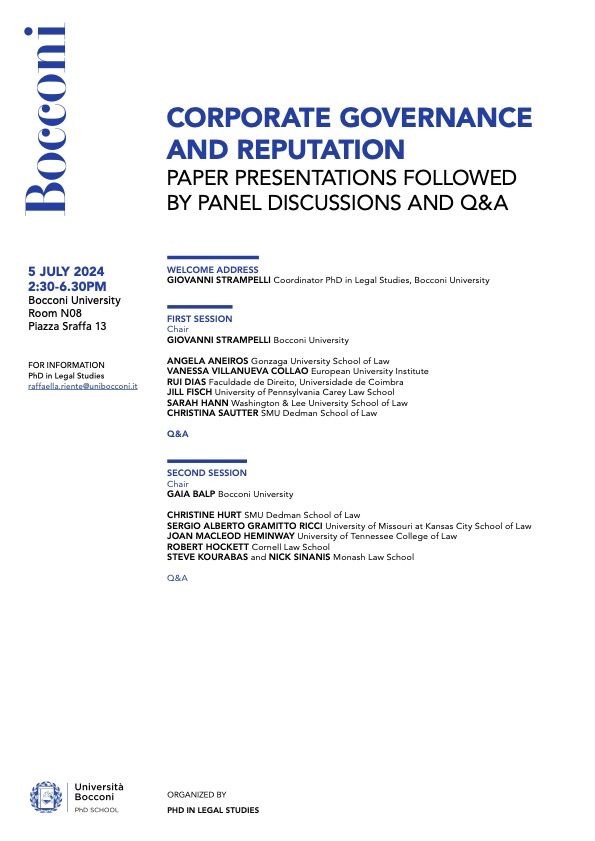
Last month I had the privilege of presenting some of my current work at Bocconi University in Milan, Italy.  The promotional poster for the event is included below. All of the workshop presentations (present company excepted) were engaging.

I presented on part of an ongoing research project–a series of papers on environmental, social, and governance (ESG) information.  The first two papers on the series, The Materiality of ESG Information: Why It May MatterT, 84 LSU L. Rev. 1365 (2024), and ESG and Insider Trading: Legal and Practical Considerations, 26 U. Penn. J. Bus. L. __ (forthcoming 2024), address the significance of ESG information under the U.S. federal securities laws and the potential and actual involvement of ESG information in insider trading.  In Milan, I shared my ideas and preliminary research for a third paper currently titled Corporate Information Compliance in an ESG World.  I expect to turn to work on this paper in earnest in the coming months.  I will briefly lay out my current thoughts here in the hope that you may have some feedback.

ESG information plays a role in many business operational settings that are invoked in legal compliance and addressed in compliance policies and programs.  These include:

  • Obligations to disclose and report information;
  • Protection of intellectual property protection;
  • Information exchanges with competitors;
  • Execution of a significant transaction;
  • Clearance of a barrier to an operational action or anticipated transaction;
  • Default under or breach of an important contract;
  • Pending changes in mission-sensitive business structures, policies, or programs; and
  • Imminent judicial, executive, legislative, or regulatory action.

ESG information is likely to impact legal risk in some of these areas of business operations.  The potential and actual effects of ESG information on legal risk raise questions about the adequacy of current business compliance regimes.

My work in this area is designed to meet a number of objectives, including confirming the connection between ESG information and legal risk, identifying related compliance review practices, offering preliminary suggestions about ESG information’s potential impacts, and proposing specific solutions.  My focus will be on securities regulation compliance, but I hope to make points that are more broadly applicable to business firm compliance practices.  Overall, I desire to use this research to create a heightened awareness of the potential legal significance of ESG information, catalyze specific ESG-related firm (and governmental) compliance activity, provide processes for engaging related compliance program review and revision, and offer substantive compliance guidance.  The ultimate core audiences for this work include compliance lawyers (in-house and outside counsel), compliance business professionals, firm management as a whole, plaintiff and defense bar litigators, and the judiciary.

Let me know what you think of this general idea–using ESG information as a leverage point for the inspection, reflection, and revision of business compliance policies and programs.  Please also respond to any of the rest of the content of this post that either resonates with you or raises questions or concerns.  And if you would like to see the current draft of the forthcoming paper, please let me know.  I am happy to send it to you.

Italy2024(BocconiCorpGov&Reputation)

AALS Section on Agency, Partnerships, LLCs, and Unincorporated Associations

Calls for Papers

The AALS Section on Agency, Partnerships, LLCs, and Unincorporated Associations is pleased to announce two calls for papers, one for a panel presentation and one for a works-in progress session geared to workshopping the research and writing of junior faculty.

Panel Presentation:

Up to three paper presenters will be selected for the section’s principal panel to be held during the AALS 2025 Annual Meeting in San Francisco, CA. The program is entitled Technology’s Intersection with Agency, Partnerships, and Unincorporated Associations. Co-Sponsored by the Sections on Technology, Law and Legal Education and Transactional Law and Skills, the session is designed to explore research and teaching involving the interactions of principal/agent relationships, partnerships, and unincorporated business associations with artificial intelligence, blockchains, cybersecurity, and other technological developments.

Works-in-Progress Session:

The section seeks paper proposals from junior scholars for a works-in-progress program.  Submissions for this session may relate to any topic within the scope of the law governing agency, partnerships, LLCs, or unincorporated associations.

Submission Information: 

To respond to either or both calls for papers, please submit a substantial abstract (five or more pages) or draft of an unpublished paper to Joan Heminway at jheminwa@tennessee.edu before September 6, 2024.  Please remove the author’s name and identifying information from the submission. Please include in the submission email your institution, your tenure status, and the number of years you have been in your current position, as well as a statement indicating whether the paper has been accepted for publication and, if not, when you anticipate submitting the article for publication. The subject line of the email should read: “Submission – Panel” or “Submission – WIP Program,” as applicable.  Authors of selected papers will be notified in September. Presenters are responsible for paying their registration fee, hotel, and travel expenses.  Inquiries about the section’s programs also should be directed to Joan Heminway at jheminwa@tennessee.edu or (865) 974-3813.

Two job announcements, early career and later stage:

Tulane University Law School invites applications from entry-level and early career lateral candidates (less than three years of tenure-track teaching experience) for one or more tenure-track faculty positions.  We welcome applications from candidates with teaching and research interests in all topics, but we are particularly interested in candidates who focus on maritime law and the first year curriculum: civil procedure, contracts, property, and torts. Please direct any questions about this position to Freddy Sourgens at fsourgen@tulane.edu. To learn more about the law school, visit our website at https://law.tulane.edu/. Interested applicants may apply at the following link: http://apply.interfolio.com/150799.

Tulane University is committed to creating a community and culture that foster a sense of belonging for all. We are a recognized employer and educator valuing AA/EEO, Protected Veterans, and Individuals with Disabilities. We encourage all qualified candidates to apply. We are intentionally seeking candidates who contribute to fostering equity, diversity, and inclusion in support of Tulane’s strategic initiatives.  

Also:

Tulane University Law School seeks to fill these faculty positions:

Houck Chair in Environmental Law (and Director of the Center for Environmental Law)
Niels F. Johnsen Chair in Maritime Law
David Boise Distinguished Chair in Law

Position Description:

Tulane University Law School invites nominations and applications for three Chairs in the following areas: Environmental Law; Maritime Law; and Public Law. We seek academic leaders with a record of distinguished scholarship, excellence in teaching, and the demonstrated capacity to direct well-established programs in their respective fields. The appointments will be made at the level of tenured, full professor.

The responsibilities of the chair holders include scholarly research and publication; classroom teaching; and participation in faculty governance. The chair holders are also expected to be actively engaged with faculty both within the Law School and throughout the University, providing leadership for integrative research activities and significant engagement with academic institutions and professional organizations in their respective fields. The chair holders are expected to provide leadership in terms of research, curriculum, and public engagement. Tulane Law School, with world-leading strength in environmental, energy, maritime, as well as international and comparative law, provides the chair holders the unique opportunity and support to lead and expand an already prominent program in these areas. Competitive salary commensurate with experience.

The qualifications required for the chair are:
• Juris Doctor (J.D.) and/or Ph.D. (or equivalent doctoral degree) in Law
• Broad recognition for scholarly distinction
• Established publication record
• Clearly developed long term research agenda
• Extensive teaching experience
• Demonstrated capacity for programmatic leadership

Application Instructions:

Interested candidates should apply through the Interfolio link. Please be prepared to submit your C.V., writing sample, teaching evaluations, and a transcript as part of your application.

All inquiries about the positions should be directed to:

Freddy Sourgens
James McCulloch Chair in Energy Law
Tulane University Law School
fsourgen@tulane.edu

Review of applications will begin in the fall and continue until completion.

Position URL: http://apply.interfolio.com/150805


The Southern Illinois University Simmons Law School is searching for three tenure-track professors to join us next fall. The successful candidates will teach doctrinal law courses. Current needs include Criminal Law, Criminal Procedure, Evidence, Business Courses, Contracts, Labor & Employment, Family Law, and Trust & Estates. Other courses are dependent on the needs of the institution and the candidate’s experience. 

See the position description for additional information.

THE OHIO STATE UNIVERSITY MORITZ COLLEGE OF LAW

Location: Columbus, OH

Subjects: Contracts, Intellectual Property, Business Law, Constitutional Law Start Date: August 15, 2025

The Ohio State University Moritz College of Law seeks to hire up to two entry-level or lateral candidates for positions in Private Law (especially contracts, intellectual property, and business law and complementary areas, including securities regulation, corporate finance, and tax) and Public Law (especially constitutional law and complementary areas).

The Ohio State University’s Shared Values include Excellence and Impact, Diversity and Innovation, Inclusion and Equity, Care and Compassion, and Integrity and Respect. Ouruniversity community welcomes differences, encourages open-minded exploration and courageous thinking, and upholds freedom of expression. We define diversity broadly andvalue multiple dimensions of diversity, including, but not limited to, demographic, religion, country of origin, perspective, ability status, and background.

Ohio State prides itself on welcoming a wide range of viewpoints and providing opportunities for all to deepen and develop their intellectual curiosities. As a land-grant university, werecognize and understand that a diverse faculty, staff, and student body in which all may engage in open dialogue, be exposed to new ideas and perspectives, belong, and feel valuedand included is essential to our efforts in meeting our mission of academic excellence and public service.

We invite applicants to share their demonstrated efforts in research, teaching, and/or outreach and engagement that reflect Ohio State’s Shared Values and that might further advance our mission and institutional excellence.

All qualified applicants will receive consideration for employment without regard to age, ancestry, color, disability, ethnicity, gender identity or expression, genetic information,HIV/AIDS status, military status, national origin, race, religion, sex, gender, sexual orientation, pregnancy, protected veteran status, or any other basis under the law.

Candidates should send their materials to Brenda Robinson, Program Coordinator, by email (Robinson.2311@osu.edu). For full consideration, candidates must also apply through Workday (reference number R110475).


Previously, I blogged about Mivtachem Insurance v. Furtarom, 54 F.4th 82 (2d Cir. 2022), where the Second Circuit held that false statements about a target company – most of which were included in the acquiring company’s S-4 – were not made “in connection with” sales of the acquirer’s securities, and therefore, purchasers of the acquirer’s stock did not have standing to bring Section 10(b) claims against target company officers.

Inevitably, the same thing came up in a pair of cases about SPACs, where purchasers in the publicly-traded SPAC entity wanted to bring claims based on pre-merger false statements about the target company.  A New York district court, following Frutarom, denied the claims; a California district court rejected the Second Circuit’s reasoning (and dismissed the claims on other grounds, namely, that at the time of the false statements it wasn’t clear that the target company really was going to be a target company).

Anyway, the California case, which involved the Lucid de-SPAC, was just appealed to the Ninth Circuit and the Ninth Circuit … followed the Second Circuit’s rule.  In Max Royal LLC v. Atieva, it held:

As noted above, Blue Chip limits standing to “purchasers or sellers of the stock in question.” 421 U.S. at 742.  Plaintiffs contend that the “stock in question” is “the security about which Plaintiffs allege injury,” and not necessarily a security of the company that made the alleged misrepresentations. Plaintiffs further contend that the “Blue Chip rule merely checks whether plaintiffs allege injury from the purchase or sale of a security” and that standing is determined based on “whether the security plaintiff purchased is sufficiently connected to the misstatement.” For several reasons, we conclude that Plaintiffs’ construction of standing is inconsistent with Blue Chip. …

Plaintiffs ignore the plain language of Blue Chip and assert that Section 10(b) standing extends to any stockowner who claims that the misstatements of another person or company negatively affected the value of the owner’s stock. Under Plaintiffs’ desired formulation of the standard, hypothetical plaintiffs would need only to have purchased a security—any security—to satisfy the purchaser-seller requirement. But Plaintiffs’ interpretation of the securities laws would vastly expand the boundaries of Section 10(b) standing and contradict the express limiting purpose of the Birnbaum Rule. The Supreme Court has cautioned that Section 10(b) does not “provide a cause of action to the world at large,” and “should not be interpreted to provide a private cause of action against the entire marketplace in which the issuing company operates.” Stoneridge, 552 U.S. at 162 (cleaned up) (quoting Blue Chip, 421 U.S. at 733 n.5)….

We agree with the Second Circuit’s reasoning in Menora and likewise reject Plaintiffs’ “sufficiently connected” test. The Supreme Court adopted a bright-line rule for standing—even at the risk of it being “arbitrary” in some cases—to avoid the type of “endless case-by-case” analysis contemplated by Plaintiffs….

It is undisputed that the securities about which Defendants allegedly made misrepresentations were those of Lucid. Under the Birnbaum Rule, Plaintiffs would need to have purchased or sold Lucid stock to have standing to bring this action under Section 10(b). Here, Plaintiffs did not purchase or sell Lucid stock, as Lucid was a privately held company during the relevant period. Plaintiffs purchased CCIV stock, but their complaint does not allege that anyone made misrepresentations about CCIV stock. Because Plaintiffs did not purchase or sell the securities about which the alleged misrepresentations were made, Plaintiffs lack standing under Section 10(b).

That CCIV later acquired Lucid does not change our analysis.

One interesting point about the Ninth Circuit’s reasoning is that the court added, “If Congress wants to treat SPAC acquisitions differently than traditional mergers, it has the authority to do so.”

Except the SEC, anyway, did do so – inapplicable to this transaction, but applicable to transactions going forward, the SEC adopted new rules requiring target company officers to sign the registration statement issued in connection with the de-SPAC transaction.  And in the adopting release, it said:

Given that the target company therefore is, in substance, an “issuer” of securities in a de-SPAC transaction regardless of transaction structure, the Commission proposed to amend Instruction 1 to the signatures section of both Form S-4 and Form F-4 to require that, when the SPAC would be the issuer filing the registration statement for a de-SPAC transaction, the term “registrant” would mean not only the SPAC but also the target company….

As discussed in more detail below, it is our view that in a de-SPAC transaction the target company is an issuer of securities under section 2(a)(4) of the Securities Act, and, therefore, the target company along with its required officers and directors must sign a registration statement filed by a SPAC or another shell company for the de-SPAC transaction, because both in substance and by operation of new Securities Act Rule 145a, the target company is issuing or proposing to issue securities in a de-SPAC transaction, regardless of the transaction structure….

Now, the SEC was explicitly contemplating Section 11 liability, not 10(b) liability, and it therefore was talking about the S-4 rather than statements made outside the securities filings, but that might be the kind of thing that … informs … a court’s analysis, no?

I also wonder how this reasoning impacts SEC v. Panuwat, i.e., the “shadow” insider trading case, which I previously blogged about here.  That case also involved information about one company being used to trade in the securities of another company – and after trial, a jury found the trader liable.  I assume Panuwat will cite Max Royal on appeal, though I suppose the Ninth Circuit might limit its holding to private Section 10(b) actions.

Anyway, here’s Marc Steinberg and Antonio R. Partida criticizing Frutarom