
Wendy Gerwick Couture has posted a thoughtful article entitled, Nevadaware Divergence in Corporate Law.  It’s available here.  She presents some new perspectives on Nevada corporate law and emphasizes that Nevada has adopted a different policy balance than Delaware. She does this through three thorough sections analyzing exculpation, appraisal, and freeze-out mergers under both Nevada and Delaware law.  

This detailed focus gives some real insights.  She recognizes that many of the claims about Nevada exculpating for breaches of the duty of loyalty are overstated.  Nevada exculpates for breach of fiduciary duty under a single standard.  To the extent that any breach of the duty of loyalty involves any intentional misconduct, it would not be exculpated under Nevada law. It’s a much narrower category–unintentional breaches of the duty of loyalty–that may be exculpated under Nevada law.

She also recognizes that burden of proof differences in exculpation may shift outcomes.  Delaware places the burden of proof on a party seeking exculpation.  Nevada places the burden of proof on the party aiming to impose monetary liability.  This difference undoubtedly shifts litigation costs for many disputes.

If you’re interested in TripAdvisor case or other comparative corporate law issues, her work helps bring real light to these issues.  Ultimately, I agree with her that Nevada has struck a different balance than Delaware to prioritize avoiding the negative effects of litigation over maximizing deterrence and ensuring compensation for all possible wrongs.  Depending on what the Delaware Supreme Court does in the TripAdvisor case, I expect that Delaware and other courts might soon look to her work here to help understand Nevada law.
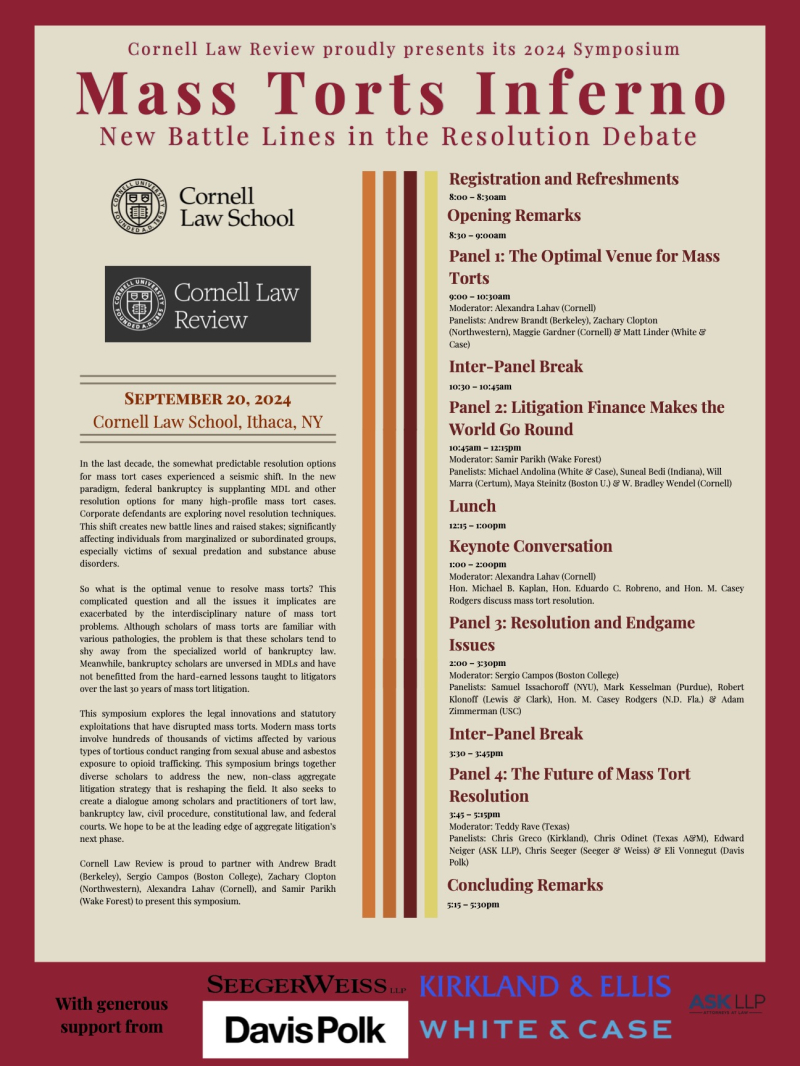
Cornell Law Review will be hosting its 2024 symposium, Mass Torts Inferno: New Battle Lines in the Resolution Debate, on September 20, 2024 in Ithaca, New York. Modern mass torts involve hundreds of thousands of victims affected by various types of tortious conduct ranging from sexual abuse and asbestos exposure to opioid trafficking. This symposium brings together diverse scholars to address the new, non-class aggregate litigation strategy that is reshaping the field. It also seeks to create a dialogue among scholars and practitioners of tort law, bankruptcy law, civil procedure, and constitutional law. The law review is proud to partner with Andrew Bradt, Sergio Campos, Zachary Clopton, Alexandra Lahav, and Samir Parikh to present this event.  

For those interested in attending, please contact Griffin Perrault at gp344@cornell.edu.

CornellPoster2024

Mississippi College School of Law invites applications from entry-level candidates for multiple tenure-track faculty positions expected to begin in July 2025. Our search will focus primarily on candidates with an interest in teaching one or more of the following subject areas: Real Property, Intellectual Property, Sports/Entertainment Law, and Cyber Law/Law & Technology.

We seek candidates with a distinguished academic background (having earned a J.D. and/or Ph.D.), a commitment to excellence in teaching, and a demonstrated commitment to scholarly research and publication. We particularly encourage applications from candidates who will enrich the diversity of our faculty. We will consider candidates listed in the AALS-distributed FAR, as well as those who apply directly.

Applications should include a cover letter, curriculum vitae, a scholarly research agenda, the names and contact information of three references, and teaching evaluations (if available). Applications should submitted using the following link: https://www.mc.edu/offices/human-resources/employment?rID[32]=389.

I am please to be able to publish this post authored by our former BLPB editor/co-blogger Stefan Padfield.  We miss his voice here, but he is doing good work in his current role, as this post shows!  Thanks for contributing this, Stefan.

+++++

On November 14, 2023, the National Center for Public Policy Research (NCPPR) – where I work – submitted a shareholder proposal to Johnson & Johnson that sought disclosures related to overboarding. (For the uninitiated, overboarding refers to the issue of corporate directors sitting on too many boards but can also be extended, as it is here, to other commitments.) On March 1, 2024, the SEC staff informed J&J that no action would be recommended against the company by the staff if J&J excluded NCPPR’s proposal. This no-action relief arguably represents a change in the long-standing SEC practice of supporting proposals related to overboarding and is thus worthy of further examination. (The underlying documents can be accessed here; the SEC staff also granted no-action relief to Verizon and Lowe’s on the same proposal.)

By way of background, the SEC staff is on record as saying that an overboarding proposal “relates to director qualifications.” Accordingly, the SEC staff has stated in the past that it does “not believe that [a company] may omit [such a] proposal from its proxy materials in reliance on rule 14a-8(i)(7)” as improperly relating to the ordinary business of the company.

Admittedly, our proposal was unique in that it asked directors to “disclose their expected allocation of hours among all formal commitments set forth in the director’s official bio, with allocation being permissible “on a weekly, monthly, or annual basis.” And perhaps this is sufficient for some to categorize our proposal as excludable micromanagement, as the SEC staff did. However, there is a good argument to be made that “the SEC has incorrectly applied the micromanagement rule to exclude disclosure proposals.” More generally, the active shareholder proponent just quoted also noted in the same piece the SEC’s heavy and arguably excessive reliance on the micromanagement exclusion this season:

In reality, the most significant substantive development in the Rule 14a-8 process in the last two seasons has been largely ignored in the anti-shareholder furor. Far from representing a system unfairly tilted toward proponents, the SEC is more readily concurring with issuers’ increasingly aggressive use of the micromanagement exclusion…. According to preliminary calculations by the Shareholder Rights Group, in 2023, micromanagement arguments accounted for 8 out of 27, or 30%, of successful Rule 14a-8(i)(7) requests. In 2024 so far, micromanagement arguments have accounted for 25 of 56, or 44.6%, of winning requests based on the ordinary business/micromanagement rule.

Regardless, in addition to prior no-action decisions that deemed overboarding proposals nonexcludable, we later submitted a similar proposal to Verizon and added the following stakeholder perspectives to urge the SEC staff to reconsider its conclusion in Johnson & Johnson:

  • Weil, Gotshal & Manges LLP: “The board should assess whether directors that may be overcommitted have sufficient time and ability to take on the significant tasks relating to public company directorship.” (Emphasis added.)
  • Wachtell, Lipton, Rosen & Katz: “As board responsibilities grow, so has the focus on director bandwidth; directors should be realistic about their bandwidth when considering new opportunities for board service.”
  • Vanguard: “The role of public company directors is complex and time-consuming, and the funds believe that directors should maintain sufficient capacity to effectively carry out their responsibilities to shareholders. For this reason, the funds look for directors to appropriately limit their board and other commitments to ensure that they are accessible and responsive to both routine and unexpected board matters …. The funds look for boards to have in place policies regarding director commitments and capacity and to disclose such policies (and any potential exceptions) to shareholders ….” (Emphasis added.)
  • The Conference Board: “[W]hile adopting an overboarding policy can be useful, it is more important for boards to have candid conversations about their evolving time requirements and the ability of directors to devote the time necessary to the role…. In light of expanding workloads, boards should take a fresh look at the time commitments expected of directors …. Overboarding policies are now a predominant practice, embraced by three-quarters of the S&P 500 and over half the Russell 3000 and supported by the proxy advisory firms. But policies alone are insufficient. As part of the annual evaluation process, directors should assess their ability, both on an individual and collective level, to dedicate the necessary time to fulfill their responsibilities effectively and make informed decisions.” (Emphasis added.)
  • State Street: “[I]n its Summary of Material Changes to State Street Global Advisors’ 2023 Proxy Voting and Engagement Guidelines, State Street[i] indicates that starting in 2024 for companies in the S&P 500, it will no longer use numerical limits to identify overcommitted directors and instead ‘require that companies themselves address this issue in their internal policy on director time commitments and that the policy be publicly disclosed.’” (Emphasis added.)

Furthermore, the need for the requested disclosure can be demonstrated by looking at the bio of a director at CVS, where our proposal was unopposed: J. Scott Kirby. Doing so reveals the following nine commitments.

  1. Director, CVS
  2. CEO, United Airlines
  3. Director, United Airlines
  4. Executive Committee, United Airlines Board
  5. Finance Committee, United Airlines Board
  6. Director, SONIFI Solutions
  7. Chairman, Star Alliance Chief Executive Board
  8. Member, Board of Governors of the International Air Transport Association
  9. Director, U.S. Air Force Academy Foundation

Suffice it to say, many would presume that Mr. Kirby would more than have his hands full simply as CEO of United Airlines. Accordingly, it seems a small thing for CVS shareholders to ask for an estimate of how exactly there will be enough hours in the day for Mr. Kirby to juggle these nine commitments without depriving CVS of the critical attention he is being nominated to provide as director. And to the extent some might argue that listing committee assignments as discrete commitments improperly inflates the perceived workload, we say: (1) either the discrete commitment is material or the disclosure of that commitment in the official bio is misleading; (2) a company is free to attribute zero hours to any disclosed commitment, and is thereby free to clarify for shareholders that, for example, membership on the finance committee is a nominal position.

Given the ever-increasing responsibilities of corporate directors, as well as generally increasing demands on their time, limiting oversight of overboarding to counting board seats and CEO spots is unsustainable. Accordingly, we will likely be submitting a similar proposal next season and urging the SEC staff to reconsider its conclusion in Johnson & Johnson. Asking prospective directors how they intend to allocate their hours among their often numerous commitments should not be viewed as improper micromanagement but rather basic accountability fully within the ambit of shareholders to request.

_____

[i] Our overboarding proposal at CVS was apparently defeated by a vote of 97% against. In light of the comments here by State Street and the preceding comments by Vanguard, it would be interesting to see how those asset managers voted (assuming they hold shares in CVS).

ST. JOHN’S UNIVERSITY SCHOOL OF LAW seeks entry-level and lateral candidates to join our dynamic faculty. We are deeply committed to equity, inclusion, and anti-racism, and are particularly interested in candidates who will enrich the diversity of our faculty. We are open to a variety of teaching and scholarly interests including Business and Transactional Law, Constitutional Law, Dispute Resolution, Environmental Law, Race and the Law, and Technology and the Law and have a special interest in Trusts and Estates.

St. John’s Law School is located in New York City in the borough of Queens, one of the most diverse urban communities in the United States. We are part of St. John’s University, a Catholic, Vincentian, metropolitan, and global institution with campuses in New York, Rome, and Paris. The Law School and University are committed to academic excellence and to providing an education for all people, especially those lacking economic, physical, or social advantages.  Many St. John’s Law students are the first in their families to attend law school; many are the first in their families to attend college. By providing our graduates with the skills and values to successfully participate in a global legal profession, the Law School serves as an engine of social mobility and fulfills the University’s broader Vincentian mission to aid those in need.

Celebrating its 100th anniversary in 2025, St. John’s Law School is proud of its vibrant student body, high bar passage and employment rates, and influential legal scholarship. Faculty publish critically-acclaimed books with academic and trade presses and place articles in prestigious journals. They also extend their scholarly reach by writing regularly for mainstream audiences and engaging in extensive law reform efforts at the state, federal, and international levels. Finally, St. John’s Law boasts a close-knit and supportive community among faculty, students, alumni, and staff.

Under the leadership of our new dean, Jelani Jefferson Exum, we look forward to a future that builds upon the school’s strong foundations and moves St. John’s Law into its next century of mission-focused impact and prominence.

Below are some links about St. John’s and our surrounding communities –

www.stjohns.edu/who-we-are/history-and-facts

www.nycgovparks.org/highlights/visit-queens

In compliance with New York City’s Pay Transparency Act, the annual hire-on rate for entry-level assistant professors is $140,000 – $150,000, plus additional compensation in the form of summer research stipends and supplemental publication awards.  Compensation for lateral candidates coming from faculty positions at other law schools is commensurate with the candidate’s experience. St. John’s considers factors such as (but not limited to) scope and responsibilities of the position, candidate’s work experience, education/training, key skills, and internal peer equity, as well as market and organizational considerations.

Entry-level and tenure-track candidates should have demonstrated potential for high scholarly achievement, teaching excellence, service, and a record of contributing to supportive and inclusive communities.

We will consider candidates listed in the AALS FAR, as well as those who apply directly. Applications should include a cover letter, curriculum vitae, writing sample, a research agenda, the names of three references, and teaching evaluations (if available). Please send these materials in a single PDF to Claire Pollicino, Director of Special Projects, at lawfac@stjohns.edu. Inquiries (but not application materials) may also be directed to Professor Elaine M. Chiu, Chair, Faculty Appointments Committee at chiue1@stjohns.edu.

St. John’s University is an Equal Opportunity Employer that does not discriminate on the basis of race, color, national or ethnic origin, sex (including sexual harassment and sexual violence), sexual orientation, gender identity and gender expression, disability, religion, age, status in the uniformed services of the United States (including veteran status), marital status, status as a victim of domestic violence, citizenship status, genetic predisposition, carrier status, or any other classification protected under federal, state, or local law.

Dear BLPB Readers:

“SOUTHWESTERN LAW SCHOOL in Los Angeles invites applications for the following positions:

• Multiple full-time entry-level and lateral tenure/tenure-track positions. Our primary curricular needs include Business Associations, Evidence, and Property. When selecting candidates to interview, we also will consider whether they might also contribute in the following areas: Administrative Law, Contracts, Copyright, Business/Corporate/Entrepreneurship electives; Cyberlaw/Technology/Privacy, Entertainment Law, Family Law, International Business Transactions, Professional Responsibility, and Wills & Trusts.

•  Multiple full-time entry-level or experienced Associate Professors of Academic Success and Bar Preparation

•  Multiple full-time entry-level or experienced Associate Professors or Professors of Legal Analysis, Writing, and Skills.

Attached are the ads for each position.

Founded in 1911, Southwestern is an ABA-accredited, independent law school located in the center of Los Angeles. Our mission includes educating lawyers ready to serve clients, the profession, and our society with excellence, empowering students to reach their potential, cultivating inclusion and belonging, and shaping the law and public policy through teaching, scholarship, and service.

To apply, please send your CV, professional references, research agenda, and preferred areas of teaching via email to academicadmin@swlaw.edu and put “Faculty Application” in the email subject line. Review of applications will begin in mid-August. Initial interviews will be held via Zoom, and callback interviews will be held in person.”

Ads for each position are below:

Doctrinal (Tenure-track) Faculty position: Download Doctrinal (Tenure-Track) Faculty Position Ad (1)

Legal Writing (LAWS) Faculty position: Download Legal Writing (LAWS) Faculty Position Ad

Academic Success and Bar Programs Faculty position: Download Academic Success and Bar Programs Faculty Position Ad


The Thomas R. Kline School of Law of Duquesne University, located in Pittsburgh, Pennsylvania, invites applications from entry-level and lateral candidates for up to two full-time tenured/tenure-track faculty positions to begin the 2025-2026 academic year.

We welcome applications from candidates across all areas of law, although subject areas of particular interest include: Pennsylvania, State, and Federal Constitutional Law, and Legal Research and Writing. Candidates with the ability and interest in potentially teaching other courses within the first year of legal study, particularly Contracts and Torts are preferred. Other areas of interest include Emerging Technologies, Business Law, Commercial Law, Health Law, and Employment/Labor Law. Candidates must be available to teach in-person, although some courses may include remote and/or hyflex teaching.

For additional details, see the full hiring announcement: Apply – Interfolio

The Belmont University College of Law invites applications for two tenure-track or tenured faculty positions to begin in Fall of 2025. Belmont is specifically seeking candidates in the areas of business law, intellectual property law, contract/commercial law, and law and technology courses.

The Belmont University College of Law encourages applications from people whose background, life experiences, and scholarly approaches would contribute to the diversity of our faculty, curriculum, and programs. Applicants must possess a J.D. or equivalent degree from an accredited U.S. law school and must demonstrate strong scholarly potential and a commitment to excellence in teaching.  Belmont is an EOE/AA employer.  Belmont College of Law reserves the right to exercise a preference for those candidates who support the goals and missions of the University.

If interested, please submit a letter of interest and curriculum vitae to the Chair of the Faculty Recruitment Committee, Associate Dean Deborah Farringer, using the recruitment committee’s email address – lawfaculty.recruitment@belmont.edu.  If you have questions about the position or Belmont University, please contact Associate Dean Farringer at deborah.farringer@belmont.edu.

Belmont University is a private, Christian university focusing on academic excellence and is located in the heart of Nashville, one of the fastest growing and most culturally rich cities in the country.  Belmont is the second largest private university in Tennessee with approximately 9,000 students. Belmont students come from every state, more than 35 countries, and all faiths. The Belmont faculty is dedicated to teaching, service, and active engagement in scholarship.  Ranked 91st among ABA-Accredited law schools by U.S. News and World Report, Belmont Law’s median LSAT/GPA for the 124 students who entered the law school in August 2023 were 160 and 3.77 (75th percentile: 162 and 3.91; 25th percentile: 157 and 3.56).  Belmont’s ultimate bar passage rate for 2018 and 2019 was 100%, one of only a few law schools in the country to have achieved a perfect pass rate in those years, and Belmont Law had the highest pass rate in the state of Tennessee in July of 2023.

This just in from friend-of-the-BLPB Arthur Laby:

We are hiring at Rutgers Law School. This position of Assistant or Associate Professor is in our Camden location, just across the river from Center City Philadelphia. Our focus is on candidates with scholarly and teaching interests in Tax, Business Organizations, Contracts and/or Constitutional Law.  Please apply here: https://jobs.rutgers.edu/postings/230914

Stoll Keenon Ogden PLLC’s Corporate Transparency Act (“CTA”) guidance, about which I posted back in June, was recently updated.  You can find the update here.  Hat tip to friend-of-the-BLPB Tom Rutledge from Stoll Keenon Odgen on this development. 

I know many are struggling to interpret and apply the CTA.  I appreciate the work firms and individual lawyers are undertaking to help enlighten that effort.  Please feel free to send me links to guidance you may have seen that you believe to be particularly useful.