
A warning to all of you in the real (non-academic) world: law school exam season has begun. You know what that means: it’s whine time. Time to read blog posts by law professors complaining about the miseries of grading exams. (What you read in the blogs is nothing compared to what you hear in the hallways of law schools.)

Grading law school exams is not a pleasant task. It’s intellectually grinding, but it’s not just the work. I care about my students and I hate to see some of them waste their promise.

But, on a scale of 1 (easy) to 10 (hard), grading law school exams is at most a 3. Some people have to clear septic tanks for a living. Police officers and soldiers put their lives on the line every day. I worked in a pea cannery two summers, and, even compared to that, grading exams is a breeze.

I have it easy, so I promise not to whine this year. I have a well-paying job that mostly allows me to do what I love, so I can tolerate grading. (Don’t bother tracking down my old blog posts; I admit I’ve whined about grading in the past.). 

To my students, good luck. I hope you all do wonderfully; nothing would be more fulfilling than to give every one of you an A. And, if you stumble, don’t forget the words of Charles Colton: “The greatest fool may ask more than the wisest man can answer.”
 

Do we have to go back to the creation of LLPs to remember a time when an organizational form was so much in the news?

First, as my co-blogger Joshua Fershee pointed out, news of Mark Zuckerberg’s investment/charitable/political vehicle, the Chan Zuckerberg Initiative LLC, has been making headlines over its structure

Beyond that, however, the New York Times has run a couple of stories now on the growing use of LLCs in the real estate market – both to hide the identities of wealthy foreign investors in Manhattan property and perhaps skirt bank secrecy laws, and to shield the identity of fraudsters who scam people out of the deeds to their houses. As a result, New York is imposing new requirements for disclosure of LLC members involved in real estate transfers.  And this report from the Sunlight Foundation highlights how the minimal disclosure requirements for LLCs has made them a popular tool for obscuring the origin of political donations.  It seems there might still be a few kinks to work out in the form, although if jurisdictions go the way of NYC, we’ll see patchwork disclosure requirements that apply only within specific areas.

In any event, all of the hoopla about Zuckerberg’s initiative provided a valuable jumping off point for discussion in my last Business class, even as it apparently is causing a headache for Zuckerberg himself – the misleading stories that suggest that Zuckerberg is getting a tax break out of this (he isn’t; as far as the IRS is concerned, the LLC doesn’t exist) have prompted Zuckerberg to put out a statement defending his choice of organizational form.  I suppose he has only himself to blame by originally touting the LLC as though it was akin to a charitable effort; as Jesse Eisinger put it, instead of announcing that Zuckerberg was donating $45 billion to charity, the headlines should have reported “Mr. Zuckerberg created an investment vehicle.”

The New York Times DealBook has a fascinating piece on the relationship between JPMorgan Chase and one of its former brokers, Johnny Burris. After Burris complained publicly about JPMorgan’s sales practices, he was terminated and customer complaints began to appear in his regulatory files. Some of the “complaining” customers now say they had no problems with Mr. Burris. One of the customers who allegedly filed a complaint can’t even read or write. And it appears that JPMorgan was involved in drafting at least some of the complaints.

Definitely worth reading.


Earlier this week, my co-blogger Josh Fershee authored an interesting post about the surprising crowdfunding success of the PicoBrew “Keurig for Beer.” After reading Josh’s post and the embedded links, I have to agree with him; I have no idea how they raised $1.4M for a product that I don’t see being that useful. The product appears to be both overly expensive and overly time-consuming.

I think many venture capitalists would join Josh and me in questioning the wisdom of PicoBrew, at least before it raised $1.4M. But as I wrote in an earlier post, crowdfunding may help overcome biases of venture capitalists. In the days since Josh’s posts, I have heard a few people talk about how excited they were about PicoBrew. These people were all at least 10 years younger than Josh, me, and most venture capitalists. While us “older folks” may not see a use for the product, judging from the crowdfunding results and a little anecdotal evidence here in Nashville, there appears to be significant market demand for PicoBrew. Similarly, on the show Shark Tank, the female “sharks” have accused their male counterparts of largely avoiding companies with products aimed at women; and while I have not run the numbers, it does seem like the sharks’ investments skew toward products that they (or maybe their family members) would use. Very few venture capitalists are under 30 years old, so perhaps products aimed at younger people got passed on more often than they should have before online crowdfunding became popular. Of course, crowdfunding can have a dark side as well; crowdfunding may be used not only to uncover good products that were passed over, but could also be used to lure more gullible funders.

Somewhat related, the Chronicle of Higher Education recently ran an article entitled “When Recruiting Teenagers, Don’t Forget to Question Your Assumptions.” The article is focused on undergraduate recruiting practices and challenges readers to question conventional wisdom. The article notes a disconnect between what universities think applicants want and what applicants say they want. For example, “[a]lthough 30 percent of admissions officials said social media was the most effective way for a college to engage students who had never heard of it, just 4 percent of students said the same. . . . And while 64 percent of admissions officials said a college’s official social-media accounts were important to prospective students after applying, only 18 percent of teenagers said the same.” The article’s main directive appears to be, don’t assume what prospective students want, ask them and use evidence to craft your recruitment programs. Using evidence rather than hunches to make decisions may be obvious to professors, but I wonder how many schools use sophisticated studies in designing their recruiting programs.

Like all of us, venture capitalists and university recruiting staff members have blind spots. Perhaps evidence, from crowdfunding and student surveys, can help these respective groups shrink those blind spots.

Earlier this month, the DC Circuit denied a petition for rehearing on the conflict minerals disclosure, meaning the SEC needs to appeal to the Supreme Court or the case goes back to the District Court for further proceedings. At issue is whether the Dodd-Frank requirement that issuers who source minerals from the Democratic Republic of Congo label their products as “DRC-conflict free” (or not) violates the First Amendment. I have argued in various blog posts and an amicus brief that this corporate governance disclosure is problematic for other reasons, including the fact that it won’t work and that the requirement would hurt the miners that it’s meant to protect. Congress, thankfully, recently held hearings on the law.

I’ve written more extensively on conflict minerals and the failure of disclosures in general in two recent publications. The first is my chapter entitled, Living in a material world – from naming and shaming to knowing and showing: will new disclosure regimes finally drive corporate accountability for human rights? in a new book that we launched two weeks ago at the UN Forum on Business and Human Rights in Geneva. You’ll have to buy the book The Business and Human Rights Landscape: Moving Forward and Looking Back to read it.

My article, Disclosing Disclosure’s Defects: Addressing Corporate Irresponsibility for Human Rights Impacts, will be published shortly by the Columbia Human Rights Law Review and is available for on SSRN. The abstract is below:

Although many people believe that the role of business is to maximize shareholder value, corporate executives and board members can no longer ignore their companies’ human rights impacts on other stakeholders. Over the past four years, the role and responsibility of non-state actors such as multinationals has come under increased scrutiny. In 2011, the United Nations Human Rights Council unanimously endorsed the “UN Guiding Principles on Business and Human Rights,” which outline the State duty to protect human rights, the corporate responsibility to respect human rights, and both the State and corporations’ duties to provide remedies to parties. The Guiding Principles do not bind corporations, but dozens of countries, including the United States, are now working on National Action Plans to comply with their own duties, which include drafting regulations and incentives for companies. In 2014, the UN Human Rights Council passed a resolution to begin the process of developing a binding treaty on business and human rights. Separately, in an effort to address information asymmetries, lawmakers in the United States, Canada, Europe, and California have passed human rights disclosure legislation. Finally, dozens of stock exchanges have imposed either mandatory or voluntary non-financial disclosure requirements, in sync with the UN Principles.

Despite various forms of disclosure mandates, these efforts do not work. The conflict lies within the flawed premise that, armed with specific information addressing human rights, consumers and investors will either reward “ethical” corporate behavior, or punish firms with poor human rights records. However, evidence shows that disclosures generally fail to change behavior because: (1) there are too many of them; (2) stakeholders suffer from disclosure overload; and (3) not enough consumers or investors penalize companies by boycotting products or divesting. In this Article, I examine corporate social contract theory, normative business ethics, and the failure of stakeholders to utilize disclosures to punish those firms that breach the social contract. I propose that both stakeholders and companies view corporate actions through an ethical lens, and offer an eight-factor test to provide guidance using current disclosures or stakeholder-specific inquiries. I conclude that disclosure for the sake of transparency, without more, will not lead to meaningful change regarding human rights impacts.


Facebook (not surprisingly) and other social media blew up when Facebook CEO, Mark Zuckerberg, and his wife, Dr. Priscilla Chan, released an open letter to their new baby daughter, Max. (Congratulations to all, by the way.) The Chan Zuckerberg family announced that they would be giving a ton of money to support important causes, which caused people to get excited, get skeptical, and get mad.

One big complaint has been that the family chose a limited liability company (LLC), which is not a corporation (more on that later), rather than a not-for-profit entity to do the work.  Some say this makes it a scam.  I say hooey.  Even if it were a scam, it’s not because they chose an LLC. 

  1. First, without knowing the LLCs members or structure, there’s no reason to say the LLC cannot be a 501(c)(3). But, more important, the Letter to Max never says they will give money to charity.  Never. 

The letter says: 

As you begin the next generation of the Chan Zuckerberg family, we also begin the Chan Zuckerberg Initiative to join people across the world to advance human potential and promote equality for all children in the next generation. Our initial areas of focus will be personalized learning, curing disease, connecting people and building strong communities.

We will give 99% of our Facebook shares — currently about $45 billion — during our lives to advance this mission.  

How the Chan Zuckerberg’s choose to advance that mission can easily be through an LLC, whether it is tax-exempt or not.  They may have chosen the for-profit (or benefit) LLC as the entity so that they could seek profit in certain ways, with the thought that the profit seeking supports the mission.  Or maybe they want to be able to give to for-profit entities to build and grow business in areas that further their mission, but lacks status that would satisfy IRS nonprofit requirements.

Regardless, the choice of LLC may be a good one.  I am thinking these folks have good counsel and financial advisors, so the entity choice probably serves their purposes, or at least their best estimate of those future purposes.  And I am all for them putting that kind of money behind what seems to me like an excellent mission.  So, like them or hate, but back off their choice of entity. (Leave the LLC alone!)

And, since this would not be a post of mine without noting the utter media failure in referring to the LLC, again, it’s a limited liability company, not corporation, as several news outlets have reported.  PBS tends to be my favorite news source, which makes it all the more painful that they may be the source of this limited liability corporation nonsense. 

The apparent source of the limited liability “corporation” nonsense is the PBS Newshour, link here.  I know the U.S. Supreme Court has gotten this wrong, too,  but I had hope for better from PBS.  Oh well.  I’ll still be listening to PBS for quality news, and I’ll still be happy to hear when someone commits to putting billions of dollars behind good causes.  If either one doesn’t follow through, I’ll be disappointed, but I am not ready to give up hope on either one, just yet.  

CALL FOR PROPOSALS AND REGISTRATION INFORMATION

Emory’s Center for Transactional Law and Practice is delighted to announce its fifth biennial conference on the teaching of transactional law and skills. The conference, entitled “Method in the Madness: The Art and Science of Teaching Transactional Law and Skills,” will be held at Emory Law, beginning at 1:00 p.m. on Friday, June 10th and ending at 3:45 p.m. on Saturday, June 11th.

CALL FOR PROPOSALS

We are accepting proposals immediately, but in no event later than 5 p.m. on Monday, February 15, 2016. We welcome proposals on any subject of interest to current or potential teachers of transactional law and skills, focusing particularly on our overarching theme: “Method in the Madness: The Art and Science of Teaching Transactional Law and Skills.”

We hope to receive proposals about teaching: business/corporate law; contract drafting and other transactional drafting; deal skills (interviewing a client, conducting due diligence, negotiating, etc.); business and financial literacy; and ethics and professionalism.

We also welcome proposals about the interplay between teaching transactional law and skills and the ABA’s new experiential learning requirement (Standard 303(a)(3)). Moreover, with regard to the teaching of transactional law and skills, we would like to hear about your efforts to use technology in the classroom, create meaningful assessment tools, and conduct empirical studies. Please submit the proposal form electronically via the Emory Law website at http://bit.ly/trans-proposals before 5 p.m. on Monday, February 15, 2016.

Each session will be approximately 80 minutes long. We invite you to present your topic individually or with a panel of other participants and we encourage you to make your presentation creative and interactive. We look forward to receiving your proposals so that we can finalize the Program.

As in prior years, some of the conference proceedings as well as the materials distributed by speakers will be published in Transactions: The Tennessee Journal of Business Law, a publication of the Clayton Center for Entrepreneurial Law of The University of Tennessee.

CONFERENCE REGISTRATION

Both attendees and presenters must register for the Conference and pay the registration fee of $189.00. The registration fee includes a pre-Conference lunch beginning at 11:30 a.m., snacks, and a reception on June 10, and breakfast, lunch, and snacks on June 11. We are planning an optional dinner for attendees and presenters on Friday evening, June 10, at an additional cost of $45 per person.

Registration is now open for the Conference and the optional Friday night dinner at our Emory Law website at http://bit.ly/trans-registration.

TRAVEL ARRANGEMENTS AND HOTEL ACCOMMODATIONS

Attendees and presenters are responsible for their own travel arrangements and hotel accommodations. Special hotel rates for conference participants are available at the Emory Conference Center Hotel, less than one mile from the conference site at Emory Law. Subject to availability, rates are $129 per night. Free shuttle transportation will be provided between the Emory Conference Center Hotel and Emory Law.

To make a reservation at the special conference rate, call the Emory Conference Center Hotel at 800.933.6679 and mention “The Emory Law Transactional Conference.” Note: The hotel’s special conference rate expires at the end of the day on Wednesday, May 18, 2016.

If you encounter any technical difficulties in submitting your proposal or in registering online, please contact Kelli Pittman, Conference Coordinator, at kelli.pittman@emory.edu or 404.727.3382.

We look forward to seeing you in June!

Sue Payne                                                  Katherine Koops
Executive Director                               Assistant Director

I am about 10, if not 15 years late to this party.  This is not a new question:  have investment time horizons shrunk, and if so, in a way that extracts company value at the expense of long-term growth and sustainability?

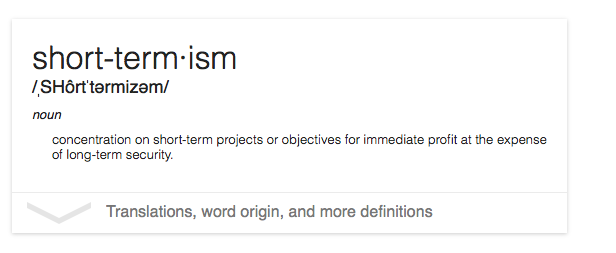
Short termism definition image

Since this isn’t a new question, there is a considerable amount of literature available in law and finance (and a definition available on investopedia).  This may seem like great news, if like me, you are interested in acquiring a solid understanding of short termism.  By solid understanding,  I mean internalization of knowledge, not mere familiarity where I can be prompted to recall something when someone else talks/writes about it.  I have some basic questions that I want answers to:   What is short-termism?,  What empirical evidence best proves or disproves short-termism?  Which investors, if any, are short-term?  What are the consequences (good and bad) of a short-term investment horizon?  If there is short-termism, what are the solutions?  I’ll briefly discuss each below, and my utter failure to answer these questions with any real certainty thus far.

What is the definition of short-termism and does it change depending upon context or user?  There appears to be consensus on the conceptual definition of foregoing long-term investments in favor of corporate policies maximizing present payouts like dividends and stock buy-backs among hedge funds.  As for what determines “short-term” with institutional investors- responsiveness to quarterly earnings? Over-reliance on algorithmic trading models? The definition gets less clear when we start looking at different types of investors.

How can one test the presence of short-termism?  Stock holding patterns and redemption rates and turnover would be the obvious answers.  This information is hard to aggregate, much of it is proprietary.  Second, the issue of outliers, like high value high-frequency trades, may distort the view if most shareholders or at least the most influential shareholders like institutions, aren’t operating with a short-term time horizon. But that can mean different things for different investors. Once again which investors we are looking at drives this question in part. 

This brings us to the next question, WHO might be short term?  Hedge Funds? Institutional Investors like pensions and mutual funds? High Frequency Traders? Retail investors? Retirement Investors (I call these folks Citizen Shareholders)?

Looking to the next question: what are the consequences of a short-term investment horizon? Shareholders like hedge funds whose investment model differs from institutional investors, often employ shareholder activism to change management and corporate policies as a means to increase the share value of the company, after which the fund usually divests significantly, if not completely.  The evidence here too is mixed (see e.g., conflicting findings by Bebchuk & Coffee).

For many the anecdotal evidence of short-termism pressures coming from board rooms is powerfully persuasive and hard to ignore even where researchers can’t pin down the source. I don’t use anecdotal in a derogatory sense at all, there is truth in experience and limitations in our ability to quantify naturally occurring phenomenons. Perhaps the question of short-termism is like trying to identify what smells bad in a pantry.  You know it is there; finding the cause is much more difficult. Consider the position of Martin Lipton who wrote in response to the Bebchuk article:  

“To the contrary, the attacks and the efforts by companies to adopt short-term strategies to avoid becoming a target have had very serious adverse effects on the companies, their long-term shareholders, and the American economy.  To avoid becoming a target, companies seek to maximize current earnings at the expense of sound balance sheets, capital investment, research and development and job growth.” 

Also consider a survey of corporate board members reported that over 60% felt short term pressure from investors.  It is a real problem to directors and one that corporate governance cannot ignore.  A fair question to ask is whether or not the fear is misstated or if the concern is another way of arguing for greater control.  And this brings us to the last question.

If there is short-termism, what are the solutions?  Aligning corporate managers/directors incentive payments has been critiqued.  Giving corporate boards more power and isolating them from shareholders tips the scales of the corporate power puzzle heavily towards managers which brings threats of agency costs and managerial abuses.  But on the other hand, if a short-term investment perspective extracts company value in a way that causes externalities that undercuts the contractarian argument for shareholder primacy.  If shareholders’, or at least some shareholders’, primary investment stake isn’t to be residual claimants in the traditional sense then their incentives aren’t aligned with the interests of other stakeholders.  Those shareholders aren’t acting in everyone’s best interest.  The debate often devolves into one of consequences, or perhaps it is the starting point for many who write in the area. If short-termism doesn’t exist or isn’t bad then there is no push back on shareholder primacy.  If short-termism does exit and it does cause externalities then it is a powerful argument in favor of director primacy. 

I am weeks into this inquiry and all I have done is further confuse myself about what I thought I knew, expanded my questions list and flooded my dropbox with articles (tedious, dense, often empirical articles).

A few things have come out of this quagmire.  First, I have great discussion points for my corporate governance seminar and certainly a supplemental segment for my casebook.  Second, I am increasingly thinking the tremendously important insights provided by many law and finance scholars isn’t the complete picture. I can’t get to the bottom of this question, because there might not be one (or one that I understand) yet.  So where are the gaps?  What do we still need to know to further explore this topic? These big, heavy, interdisciplinary questions are hard to tackle alone at our desks and benefit from engagement, dialogue, and rapid fire thinking that takes places at conferences/symposiums.

In terms of blogging, let’s focus back on you readers.  I’ll check back in periodically on this topic by sharing my reading list on the topic and also highlighting some of the articles on my list. If you have a seminal article that you found help explain short-termism to you (or your students) please share.  If you are working on any papers in this area, please email me separately (amtucker@gsu.edu) as I am working on putting together a symposium for summer 2017. 

-Anne Tucker